GRADE & PURITYMoligand™?Moligand™ — Aladdin's line of ligands and bioactive small molecules. Use for receptor, pathway, and binding studies needing defined small-molecule tools.≥97%(HPLC)
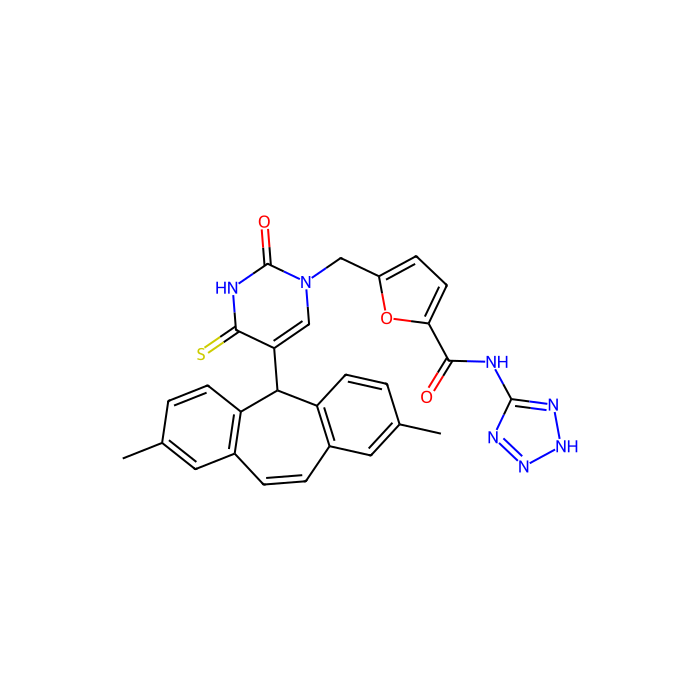
Selective, competitive P2Y2receptor antagonist. Inactive against a panel of 37 other receptors at a concentration of 10μM. Inhibits ATP-γS-induced mucin secretion in bronchial epithelial cells (IC50= 1μM). Inhibits P2Y2receptor-induced β-arrestin transloc
Condizioni di conservazione di stoccaggio
Protected from light,Store at -20°C
Spedito in
Ice chest + Ice pads
Questo prodotto richiede spedizione a catena fredda. I servizi di terra e altri servizi economici non sono disponibili.
This compound belongs to the class of organic compounds known as dibenzocycloheptenes. These are compounds containing a dibenzocycloheptene moiety, which consists of two benzene rings connected by a cycloheptene ring.
External Descriptors
Not available
1. Djoumbou Feunang Y, Eisner R, Knox C, Chepelev L, Hastings J, Owen G, Fahy E, Steinbeck C, Subramanian S, Bolton E, Greiner R, and Wishart DS. ClassyFire: Automated Chemical Classification With A Comprehensive, Computable Taxonomy. Journal of Cheminformatics, 2016, 8:61.
Determine the necessary mass, volume, or concentration for preparing a solution.
Dilution Calculator
Determine the dilution needed to prepare a stock solution.
Reconstitution Calculator
Recensioni
Recensioni dei clienti
Application Protocols
Only product-data-derived application details may be listed here.
Tested applications: Not specified for this item.
Recommended concentrations/dilutions: Not specified for this item.
Positive/negative controls: Not specified for this item.
General guidance (not item-specific):
For biochemical or cellular assays, prepare a serial dilution series (e.g., 10-point, 3-fold) from a validated DMSO stock to enable full concentration–response curves.
Include vehicle controls matched for final solvent percentage, and incorporate known reference ligands where available to benchmark assay performance (Z′-factor, EC50/IC50 alignment).
Pre-validate compound solubility and lack of aggregation (e.g., detergent controls, counter-screens) to minimize false positives/negatives.
Biological Roles
Context for research use (literature/general knowledge, not item specifications):
AR-C 118925XX is widely referenced in the literature as a selective small-molecule tool in studies of purinergic signaling. Researchers commonly employ it to interrogate pathways mediated by P2Y-class receptors, helping to delineate nucleotide-driven signaling in epithelial, immune, and neuronal systems. Always verify the latest peer-reviewed sources for potency, selectivity, and species cross-reactivity prior to use in critical experiments.
Utility in experimental biology (general guidance):
In vitro: Used to probe receptor-mediated second messenger cascades (e.g., PLC/IP3–Ca2+ mobilization or other GPCR-linked pathways), enabling target validation and pathway mapping.
Ex vivo/cellular models: Facilitates dissection of autocrine/paracrine nucleotide signaling; supports pharmacological profiling, desensitization studies, and receptor reserve analyses.
Systems biology: Serves as a reference perturbagen in omics studies to connect receptor engagement with transcriptional or metabolomic responses.
Best practices:
Confirm the exact receptor subtype(s), Ki/IC50, and functional antagonism/agonism mode from primary publications and confirm lot identity.
Run concentration–response curves with appropriate vehicle and benchmark controls; document solvent carryover and plate effects.
Important note: No target specificity or potency data are provided in this listing; users must rely on the current literature and internal validation for application-specific parameters.
Buffer Applications
This product is not itself a buffering agent. However, practical buffer considerations are essential for bioassays employing small-molecule ligands.
Vehicle control: Maintain constant final DMSO or ethanol across all wells (e.g., ≤0.1–0.5% v/v) to isolate ligand effects from solvent artifacts.
Typical assay buffers: HEPES- or phosphate-based physiological buffers (e.g., HBSS, PBS, or HEPES-buffered saline) supplemented with Ca2+/Mg2+ as required by the readout. Add 0.01–0.1% BSA to minimize nonspecific adsorption where appropriate.
Solubility aids: For poorly soluble ligands, consider 0.1–1% DMSO final, 0.5–2% cyclodextrin (e.g., HPβCD), or low levels of nonionic surfactants compatible with your assay. Validate that additives do not perturb the biological response.
pH and osmolarity: Maintain physiological pH (7.2–7.4 for many cell assays) and appropriate osmolarity; adjust carefully if chelators or divalent cations influence target function.
Note: No item-specific buffer recipes or compatibility data are provided for this product. Optimize buffer composition empirically for your assay format (biochemical vs. cellular) and detection technology (fluorescence, luminescence, radiometric).
Green Alternatives
Because AR-C 118925XX is used as a research ligand rather than as a process solvent or bulk reagent, “green alternatives” mainly concern solvent and handling practices during solution preparation and assay execution.
Greener choices for solution handling (general guidance):
Prefer aqueous buffers with minimal organic cosolvent (≤0.1–0.5% DMSO or ethanol) whenever solubility and assay tolerance permit.
Use 2-hydroxypropyl-β-cyclodextrin (HPβCD) or other benign solubilizers to reduce DMSO content while maintaining solubility.
Prepare high-concentration DMSO stocks to minimize total solvent volume introduced into assays; accurately back-dilute into buffer to keep final DMSO low.
Comparison of common vehicles (general, not item-specific):
DMSO: Benchmark for screening; readily recyclable in some facilities; use minimal volumes.
Ethanol: Renewable origin possible; higher volatility may aid solvent removal but can stress cells—validate carefully.
PEG400: Nonvolatile, low toxicity; may alter viscosity and assay readouts at higher percentages.
Operational tips:
Use amber polypropylene or glass vials to reduce photodegradation and avoid unnecessary overpackaging.
Plan aliquots to prevent freeze–thaw waste.
Implement microplate-based solubility checks to avoid preparing large volumes of unusable solutions.
Note: No greener “substitute compound” is suggested here because this item’s utility is target/assay-specific rather than driven by bulk chemical function.
Pharmaceutical Uses
No clinical or therapeutic claims are made for this product. It is supplied strictly for research use.
Typical roles in pharmaceutical research (general, not item-specific):
Reference ligand/antagonist in target validation and hit-to-lead benchmarking studies.
Tool compound for pathway deconvolution in cellular models and for establishing pharmacological fingerprints alongside proprietary leads.
Analytical reference standard for method development (e.g., LC–MS assay qualification) when identity/purity are verified.
Formulation considerations for preclinical assays:
Prepare concentrated DMSO stocks and dilute into vehicle suitable for the test system (aqueous buffers for in vitro; validate excipients for any ex vivo models). Avoid excipients that interfere with readouts (e.g., autofluorescent components in fluorescence assays).
Regulatory status:
Pharmacopoeial monographs: Not specified for this item; refer to CoA/Spec Sheet.
GMP suitability: Not intended for GMP use unless explicitly stated; this listing does not provide GMP certification.
Important: Any use in manufacturing, diagnostic, or clinical contexts requires separate qualification and is outside the scope of this research-use-only product.
Physical Properties
Item-specific physicochemical specifications have not been provided in this listing.
Appearance: Not specified for this item; refer to CoA/Spec Sheet.
Melting point: Not specified for this item; refer to CoA/Spec Sheet.
Boiling point: Not specified for this item; refer to CoA/Spec Sheet.
Density: Not specified for this item; refer to CoA/Spec Sheet.
Refractive index: Not specified for this item; refer to CoA/Spec Sheet.
Solubility: Not specified for this item; refer to CoA/Spec Sheet.
logP/logD: Not specified for this item; refer to CoA/Spec Sheet.
pKa: Not specified for this item; refer to CoA/Spec Sheet.
Literature/computed notes (general guidance, not item specifications):
Many small-molecule GPCR ligands are formulated as DMSO stock solutions (e.g., 10–50 mM) for screening. Actual solubility and stability depend on the compound’s exact structure and counterion (if a salt).
Verify hygroscopicity and photolability experimentally; this item is recommended to be protected from light (see Storage), suggesting potential light sensitivity.
Practical tips:
Before large-scale assay setup, perform a small solubility screen (DMSO, ethanol, methanol, aqueous buffers with 0.1–1% DMSO or 0.5–2% cyclodextrin as needed).
Filter (0.22 µm PTFE) solutions destined for cell-based work to remove particulates. Record solvent lots, concentrations, and preparation date for reproducibility.
Quality and Grades
Grade/Purity: Moligand™
What Moligand™ signifies (general description):
Moligand™ designates small-molecule research ligands curated for biochemical/cellular target engagement studies, screening, and mechanistic exploration. While exact purity and impurity limits are not specified in this listing, Moligand™ items are intended for research workflows that demand identity confirmation and batch-to-batch consistency.
Implications for use:
Spectral conformity: Expect provision of identity/supporting documents (e.g., CoA with HPLC purity, MS). If you require specific chromatography baselines (e.g., UV cutoff for HPLC assays) or impurity profiles, request the latest CoA/Spec Sheet before critical experiments.
Bioassay suitability: Moligand™ items are typically compatible with common assay solvents (DMSO, ethanol) and cell-based formats when properly diluted, but users must validate working concentrations and vehicle controls.
What is NOT specified for this item (consult CoA):
Exact purity percentage and assay method
Residual solvent limits and water content
Counterion/salt form (if applicable) and polymorph information
Recommendations:
Authenticate each lot upon receipt (HPLC-UV or LC–MS, plus optional 1H NMR) for regulated workflows.
Document storage history and freeze–thaw cycles to ensure reproducibility across screens.
Reaction and Applications
This product is primarily positioned as a research ligand (Moligand™) rather than as a synthetic reagent. Consequently, classical synthetic reaction applications (e.g., cross-couplings, condensations) are not the intended use case.
Research applications (general for small-molecule ligands):
Target engagement assays: Radioligand displacement, fluorescence polarization, NanoBRET, or CETSA to quantify binding to the intended protein target(s).
Functional assays: Second-messenger readouts (e.g., Ca2+ flux, cAMP), reporter gene assays, or electrophysiology, depending on the target class (e.g., GPCRs, ion channels, enzymes). Optimize vehicle and incubation time to capture on/off rates.
Phenotypic screening: Assess cellular responses with high-content imaging or viability/metabolic assays; follow up with MoA studies to confirm on-target effects.
ADME profiling: Determine solubility, chemical stability, microsomal stability, and permeability (PAMPA/MDCK) to contextualize cellular potency.
Good practices:
Validate concentration ranges spanning at least 3–4 logs around expected potency; include full vehicle controls and positive/negative reference ligands.
Confirm identity and purity by LC–MS/HPLC prior to key experiments, particularly in structure–activity relationship (SAR) or mechanistic studies.
Note: No item-specific bioactivity or target data are provided in this listing; consult primary literature and the CoA for additional context and ensure that any assay conditions are independently validated in your laboratory.
Reaction Conditions
Not applicable. This product is not provided for use as a reagent in chemical synthesis, and no item-specific reaction condition data are available.
If you intend to use the compound in chemical biology coupling or immobilization:
Verify the presence of suitable functional groups from an authenticated structure source (SDF/MOL) and confirm reactivity via small-scale tests.
For conjugations (general guidance), standard conditions include: NHS–ester coupling to primary amines (pH 7.5–8.5), carbodiimide coupling for carboxylates (pH 4.5–6 or 7–8 with NHS), or click chemistry for azide/alkyne handles (CuAAC with CuSO4/sodium ascorbate, room temperature). These are generic examples and may not apply to this molecule without structural confirmation.
Always validate any modification by LC–MS/NMR and re-check bioactivity post-derivatization.
Safety and Handling
Safety information is limited in this entry; consult the SDS for authoritative guidance.
GHS classification: Not specified for this item; refer to SDS.
Signal word / pictograms / H-statements: Not specified for this item; refer to SDS.
Research use: For research use only (not for human or veterinary use).
General laboratory handling for small-molecule bioactives:
PPE: Use lab coat, nitrile gloves, and eye protection. Handle powders/solids in a fume hood to minimize inhalation/dermal exposure.
Avoid generating dust or aerosols. Use closed containers and clean tools for weighing.
Incompatibilities (general): Avoid strong oxidizers, strong acids/bases, and reactive reducing agents unless compatibility is known.
Photoprotection: The product should be protected from light (per Storage). Use amber vials/foil wrap and low-light handling where feasible.
Peroxide formation: Not generally a concern for most solid ligands; verify solvent stability if stored in ethers.
First-aid overview (refer to SDS for details):
Inhalation: Move to fresh air; seek medical attention if symptoms persist.
Skin/eye contact: Rinse with water for at least 15 minutes; remove contaminated clothing; seek medical advice as needed.
Ingestion: Rinse mouth; do not induce vomiting unless directed by medical personnel; get medical attention.
Waste disposal:
Collect organic solutions and contaminated consumables in appropriate hazardous waste streams per institutional and local regulations.
Solvent Selection
Given the lack of item-specific solubility data, choose solvents empirically with emphasis on assay compatibility and compound stability.
Primary stock solvent (general best practice): DMSO is the default for many bioactive ligands due to broad solvency, ease of sterile filtration, and compatibility with most biochemical and cellular assays at ≤0.1–0.5% v/v in final wells. Confirm tolerance with your system.
Alternative organic solvents: Ethanol or methanol can be used for initial dissolution; PEG400 or co-solvents (e.g., 10–20% PEG400 in aqueous buffer) may assist with challenging compounds. Ensure vehicle controls are run.
Aqueous media: Direct water/buffer dissolution is frequently limited for hydrophobic ligands; consider inclusion complexes (e.g., 2-hydroxypropyl-β-cyclodextrin at 1–10% w/v) or minimal DMSO (0.1–1%) to aid solubilization.
Comparison (general considerations):
DMSO: Broad solvency; widely accepted in screening; may affect membrane stability at higher percentages.
Ethanol: Volatile; acceptable in some biochemical assays; can affect cells differently than DMSO.
DMF: High solvency but less favored for cell work; use sparingly and with caution.
Practical tips:
Prepare concentrated stocks (e.g., 10–50 mM in DMSO), aliquot in amber vials, and store at −20 °C protected from light. Avoid repeated freeze–thaw.
Confirm absence of precipitation upon dilution into assay buffer by visual inspection and, if critical, by DLS or nephelometry.
Storage and Reconstitution
Item-specific storage conditions:
Storage conditions: Protected from light, Store at −20 °C (as provided in product data).
Shipped in: Ice chest + ice pads.
Reconstitution guidance (general, not item-specific specifications):
Upon receipt, allow the sealed container to equilibrate to room temperature before opening to prevent moisture condensation.
Prepare concentrated stock solutions in an appropriate solvent (commonly DMSO for small-molecule ligands). Typical working stocks are 10–50 mM; adjust based on solubility and assay needs. Record exact concentration and solvent.
Aliquot into amber vials or light-protective tubes to minimize headspace and avoid repeated freeze–thaw cycles. Store aliquots at −20 °C protected from light.
Handling notes:
If precipitation is observed after thawing, warm gently to room temperature and vortex/sonicate briefly. Discard if persistent particulates remain or if discoloration develops, and prepare a fresh aliquot.
For aqueous use, dilute the organic stock into buffer immediately before the experiment to the lowest feasible final solvent percentage, verifying clarity and stability.
Shelf-life and stability:
Exact stability limits, retest intervals, and appearance criteria: Not specified for this item; refer to CoA/Spec Sheet and SDS.
Always document storage history and number of freeze–thaw events for reproducibility.
Structure and Identity
Brief overview: AR-C 118925XX is listed as a small-molecule research ligand in our Moligand™ collection; detailed structural information is limited in this catalog entry.
SKU: A287202
Product name: AR-C 118925XX
CAS: 216657-60-2
PubChem CID: 54210200
InChIKey: 288009 (as provided)
SMILES: Not specified for this item; refer to CoA/Spec Sheet.
Molecular formula: Not specified for this item; refer to CoA/Spec Sheet.
Molecular weight: Not specified for this item; refer to CoA/Spec Sheet.
Structural features (general notes):
Item-specific structural motifs (ring systems, heteroatoms, stereocenters) are not provided in this listing. Please consult the CoA/SDS or primary literature for exact 2D/3D structure.
2D description: Not available in this entry. If structure is needed for cheminformatics or docking, retrieve a vetted structure file (SDF/MOL) from a trusted database using the CAS or CID and verify against the CoA.
Identity verification best practices (general guidance):
Cross-check CAS and CID against vendor CoA and spectral data (1H/13C NMR, HRMS, HPLC).
For bioactive ligands, confirm salt form and stereochemistry (if applicable) before use, as potency can be form- and stereochemistry-dependent.
Synthetic Utility
AR-C 118925XX is offered as a research ligand for biological studies rather than as a synthetic building block. As such, it is not typically employed to construct new chemical entities via standard organic transformations.
General notes (for users considering derivatization):
Without item-specific structural information in this listing, no guidance can be provided on functional handles (e.g., amines, carboxylates, halogens) for conjugation or SAR exploration.
If derivatization (e.g., biotinylation, fluorophore attachment, or photoaffinity tagging) is desired, consult the primary literature for known positions tolerant to modification and verify that any modification preserves activity.
Alternatives for chemical biology:
When probe development is needed, consider using literature-reported analogs or commercially available photoaffinity/fluorescent probes targeting the same pathway, ensuring proper controls to confirm on-target engagement.
Bottom line: No item-specific synthetic utility information is provided. This product is best utilized as supplied for pharmacological assays, with any chemical modifications undertaken only after thorough literature review and pilot testing.
Target Specificity
Only product-data-derived details may be listed here.
Target/antigen: Not specified for this item; no target specificity data are provided in this listing.
Species reactivity / subtype selectivity: Not specified for this item.
Clone/isotype (if antibody): Not applicable.
Note: For research planning, consult peer-reviewed literature and verify the intended biological target, potency, and selectivity independently. This section intentionally omits literature-based claims because the product listing does not provide them.
Need help choosing the grade?
Our grade selection guide covers purity, stabilizer status, and application suitability for all variants in our catalog.
We use cookies to ensure the website functions properly and, where permitted, to improve your experience. You can manage your preferences at any time in Settings. Learn more in our Cookie Policy.
Shall we send you a message when we have discounts available?
Remind me later
Thank you! Please check your email inbox to confirm.
Products are supplied to verified businesses, institutions, and qualified professionals for research and development use only. Not for use in humans, animals, diagnosis, or therapy.

 H2310634