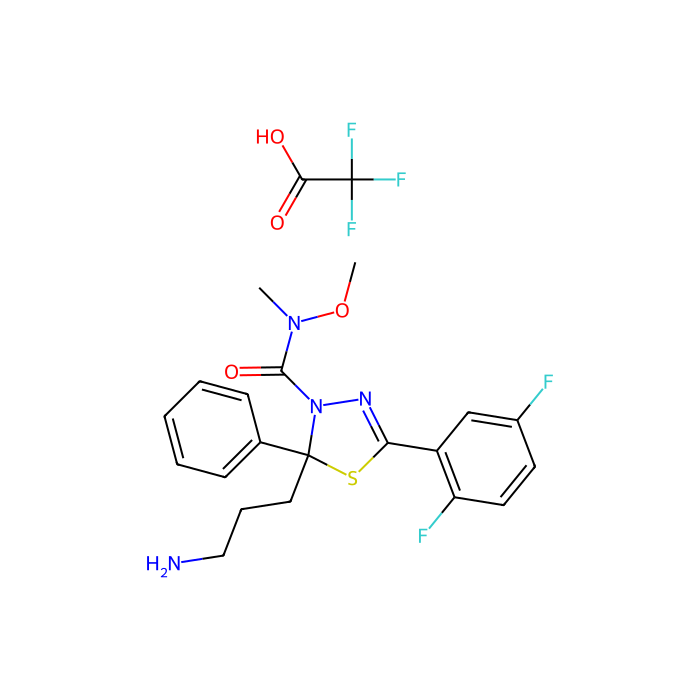
Potent kinesin spindle protein (KSP) inhibitor (IC50= 6 nM); selective for KSP over >250 other receptors and kinases at a concentration of 10μM. Displays robust antitumor activity in bortezomib-resistant xenografts either alone or in combination with bort
Condizioni di conservazione di stoccaggio
Store at -20°C
Spedito in
Ice chest + Ice pads
Questo prodotto richiede spedizione a catena fredda. I servizi di terra e altri servizi economici non sono disponibili.
Certificati (CoA, COO, BSE/TSE e tabella di analisi)
C of A & Other Certificates(BSE/TSE, COO):
Analytical Chart:
Proprietà chimiche e fisiche
Solubilità
Solvent:DMSO, Max Conc. mg/mL: 31.54, Max Conc. mM: 75; Solvent:ethanol, Max Conc. mg/mL: 31.54, Max Conc. mM: 75
Calcolatori di soluzioni
Molarity Calculator
Determine the necessary mass, volume, or concentration for preparing a solution.
Dilution Calculator
Determine the dilution needed to prepare a stock solution.
Reconstitution Calculator
Recensioni
Recensioni dei clienti
Application Protocols
Item-specific (from Product Data)
No tested applications, assay types, or recommended dilutions are provided for this item.
General handling (non-specific guidance)
Prepare a concentrated stock in anhydrous DMSO under inert, dry conditions if possible. Vortex to dissolve fully; gentle heating (≤37 °C) and brief sonication can aid dissolution if compatible with stability.
Filter sterilize (0.22 µm) if sterile applications are required and the compound is stable under the conditions.
Dilute into pre‑warmed assay medium with thorough mixing; add stock as the final component to minimize precipitation. Maintain consistent vehicle percentage in controls.
Establish concentration ranges empirically (e.g., serial dilutions spanning orders of magnitude) and include time‑matched vehicle controls.
Note
These are general best practices for small‑molecule tool compounds and are not item‑validated protocols. Consult your institutional SOPs.
Biological Roles
General/literature context (non-clinical, not item specifications)
ARRY‑520 (filanesib) is widely cited as a selective small‑molecule inhibitor of the mitotic kinesin Eg5 (also known as KSP, KIF11), a motor protein essential for bipolar spindle formation during cell division.
Inhibition of Eg5 disrupts centrosome separation and spindle bipolarity, leading to characteristic monopolar spindles and mitotic arrest in proliferating cells—a phenotype commonly used as a readout of target engagement.
As a chemical probe, ARRY‑520 supports studies of mitotic mechanics, checkpoint signaling, and synthetic‑lethal interactions with DNA damage responses in cell lines.
Experimental considerations (general)
Cellular uptake and activity can depend on serum binding and efflux transporter expression; titration curves and time‑course experiments are recommended.
Phenotypic confirmation typically involves immunofluorescence microscopy of microtubules/centrosomes, mitotic index quantification, or live‑cell imaging of spindle dynamics.
Orthogonal validation may use genetic knockdown/knockout of KIF11 or alternative Eg5 inhibitors to confirm on‑target effects.
Important notes
All uses are for research only; no medical, diagnostic, or therapeutic use is implied.
Specific activity values, EC50/IC50, and selectivity panels vary by cell line and assay format and are not specified for this item; consult primary literature for context and determine parameters empirically in your system.
Buffer Applications
Applicability statement
This product is a small‑molecule research tool rather than a buffering agent. It does not form classical buffer systems and is not used to control solution pH.
Practical notes for assay buffers (general)
When preparing working solutions, use physiologically relevant buffers/media (e.g., PBS, HBSS, or cell culture media) and keep final organic solvent content low and consistent across treatments.
If aqueous solubility is limited, modest acidification (e.g., adding a small fraction of acidic buffer) or inclusion of tolerated cosolvent can help maintain the TFA salt in solution.
Green Alternatives
Context
As a small‑molecule research tool, the main environmental footprint arises from solvent use in preparation and assay workflows rather than from the compound itself.
Greener solvent choices (general guidance)
Prefer aqueous buffers with minimal DMSO where feasible; consider pH adjustment or formulation aids (e.g., hydroxypropyl‑β‑cyclodextrin) to reduce organic solvent percentage.
If an organic cosolvent is required, ethanol is generally considered a greener alternative to DMF or acetonitrile for biological applications.
Comparative considerations (general)
DMSO: High solvency; relatively low volatility; acceptable toxicity profile in small volumes but not classified as “green.”
Ethanol: Renewable feedstock and lower toxicity; may have lower solvency and can impact cells at higher percentages.
Aqueous buffer: Greenest option; may require careful pH control to maintain the TFA salt in solution.
Practical steps to improve sustainability
Use concentrated stocks to minimize solvent volumes added to assays.
Standardize stock concentrations to reduce waste from repeated dilutions.
Dispose of halogenated waste streams (if any arise from analytical work) separately to facilitate appropriate treatment.
Note
No alternative “green” chemical replacement exists for the biological activity of ARRY‑520; sustainability efforts should focus on solvent minimization and responsible waste management.
Pharmaceutical Uses
Applicability statement
Supplied strictly for research use only. No medical, diagnostic, or therapeutic use is intended or implied.
Formulation context (general, non-claim)
In preclinical research settings, small‑molecule TFA salts are often formulated for in vitro studies in DMSO stocks and for in vivo model research (where permitted) in aqueous vehicles containing suitable cosolvents/surfactants (e.g., PEG, Cremophor, or cyclodextrins). Specific vehicle compositions and dosing regimens are not provided for this item and must be developed and approved under relevant institutional protocols.
No pharmacopeial monograph is cited here for ARRY‑520 TFA.
Manufacturing/analytical considerations (general)
Counterion identity and stoichiometry should be verified for dose normalization to free‑base equivalents.
Stability‑indicating methods (e.g., HPLC with UV/fluorescence or LC–MS) are recommended to monitor degradation in formulated matrices.
Note
All handling and formulation should comply with local regulations for laboratory research chemicals.
Physical Properties
Item-specific (from Product Data)
Appearance: Not specified for this item; refer to CoA/Spec Sheet.
Literature/general values and expectations (not item specifications)
Physical state: Typically an off‑white to light solid for small‑molecule TFA salts; exact appearance depends on lot and hydration.
Solubility (typical practice): Readily soluble in DMSO; often soluble to working stocks (e.g., millimolar range) in anhydrous DMSO; sparingly to moderately soluble in aqueous buffers depending on pH and cosolvent content. Actual solubility for this item is not specified; confirm experimentally.
pKa (qualitative): Presence of a basic amine implies protonation under physiological pH; salt formation with TFA reflects basicity of the cation. Numerical pKa not stated here.
Partitioning: Aromatic, cationic salts often show higher aqueous compatibility than the free base at acidic pH; logP/logD are formulation‑dependent and not provided here.
Melting point, boiling point, density, refractive index, UV cutoff: Not specified for this item; refer to CoA/Spec Sheet.
Practical notes
Stock solutions are commonly prepared in dry DMSO and diluted into assay media immediately before use to minimize precipitation.
The TFA counterion can influence hygroscopicity; minimize exposure to humid air to avoid water uptake that can change apparent mass concentration.
Quality and Grades
Item-specific (from Product Data)
Grade/purity: Not specified for this item; refer to CoA/Spec Sheet.
How to interpret grade/purity when provided (general guidance)
For small‑molecule research tools, vendors may report HPLC area % purity, residual solvent content, counterion content, and water (Karl Fischer). A higher HPLC purity (e.g., ≥98%) is typically preferred for biological assays to reduce confounding off‑target effects from impurities.
Trifluoroacetate salt form: The counterion content can be quantified (e.g., by 19F NMR, ion chromatography) and may vary slightly between lots; this affects mass‑based dosing. If your assay is sensitive to exact molarity, consider normalizing by free‑base equivalent based on the counterion stoichiometry provided on the CoA.
UV/HPLC suitability: If HPLC grade or LC–MS suitability is claimed in documentation, expect low baseline and well‑resolved main peak; otherwise, verify with your own method development.
Recommendations
Request and review the CoA for: HPLC chromatogram, assay/purity, residual solvents, water content, and TFA stoichiometry. Adjust dosing to free‑base equivalents when comparing across lots or suppliers.
Reaction and Applications
Item-specific (from Product Data)
Manufacturer application text: Not provided.
Applicability statement
ARRY 520 trifluoroacetate is a small‑molecule research tool and is not typically used as a reagent or catalyst in synthetic organic reactions. Therefore, conventional “reaction families” (e.g., cross‑coupling, reductions) are not applicable to this product.
Research usage (general, non-clinical)
Employed as a biochemical probe of mitotic kinesin function in cell and molecular biology experiments, including target engagement studies, mechanism‑of‑action assays, and phenotypic screenings where modulation of mitotic spindle dynamics is desired.
Often used alongside orthogonal tool compounds and negative controls to validate pathway dependence in cellular models.
Practical notes
Prepare fresh working solutions immediately before dosing to maintain solubility and consistency.
Include vehicle controls matched for DMSO/ethanol content.
Consider time‑course and washout experiments to probe reversibility and cell‑cycle phase specificity.
Reaction Conditions
Applicability statement
Not applicable. This product is not intended for use as a reagent or catalyst in chemical synthesis, so there are no recommended reaction temperatures, catalysts, or solvent systems.
Practical notes for research use (general)
For solution preparation and biological assays, see Solvent Selection and Storage & Reconstitution sections for guidance on stock preparation, dilution, and handling.
Safety and Handling
Item-specific (from Product Data)
Storage: Store at −20 °C.
Shipping: Ice chest + ice pads.
GHS classification, signal word, pictograms, and H‑statements: Not specified for this item; refer to SDS.
General laboratory safety (defer to the SDS for authoritative guidance)
Handle in a certified chemical fume hood to avoid inhalation of dust or aerosols from fine organic solids/salts.
Personal protective equipment (PPE): lab coat, safety glasses, and appropriate chemical-resistant gloves (e.g., nitrile). Avoid skin/eye contact and ingestion.
Avoid generating dust; use antistatic precautions and weigh with care. Wash thoroughly after handling. Do not pipette by mouth.
Incompatibilities (general): Strong oxidizers, strong acids/bases may lead to degradation; avoid prolonged exposure to moisture which can alter the TFA salt stoichiometry.
First aid overview (general): If inhaled—move to fresh air; seek medical attention if symptoms persist. Skin contact—wash with soap and water; remove contaminated clothing. Eye contact—rinse cautiously with water for several minutes; remove contact lenses if present and easy to do. Ingestion—rinse mouth; seek medical advice.
Spill response: Avoid dust; carefully collect solids with disposable tools, wipe residues with dampened absorbent, and dispose according to institutional and local regulations.
Fire safety: Combustible organic solid; use dry chemical, CO2, or foam extinguishers. Thermal decomposition may produce irritating/toxic fumes (e.g., HF from TFA residues under severe conditions).
Solvent Selection
Item-specific (from Product Data)
No solvent recommendations specified for this item; see general guidance below.
General/literature guidance for ARRY‑520 TFA and similar small‑molecule salts
Primary stock solvent: DMSO (anhydrous) is the default due to high solvating power for aromatic, cationic drug‑like molecules and compatibility with most biochemical assays at ≤0.5% v/v.
Aqueous compatibility: The TFA salt can improve water compatibility, but precipitation may occur upon dilution if the free base forms at neutral pH. Use co‑solvents (DMSO, ethanol) and/or pH control to maintain solubility.
Alternative solvents: Ethanol or methanol can dissolve many TFA salts; for cell‑based work, ethanol is often preferred over methanol. DMF may be used for preparative dissolution but is less favored in live‑cell assays.
Buffering strategy: Dilute concentrated organic stock into pre‑warmed media/buffer while vortexing; add stock last to well‑mixed solutions to minimize local supersaturation.
Comparison (general)
DMSO: Highest solvency; broad assay compatibility; hygroscopic and can carry water—store dry.
Ethanol: Biologically tolerated at low %; lower solvency; volatile—allows quick evaporation for coating.
Aqueous buffer: Most biocompatible; may require acidic pH or cyclodextrin/formulation aids for sufficient solubility.
Practical tips
Filter sterilize final working solutions (0.22 µm) if sterility is required and the compound is stable.
Avoid repeated freeze–thaw of DMSO stocks to prevent concentration drift from moisture uptake.
Storage and Reconstitution
Item-specific (from Product Data)
Storage: Store at −20 °C.
Shipping: Ice chest + ice pads.
Reconstitution and aliquoting (general best practices)
Open containers only after equilibrating to room temperature in a desiccator to prevent condensation. Minimize exposure to ambient humidity to avoid changes in TFA stoichiometry.
Reconstitute in anhydrous DMSO to prepare a concentrated stock. The exact solubility and recommended stock concentration are not specified for this item; refer to CoA/Spec Sheet and determine empirically.
After dissolution, prepare single‑use aliquots in low‑bind tubes to avoid repeated freeze–thaw cycles. Flush headspace with dry inert gas (e.g., nitrogen or argon) if long‑term storage is anticipated.
Store DMSO stocks at −20 °C or below in tightly sealed vials; protect from light if the compound is light‑sensitive (not specified here).
Stability notes
Long‑term stability, degradation pathways, and retest intervals are not specified for this item; monitor by HPLC/LC‑MS as appropriate.
Avoid repeated freeze–thaw; thaw on ice or at room temperature just before use and immediately return unused aliquots to cold storage.
Structure and Identity
Item-specific (from Product Data)
SKU: A287172
Product name: ARRY 520 trifluoroacetate
CAS: 1781834-99-8
PubChem CID: 90488964
InChIKey: 44997 (as provided)
SMILES: Not specified for this item; refer to CoA/Spec Sheet.
Molecular formula: Not specified for this item; refer to CoA/Spec Sheet.
Molecular weight: Not specified for this item; refer to CoA/Spec Sheet.
General/literature context (non-specification)
ARRY‑520 (also known in literature as filanesib) is a small‑molecule inhibitor typically supplied as a trifluoroacetate (TFA) salt to improve handling and solubility.
As a TFA salt, the material is a protonated amine-containing organic compound paired with trifluoroacetate anion; no polymeric or macromolecular features are expected.
Structural features reported in the literature for ARRY‑520 include multiple aryl/heteroaryl rings and a basic amine that forms the salt with TFA; stereochemistry may be present in the free base depending on the specific scaffold.
2D structural description (general)
The cationic portion consists of a polycyclic/aryl-rich, nitrogen‑containing framework bearing at least one basic tertiary/secondary amine center; the anion is CF3CO2−. The salt form is expected to be a discrete ion pair under anhydrous conditions and partially dissociated in polar protic/aqueous media.
Synthetic Utility
Applicability statement
ARRY 520 trifluoroacetate is an end‑use small‑molecule probe and is not typically employed as a reagent, catalyst, or building block in synthetic chemistry.
Recommendations
If derivatization or analog synthesis is of interest, consult primary medicinal chemistry literature on ARRY‑520/filanesib scaffolds for SAR and late‑stage functionalization strategies. Such work generally begins from the documented intermediates rather than from the final TFA salt.
For analytical characterization during any exploratory derivatization, orthogonal methods (1H/13C/19F NMR, HRMS, HPLC) are advised to quantify counterion content and confirm purity.
Non-applicable details
Named reaction conditions, protective group strategies, and reagent compatibility are not provided here because the compound is not intended for use as a synthetic reagent.
Target Specificity
Item-specific (from Product Data)
No target, antigen, clone, or species reactivity information has been provided for this item.
Statement of limitation
Target specificity details are not specified for this item; refer to CoA/Spec Sheet and primary literature for context appropriate to your study design.
We use cookies to ensure the website functions properly and, where permitted, to improve your experience. You can manage your preferences at any time in Settings. Learn more in our Cookie Policy.
Shall we send you a message when we have discounts available?
Remind me later
Thank you! Please check your email inbox to confirm.
Products are supplied to verified businesses, institutions, and qualified professionals for research and development use only. Not for use in humans, animals, diagnosis, or therapy.