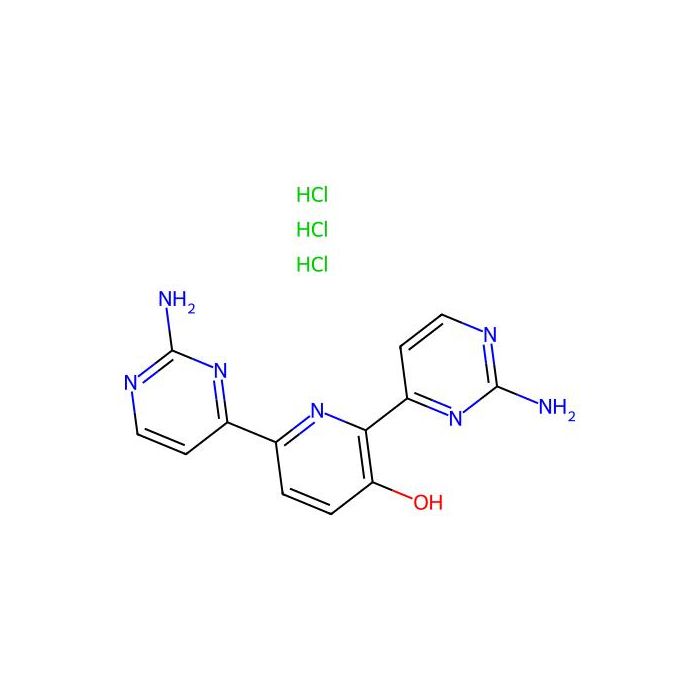
Avotaciclib (BEY1107) trihydrochloride is a potent and orally active inhibitor of cyclin dependent kinase 1 (CDK1) . Avotaciclib trihydrochloride can be used for the research of locally advanced or metastatic pancreatic cancer
Form:Solid
IC50& Target:CDK1
Specifiche
Specifiche e purezza
≥95%
Meccanismi biochimici e fisiologici
Avotaciclib (BEY1107) trihydrochloride is a potent and orally active inhibitor of cyclin dependent kinase 1 (CDK1) . Avotaciclib trihydrochloride can be used for the research of locally advanced or metastatic pancreatic cancer.
Condizioni di conservazione di stoccaggio
Store at 2-8°C,Argon charged,Desiccated
Spedito in
Wet ice
Questo prodotto richiede spedizione a catena fredda. I servizi di terra e altri servizi economici non sono disponibili.
Certificati (CoA, COO, BSE/TSE e tabella di analisi)
C of A & Other Certificates(BSE/TSE, COO):
Analytical Chart:
Proprietà chimiche e fisiche
Solubilità
DMSO : 5 mg/mL (12.80 mM; ultrasonic and warming and heat to 60°C)
Calcolatori di soluzioni
Molarity Calculator
Determine the necessary mass, volume, or concentration for preparing a solution.
Dilution Calculator
Determine the dilution needed to prepare a stock solution.
Reconstitution Calculator
Recensioni
Recensioni dei clienti
Application Protocols
No tested application protocols, assay formats, or recommended dilutions are provided for this catalog item.
General guidance for small-molecule handling in common research workflows:
Stock preparation: Prepare a 10–50 mM stock in anhydrous DMSO. Vortex and, if required, sonicate briefly to aid dissolution. Filter through 0.22 µm if sterile stocks are needed and the compound is stable.
Working concentrations: Establish dose–response curves spanning low nM to mid-µM (e.g., 10-point or 12-point serial dilutions, 3-fold spacing) appropriate to your assay sensitivity.
Controls: Include vehicle controls (matching DMSO%), positive controls (reference inhibitor/compound for the pathway), and negative controls.
Plate handling: Use low-binding tubes/plates; seal assay plates to minimize evaporation, particularly for long incubations.
Data quality: Track final DMSO percentage, temperature, and incubation time; replicate across days/lots to confirm reproducibility.
Note: These are general, non–product-specific recommendations. Optimize for your assay system and consult the literature for compound-specific protocols if available.
Biological Roles
No target, pathway, or mechanism details are specified in the Product Data for this item. The following provides general guidance for handling bioactive small molecules in research contexts without making therapeutic claims.
Research scope: Such compounds are typically used for in vitro biochemical assays, target engagement studies, and cell-based profiling. Confirm the biological target and expected mode of action from primary literature before designing experiments.
Concentration ranges: Pilot studies often explore 0.1 nM–50 µM depending on target potency and cellular uptake; titrate to define on-target windows vs cytotoxicity.
Off-target assessment: Use counterscreens (e.g., orthogonal assays or broad kinase panels) to contextualize phenotypes and reduce false positives.
Time-course considerations: Establish exposure times that reflect the kinetic behavior of your biological system (acute vs chronic exposure) and compound stability in media.
Data integrity: Record salt form, lot number, solvent, final DMSO percentage, and free-base-equivalent concentrations for reproducibility.
Important: For research use only. This product is not intended for diagnostic, therapeutic, or clinical applications.
Buffer Applications
This product is a small-molecule research compound and is not a buffering agent. Conventional buffer system development (e.g., phosphate, HEPES, Tris) is not typically applicable to the compound itself.
Practical guidance for preparing working solutions (general):
If soluble, aqueous buffers (e.g., PBS, HEPES, or assay-specific buffers) can be used as final diluents after making a concentrated DMSO stock solution. Maintain a low final DMSO content consistent with assay requirements (e.g., 0.1–0.5%).
Check for precipitation upon dilution; if observed, increase the proportion of co-solvent slightly (e.g., 1–5% DMSO) or adjust ionic strength/pH carefully where compatible with compound stability.
Filter sterilization (0.22 µm, PES or PTFE) may be used for cell-based assays if the compound is stable and remains in solution.
For detailed buffer recipes and pH ranges, refer to standard biochemical buffers rather than the compound itself.
Green Alternatives
As a bioactive small-molecule salt rather than a solvent or bulk reagent, “green alternatives” primarily relate to handling media and process choices rather than replacing the compound itself.
Greener handling strategies (general guidance):
Solvent choice for stock solutions: Prefer DMSO and water/buffer over chlorinated solvents. Use the minimum DMSO percentage compatible with solubility and assay performance.
Minimizing waste: Prepare small aliquots to reduce freeze–thaw cycles and discard volumes. Use high-throughput formats to scale down per-experiment consumption.
Energy-efficient storage: While cold storage is recommended for stability, consolidate aliquots and maintain organized inventory to minimize door-open time and temperature cycling.
Packaging: If repackaging for screening campaigns, choose amber vials or 96/384-well plates with low-evaporation seals to reduce losses and rework.
Comparison (general solvent guidance):
DMSO vs DMF/NMP: DMSO offers a better EHS profile and biodegradability compared to DMF/NMP, which carry stricter reproductive toxicity classifications.
Aqueous buffers vs organic-only: Where solubility allows, aqueous media reduce VOC emissions and flammability risks.
Trade-offs:
Aqueous buffers may reduce shelf-life for some salts due to hydrolysis or pH-driven degradation; validate stability before committing to water-based workflows.
Pharmaceutical Uses
No pharmacopeial status, excipient role, or formulation details are provided for this item. This product is supplied strictly for research use only and is not intended for clinical or diagnostic applications.
General formulation context for research compounds (non-clinical, not specific to this product):
Preclinical formulation screening may evaluate solubilizing vehicles (e.g., aqueous buffer with co-solvent, cyclodextrins, PEGs) for in vivo exploratory studies in laboratory animals. Such use requires institutional approvals and is outside the scope of this catalog listing.
For in vitro work, DMSO stocks diluted into assay buffers are standard. Confirm stability in the chosen vehicle and avoid adsorption to plastics by using low-binding labware.
Salt selection: Hydrochloride salts often enhance aqueous solubility and handling but may influence pH and osmolality; adjust formulations accordingly.
Important: Aladdin Scientific supplies this compound for research use only. No claims are made regarding therapeutic efficacy, safety, or suitability for human or veterinary use.
Physical Properties
Item-specific properties (from Product Data):
Appearance: Not specified for this item; refer to CoA/Spec Sheet.
Molecular Weight: Not specified for this item; refer to CoA/Spec Sheet.
Literature/typical behavior for HCl salts of basic small molecules (general guidance; not specifications):
Physical state: Frequently isolated as a crystalline or amorphous solid; color typically off-white to light yellow depending on impurities.
Solubility profile: HCl salts of polybasic amines are commonly soluble in polar aprotic solvents (DMSO, DMF, NMP) and show enhanced solubility in water and aqueous buffers compared to their free bases. Actual solubility can vary widely; verify experimentally.
Melting point (MP), boiling point (BP), density, refractive index, pKa, logP/logD: Not specified for this item; consult literature or measure under your conditions.
Practical notes (general guidance):
Preparing concentrated DMSO stocks (e.g., 10–50 mM) is common for biological screening; filter-sterilize if needed.
Hygroscopicity: Many multi-HCl salts are hygroscopic; minimize atmospheric exposure to maintain accurate mass and composition.
If preparing aqueous solutions, confirm pH after dissolution; the trihydrochloride counterions can acidify the medium.
Quality and Grades
Item-specific quality fields in the provided Product Data:
Grade/Purity: Not specified for this item; refer to CoA/Spec Sheet.
Guidance on grades and relevance (general, not item-specific):
Research/Screening grade: Suitable for discovery biology, target validation, and medicinal chemistry workflows. Often supported by HPLC purity and identity by MS/1H NMR.
HPLC grade (if stated in CoA): Implies high chemical purity; does not by itself specify salt stoichiometry or water content.
Salt form confirmation: For trihydrochlorides, CoA should indicate counterion content and salt stoichiometry; Karl Fischer moisture may be reported to assess hydration/hygroscopic uptake.
Identity testing: Typical methods include LC–MS, HRMS, 1H/13C NMR, and sometimes elemental analysis or chloride assay for salt content.
Impurity profile: If you require thresholds for residual solvents, metals, or specific related substances, request the batch CoA/Spec Sheet. Do not assume equivalence between lots.
Recommendations:
Verify salt form, purity, and counterion content on receipt against your assay requirements (e.g., cell-based assays may be sensitive to trace impurities or variable salt content).
For quantitative work, normalize dosing to free-base equivalents if your application demands precise molar concentrations; consult CoA for MW (salt vs free base).
Reaction and Applications
This product is intended primarily as a research small molecule (screening/tool compound context) rather than a synthetic reagent. No manufacturer application notes were provided for this catalog entry.
Applicable use contexts (general research guidance):
Chemical biology and screening: Researchers often evaluate small-molecule salts in target-binding assays, enzymology, and cell-based phenotypic screens. Prepare accurately quantified stock solutions and normalize to free-base equivalents if needed.
Analytical characterization: LC–MS, UPLC, and NMR to confirm identity and purity in your lab prior to critical studies; track any degradation under assay buffer conditions.
Reference standard: Can be used as a reference material in method development/validation once identity and purity are verified.
Not typical synthetic reagent:
Avotaciclib trihydrochloride is not commonly used as a building block or catalyst. If you plan derivatization, first convert to the free base (if appropriate) and verify compatibility of functional groups with your intended transformations.
Practical tips (general):
Hygroscopic salts: Work quickly on the bench; weigh in a dry box or under inert gas if high accuracy is required.
Solution stability: Assess stability in DMSO and in assay buffers over time (e.g., LC–MS at 0, 4, 24, 48 h) and under light exposure to establish handling windows.
Reaction Conditions
Not typically applicable. Avotaciclib trihydrochloride is supplied as a research compound rather than a reagent to drive chemical reactions.
General laboratory handling conditions for solution preparation (non-reaction, practical guidance):
Solvent: DMSO for stock solutions; water/buffer or culture media for final dilutions where soluble and biologically compatible.
Temperature: Room temperature handling is common; avoid prolonged exposure to elevated temperatures. Follow storage guidance for stability.
Atmosphere: Provided Product Data specifies argon-charged storage; limit atmospheric exposure and recap promptly to reduce moisture uptake and oxidation risk.
Light: Many heteroaromatic bioactives are photosensitive; use amber vials and limit intense light exposure.
If you intend to use the compound as a substrate or ligand in a chemical transformation, first confirm compatibility and structure in the primary literature. No named reaction conditions are provided or endorsed for this product.
Safety and Handling
Authoritative safety data should be obtained from the product’s SDS. The following fields are not specified in the provided Product Data and must be verified on the SDS/label:
Signal Word: Not specified for this item; refer to SDS.
H-Statements: Not specified for this item; refer to SDS.
GHS Classification: Not specified for this item; refer to SDS.
Pictograms: Not specified for this item; refer to SDS.
General laboratory precautions for small-molecule amine hydrochloride salts (non-specific guidance):
PPE: Use lab coat, safety goggles, and appropriate chemical-resistant gloves (nitrile). Handle powders/solid salts in a fume hood to avoid inhalation of dust/aerosols.
Storage incompatibilities: Keep away from strong bases (which can liberate free base and HCl), strong oxidizers, and moisture. Avoid prolonged exposure to air due to potential hygroscopicity.
First aid (overview; defer to SDS): Inhalation—move to fresh air; Skin/Eye—rinse with water for several minutes; Ingestion—rinse mouth. Seek medical attention as needed.
Spill/cleanup: Avoid dust formation. Use dampened disposable towels/absorbents or HEPA-filtered vacuum. Dispose of waste in accordance with institutional and local regulations.
Thermal and chemical stability: Salt forms often improve stability versus free bases; nevertheless, protect from heat, light, and moisture as a best practice.
Research use note: For research use only. Not for human or veterinary use.
Solvent Selection
Item-specific solvent data are not provided. The following are general best practices for dissolving small-molecule hydrochloride salts for research use:
Primary solvents for stock solutions:
DMSO: Frequently enables high-concentration stocks (e.g., 10–50 mM). Ensure anhydrous grade for stability-sensitive compounds; aliquot and store cold under inert gas.
Water or aqueous buffers: Salt forms often show improved aqueous solubility, but actual solubility should be confirmed experimentally. Adjust pH only if compatible with compound stability.
DMF or NMP: Alternative polar aprotic solvents for challenging solubility; consider cytotoxicity and downstream compatibility.
Miscibility and dilution:
For biological assays, prepare concentrated DMSO stocks and dilute into assay buffer to ≤0.1–0.5% final DMSO if required by cells/enzymes.
If precipitation occurs upon dilution into aqueous media, co-solvent strategies (DMSO:buffer 1–5%) or pH adjustments may help.
When to choose one solvent over another (general guidance):
Choose DMSO for broad solubility and compound library handling.
Choose aqueous buffers when DMSO must be minimized and the compound remains soluble at working concentrations.
Avoid volatile chlorinated solvents for biological testing; they are generally unnecessary for salt forms and complicate safety/compliance.
Filtration: If sterile working solutions are required, use 0.22 µm PTFE or PES syringe filters compatible with your solvent system.
Storage and Reconstitution
Item-specific storage from Product Data:
Storage Conditions: Store at 2–8 °C, argon charged, desiccated.
Shipped In: Wet ice.
Best practices for this item (aligned to provided guidance):
On receipt: Keep container closed when not in use. Allow to equilibrate to room temperature in a desiccator before opening to prevent moisture condensation.
Atmosphere: Maintain an inert gas headspace (argon or nitrogen) in opened vials; promptly recap after use to limit moisture and oxygen exposure.
Desiccation: Store with active desiccant. The trihydrochloride salt may be hygroscopic; minimize open time during weighing.
Reconstitution (general guidance; not a specification):
Solvent: Anhydrous DMSO is recommended for initial stock solutions. Typical screening stocks are 10–50 mM.
Procedure: Weigh quickly, add pre-measured solvent, vortex until dissolved. If necessary, sonicate briefly. Avoid heating unless stability has been verified.
Aliquoting: Dispense single-use aliquots in amber vials or 96/384-well plates. Store aliquots at 2–8 °C per product guidance; for longer-term storage, users may evaluate colder conditions if compatible with the compound (validate stability).
Freeze–thaw: Minimize cycles. Thaw on ice or at room temperature; mix gently before use.
Note: For definitive stability limits, solubility, and concentration recommendations for your application, consult the batch-specific CoA/Spec Sheet.
Structure and Identity
Brief overview: Avotaciclib trihydrochloride is supplied as a small-molecule research chemical in its trihydrochloride salt form. Specific structural identifiers for this catalog item are not provided below and should be confirmed against the product CoA/Spec Sheet.
Item-specific (from Product Data):
Product Name: Avotaciclib trihydrochloride
CAS: 1983984-01-5
SKU: A651416
Category: Small molecules and compound library (小分子和化合物库)
Molecular Formula: Not specified for this item; refer to CoA/Spec Sheet.
Molecular Weight: Not specified for this item; refer to CoA/Spec Sheet.
SMILES: Not specified for this item; refer to CoA/Spec Sheet.
InChIKey: Not specified for this item; refer to CoA/Spec Sheet.
Structural features (general, literature-style guidance; not item-specific):
“Trihydrochloride” denotes a tricationic base present as its 3×HCl salt, typically improving aqueous stability and handling versus the free base.
Many kinase-focused tool compounds feature polycyclic heteroaromatic scaffolds with basic amines; however, verify exact functional groups for Avotaciclib against the CoA/SDS.
2D structural description (general guidance):
Expect a heteroatom-containing small molecule with one or more protonated nitrogen centers balanced by three chloride counterions (salt form). Exact ring systems, stereochemistry, and substituents must be confirmed from the CoA/Spec Sheet for this specific lot.
Synthetic Utility
This item is supplied as a finished small-molecule salt for research. It is not typically employed as a synthetic building block or catalyst.
Considerations if derivatization is pursued (general guidance):
Salt-to-free-base conversion: If synthetic modification is planned, first liberate the free base under controlled basic conditions and isolate it in an anhydrous medium.
Functional group compatibility: Verify the presence and reactivity of amines, heteroaromatics, and other motifs (consult CoA/SDS or primary literature for structure). Protect sensitive sites prior to cross-couplings or acylations.
Purification: Reverse-phase preparative HPLC is commonly used for complex, polar small molecules. Ion-pairing and salt exchange may help isolate defined stoichiometric salts.
Analytical tracking: Monitor reactions by LC–MS to track mass shifts and maintain awareness of salt/counterion effects on retention and ionization.
Retrosynthetic value: Limited, as such bioactive molecules are designed end-products rather than modular synthons. Custom analog generation is typically handled within medicinal chemistry campaigns using the known core scaffold (confirm structure from literature before attempting).
Target Specificity
No target, epitope, or specificity information is provided in the Product Data for this item. Aladdin Scientific supplies this compound for research use only without claims regarding biological targets or selectivity.
For experimental planning (general guidance):
If a putative target is identified from literature, confirm with orthogonal assays (biochemical and cellular) and consider selectivity profiling against related target families to de-risk off-target effects.
Record the exact salt form and lot number in all datasets; differences in counterion content or purity can subtly shift apparent potency.
Please consult peer-reviewed literature and your internal validation data to establish target specificity appropriate to your application.
Utilizziamo i cookie per garantire il corretto funzionamento del sito web e, ove consentito, per migliorare la tua esperienza. Puoi gestire le tue preferenze in qualsiasi momento nelle Impostazioni. Per saperne di più, consulta la nostra Cookie Policy.
Desidera che le inviamo un messaggio quando avremo sconti disponibili?
Ricordamelo più tardi
Grazie! Controlli la sua casella di posta per confermare.
Products are supplied to verified businesses, institutions, and qualified professionals for research and development use only. Not for use in humans, animals, diagnosis, or therapy.