Determine the necessary mass, volume, or concentration for preparing a solution.
Taxonomy Tree
| Kingdom | Organic compounds |
|---|---|
| Superclass | Organic oxygen compounds |
| Classe | Organooxygen compounds |
| Subclass | Carbohydrates and carbohydrate conjugates |
| Intermediate Tree Nodes | Not available |
| Direct Parent | Oligosaccharides |
| Alternative Parents | Aminoglycosides O-glycosyl compounds Oxanes Methylcarbamates 1,2-aminoalcohols Secondary alcohols Hemiacetals Organic carbonic acids and derivatives Acetals Oxacyclic compounds Monoalkylamines Primary alcohols Hydrocarbon derivatives Carbonyl compounds Organic oxides Organopnictogen compounds |
| Molecular Framework | Aliphatic heteromonocyclic compounds |
| Substituents | Oligosaccharide - Aminoglycoside core - Glycosyl compound - O-glycosyl compound - Amino saccharide - Oxane - Methylcarbamate - Carbamic acid ester - 1,2-aminoalcohol - Secondary alcohol - Hemiacetal - Carbonic acid derivative - Acetal - Oxacycle - Organoheterocyclic compound - Organic nitrogen compound - Organonitrogen compound - Primary alcohol - Primary aliphatic amine - Primary amine - Hydrocarbon derivative - Carbonyl group - Organic oxide - Amine - Alcohol - Organopnictogen compound - Aliphatic heteromonocyclic compound |
| Descrizione | This compound belongs to the class of organic compounds known as oligosaccharides. These are carbohydrates made up of 3 to 10 monosaccharide units linked to each other through glycosidic bonds. |
| External Descriptors | Not available |
Find and download the COA for your product by matching the lot number on the packaging.
| Lot Number | Certificate Type | Data | Oggetto |
|---|---|---|---|
| Certificate of Analysis | Mar 26, 2026 | C1516211 | |
| Certificate of Analysis | Mar 26, 2026 | C1516211 | |
| Certificate of Analysis | Mar 26, 2026 | C1516211 | |
| Certificate of Analysis | Mar 26, 2026 | C1516211 | |
| Certificate of Analysis | Mar 26, 2026 | C1516211 |
| Punto di fusione (°C) | 102.5°C |
|---|---|
| Peso molecolare | 1526.500 g/mol |
| XLogP3 | -21.400 |
| Hydrogen Bond Donor Count | 29 |
| Hydrogen Bond Acceptor Count | 47 |
| Rotatable Bond Count | 27 |
| Exact Mass | 1525.64 Da |
| Monoisotopic Mass | 1525.64 Da |
| Topological Polar Surface Area | 808.000 Ų |
| Heavy Atom Count | 104 |
| Formal Charge | 0 |
| Complexity | 2630.000 |
| Isotope Atom Count | 0 |
| Defined Atom Stereocenter Count | 45 |
| Undefined Atom Stereocenter Count | 0 |
| Defined Bond Stereocenter Count | 0 |
| Undefined Bond Stereocenter Count | 0 |
| The total count of all stereochemical bonds | 0 |
| Covalently-Bonded Unit Count | 1 |
The following are example research protocols (general literature) to prepare and process chitosan. Adjust for your material’s DD/Mw and equipment. These are not item-specific specs.
1% w/v chitosan solution in acetic acid
Film casting and neutralization
TPP-crosslinked beads (ionic gelation)
Reductive amination (surface functionalization)
Note: Verify sterility/pyrogen levels if using in cell culture research. For exact dissolution time, viscosity, and DD-dependent behavior, refer to the CoA/Spec Sheet.
Origin and metabolism (literature)
Physicochemical interactions (literature)
Functional attributes relevant to research (literature)
Note: The above describes biological context and is not a statement of clinical safety or efficacy. Performance is highly dependent on DD, Mw, ionic environment, and processing history.
While chitosan is not a buffer component per se, its dissolution and performance strongly depend on the buffer system and pH.
Dissolution media (literature)
Practical tips
Not typically applicable
Chitosan itself is a renewable, biodegradable, and biobased polymer derived from chitin (crustacean fungal biomass). When selecting cationic polymers or flocculants, chitosan can replace petroleum-derived materials.
| Attribute | Chitosan | Polyethyleneimine (PEI) | PDADMAC | Quaternized cellulose | |---|---|---|---|---| | Feedstock | Biobased (chitin) | Petrochemical | Petrochemical | Partially biobased | | Biodegradability | High (enzymatic) | Moderate/low | Moderate | High | | Toxicity/biocompatibility | Generally favorable | Can be cytotoxic | Moderate | Favorable | | Solvent for processing | Dilute organic acids (aq) | Water | Water | Water | | Charge type | Primary amines (pH-dependent) | Primary/secondary/tertiary (broad) | Permanent quaternary | Quaternary (permanent) |
Trade-offs
Greener processing tips (literature)
For research formulation and process development only. No clinical use is implied.
Roles in dosage-form development (literature/general)
Regulatory/compendial context (general)
Processing considerations
Item-specific grade and compliance for SKU C1516211: Not specified for this item; refer to CoA/Spec Sheet.
Item-specific specifications
General/literature properties (typical for chitosan; not item specifications)
Notes: Exact numeric values vary with source, DD, Mw, moisture, and counterions. For the specific item’s analytical parameters (DD %, ash, moisture, metal content, viscosity), consult the CoA/Spec Sheet.
Item-specific quality information
How chitosan quality is typically defined (general guidance)
Implications for selection
For this specific SKU (C1516211), consult the Aladdin CoA/Spec Sheet for DD %, viscosity/Mw, ash, moisture, and any bioburden or metal specifications.
Materials and processing applications (literature)
Chemical derivatization on polymer (synthetic “reagent” roles; literature)
As a support or catalyst (literature)
Notes: Optimize degree of deacetylation (DD), molecular weight, and counterion for target performance. For any specific application claims, validate with in-house testing under your conditions.
General literature guidance for common chitosan transformations (not item-specific specifications):
Dissolution baseline
Reductive amination (Schiff base → secondary amine)
Carbodiimide coupling (EDC/NHS) to –NH2
Ionic crosslinking with TPP (for beads/microparticles)
Genipin crosslinking
Yields and degrees of substitution vary widely with DD, Mw, stoichiometry, and medium; confirm by titration, FTIR, NMR (on soluble derivatives), or XPS.
Item-specific safety
General safety considerations (literature/good practice)
Always consult the product-specific SDS for authoritative hazard, exposure limits, and emergency procedures.
Chitosan is a cationic polysaccharide that dissolves upon protonation of C2 amines. Solvent choice focuses on mildly acidic aqueous media.
Polarity/miscibility (general)
Practical selections (literature guidance)
When to choose alternatives
Small comparison (literature)
Note: Always add acid to water, then slowly add chitosan with efficient stirring to avoid gel lumps.
Item-specific storage (from Product Data)
General best practices for chitosan (literature/good practice)
Reconstitution/dissolution guidance (general)
Freeze–thaw guidance
For any item-specific parameters (moisture limit, DD %, viscosity), consult the Aladdin CoA/Spec Sheet for SKU C1516211. Research use only.
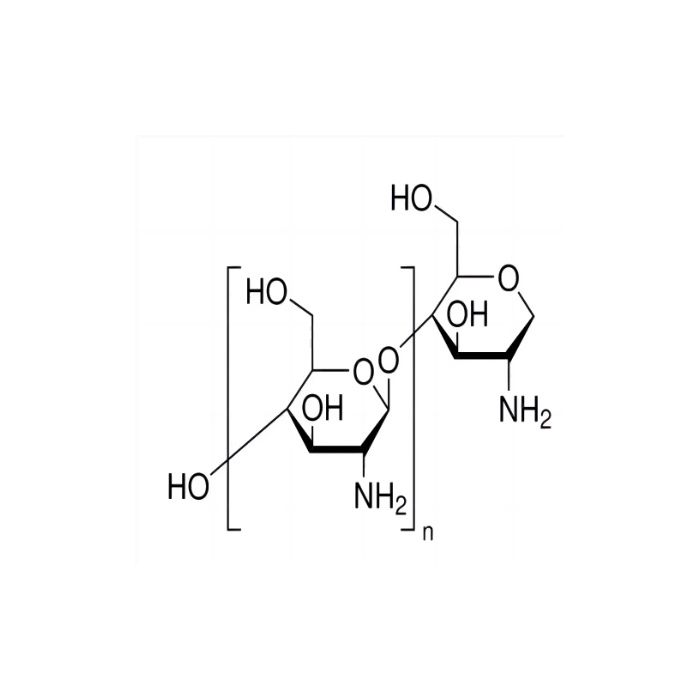
Chitosan is a partially deacetylated chitin derivative: a linear β-(1→4)-linked copolymer of D-glucosamine and N-acetyl-D-glucosamine units. Each repeat bears C2 primary amines (on deacetylated units) and C3/C6 hydroxyls.
Item-specific identifiers (from Product Data)
Structural features (general/literature)
2D description in words
Chitosan serves as a versatile macromolecular scaffold bearing nucleophilic primary amines and hydroxyl groups.
N-functionalization (literature)
O-functionalization (literature)
Crosslinking and network formation
Supports and separations
Selection of DD and Mw is central: higher DD increases available –NH2 sites; lower Mw improves processability; heterogeneous vs homogeneous routes balance selectivity and accessibility. Always report DD, Mw, solvent, and counterion when documenting synthetic transformations.
Not applicable to this product category. Chitosan is a polysaccharide material, not an antibody or affinity reagent. No antigen/epitope specificity, clone, isotype, or species reactivity applies.