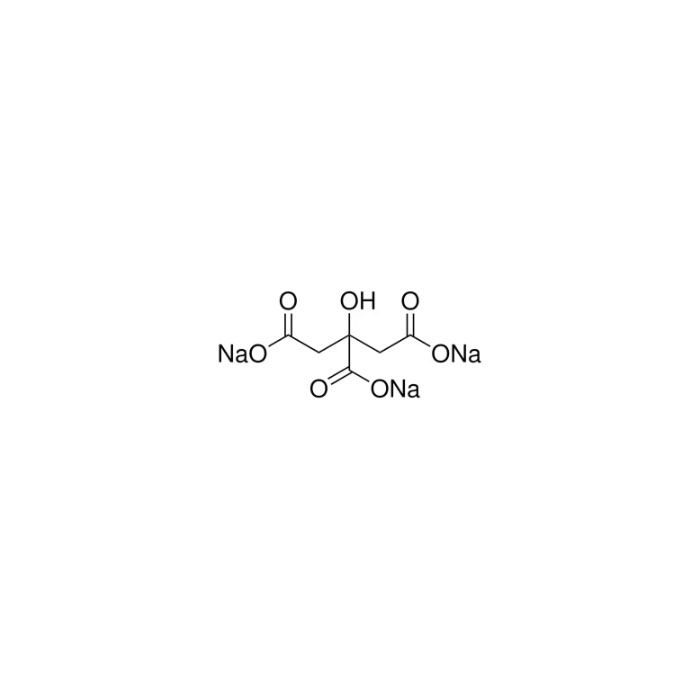
Citrate Concentrated Solution - BioReagent, 4 % (w/v), suitable for coagulation assays , CAS No.68-04-2

CAS: 68-04-2 Cat. No.: C433300 Formula: C6H5O7Na3 Peso molecolare: 258.07 Numero EC: 200-675-3
Disponibile su ordine
GRADE & PURITY BioReagent ? BioReagent grade — tested suitable for life-science and molecular-biology use. Use for cell culture, assays, and biochemical work needing biological compatibility. 4 % (w/v), suitable for coagulation assays
Synonyms
Oracit | Natrocitral | 1,2,3-Propanetricarboxylic acid, 2-hydroxy-, trisodium salt | anhydrous sodium citrate | SODIUM CITRATE (USP IMPURITY) | Sodium citrate,anhydrous | Citrosodina | INS-331(III) | Modified Shohl's Solution | SODIUM CITRATE ANHYDROUS [H
Storage
Store at 2-8°C
Shipped In
Wet ice
★
Size
Germania (EU)
USA*
Price
Qty
50ml
C433300-50ml
Su ordinazione · 8–12 settimane
34,62€
Enter a quantity for the sizes you want to add.
🧪
Why this grade

BioReagent, 4 % (w/v), suitable for coagulation assays BioReagent for sensitive chromatographic and analytical workflows requiring minimal baseline interference.

🌡

Storage & shipping

Store at 2-8°C Ships Wet ice Check lot-specific COA for exact specifications.

📋

Quality documents

SDS, COA, datasheet, and spec sheet available for download. Lot-specific COA accessible via lot number lookup.

📚

Literature proof

Cited in 2075 peer-reviewed publications across chromatography, organic synthesis, and cross-coupling reactions.

Panoramica

For routine coagulation assays. Suggested anticoagulant: whole blood ratio: 1:9.

Specifications

Sinonimi
Oracit | Natrocitral | 1,2,3-Propanetricarboxylic acid, 2-hydroxy-, trisodium salt | anhydrous sodium citrate | SODIUM CITRATE (USP IMPURITY) | Sodium citrate,anhydrous | Citrosodina | INS-331(III) | Modified Shohl's Solution | SODIUM CITRATE ANHYDROUS [H
Specifiche e purezza
BioReagent, 4 % (w/v), suitable for coagulation assays
Meccanismi biochimici e fisiologici
Citric acid concentrate or sodium citrate is an anticoagulant used to collect blood samples. It can be used in coagulation test and erythrocyte sedimentation rate. Sodium citrate can eliminate calcium, which can mediate coagulation.
Condizioni di conservazione di stoccaggio
Store at 2-8°C
Spedito in
Wet ice
Questo prodotto richiede spedizione a catena fredda. I servizi di terra e altri servizi economici non sono disponibili.
Grado
BioReagent
Nomi e identificatori
Pubchem Sid
Sorrisi canonici
C(C(=O)[O-])C(CC(=O)[O-])(C(=O)[O-])O.[Na+].[Na+].[Na+]
IUPAC Name
trisodium;2-hydroxypropane-1,2,3-tricarboxylate
InChIKey
HRXKRNGNAMMEHJ-UHFFFAOYSA-K
INCHI
1S/C6H8O7.3Na/c7-3(8)1-6(13,5(11)12)2-4(9)10;;;/h13H,1-2H2,(H,7,8)(H,9,10)(H,11,12);;;/q;3*+1/p-3
Isomeri SMILES
C(C(=O)[O-])C(CC(=O)[O-])(C(=O)[O-])O.[Na+].[Na+].[Na+]
Peso molecolare
258.07
Reaxy-Rn
3920956
Reaxys-RN_link_address
https://www.reaxys.com/reaxys/secured/hopinto.do?context=S&query=IDE.XRN=3920956&ln=

Documentazione

📋 Safety Data Sheet (SDS)

Comprehensive hazard, handling, storage, and regulatory compliance document.

Download SDS →

✅ Certificate of Analysis (COA)

Lot-specific quality data. Enter your lot number to retrieve the exact COA.

Look up COA →

📊 Datasheet

Quick-reference summary of product specifications and applications.

View datasheet →

🔬 Specification Sheet

Full quality attributes and acceptance criteria for this grade.

View spec sheet →

Advanced Data

Taxonomic Classification

Taxonomy Tree

KingdomOrganic compounds
SuperclassOrganic acids and derivatives
ClasseCarboxylic acids and derivatives
SubclassTricarboxylic acids and derivatives
Intermediate Tree Nodes Not available
Direct ParentTricarboxylic acids and derivatives
Alternative Parents Tertiary alcohols  Carboxylic acid salts  Carboxylic acids  Organic sodium salts  Organic oxides  Hydrocarbon derivatives  Carbonyl compounds  
Molecular FrameworkAliphatic acyclic compounds
Substituents Tricarboxylic acid or derivatives - Tertiary alcohol - Carboxylic acid salt - Organic alkali metal salt - Carboxylic acid - Organic oxygen compound - Organic oxide - Hydrocarbon derivative - Organic sodium salt - Organic salt - Organooxygen compound - Carbonyl group - Alcohol - Aliphatic acyclic compound
DescrizioneThis compound belongs to the class of organic compounds known as tricarboxylic acids and derivatives. These are carboxylic acids containing exactly three carboxyl groups.
External Descriptors organic sodium salt
Struttura 3D
Modello di struttura chimica interattiva


Obiettivi associati (umani)
CA2 Tclin Carbonic anhydrase II (17698 Activities)
Activity TypeRelationActivity valueUnitsAction TypeJournalPubMed IddoiAssay Aladdin ID
CA1 Tclin Carbonic anhydrase I (13240 Activities)
Activity TypeRelationActivity valueUnitsAction TypeJournalPubMed IddoiAssay Aladdin ID
CA5A Tclin Carbonic anhydrase VA (1168 Activities)
Activity TypeRelationActivity valueUnitsAction TypeJournalPubMed IddoiAssay Aladdin ID
CA9 Tclin Carbonic anhydrase IX (8255 Activities)
Activity TypeRelationActivity valueUnitsAction TypeJournalPubMed IddoiAssay Aladdin ID
Obiettivi associati (non umani)
CA4 Carbonic anhydrase IV (1713 Activities)
Activity TypeRelationActivity valueUnitsAction TypeJournalPubMed IddoiAssay Aladdin ID
Carbonic anhydrase (69 Activities)
Activity TypeRelationActivity valueUnitsAction TypeJournalPubMed IddoiAssay Aladdin ID
Meccanismi d'azione
Certificati (CoA, COO, BSE/TSE e tabella di analisi)
C of A & Other Certificates(BSE/TSE, COO):
Analytical Chart:

Find and download the COA for your product by matching the lot number on the packaging.

1 results found

Lot NumberCertificate TypeDataOggetto
B2628755Certificate of AnalysisDec 01, 2025 C433300
Proprietà chimiche e fisiche
Punto di fusione (°C)150 °C (decomposition)
Peso molecolare258.070 g/mol
XLogP3
Hydrogen Bond Donor Count1
Hydrogen Bond Acceptor Count7
Rotatable Bond Count2
Exact Mass257.973 Da
Monoisotopic Mass257.973 Da
Topological Polar Surface Area141.000 Ų
Heavy Atom Count16
Formal Charge0
Complexity211.000
Isotope Atom Count0
Defined Atom Stereocenter Count0
Undefined Atom Stereocenter Count0
Defined Bond Stereocenter Count0
Undefined Bond Stereocenter Count0
The total count of all stereochemical bonds0
Covalently-Bonded Unit Count4
Domande frequenti e articoli
Differences Among Antibodies for WB/FC/IP/ChIP/IF/IHC
Structural–Functional Characteristics, Production Technologies, and Application Progress of Thrombin
Practical Guide to Sodium Carboxymethyl Cellulose (CMC-Na): Thickening/Stabilizing Mechanisms, Key Controls for Solution Preparation, and Selection Navigation (including Table 1 and Tables A–C)
Systematic Anticoagulant Selection Strategy
Chymosin: A Review of Molecular Features, Coagulation Kinetics, and Activity Evaluation
Hemicellulases: A Review of Substrate Specificity, Catalytic Systems, and Research and Industrial Applications
Types, Mechanisms, and Applications of Blood Collection Tube Additives
Why LABSA (Sulfonic Acid) Is Commonly Used in Household Cleaning Formulations: Neutralization Mechanism, Detergency Action, and Formulation Application Points
From Structure to Performance: Conditioning, Film-Forming, Thickening, and Chelating Applications of Functional Ingredients in Personal Care and Home Care
Application of Fatty Acid Methyl Ester Sulfonate (MES) in Household Detergent and Cleaning Formulations: Detergency, Hard-Water Tolerance, and Selection Criteria
Differences, Mechanisms of Action, and Selection of Sodium Metasilicate and Sodium Tripolyphosphate in Detergent and Cleaning Formulations
The Role, Selection, and Validation of Chelating Agents in Daily Chemical Formulations
Differences, Functions, and Selection Guidelines for Sodium Hydroxide Flakes, Granules, Liquid Caustic Soda, and Caustic Soda in Household and Personal Care Product Manufacturing: The Functional and Application Logic of Sodium Hydroxide
Why Daily Chemical Formulations Need Alkaline Ingredients: From pH Adjustment and Saponification to Detergency Boosting and Selection Logic
Xiao Fang Bai, Da Fang Bai, PnB and DPnB: Mechanisms and Selection of Butyl Glycol Ethers in Hard-Surface Cleaning Formulations
Why Limonene Can Soften Greasy Soils Yet Is Difficult to Dissolve in Water: Understanding the Cleaning Mechanism and Formulation Applications of Naturally Derived Solvents from Molecular Structure
Degreasing Agents from a Molecular-Structure Perspective: How AEO, APG, and Related Surfactants Can Replace Nonylphenol Ethoxylates (NPE)
How Can Sodium Tripolyphosphate (STPP) Be Replaced? From Detergency Mechanisms to Formulation Choices for Low-Phosphorus/Phosphorus-Free Builder Systems
Interfacial Mechanism and Formulation Applications of AEO-9 (Fatty Alcohol Polyoxyethylene Ether): An Analysis of Emulsification, Wetting, Oil Soil Removal, and Co-Formulation Compatibility
More Than a pH Adjuster: Mechanisms, Selection Logic, and Alternative Acid Source Analysis of Citric Acid in Home-Care Cleaning
Structural Characteristics, Low-Temperature Flowability, and Home-Care Cleaning Applications of Palm-Derived Isomeric Alcohol Polyoxyethylene Ether PLE-S9
Performance Sources and Formulation Applications of Enzyme-Based Ingredients in Daily Chemical Products: Fermentation Transformation, Enzymatic Reactions, and Application Principles
Dispersants, Anti-Redeposition Agents, and Scale-Control Materials in Household Cleaning Formulations: Mechanisms of Action, Selection Logic, and Representative Products
Mechanism of Kojic Acid in Reducing Hyperpigmentation: From Tyrosinase Inhibition to Melanin Production Regulation
Antioxidant Mechanisms of Ferulic Acid in Skincare, Vitamin C/E Synergy, and Stable Delivery Applications
Potential Mechanisms of Succinic Acid in Acne Care: From Dicarboxylic Acid–Base Equilibria to Metabolic Antagonism Among Skin Microorganisms
Citations of This Product
Calcolatori di soluzioni
Recensioni

Recensioni dei clienti

Need help choosing the grade?

Our grade selection guide covers purity, stabilizer status, and application suitability for all variants in our catalog.

View BioReagent grade guide →

Shall we send you a message when we have discounts available?

Remind me later

Thank you! Please check your email inbox to confirm.

Oops! Notifications are disabled.