Citric acid monohydrate - ≥99.995% metals basis , CAS No.5949-29-1

CAS: 5949-29-1 Cat. No.: C112633 Formula: C6H8O7·H2O Peso molecolare: 210.14 Beilstein Registry Number: 4018641 Numero EC: 611-842-9
Disponibile su ordine
GRADE & PURITY ≥99.995% metals basis
Synonyms
2-Hydroxy-1,2,3-propanetricarboxylic acid monohydrate | Citric acid hydrate | 2-hydroxypropane-1,2,3-tricarboxylic acid hydrate
Storage
Argon charged,Room temperature
Shipped In
Normal
★
Size
Germania (EU)
USA*
Price
Qty
25g
C112633-25g
—
Disponibile ≥10

23,34€

27,68€
Salva 4,34 € (15.67%)
100g
C112633-100g
3 Disponibile
9 Disponibile

77,14€

90,16€
Salva 13,02 € (14.44%)
500g
C112633-500g
—
1 Disponibile

255,03€

298,42€
Salva 43,39 € (14.54%)
Enter a quantity for the sizes you want to add.
🧪
Why this grade

≥99.995% metals basis for sensitive chromatographic and analytical workflows requiring minimal baseline interference.

🌡

Storage & shipping

Argon charged,Room temperature Ships Normal Check lot-specific COA for exact specifications.

📋

Quality documents

SDS, COA, datasheet, and spec sheet available for download. Lot-specific COA accessible via lot number lookup.

📚

Literature proof

Cited in 2054 peer-reviewed publications across chromatography, organic synthesis, and cross-coupling reactions.

Panoramica

Citric Acid is an acidic compound from citrus fruits; as a starting point in the Krebs cycle, citrate is a key intermediate in metabolism. Citric acid is one of a series of compounds responsible for the physiological oxidation of fats, carbohydrates, and proteins to carbon dioxide and water. It has been used to prepare citrate buffer for antigen retrieval of tissue samples. The citrate solution is designed to break protein cross-links, thus unmasking antigens and epitopes in formalin-fixed and paraffin embedded tissue sections, and resulting in enhanced staining intensity of antibodies. Citrate has anticoagulant activity; as a calcium chelator, it forms complexes that disrupt the tendency of blood to clot. May be used to adjust pH and as a sequestering agent for the removal of trace metals.
A useful buffer component for antigen and epitope unmasking

Specifications

Sinonimi
2-Hydroxy-1,2,3-propanetricarboxylic acid monohydrate | Citric acid hydrate | 2-hydroxypropane-1,2,3-tricarboxylic acid hydrate
Specifiche e purezza
≥99.995% metals basis
Condizioni di conservazione di stoccaggio
Argon charged,Room temperature
Spedito in
Normal
Purezza
≥99.995% metals basis
Nomi e identificatori
Pubchem Sid
Pubchem Sid Url
https://pubchem.ncbi.nlm.nih.gov/substance/488182748
Sorrisi canonici
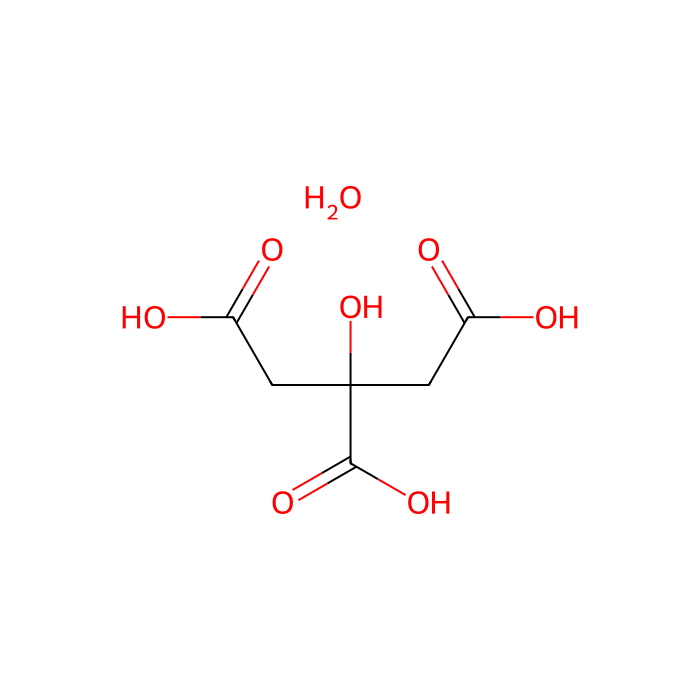
C(C(=O)O)C(CC(=O)O)(C(=O)O)O.O
IUPAC Name
2-hydroxypropane-1,2,3-tricarboxylic acid;hydrate
InChIKey
YASYEJJMZJALEJ-UHFFFAOYSA-N
INCHI
1S/C6H8O7.H2O/c7-3(8)1-6(13,5(11)12)2-4(9)10;/h13H,1-2H2,(H,7,8)(H,9,10)(H,11,12);1H2
Isomeri SMILES
C(C(=O)O)C(CC(=O)O)(C(=O)O)O.O
WGK Germania
1
RTECS
GE7810000
Peso molecolare
210.14
Beilstein
4018641
Reaxy-Rn
4018641
Reaxys-RN_link_address
https://www.reaxys.com/reaxys/secured/hopinto.do?context=S&query=IDE.XRN=4018641&ln=

Documentazione

📋 Safety Data Sheet (SDS)

Comprehensive hazard, handling, storage, and regulatory compliance document.

Download SDS →

✅ Certificate of Analysis (COA)

Lot-specific quality data. Enter your lot number to retrieve the exact COA.

Look up COA →

📊 Datasheet

Quick-reference summary of product specifications and applications.

View datasheet →

🔬 Specification Sheet

Full quality attributes and acceptance criteria for this grade.

View spec sheet →

Advanced Data

Taxonomic Classification

Taxonomy Tree

KingdomOrganic compounds
SuperclassOrganic acids and derivatives
ClasseCarboxylic acids and derivatives
SubclassTricarboxylic acids and derivatives
Intermediate Tree Nodes Not available
Direct ParentTricarboxylic acids and derivatives
Alternative Parents Alpha hydroxy acids and derivatives  Tertiary alcohols  Carboxylic acids  Organic oxides  Hydrocarbon derivatives  Carbonyl compounds  
Molecular FrameworkAliphatic acyclic compounds
Substituents Tricarboxylic acid or derivatives - Hydroxy acid - Alpha-hydroxy acid - Tertiary alcohol - Carboxylic acid - Organic oxygen compound - Organic oxide - Hydrocarbon derivative - Organooxygen compound - Carbonyl group - Alcohol - Aliphatic acyclic compound
DescrizioneThis compound belongs to the class of organic compounds known as tricarboxylic acids and derivatives. These are carboxylic acids containing exactly three carboxyl groups.
External Descriptors organic molecular entity
Struttura 3D
Modello di struttura chimica interattiva


Certificati (CoA, COO, BSE/TSE e tabella di analisi)
C of A & Other Certificates(BSE/TSE, COO):
Analytical Chart:

Find and download the COA for your product by matching the lot number on the packaging.

48 results found

Lot NumberCertificate TypeDataOggetto
L2220377Certificate of AnalysisSep 21, 2026 C112633
L2220372Certificate of AnalysisSep 21, 2026 C112633
I2624257Certificate of AnalysisMay 22, 2026 C112633
I2624256Certificate of AnalysisMay 22, 2026 C112633
I2624255Certificate of AnalysisMay 22, 2026 C112633
I2603575Certificate of AnalysisMay 22, 2026 C112633
I2603569Certificate of AnalysisMay 22, 2026 C112633
H2604269Certificate of AnalysisMay 22, 2026 C112633
F2625306Certificate of AnalysisMay 22, 2026 C112633
F2625276Certificate of AnalysisMay 22, 2026 C112633
C2619575Certificate of AnalysisMar 13, 2026 C112633
L2509315Certificate of AnalysisNov 26, 2025 C112633
A2629368Certificate of AnalysisNov 26, 2025 C112633
K2514006Certificate of AnalysisNov 24, 2025 C112633
J2524084Certificate of AnalysisOct 27, 2025 C112633
I2508256Certificate of AnalysisAug 26, 2025 C112633
I2508255Certificate of AnalysisAug 26, 2025 C112633
E2508192Certificate of AnalysisApr 25, 2025 C112633
G2503341Certificate of AnalysisApr 25, 2025 C112633
E2508144Certificate of AnalysisApr 25, 2025 C112633
E2508161Certificate of AnalysisApr 25, 2025 C112633
L2405329Certificate of AnalysisNov 28, 2024 C112633
L2405331Certificate of AnalysisNov 28, 2024 C112633
C2519180Certificate of AnalysisNov 28, 2024 C112633
C2519179Certificate of AnalysisNov 28, 2024 C112633
C2519178Certificate of AnalysisNov 28, 2024 C112633
H2406382Certificate of AnalysisJul 26, 2024 C112633
J2408302Certificate of AnalysisJul 26, 2024 C112633
G2305337Certificate of AnalysisApr 17, 2023 C112633
G2320463Certificate of AnalysisMar 29, 2023 C112633
G2320464Certificate of AnalysisMar 29, 2023 C112633
E2324746Certificate of AnalysisMar 29, 2023 C112633
K2307100Certificate of AnalysisMar 29, 2023 C112633
J2318304Certificate of AnalysisMar 29, 2023 C112633
A2331479Certificate of AnalysisFeb 10, 2023 C112633
B2327212Certificate of AnalysisFeb 02, 2023 C112633
B2327215Certificate of AnalysisFeb 02, 2023 C112633
A2331483Certificate of AnalysisFeb 02, 2023 C112633
L2220373Certificate of AnalysisNov 28, 2022 C112633
L2220415Certificate of AnalysisNov 28, 2022 C112633
L2220460Certificate of AnalysisNov 28, 2022 C112633
K2204275Certificate of AnalysisOct 21, 2022 C112633
K2204331Certificate of AnalysisOct 21, 2022 C112633
K2204332Certificate of AnalysisOct 21, 2022 C112633
D2226064Certificate of AnalysisMar 12, 2022 C112633
F2206306Certificate of AnalysisMar 12, 2022 C112633
F2206301Certificate of AnalysisMar 12, 2022 C112633
F2206299Certificate of AnalysisMar 12, 2022 C112633
Proprietà chimiche e fisiche
SolubilitàSoluble in water (59.2 g/100 ml) at 20 °C, ethanol, ether, and water (84.0 g/100 ml) at 100 °C. Soluble in water, ethanol and ether. Partially soluble in methanol, diethyl ether. Insoluble in n-octanol.
Punto di infiammabilità (°F)345.0 °F
Punto di infiammabilità (°C)173.9℃
Punto di fusione (°C)135-152°C
Peso molecolare210.140 g/mol
XLogP3
Hydrogen Bond Donor Count5
Hydrogen Bond Acceptor Count8
Rotatable Bond Count5
Exact Mass210.038 Da
Monoisotopic Mass210.038 Da
Topological Polar Surface Area133.000 Ų
Heavy Atom Count14
Formal Charge0
Complexity227.000
Isotope Atom Count0
Defined Atom Stereocenter Count0
Undefined Atom Stereocenter Count0
Defined Bond Stereocenter Count0
Undefined Bond Stereocenter Count0
The total count of all stereochemical bonds0
Covalently-Bonded Unit Count2
Domande frequenti e articoli
How Organic Acids “Stabilize a System”: Selection Logic via the pH Window, Salt Forms, and Metal-Ion Management (with a navigation guide to Tables A–E)
Phycocyanin: A Review of Sources, Structural Features, Production Processes, Applications, and Claimed Benefits
Technical Comparison and Method Selection for Hydroxyproline Determination
Perovskite Oxides for Energy and Environmental Catalysis: How Oxygen Vacancies, B-Site Metals, and the Metal–Oxygen Bond Network Regulate Reaction Performance
The Role, Selection, and Validation of Chelating Agents in Daily Chemical Formulations
Differences, Functions, and Selection Guidelines for Sodium Hydroxide Flakes, Granules, Liquid Caustic Soda, and Caustic Soda in Household and Personal Care Product Manufacturing: The Functional and Application Logic of Sodium Hydroxide
Practical Guide to TSA Tyramide Signal Amplification: How to Select Reagents, Optimize the Workflow, and Reduce Background When Detection Signals Are Weak for Low-Abundance Targets
How Can Sodium Tripolyphosphate (STPP) Be Replaced? From Detergency Mechanisms to Formulation Choices for Low-Phosphorus/Phosphorus-Free Builder Systems
More Than a pH Adjuster: Mechanisms, Selection Logic, and Alternative Acid Source Analysis of Citric Acid in Home-Care Cleaning
Sodium Metasilicate in Cleaning Applications: Hydration-Form Differences, Mechanisms of Action, and Selection Logic
Establishment and Evaluation Methods of Diabetic Animal Models
Potential Mechanisms of Succinic Acid in Acne Care: From Dicarboxylic Acid–Base Equilibria to Metabolic Antagonism Among Skin Microorganisms
Citations of This Product
Calcolatori di soluzioni
Recensioni

Recensioni dei clienti

Shall we send you a message when we have discounts available?

Remind me later

Thank you! Please check your email inbox to confirm.

Oops! Notifications are disabled.