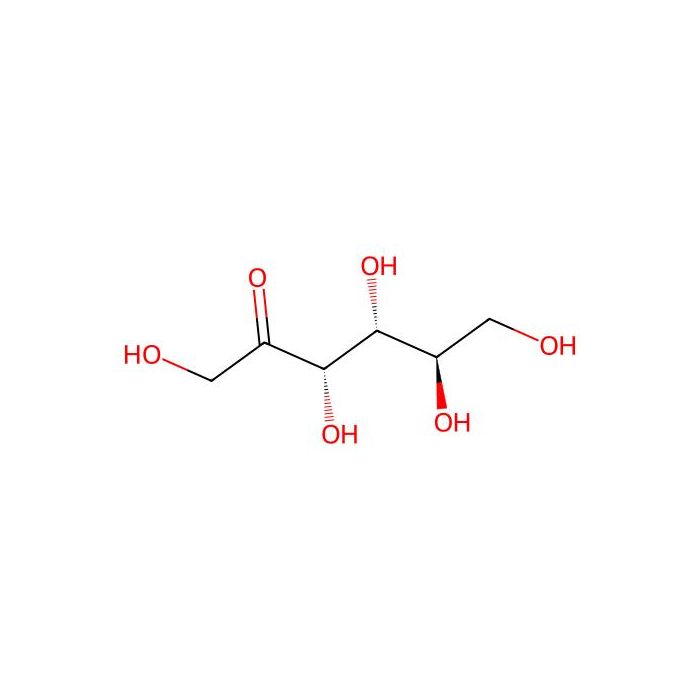
D-(−)-Fructose - UltraBio™, ≥99%(HPLC) , CAS No.57-48-7

CAS: 57-48-7 Cat. No.: D755696 Formula: C6H12O6 Peso molecolare: 180.16 Beilstein Registry Number: 31321 Numero EC: 200-333-3
Disponibile su ordine
QUALITÀ & PUREZZA UltraBio™ ? UltraBio™ — Aladdin's line for molecular-biology applications. Use for nuclease-free, high-consistency reagents across molecular workflows. ≥99%(HPLC)
Storage
Room temperature
Shipped In
Normal
★
Dimensione
Germania (EU)
USA*
Prezzo
Qtà
250g
D755696-250g
Su ordinazione · 8–12 settimane
229,00€
Enter a quantity for the sizes you want to add.

Panoramica

D-Fructose is an important monosaccharide used in a wide range of applications. D-fructose is used in carbohydrate research, in organic and bioorganic synthesis; as a model compound; as a reference material, as an enzyme substrate and as a nutrient.

Specifiche

Specifiche e purezza
UltraBio™, ≥99%(HPLC)
Condizioni di conservazione di stoccaggio
Room temperature
Spedito in
Normal
Grado
UltraBio™
Purezza
≥99%(HPLC)
Nomi e identificatori
PH
5.0-7.0 (25 °C, 0.1 M in H 2 O)
Sorrisi canonici
C(C(C(C(C(=O)CO)O)O)O)O
IUPAC Name
(3S,4R,5R)-1,3,4,5,6-pentahydroxyhexan-2-one
InChIKey
BJHIKXHVCXFQLS-UYFOZJQFSA-N
INCHI
1S/C6H12O6/c7-1-3(9)5(11)6(12)4(10)2-8/h3,5-9,11-12H,1-2H2/t3-,5-,6-/m1/s1
Isomeri SMILES
C([C@H]([C@H]([C@@H](C(=O)CO)O)O)O)O
RTECS
LS7120000
Peso molecolare
180.16
Beilstein
31321
Reaxy-Rn
2207947
Reaxys-RN_link_address
https://www.reaxys.com/reaxys/secured/hopinto.do?context=S&query=IDE.XRN=2207947&ln=

Dati avanzati

Taxonomic Classification

Taxonomy Tree

KingdomOrganic compounds
SuperclassOrganic oxygen compounds
ClasseOrganooxygen compounds
SubclassCarbohydrates and carbohydrate conjugates
Intermediate Tree Nodes Not available
Direct ParentMonosaccharides
Alternative Parents Beta-hydroxy ketones  Acyloins  Alpha-hydroxy ketones  Secondary alcohols  Polyols  Primary alcohols  Organic oxides  Hydrocarbon derivatives  
Molecular FrameworkAliphatic acyclic compounds
Substituents Monosaccharide - Beta-hydroxy ketone - Acyloin - Alpha-hydroxy ketone - Secondary alcohol - Ketone - Polyol - Organic oxide - Hydrocarbon derivative - Primary alcohol - Carbonyl group - Alcohol - Aliphatic acyclic compound
DescrizioneThis compound belongs to the class of organic compounds known as monosaccharides. These are compounds containing one carbohydrate unit not glycosidically linked to another such unit, and no set of two or more glycosidically linked carbohydrate units. Monosaccharides have the general formula CnH2nOn.
External Descriptors D-fructose - keto-fructose
Struttura 3D
Modello di struttura chimica interattiva


Certificati (CoA, COO, BSE/TSE e tabella di analisi)
C of A & Other Certificates(BSE/TSE, COO):
Analytical Chart:
Proprietà chimiche e fisiche
SolubilitàH 2 O: 0.1 M at 20 °C, clear, colorless
Indice di rifrazione1.57
Rotazione specifica [α]-92° (C=4,H2O)
Punto di ebollizione (°C)511.74°C
Punto di fusione (°C)103-105°C
Peso molecolare180.160 g/mol
XLogP3-3.200
Hydrogen Bond Donor Count5
Hydrogen Bond Acceptor Count6
Rotatable Bond Count5
Exact Mass180.063 Da
Monoisotopic Mass180.063 Da
Topological Polar Surface Area118.000 Ų
Heavy Atom Count12
Formal Charge0
Complexity147.000
Isotope Atom Count0
Defined Atom Stereocenter Count3
Undefined Atom Stereocenter Count0
Defined Bond Stereocenter Count0
Undefined Bond Stereocenter Count0
The total count of all stereochemical bonds0
Covalently-Bonded Unit Count1
Domande frequenti e articoli
UltraBio™: Defining Excellence in Molecular Biology Applications
Research Progress in Detection Technologies for Soluble Sugars in Plants
An Introduction to Research-Grade Carbohydrates: Decoding the “Glycan Language” and a Product-Selection Guide (with Tables 1–3)
Isomerases: Overview and Recommended Application Technical Guide
Glucose Content Determination: A Systematic Review of Detection Principles, Method Validation, and Research Application Frameworks
Physicochemical Properties of Diphenylamine, Analytical Applications, and a Review of Its DNA Colorimetric Reaction
Functional Properties, Application Scenarios, and Manufacturing Processes of Maltotetraose (G4): A Review
Pyran and the “Pyran Family” Research Selection Guide: Key Structural Points, a Classification Roadmap, and Experimental Selection Navigation
What a Disagreement in Specific Rotation Results Reveals About Method Control: Why Specific Rotation Values for Chiral Samples Cannot Be Discussed Apart from Measurement Conditions
From Sucrose to Monosaccharides: Key Enzymatic Nodes and Regulatory Logic in Sugar Conversion
Galactose-Related Precursor Conversion and Redox Regulation in Plant Ascorbate Biosynthesis
Porous Graphitic Carbon (PGC) Chromatography Columns: Creating New Selectivity for Challenging Separations through Molecular Shape and the π-Electron Cloud on the Graphitic Surface
Performance Sources and Formulation Applications of Enzyme-Based Ingredients in Daily Chemical Products: Fermentation Transformation, Enzymatic Reactions, and Application Principles
Establishment and Evaluation Methods of Diabetic Animal Models
Comparison of Reducing Sugar Detection Methods: Selection of Fehling’s Reagent, Benedict’s Method, DNS Method, and HPLC
Enzymatic Preparation of D-Mannose: Isomerization Conversion, Polysaccharide Hydrolysis, and Process Control
The Skin Anti-Aging Mechanisms of α-Lipoic Acid: ALA/DHLA Redox Cycling, the Antioxidant Network, and Regulation of Collagen AGE Formation
Skin Anti-Aging Mechanisms of Carnosine and Decarboxy Carnosine: Active Carbonyl Scavenging, Oxidative-Stress Buffering, and Inhibition of Collagen Glycation Cross-Linking
Mechanisms by Which Fructan-Rich Ophiopogon japonicus Tuberous Root Extract Supports Skin Moisturization and Barrier Function
Carbohydrate Oxidases: Catalytic Mechanisms and Bioanalytical Applications
Citations of This Product
Calcolatori di soluzioni
Recensioni

Recensioni dei clienti

Desidera che le inviamo un messaggio quando avremo sconti disponibili?

Ricordamelo più tardi

Grazie! Controlli la sua casella di posta per confermare.

Ops! Le notifiche sono disabilitate.