QUALITÀ & PUREZZAMoligand™?Moligand™ — Aladdin's line of ligands and bioactive small molecules. Use for receptor, pathway, and binding studies needing defined small-molecule tools.10mM in DMSO
Store at -20°C. Store under desiccating conditions. The product can be stored for up to 12 months.
Specifiche
Sinonimi
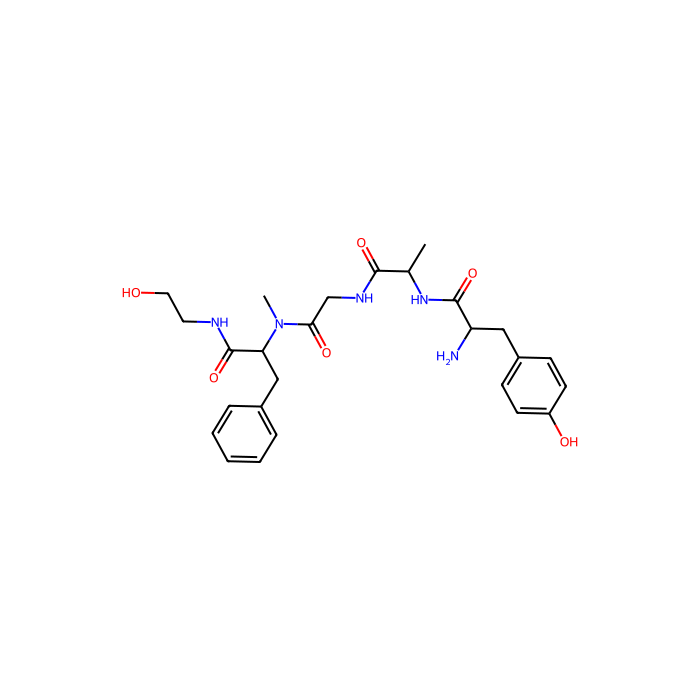
H-Tyr-D-Ala-Gly-N(Me)Phe-Gly-ol | Tyr-D-Ala-Gly-N(CH3)Phe-Gly-ol | (2S)-2-[[2-[[(2R)-2-[[(2S)-2-amino-3-(4-hydroxyphenyl)propanoyl]amino]propanoyl]amino]acetyl]-methylamino]-N-(2-hydroxyethyl)-3-phenylpropanamide | 158: PN: US20030176421 PAGE: 54-55 CLAIMED PROTEIN | bicyclo[2.2.1]-5-heptene-2,3-dicarboxylic anhydride | (S)-2-amino-N-((R) Mostra altro
Specifiche e purezza
Moligand™, 10mM in DMSO
Meccanismi biochimici e fisiologici
Potent and selective μ opioid receptor agonist (K i values are 2.0, >1000 and >1000 nM for opioid receptor subtypes μ, κ and δ, respectively). Partial central activity following systemic administration. Antinociceptive.
Condizioni di conservazione di stoccaggio
Store at -80°C
Spedito in
Dry ice packs + Cold packs
Questo prodotto richiede spedizione a catena fredda. I servizi di terra e altri servizi economici non sono disponibili.
This compound belongs to the class of organic compounds known as oligopeptides. These are organic compounds containing a sequence of between three and ten alpha-amino acids joined by peptide bonds.
External Descriptors
peptide
1. Djoumbou Feunang Y, Eisner R, Knox C, Chepelev L, Hastings J, Owen G, Fahy E, Steinbeck C, Subramanian S, Bolton E, Greiner R, and Wishart DS. ClassyFire: Automated Chemical Classification With A Comprehensive, Computable Taxonomy. Journal of Cheminformatics, 2016, 8:61.
Determine the necessary mass, volume, or concentration for preparing a solution.
Dilution Calculator
Determine the dilution needed to prepare a stock solution.
Reconstitution Calculator
Recensioni
Recensioni dei clienti
Application Protocols
Only application data from Product Data may be listed here.
Tested applications (e.g., WB, IHC, IF, FC) and recommended dilutions: Not specified for this item; refer to CoA/Spec Sheet.
Positive/negative controls and assay conditions: Not specified for this item; refer to CoA/Spec Sheet.
General suggestion: Establish assay-specific titrations and include solvent controls when implementing this ligand in new experimental systems.
Biological Roles
Literature/general knowledge (for research context; not a medical/clinical claim):
Pharmacological class: Enkephalin-derived peptidic ligand commonly used as a selective μ-opioid receptor (MOR) agonist in biochemical and cellular research.
Mechanistic note: The N-methylphenylalanine and reduced C-terminus (Gly-ol) enhance receptor affinity/selectivity and metabolic stability relative to native enkephalins, while D-Ala reduces degradation by proteases (literature).
Signaling context: MOR activation modulates Gi/o-coupled pathways, typically reducing cAMP levels, opening GIRK channels, and inhibiting voltage-gated Ca2+ channels in cellular systems (literature).
Assay roles:
Positive control ligand in receptor-binding assays (radioligand displacement, fluorescence polarization) and functional readouts (cAMP inhibition, β-arrestin recruitment, calcium flux via reporter systems) (literature guidance).
Tool compound for dissecting receptor selectivity across μ, δ, and κ opioid receptors in recombinant or native systems (literature).
Stability considerations: Peptidic ligands may undergo enzymatic and chemical degradation in biological matrices; inclusion of peptidase inhibitors and low-temperature handling can improve stability during experiments (literature).
Note: Target specificity, tested applications, and potencies for this catalog item are not provided in the Product Data and should be confirmed experimentally under your assay conditions.
Buffer Applications
DAMGO is not a buffering agent. However, it is routinely prepared and used in buffered media for biochemical and cell-based assays.
Not typically applicable as a buffer: It does not maintain pH and is not used to formulate buffering systems.
Practical preparation in buffers (literature guidance):
Stock solutions: Dissolve in water or DMSO to prepare concentrated stocks (e.g., 1–50 mM). Filter-sterilize if sterility is required.
Working solutions: Dilute stocks into assay buffers such as PBS, HEPES (pH 7.2–7.4), or Krebs–Henseleit solution, maintaining minimal DMSO (≤0.1–1% v/v as assay permits).
Adsorption mitigation: Use low-bind plastics or glass; carrier proteins (e.g., 0.1% BSA) may reduce nonspecific binding if compatible with the assay.
Stability: Prepare fresh working solutions; keep on ice during use and discard after the session to limit degradation.
Compatibility notes:
Avoid strong acids/bases that can degrade peptides; avoid metal-catalyzed oxidation by using fresh, degassed buffers when feasible.
For receptor-binding assays, ionic strength and pH can influence affinity and signal; validate buffer composition empirically.
Refer to the CoA/Spec Sheet for any item-specific recommendations on solvent choice and concentration limits.
Green Alternatives
As a bioactive peptide ligand, DAMGO is not a process solvent or commodity reagent where greener substitutions are typically evaluated.
Not typically applicable:
There are no direct “green solvent” alternatives to DAMGO, as it is the active analyte/ligand itself.
Use aqueous buffers as the primary medium when feasible; minimize DMSO content in working solutions.
Prepare concentrated stocks to reduce solvent volumes and packaging waste; aliquot to minimize repeated freeze–thaw cycles and associated loss.
Implement cold-chain efficiency (consolidate shipments, use validated insulated containers) consistent with the product’s low-temperature requirements.
Comparison concept (ligand selection):
When assay objectives permit, consider non-peptidic small-molecule surrogates that may offer improved stability and reduced cold-chain demands; however, such substitutions may alter target engagement profiles and are application-dependent (literature note).
Pharmaceutical Uses
This product is supplied strictly for research use only (as stated in Product Data) and is not indicated for clinical or therapeutic applications.
Not typically applicable:
DAMGO is not used as an excipient or processing aid, and no pharmacopeial monograph is associated with this research-grade material.
In preformulation research, peptidic ligands like DAMGO are commonly prepared as sterile-filtered aqueous or DMSO stocks for in vitro assays.
Adsorption to containers and instability in aqueous media can be mitigated with appropriate solvents, carriers, and low-temperature storage.
Any discussion of dosage forms or therapeutic use would be out of scope. For regulated applications, obtain GMP-grade materials and follow applicable quality and regulatory frameworks.
Physical Properties
Item-specific physical constants are not provided in the Product Data for this catalog entry.
Item-specific values:
Appearance: Not specified for this item; refer to CoA/Spec Sheet.
Molecular weight: Not specified for this item; refer to CoA/Spec Sheet.
Molecular formula: Not specified for this item; refer to CoA/Spec Sheet.
Melting point, boiling point, density, refractive index: Not specified for this item; refer to CoA/Spec Sheet.
Literature/general properties (for reference; not item specifications):
Typical molecular weight reported for DAMGO: ~513.6 g/mol (literature).
Physical form: commonly supplied as a lyophilized solid or film (literature).
Solubility: readily soluble in water, dilute aqueous buffers (e.g., PBS), and DMSO; limited solubility in nonpolar organic solvents (literature).
Charge/ionization: multiple backbone amides; phenolic OH (Tyr) can deprotonate at high pH; overall peptide exhibits cationic character at neutral pH due to N-terminus (literature).
pKa values: phenolic Tyr side-chain pKa typically ~10; N-terminus (if free) pKa typically ~8–9 (literature, context-dependent).
Notes: Actual solubility and physical constants can vary with counterions, residual moisture, and exact salt/form. Consult the CoA/Spec Sheet for item-specific measurements before preparing stock solutions.
Quality and Grades
Grade: Moligand™ (as provided in Product Data).
What Moligand™ typically implies (general guidance; not item-specific specifications):
Intended for research screening and ligand discovery workflows where bioactivity and target engagement are relevant parameters.
Emphasis on identity confirmation and suitability for biochemical/biophysical assays rather than chromatographic solvent standards.
Item-specific notes:
Purity: Not specified for this item; refer to CoA/Spec Sheet.
Stabilizers/additives: Not specified for this item; refer to CoA/Spec Sheet.
Counterion/salt form: Not specified for this item; refer to CoA/Spec Sheet.
Quality considerations for peptide ligands (general):
Identity verification is commonly supported by high-resolution MS and, where applicable, analytical HPLC and peptide mapping (literature).
Low levels of truncations, epimerization, and residual protecting groups are important for consistent bioassay performance.
For fluorescence or biotinylated derivatives, confirm degree of labeling; for this item, no labeling is indicated in the Product Data.
Recommendation: Review the batch-specific CoA for purity, identity data (MS/HPLC), residual solvent levels, and salt/counterion information prior to critical assays.
Reaction and Applications
This product is primarily a finished bioactive peptide ligand and is not typically employed as a general synthetic reagent or solvent.
Not typically applicable:
DAMGO is not commonly used to initiate or catalyze organic reactions, nor as a building-block for routine multistep synthesis in solution-phase organic chemistry.
Relevant applications (research use; literature guidance):
Employed as a reference ligand/positive control in receptor-binding and signaling studies in biochemical and cell-based assays.
Utilized in structure–activity relationship (SAR) explorations of enkephalin-derived peptides and peptidomimetics.
Practical notes for use in assays (literature):
Prepare high-concentration DMSO or aqueous stocks, aliquot, and store cold to maintain integrity.
Titrate concentrations across several orders of magnitude to establish potency curves; include appropriate solvent controls.
For synthetic transformations or named reactions, refer instead to the “Synthetic Utility” section, which discusses SPPS-related considerations for analogous sequences rather than transformations using DAMGO itself.
Reaction Conditions
This product is not intended for use as a reagent in chemical transformations; thus, standard reaction conditions are not applicable.
Not typically applicable:
No named organic reactions customarily employ DAMGO as a substrate, catalyst, or solvent.
Contextual notes for related synthesis (literature guidance):
For SPPS of DAMGO analogs: Typical Fmoc-SPPS on polystyrene-based resins at room temperature, with HBTU/HATU coupling and piperidine deprotection cycles. N-methyl amino acid couplings may require extended times, higher equivalents, or alternate activation (e.g., COMU, PyBOP).
C-terminal alcohol installation: Reduction of peptide esters (e.g., with NaBH4 under carefully controlled conditions) or specialized linkers that yield an alcohol upon cleavage (literature). Conditions must be optimized to avoid backbone cleavage or side reactions.
Experimental details should be tailored to the specific synthetic route and validated at small scale before scale-up.
Safety and Handling
GHS/Classification (item-specific):
Signal word: Not specified for this item; refer to SDS.
H-statements: Not specified for this item; refer to SDS.
GHS classification/pictograms: Not specified for this item; refer to SDS.
General laboratory precautions (peptidic research ligand; literature guidance):
Use in a chemical fume hood when weighing or dissolving powders to avoid inhalation of particulates/aerosols.
Wear appropriate PPE: lab coat, safety glasses, and nitrile gloves. Avoid skin and eye contact.
Prevent cross-contamination of bioassay areas; dedicate tools/consumables when handling bioactive ligands.
Handling tips:
DAMGO solutions are susceptible to adsorption onto plastic surfaces; use low-bind polypropylene or glass when possible.
Prepare concentrated stocks, aliquot, and minimize freeze–thaw to preserve integrity and potency.
Use sterile, filtered solvents/buffers for biological assays; pass solutions through 0.22 μm filters if sterility is required.
Incompatibilities/instability (general):
Avoid strong acids/bases and oxidants that can degrade peptide bonds or phenolic moieties.
Peptides can undergo hydrolysis and oxidation; limit exposure to elevated temperature, light, and air.
First aid and spill response: For exposure or spills, follow standard laboratory SOPs and consult the SDS for authoritative guidance. Dispose of peptide-containing waste according to institutional and local regulations.
Solvent Selection
DAMGO is a polar, peptidic ligand best handled in polar protic media or DMSO.
Polarity class and miscibility (literature):
Highly polar; multiple H-bond donors/acceptors.
Freely miscible in water when protonated; readily soluble in DMSO. Poorly soluble in nonpolar solvents (e.g., hexanes, toluene).
Typical solvent choices and scenarios:
Aqueous buffers (e.g., PBS, HEPES, Tris) for biochemical assays. Adjust pH 6.5–7.4 to balance solubility and stability (literature guidance).
DMSO for concentrated stocks (e.g., 10–50 mM), followed by dilution into assay buffer; keep final DMSO ≤0.1–1% v/v as assay permits (literature).
Water or 0.1% TFA/water can aid initial dissolution for lyophilized powders (literature), followed by buffer exchange if needed.
Practical tips:
Warm gently to room temperature and vortex/sonicate briefly to aid dissolution; avoid prolonged heating.
Use low-bind tubes to minimize adsorption losses; pre-rinse plastics with buffer containing carrier protein (e.g., 0.1% BSA) if allowed by the assay.
Filter through 0.22 μm if sterility or clarity is required; avoid PVDF membranes that may bind peptides.
Alternatives and comparisons (literature):
DMF can dissolve peptides but may be less desirable in bioassays compared with DMSO.
For cell-based assays, prefer aqueous buffers or minimal DMSO to limit solvent effects.
Storage and Reconstitution
Item-specific storage and shipping (from Product Data):
Storage Conditions: Store at -80°C.
Shipped In: Dry ice packs + Cold packs.
Reconstitution (general literature guidance; not item-specific specs):
Allow vial to equilibrate to room temperature before opening to avoid condensation.
Dissolve in sterile water or DMSO to prepare a concentrated stock (e.g., 1–50 mM, as solubility permits). For immediate aqueous use, brief sonication may aid dissolution.
Filter-sterilize if required (0.22 μm) and aliquot into low-bind tubes to avoid adsorption and freeze–thaw.
Handling and storage of solutions (literature guidance):
Working solutions: Keep on ice and use the same day when possible.
Aliquoted stocks: Store at -80°C protected from light and moisture. Avoid repeated freeze–thaw cycles; thaw once, use, and discard remainder or refreeze once if necessary.
Stability can be buffer-, pH-, and temperature-dependent; verify potency periodically in your assay.
Additional item-specific details (appearance, exact solubility, counterion): Not specified for this item; refer to CoA/Spec Sheet.
Research Use Note: For research use only.
Structure and Identity
DAMGO is a peptide-based small molecule ligand derived from the enkephalin scaffold, commonly denoted as Tyr-D-Ala-Gly-N-MePhe-Gly-ol.
Item-specific identifiers (Product Data):
CAS: 78123-71-4
CID: 5462471
InChIKey: 128036 (as provided)
SMILES: Not specified for this item; refer to CoA/Spec Sheet.
Molecular formula: Not specified for this item; refer to CoA/Spec Sheet.
Molecular weight: Not specified for this item; refer to CoA/Spec Sheet.
Literature/structural description (for reference; not item-specific specs):
Common name expansion: [D-Ala2, N-MePhe4, Gly-ol]-enkephalin.
Peptidic sequence: Tyr–D-Ala–Gly–N-MePhe–Gly-ol (C-terminus reduced to an alcohol).
Stereochemistry: L-Tyr at position 1, D-Ala at position 2; chiral centers at Tyr Cα and D-Ala Cα; Phe ring N-methylation removes amide NH donor at position 4.
2D structure in words: A pentapeptidomimetic chain starting with a phenolic aromatic ring (tyrosine) linked via peptide bonds to D-alanine and glycine, followed by an N-methylated phenylalanine residue, and terminating in glycine whose carboxyl has been reduced to a primary alcohol (–CH2OH). The backbone comprises standard amide linkages, except at the C-terminus where an alcohol replaces the carboxylate.
Synthetic Utility
As supplied, DAMGO is a completed peptide ligand rather than a general-purpose synthetic intermediate. Nevertheless, its structure informs peptide and peptidomimetic synthesis strategies (literature guidance):
Key structural motifs: N-methylated amide (N-MePhe) and a reduced C-terminus (Gly-ol) showcase strategies to enhance potency and proteolytic stability in opioid peptide analogs.
SPPS considerations:
Incorporation of D-Ala at position 2 is routine in Fmoc-SPPS.
N-MePhe requires careful coupling (e.g., stronger activators or longer coupling times) due to steric hindrance of secondary amines. Reagents like HATU/HBTU with base (DIPEA) are commonly used (literature).
C-terminal alcohols can be introduced via post-assembly reduction of the corresponding acid/ester or by using a preloaded resin/handle enabling cleavage to the alcohol (e.g., use of a glycolic linker; literature).
Protecting-group strategy: Phenolic Tyr side chain typically protected (e.g., tBu) during assembly and deprotected under acidic cleavage.
Purification/analysis: Preparative RP-HPLC for final product, with identity confirmation by HRMS and analytical HPLC; epimerization control at chiral centers is critical (literature).
For researchers designing analogs, DAMGO serves as a reference template highlighting the impact of backbone N-methylation and C-terminal reduction on receptor engagement.
Target Specificity
Only information from Product Data may be listed here.
Target, epitope/antigen, species reactivity, clone/isotype: Not specified for this item; refer to CoA/Spec Sheet.
Note: Although literature discusses DAMGO’s activity in opioid receptor systems, no item-specific target data are provided in this catalog entry.
Hai bisogno di aiuto per scegliere la qualità?
La nostra guida alla selezione delle qualità copre purezza, stato dello stabilizzatore e idoneità all'applicazione per tutte le varianti del nostro catalogo.
Utilizziamo i cookie per garantire il corretto funzionamento del sito web e, ove consentito, per migliorare la tua esperienza. Puoi gestire le tue preferenze in qualsiasi momento nelle Impostazioni. Per saperne di più, consulta la nostra Cookie Policy.
Desidera che le inviamo un messaggio quando avremo sconti disponibili?
Ricordamelo più tardi
Grazie! Controlli la sua casella di posta per confermare.
Products are supplied to verified businesses, institutions, and qualified professionals for research and development use only. Not for use in humans, animals, diagnosis, or therapy.