≥98% per flussi di lavoro cromatografici e analitici sensibili che richiedono un'interferenza minima della linea di base.
🌡
Stoccaggio e spedizione
Room temperature,Argon charged Spedizione Normal. Consultare il COA specifico del lotto per le specifiche esatte.
📋
Documenti di qualità
SDS, COA, scheda tecnica e scheda delle specifiche disponibili per il download. COA specifico del lotto accessibile tramite ricerca per numero di lotto.
📚
Prova documentale
Citato in 0 pubblicazioni peer-reviewed su cromatografia, sintesi organica e reazioni di accoppiamento incrociato.
Racemic mixture of L-carnitine and D-carnitine. Regulates fatty acid transport in mitochondria. Elevates serum carnitine fractions. D-carnitine competitively depletes muscle level of L-carnitine. Orally active.
Condizioni di conservazione di stoccaggio
Room temperature,Argon charged
Spedito in
Normal
Tipo di azione
INHIBITOR
Nota
Wherever possible, you should prepare and use solutions on the same day. However, if you need to make up stock solutions in advance, we recommend that you store the solution as aliquots in tightly sealed vials at -20°C. Generally, these will be useable for up to one month. Before use, and prior to opening the vial we recommend that you allow your product to equilibrate to room temperature for at least 1 hour. Need more advice on solubility, usage and handling? Please visit our frequently asked questions (FAQ) page for more details.
This compound belongs to the class of organic compounds known as carnitines. These are organic compounds containing the quaternary ammonium compound carnitine.
External Descriptors
Not available
1. Djoumbou Feunang Y, Eisner R, Knox C, Chepelev L, Hastings J, Owen G, Fahy E, Steinbeck C, Subramanian S, Bolton E, Greiner R, and Wishart DS. ClassyFire: Automated Chemical Classification With A Comprehensive, Computable Taxonomy. Journal of Cheminformatics, 2016, 8:61.
Determine the necessary mass, volume, or concentration for preparing a solution.
Dilution Calculator
Determine the dilution needed to prepare a stock solution.
Reconstitution Calculator
Recensioni
Recensioni dei clienti
Application Protocols
Illustrative, literature-based protocols for research use (adjust to your system; not item-specific specifications):
Preparation of aqueous stock solution
Weigh DL-carnitine HCl accurately. Dissolve in ultrapure water to prepare a 100–500 mM stock. Filter sterilize (0.22 μm) if sterility is required. Store aliquots at 2–8 °C for short term, or −20 °C for extended periods.
Couple CoA formation to DTNB (Ellman’s reagent) at 412 nm or monitor acylcarnitine formation by LC–MS. Incubate at 25–37 °C for 5–30 min; ensure linearity with respect to time and enzyme.
LC–MS calibration standard (positive ESI)
Prepare serial dilutions (e.g., 0.01–10 μg/mL) in 50:50 water:methanol with 0.1% formic acid. Include an isotopically labeled internal standard if available. Store at −20 °C to minimize degradation; avoid repeated freeze–thaw.
Osmoprotectant additive in cell-free systems
Add 1–50 mM to the reaction medium and evaluate effects on enzyme stability or ionic strength; optimize empirically.
Note: For biological assays with stereoselective enzymes/transporters, prefer L-carnitine. This SKU is racemic (DL).
Biological Roles
Literature/general context (no medical claims):
Role in metabolism: Carnitine serves as the carrier for long-chain fatty acids into mitochondria via conversion to acylcarnitines, enabling β-oxidation (carnitine shuttle). The quaternary ammonium headgroup and hydroxyl functionality facilitate acyl transfer by carnitine acyltransferases.
Chemical form: As the hydrochloride, the carboxyl group is predominantly protonated (CO2H) with Cl− as counterion; in physiological buffers, the carboxyl can deprotonate to form the zwitterionic inner salt.
Stereochemistry: Only the L-enantiomer is biosynthesized/utilized in mammalian metabolism. This product is DL (racemic); in biological assays, only the L component is typically active with stereospecific enzymes/transporters, while the D form is generally much less active or inactive.
Transport: Uptake in cells is mediated by specific transporters (e.g., OCTN2 family), which exhibit stereoselectivity favoring L-carnitine (literature).
Additional roles: Functions as an osmolyte and can modulate cellular osmotic balance in vitro; forms a family of acylcarnitines that are widely profiled as metabolic biomarkers in research.
Use note: For quantitative biochemical studies, consider enantiopure L-carnitine controls and report concentrations with enantiomeric context when using the DL mixture.
Buffer Applications
DL-Carnitine hydrochloride is not a standard biological buffer component. Although it bears a carboxylic acid (pKa ~3–4, literature) and a permanent quaternary ammonium, it does not provide a defined buffering range comparable to dedicated buffers (e.g., citrate, phosphate, Tris).
When it may be present: As an additive or substrate in enzyme assays or cell-free systems, prepared in a separate, well-characterized buffer (e.g., phosphate, HEPES, or ammonium acetate for LC–MS).
Practical guidance:
Prepare carnitine solutions in your chosen buffer at the desired pH; account for the initial acidity contributed by the HCl salt.
For LC–MS, prefer volatile buffers (ammonium formate/acetate, pH 3.5–7.5) to minimize nonvolatile residue.
For buffering needs, select an appropriate buffer system; refer to the Reaction & Applications and Biological Roles sections for more relevant uses of this material.
Green Alternatives
This product is a specific small-molecule metabolite salt rather than a process solvent or commodity reagent, so “green substitution” concepts are not directly applicable. Nonetheless, a few considerations can reduce environmental footprint in laboratory use:
Alternative form factors (literature/general):
Use the inner salt (zwitterion) or enantiopure L-carnitine when experimental design does not require the chloride counterion or the racemate. This can reduce titrant use for pH adjustment and minimize chloride-containing waste.
Process considerations:
Prepare concentrated stock solutions in water and aliquot to minimize container waste and repeated dissolutions.
Favor volatile, low-toxicity buffers (e.g., ammonium formate/acetate) for LC–MS to simplify waste treatment compared with phosphate when compatible with your method.
Comparative notes:
Counterion exchange to less persistent anions (e.g., acetate) may be advantageous for certain workflows; verify stability and performance before adoption.
Because this compound is not a bulk solvent or catalyst, the primary “green” levers are scale minimization, correct form selection (DL vs L), and efficient solution handling rather than replacing it with a generic greener alternative.
Pharmaceutical Uses
No clinical or therapeutic claims are made. This product is for research use only.
DL-carnitine hydrochloride is not commonly used as a pharmaceutical excipient. In research and development settings, carnitine salts may appear as reference standards, process controls, or matrix-matched spikes for analytical method development (e.g., LC–MS of acylcarnitines).
Compendial status: Not specified for this item; refer to CoA/Spec Sheet and relevant pharmacopeias if compendial compliance is required for your application.
Manufacturing/QC applications:
Calibration of MS response for quaternary ammonium metabolites.
System suitability and recovery studies in bioanalytical assays.
If a regulated use is contemplated, verify identity, purity, residual solvents, water content, and microbial limits per internal quality systems, using lot-specific documentation.
Physical Properties
Note: Values below are literature/general references for DL-carnitine hydrochloride (or carnitinium chloride) and are not item-specific specifications.
Appearance: Not specified for this item; refer to CoA/Spec Sheet.
Physical state: Typically a hygroscopic, crystalline solid (literature/general)
Melting point: ~197–200 °C, often with decomposition (literature)
Solubility (literature):
Water: Freely soluble; forms clear solutions over a wide concentration range
Alcohols: Soluble in methanol and ethanol to a moderate/high extent; less soluble in isopropanol
Practically insoluble in nonpolar solvents (e.g., hexane, toluene)
pKa (relevant functionality, literature): Carboxylic acid pKa ~3–4 (the quaternary ammonium is permanently charged and non-titratable)
LogP/LogD: Very low logP; highly polar and cationic at neutral pH (literature qualitative)
Hygroscopicity: Reported hygroscopic; may absorb moisture from air (literature)
Refractive index, density, UV cutoff, peroxide/metal limits: Not specified for this item; refer to CoA/Spec Sheet.
Practical note: Because of high water solubility and ionic character, dry weight-by-mass preparation and gravimetric solution making are preferred over volumetric dissolution in nonaqueous media.
Quality and Grades
Grade/Purity: Not specified for this item; refer to CoA/Spec Sheet.
What the absence of a stated grade implies:
Without a declared “bio/USP/HPLC/AR” grade, the material should be treated as a general laboratory reagent intended for research use only (per Product Data). For analytical or regulated workflows, verify conformance against your method requirements using the lot-specific CoA.
UV and trace limits: Not specified for this item; refer to CoA/Spec Sheet. If using for LC/LC–MS metabolomics, evaluate background and ion suppression with system suitability tests.
Stabilizers/additives: None stated. The argon-charged packaging (Product Data) is consistent with protection from atmospheric moisture and CO2. If your application is sensitive to counterions or water content, confirm by Karl Fischer and ion chromatography on receipt.
Racemate note:
This product is DL (racemic). If enantioselective biological assays or chiral syntheses are envisioned, consider using enantiopure L-carnitine HCl or the inner salt, and verify enantiomeric composition (e.g., chiral HPLC) if needed.
Recommendation: For quantitative work (e.g., reference standards), confirm identity and purity by NMR and LC–MS and review the CoA for assay, water, and residual solvent data.
Reaction and Applications
While primarily a biochemical reagent, DL-carnitine hydrochloride has niche synthetic and analytical uses.
Biochemical/analytical (literature/general):
Substrate and co-substrate in assays of carnitine acyltransferases (e.g., carnitine acetyltransferase), generating acylcarnitines detectable by LC–MS.
Matrix component or standard in metabolomics workflows to evaluate ionization of quaternary ammonium metabolites.
Osmoprotectant additive in some in vitro systems due to zwitterion-derived properties (use conditions must be empirically optimized).
Chemical transformations (literature/general):
Acylation of the hydroxyl group to furnish O-acylcarnitines using activated carboxylic acids (acid chlorides/anhydrides) or carbodiimide coupling (e.g., EDC/NHS). These derivatives enhance organic solubility and enable mechanistic studies of acyl transfer.
Formation of ion pairs with hydrophobic anions (e.g., PF6−, BF4−) can modulate solubility and facilitate phase-transfer-like behavior, though such counterion exchanges must be validated for stability.
Practical tips:
Control pH in aqueous assays; the HCl salt introduces acidity. Adjust to the desired pH (commonly neutral) using a minimally interfering base (e.g., ammonium bicarbonate for LC–MS workflows).
Because it is racemic (DL), enzyme assays with stereoselective enzymes may display reduced apparent activity versus L-carnitine; consider using the natural enantiomer for biological kinetics.
Minimize prolonged exposure to elevated temperatures to avoid decomposition near its melting range.
Reaction Conditions
General literature guidance for common manipulations of carnitine salts (not item-specific specifications):
O-Acylcarnitine formation:
Method A (acid chloride): Dissolve DL-carnitine HCl in aqueous buffer (pH 8–9, e.g., bicarbonate) or in a water/methanol mixture. Add the acid chloride portionwise at 0–5 °C, maintaining pH with base. Stir 1–3 h, then quench and purify (ion-exchange or reverse-phase chromatography). Typical isolated yields vary widely (30–80%) depending on acyl chain and conditions.
Method B (EDC coupling): In water/DMF (or water/MeOH), combine carboxylic acid (1.1–1.5 eq), EDC·HCl (1.2–2.0 eq), and catalytic DMAP; add DL-carnitine HCl and adjust pH 6–7. Stir at ambient temperature 4–16 h. Purify as above. Advantages: milder conditions and compatibility with sensitive acyl groups.
Protection of the hydroxyl group:
Silylation (e.g., TBS-Cl, imidazole) generally requires solvent systems that solubilize the salt (DMF with minimal water) and careful workup to avoid quaternary ammonium degradation.
Counterion exchange:
Dissolve in water, add inorganic acid (e.g., HBF4) or ammonium salt of the desired anion, then evaporate/lyophilize. Confirm by ion chromatography/NMR before use.
Analytical prep:
LC–MS mobile phases: water/acetonitrile with 0.1% formic acid or 5–20 mM ammonium formate; monitor for ion suppression in the presence of salts.
Always pilot on small scale and verify stereochemical integrity if enantioselectivity matters (this SKU is racemic).
Safety and Handling
Item-specific hazard classifications are not provided in the Product Data for this SKU. Always consult the SDS for authoritative information.
GHS classification, signal word, pictograms, H-statements: Not specified for this item; refer to SDS.
General laboratory precautions (good practice for aminoalcohol quaternary ammonium salts):
Avoid dust formation; handle powders in a fume hood or enclosure to prevent inhalation.
Wear appropriate PPE: lab coat, safety glasses, and compatible gloves (e.g., nitrile). For large-scale handling, consider a particulate respirator per institutional guidance.
Prevent contamination with moisture to maintain assay integrity; product is stored argon-charged per Product Data.
First-aid overview (general):
Inhalation: Move to fresh air; seek medical advice if symptoms persist.
Skin/eye contact: Rinse with plenty of water for several minutes; remove contaminated clothing; seek medical attention for persistent irritation.
Ingestion: Rinse mouth; seek medical advice. Do not induce vomiting unless directed by medical personnel.
Incompatibilities (general): Strong oxidizers may be incompatible with organic salts; avoid strong bases or acids for prolonged periods if purity and stoichiometry are critical.
Thermal stability: Literature indicates melting with decomposition near 200 °C; avoid overheating and drying at elevated temperatures that can promote degradation.
Always follow institutional risk assessments and consult the SDS for this specific lot before use.
Solvent Selection
DL-Carnitine hydrochloride is a highly polar, ionic organic salt; solvent choice should reflect its strong water affinity and low organic partitioning.
Freely soluble in water; forms conductive aqueous solutions.
Soluble in lower alcohols (methanol, ethanol); limited in higher alcohols.
Poorly soluble in aprotic/nonpolar media (e.g., acetonitrile alone, ethers, hydrocarbons). Co-solvents or ion-pairing may be required.
Typical use scenarios:
Aqueous buffers (e.g., water, saline, phosphate buffers) for biochemical assays and enzyme kinetics.
Aqueous-organic mixtures (water/methanol) for LC–MS standards and calibration curves; consider volatile buffers (ammonium formate/acetate) if pH control is required.
Comparisons:
Versus the inner salt (zwitterion): The HCl salt is similar in aqueous solubility but can simplify pH control (initially acidic); the inner salt behaves near neutral pH without added counterions.
Versus quaternary ammonium analogs: Carnitinium chloride is less lipophilic than many tetraalkylammonium salts due to the alcohol and acid functions; expect minimal solubility in nonpolar matrices without derivatization.
Practical tips:
Prepare solutions gravimetrically in high-purity water (18 MΩ·cm). Filter (0.22 μm) for sterile applications.
For organic-phase manipulations or extractions, convert to acylcarnitines or use ion-pairing to increase organic solubility.
Storage and Reconstitution
Storage conditions (from Product Data): Store at room temperature; argon charged. Shipped under normal conditions.
Container handling: Keep tightly sealed to minimize moisture uptake and CO2 absorption. Argon headspace should be preserved when possible; re-cap promptly after weighing.
Stability considerations (literature/general): Hygroscopic; prolonged exposure to ambient humidity can change mass and concentration. Decomposes on strong heating (near 200 °C). Avoid drying at elevated temperatures.
Reconstitution guidelines:
Solvent: Ultrapure water is recommended. The HCl salt readily dissolves; gentle stirring is sufficient.
Concentration: Common stock solutions are 0.1–0.5 M for lab use; adjust to application needs.
pH: Solutions may be slightly acidic due to HCl; adjust to the desired pH with a compatible base (e.g., ammonium bicarbonate for LC–MS or NaOH for general biochemistry).
Sterilization: If sterility is required, filter through 0.22 μm PES or PVDF membranes. Avoid heat sterilization.
Solution storage:
Short term: 2–8 °C for up to several weeks, protected from light if co-formulated with light-sensitive components.
Long term: Aliquot and store at −20 °C or below to limit microbial growth and degradation. Avoid repeated freeze–thaw cycles.
Research use only (per Product Data). Consult the CoA/SDS for lot-specific guidance on stability and handling.
Structure and Identity
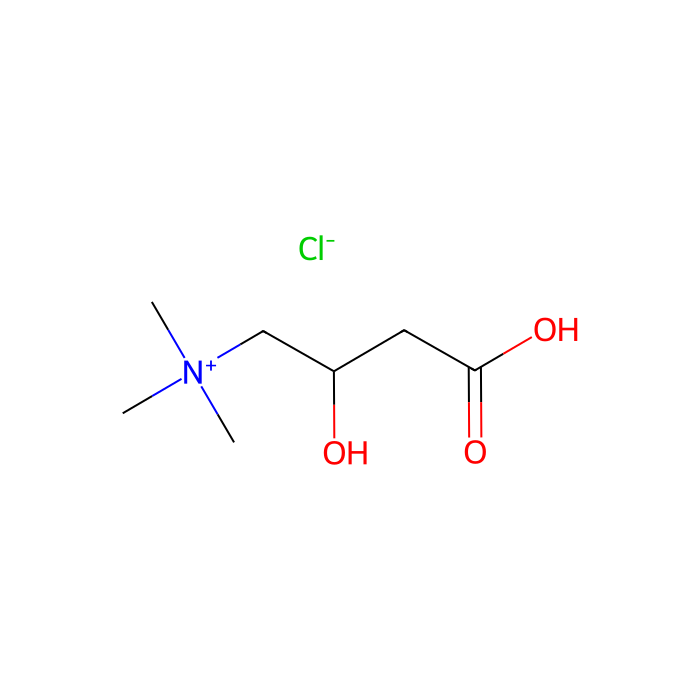
DL-Carnitine hydrochloride is the racemic quaternary ammonium salt of carnitine, isolated as the chloride of the carnitinium cation.
Item-specific identifiers (from Product Data)
CAS: 461-05-2
SKU: C119784
Category: Life Science (research use only)
InChIKey: Not specified for this item; refer to CoA/Spec Sheet.
Computed/literature identifiers (general reference; not item-specific specs)
Common name: DL-carnitinium chloride; DL-carnitine HCl (racemate)
Contains a permanent quaternary ammonium center (trimethylammonium), a primary alcohol (–CH2OH), and a carboxylic acid (as the HCl salt, non-zwitterionic overall; net +1 with Cl− counterion).
DL designates a racemic mixture at the C-3 stereocenter of the 3-hydroxy-4-(trimethylammonio)butanoate backbone.
2D description: A four-carbon chain bearing (from one end) a carboxyl group (–CO2H), a β-hydroxyl substituent (–CH2OH on C-2), and a terminal trimethylammonium substituent attached via –CH2–CH2– to the backbone; chloride serves as counterion.
Synthetic Utility
Although not a common synthetic building block, DL-carnitine hydrochloride provides distinct functionality useful in niche transformations and standards preparation.
Functional handles (general chemistry):
Primary alcohol (–CH2OH): amenable to acylation, sulfonylation, carbonate/carbamate formation, and oxidation (with care due to salt character).
Carboxylic acid (as HCl salt form): can be activated or protected; however, in the hydrochloride, the acid is already protonated.
Permanent quaternary ammonium: confers water solubility and facilitates ion-pair interactions; can participate in phase-transfer-like behaviors when paired with hydrophobic counterions.
Typical transformations (literature):
O-Acylcarnitine synthesis using acid chlorides or carbodiimide coupling agents (EDC/HOBt or EDC/NHS) in aqueous or mixed aqueous–organic media; valuable as standards for enzyme assays and metabolomics.
Selective protection strategies: transient protection of the alcohol (e.g., silyl ethers in carefully chosen conditions) to allow modification at the carboxyl group, then deprotection.
Counterion exchange (e.g., Cl− to BF4−/PF6−) to adjust solubility and crystallization behavior for structural studies.
Retrosynthetic perspective:
The cationic trimethylammonium hydroxyl acid motif can serve as a template for preparing other betaine-like salts or for installing a carnitinium fragment onto complex scaffolds via esterification.
Note: Due to ionic character, reactions often benefit from polar protic solvents or biphasic systems with phase-transfer strategies.
Target Specificity
Not applicable. This product is a small-molecule metabolite, not an antibody, enzyme, or probe with defined biological target binding specificity under the product listing. For biochemical context regarding metabolic pathways and enzyme interactions, see the Biological Roles section.
Utilizziamo i cookie per garantire il corretto funzionamento del sito web e, ove consentito, per migliorare la tua esperienza. Puoi gestire le tue preferenze in qualsiasi momento nelle Impostazioni. Per saperne di più, consulta la nostra Cookie Policy.
Desidera che le inviamo un messaggio quando avremo sconti disponibili?
Ricordamelo più tardi
Grazie! Controlli la sua casella di posta per confermare.
Products are supplied to verified businesses, institutions, and qualified professionals for research and development use only. Not for use in humans, animals, diagnosis, or therapy.

 C2507314