Fibulin 1 Antibody - Anticorpo primario, specific to P23142, Rabbit IgG

Cat. No.: Ab103558
Disponibile su ordine
QUALITÀ & PUREZZA Carrier Free ? Carrier-free — supplied without added carrier protein/stabilizer. Use when carriers (e.g. BSA) would interfere with conjugation or sensitive assays. ExactAb™ ? ExactAb™ — Aladdin's antibody line emphasizing precision and validated quality. Use for reliable, specificity-validated antibody applications. Validated ? Validated grade — performance confirmed in defined applications before release. Use when you want documented assurance the reagent works as stated. 1.0 mg/mL
Application
WB
Host species
Coniglio
Reactive species
consiglio, Mouse, Umano
Isotype
Rabbit IgG
Conjugation
Unconjugated
★
Dimensione
Germania (EU)
USA*
Prezzo
Qtà
10μl
Ab103558-10μl
—
1 Disponibile
86,69€
50μl
Ab103558-50μl
—
1 Disponibile
225,53€
100μl
Ab103558-100μl
Su ordinazione · 8–12 settimane
329,65€
1ml
Ab103558-1ml
Su ordinazione · 8–12 settimane
2.429,58€
Enter a quantity for the sizes you want to add.

Panoramica

Rabbit anti Human Fibulin 1 Antibody, Polyclonal antibody, could be used for WB and so on.
Application:
WB: 1/500-1/1000
Protein Function:
Incorporated into fibronectin-containing matrix fibers. May play a role in cell adhesion and migration along protein fibers within the extracellular matrix (ECM). Could be important for certain developmental processes and contribute to the supramolecular organization of ECM architecture, in particular to those of basement membranes. Has been implicated in a role in cellular transformation and tumor invasion, it appears to be a tumor suppressor. May play a role in haemostasis and thrombosis owing to its ability to bind fibrinogen and incorporate into clots. Could play a significant role in modulating the neurotrophic activities of APP, particularly soluble APP.

Specifiche

Product Name
Fibulin 1 Antibody - Anticorpo primario, specific to P23142, Rabbit IgG
Sinonimi
FBLN1|FBLN|FIBL1|Basement membrane protein 90 antibody|BM 90 antibody|FBLN antibody|Fbln1 antibody|FIBL 1 antibody|FIBL-1 antibody|FIBL1 antibody|Fibulin 1 antibody|Fibulin-1 antibody
Specifiche e purezza
ExactAb™, Validated, Carrier Free, 1.0 mg/mL
Specie ospite
Coniglio
Specificità
P23142
Immunogeno
A KLH-conjugated synthetic peptide encompassing a sequence within the center region of human Fibulin 1.
Controllo positivo
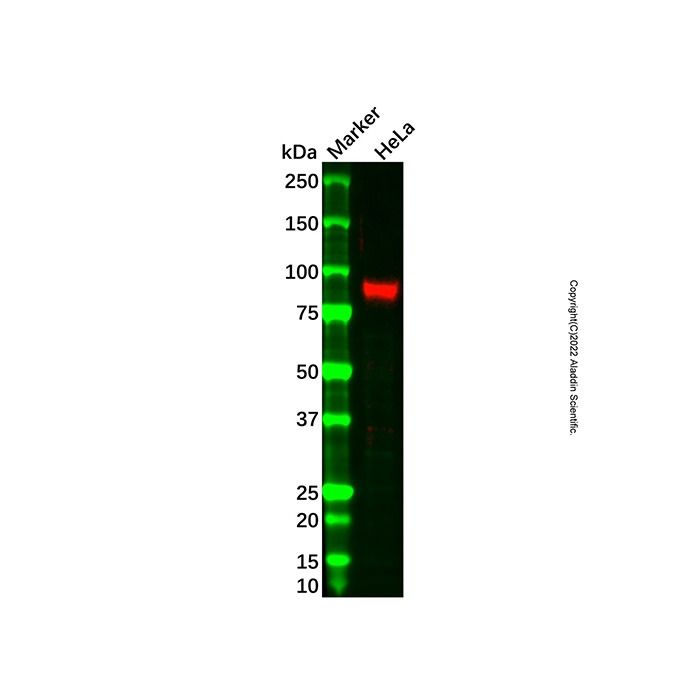
WB: HeLa cell lysate.
Coniugazione
Unconjugated
Grado
Carrier Free, ExactAb™, Validated
Isotipo
Rabbit IgG
SDS-PAGE
150 kDa
Metodo di purificazione
Immunogen affinity purified
Concentrazione
1.0 mg/mL
Product Line
Prodotti biologici
Stoccaggio e spedizione
Forma
Liquid
Condizioni di conservazione di stoccaggio
Store at -20°C,Avoid repeated freezing and thawing
Spedito in
Ice chest + Ice pads
Stabilità e conservazione
Store at 4°C short term (1-2 weeks). Store at -20°C long term (12 months). Upon receipt, it is recommended to aliquot. Avoid freeze/thaw cycle.
Immagini

Fibulin 1 Antibody (Ab103558) - Western Blot
All lanes: Fibulin 1 Antibody (Ab103558) at 1/1000 dilution
Samples: Lysates at 20 µg per lane
Secondary: Goat Anti-Rabbit IgG H&L (HRP) at 1/5000 dilution
Predicted band size: 77 kDa
Observed band size: 87 kDa
Exposure time: 60.0 s

Applicazione
Applicazione
Dilution info
WB

1/500-1/1000

Dati avanzati

Obiettivi associati (umani)
FBLN1 Tbio Fibulin-1 (0 Activities)
Activity TypeActivity Value -log(M)Mechanism of ActionActivity ReferencePublications (PubMed IDs)
Certificati (CoA, COO, BSE/TSE e tabella di analisi)
C of A & Other Certificates(BSE/TSE, COO):
Analytical Chart:

Find and download the COA for your product by matching the lot number on the packaging.

2 results found

Lot NumberCertificate TypeDataOggetto
ZJ24F1013165ZJ24F1013165Certificate of AnalysisMay 21, 2026 Ab103558
ZJ24F1013167ZJ24F1013167Certificate of AnalysisMay 21, 2026 Ab103558
Calcolatori di soluzioni
Recensioni

Recensioni dei clienti

Application Protocols

Tested applications, recommended dilutions, and positive control tissues/cell lines are Not specified for this item; refer to the CoA/Spec Sheet.

General optimization guidance (non-validated, literature-based):

  • Titration: Determine an optimal working concentration by checkerboard titration against your matrix (e.g., tissue lysate, ECM extract). Start with broad ranges (e.g., low ng/mL to low µg/mL) depending on assay format, then refine.
  • Controls: Include no-primary and isotype controls (if applicable), plus a known fibulin-1–positive matrix (e.g., ECM-rich tissue extract) and a negative control.
  • Incubation: Lower temperatures (4°C, overnight) can enhance specificity; higher temperatures (RT, 1–2 h) may speed throughput at potential cost to specificity.
  • Washing: Increase stringency (salt, mild detergent) to reduce background; balance against potential loss of weak-specificity interactions.
  • Detection: Choose secondary antibodies compatible with the host/isotype of this primary (host/isotype Not specified for this item). Validate secondary-only background.
  • Sample preparation: For matrix-associated antigens like fibulin-1, ensure adequate extraction/antigen retrieval to expose epitopes.

Document and lock optimized parameters per lot for reproducibility.

Biological Roles

Target: Fibulin-1 (FBLN1) — an extracellular matrix (ECM) glycoprotein widely expressed in connective tissues (literature overview).

Key biology (literature):

  • Domain architecture: Multiple calcium-binding EGF-like repeats and a C-terminal fibulin module enable interaction with ECM partners.
  • ECM assembly: Fibulin-1 associates with basement membrane components (e.g., fibronectin, laminins, nidogens) and elastic fiber constituents, contributing to matrix organization and tissue integrity.
  • Cell adhesion and signaling: Via binding to integrins and other ECM proteins, fibulin-1 modulates cell adhesion, migration, and mechanotransduction. It can influence focal adhesion dynamics and growth factor availability in the pericellular matrix.
  • Development and homeostasis: Roles reported in vasculogenesis, cardiac and skeletal development, and maintenance of elastic tissues (aorta, skin). Alternative splicing generates isoforms (e.g., FBLN1C/D) with tissue-preferential expression patterns.
  • Pathway intersections: Crosstalk with TGF-β signaling, MMP activity, and elastic fiber biogenesis pathways has been described; deposition and proteolytic processing of fibulin-1 can remodel the ECM microenvironment.
  • Research relevance: As a structural ECM component and modulator of cell–matrix interactions, fibulin-1 is studied in developmental biology, tissue engineering, fibrosis models, and tumor microenvironment research (no clinical/diagnostic claims).

Implications for antibody experiments:

  • Matrix-rich samples (tissue lysates, decellularized ECM) often require optimized extraction (e.g., chaotropic buffers) to solubilize fibulin-1.
  • Isoform awareness is important for epitope selection; check antibody epitope mapping and species cross-reactivity (Not specified for this item; see CoA/Spec Sheet).
Buffer Applications

Antibody performance depends strongly on buffer composition and sample preparation. While item-specific formulation is Not specified, the following general practices are commonly effective in ECM-target antibody workflows (literature-based guidance):

  • Assay buffers:
    • PBS or TBS at pH 7.2–7.6 with 0.05% Tween-20 for washing steps in plate- and blot-based assays to reduce nonspecific binding.
    • Blocking: 1–5% nonfat dry milk or BSA for Western blotting; protein-free blockers for phospho- or biotin/streptavidin-sensitive assays. For carrier-free handling or conjugation, avoid proteinaceous blockers until after conjugation.
  • Sample extraction for ECM proteins:
    • Use RIPA or urea-containing buffers (e.g., 6–8 M urea with 2% CHAPS) to solubilize matrix-bound fibulin-1 from tissues; follow with dilution or buffer exchange before antibody incubations.
  • Antigen retrieval (IHC/IF on FFPE):
    • Citrate buffer pH 6.0 or Tris-EDTA pH 9.0 in a heat-induced epitope retrieval step is commonly evaluated; optimal conditions are epitope-dependent (Not specified for this item; optimize empirically).
  • Storage/working solutions:
    • Prepare aliquots in PBS/TBS at neutral pH; include 0.01–0.05% nonionic surfactant to minimize adsorption if compatible with your assay. Preservative use (e.g., sodium azide) depends on application; status for this item is Not specified.

Always verify compatibility with the supplied formulation and the product’s CoA/Spec Sheet before finalizing buffers.

Green Alternatives

While “green alternatives” typically address solvent choices, sustainability considerations also apply to antibody reagents:

  • Formulation choices: Carrier-free formulations can reduce the use of glycerol and protein carriers, easing downstream purification and minimizing additive burden. Tradeoff: may require low-binding plastics and more stringent aseptic technique to prevent loss/contamination.
  • Concentration and aliquoting: Order concentrations that match usage to reduce freeze–thaw cycles, waste, and cold-chain burden. Aliquot into single-use volumes to extend shelf life.
  • Cold-chain efficiency: Coordinate deliveries to minimize transit time. Consolidate shipments to reduce packaging waste and dry-ice/ice-pad use while maintaining product integrity.
  • Preservatives: If azide-free formulations are available/required for live-cell applications, they avoid heavy-metal waste concerns associated with azide-containing buffers; however, azide-free products demand stricter sterile handling to prevent bioburden (general consideration; preservative status for this item Not specified).
  • Reusability of consumables: Employ certified low-binding, reusable labware where compatible with sterility requirements to reduce plastic waste.

Comparison (general considerations):

  • Carrier-free vs stabilized: Lower additive footprint vs improved robustness to handling.
  • Concentrated stock vs dilute: Less packaging and shipping weight vs need for accurate microvolumetric handling.

Adopt lab sustainability practices (energy-efficient freezers, inventory rotation) to lower environmental impact without compromising data quality.

Pharmaceutical Uses

This product is designated For research use only and is not intended for diagnostic, therapeutic, or GMP manufacturing applications.

Relevant non-clinical contexts (literature/general practice):

  • Analytical reagent: As an affinity reagent for quantifying or detecting fibulin-1 in research samples (e.g., ELISA plates, Western blots, immunocapture for LC–MS). Any validated applications for this SKU are Not specified; refer to CoA/Spec Sheet.
  • Process development tools: Potential utility in upstream/downstream characterization of ECM deposition in cell culture models or engineered tissues (nonclinical).
  • Conjugation precursor: Carrier-free format is generally favorable for creating custom conjugates (enzymes, fluorophores, beads) for assay development. Actual compatibility for this item is Not specified; confirm formulation before conjugation.

Compliance note:

  • No pharmacopoeial status is claimed. This reagent is not released under ICH/GMP and is unsuitable for administration to humans or animals for therapeutic purposes.
  • For regulated studies, document lot-specific identity, purity, and performance using the CoA/Spec Sheet and internal qualification protocols.
Physical Properties

Item-specific physicochemical specifications have not been provided for this antibody preparation.

  • Appearance: Not specified for this item; refer to CoA/Spec Sheet.
  • Concentration/formulation: Not specified for this item; refer to CoA/Spec Sheet.
  • pH/osmolarity: Not specified for this item; refer to CoA/Spec Sheet.
  • Molecular weight: Not specified for this item (typical whole IgG ~150 kDa; Fab ~50 kDa; literature).
  • Extinction coefficient: Not specified for this item (sequence- and glycosylation-dependent; literature only).
  • Solubility: Antibodies are generally soluble in aqueous buffers (PBS, TBS) across pH ~6.5–8.0; solubility and stability are sequence/formulation dependent (literature).
  • Isoelectric point (pI): Antibodies typically span pI 6–9 depending on isotype/sequence (literature).
  • Storage conditions (from Product Data): Store at -20°C; avoid repeated freezing and thawing. Shipped in ice chest with ice pads.

Notes for practitioners (general, literature):

  • Maintain antibodies in neutral isotonic buffers; avoid low-ionic-strength water that can promote aggregation.
  • Repeated freeze–thaw cycles can denature and aggregate proteins; prepare single-use aliquots.
  • If lyophilized (status Not specified), reconstitution buffer and target concentration critically influence stability; see Storage & Reconstitution tab.
Quality and Grades

Provided designations for this item:

  • Grade/Purity: Carrier Free, ExactAb™, Validated (as listed). No further item-specific specifications are provided.

What these designations generally imply (literature/manufacturer practice; not item-specific specifications):

  • Carrier Free: Typically indicates the antibody is supplied without carrier proteins (e.g., BSA) or stabilizing excipients (e.g., glycerol). Advantages include minimal interference in conjugation, cell-based assays, and MS-based analytics. Practical note: carrier-free antibodies can be more sensitive to adsorption and microbial contamination; use low-binding plastics and aseptic technique. Actual excipient content for this item is Not specified; refer to CoA/Spec Sheet.
  • ExactAb™: Denotes Aladdin’s high-consistency antibody line. In general, ExactAb™ focuses on sequence-defined production for reduced lot-to-lot variability and reproducible performance across batches. Specific format (recombinant/monoclonal) for this item is Not specified; refer to CoA/Spec Sheet.
  • Validated: Indicates the product has undergone internal performance checks against defined criteria. The exact validation applications, species reactivity, and acceptance thresholds for this SKU are Not specified; refer to CoA/Spec Sheet.

Recommendations:

  • Verify buffer composition, concentration, and any preservative/stabilizer content on the CoA before critical experiments.
  • For regulated workflows, request a detailed Specification Sheet and lot-specific CoA to document identity, purity, and performance metrics.
Reaction and Applications

This section (synthetic reaction chemistry) is generally not applicable to an antibody reagent. Fibulin 1 Antibody is intended for biochemical detection/quantification of fibulin-1 in research workflows rather than for use as a reactant or solvent in chemical synthesis.

For relevant usage, please consult:

  • Target Specificity (antigen information for experimental design).
  • Application Protocols (experiment planning, optimization notes).
  • Buffer Applications (assay buffer recommendations).

If you intend to conjugate this antibody (e.g., biotin, fluorophore, enzyme), typical bioconjugation chemistries (literature) include NHS-ester amine coupling, maleimide-thiol conjugation after partial reduction, and click-chemistry with azide/alkyne handles. Conjugation feasibility, allowed pH range, and required excipient removal depend on the supplied formulation, which is Not specified for this item; confirm by CoA before proceeding.

Reaction Conditions

Not applicable in the context of chemical reaction optimization. This antibody is intended for immunoassays and biochemical detection, not for stoichiometric or catalytic reactions.

General handling conditions (literature) to preserve activity:

  • Temperature: Keep on ice or at 2–8°C during short-term handling; store at the recommended -20°C. Avoid elevated temperatures.
  • pH/ionic strength: Maintain near-neutral pH and physiological ionic strength to reduce aggregation or denaturation.
  • Time: Minimize time at room temperature; prepare aliquots to avoid repeated freeze–thaw cycles.

For assay-specific incubation times and temperatures (e.g., for blots or plates), see your internal SOPs and optimize empirically; item-specific recommendations are Not specified for this SKU.

Safety and Handling

Safety information specific to this item has not been provided.

  • GHS classification, signal word, pictograms, H-statements: Not specified for this item; consult the SDS.
  • General laboratory precautions (literature/standard practice):
    • Wear appropriate PPE: lab coat, gloves, eye protection. Handle as a proteinaceous biological material.
    • Avoid inhalation of powders/aerosols and contact with skin/eyes. Work in a clean area to prevent microbial contamination.
    • Do not pipette by mouth; wash hands after handling.
  • Incompatibilities (general): Avoid mixing with strong oxidizers or proteases. Preserve cold chain and protect from microbial contamination. If the product is carrier-free, it may lack preservatives (e.g., azide); aseptic technique is recommended.
  • Special risks for antibodies (literature): Protein denaturation/aggregation with freeze–thaw, extremes of pH, high shear (vortexing), or organic solvents; loss of binding activity upon prolonged exposure to elevated temperature.
  • First aid (general): In case of contact, rinse with water. If inhaled, move to fresh air. If ingested or if irritation persists, seek medical attention. Provide SDS to healthcare personnel.
  • Waste disposal: Dispose of unused material and contaminated disposables according to institutional guidelines for nonhazardous biological laboratory waste, unless SDS dictates otherwise.

Always defer to the product SDS and institutional EHS policies for authoritative safety guidance.

Solvent Selection

This product is a protein antibody reagent, not a solvent; classical solvent selection is not directly applicable. For experimental success, focus on buffer composition and solution conditions that preserve antibody structure and activity.

General buffer guidance (literature):

  • Base buffers: PBS (10–50 mM phosphate, 150 mM NaCl, pH 7.2–7.6) or TBS (25–50 mM Tris, 150 mM NaCl, pH 7.4–8.0) are common. Maintain isotonic ionic strength to minimize aggregation.
  • pH window: Most IgGs are stable between pH 6.5–8.0; transient exposures to pH ~3 can elute from affinity resins but may reduce activity if not promptly neutralized.
  • Additives: If allowed by your assay, 0.01–0.05% nonionic surfactant (Tween-20) can reduce nonspecific adsorption; 0.1–0.5% carrier protein (BSA) can block surfaces, but avoid if carrier-free conditions or downstream conjugations are required. For this item, actual excipient tolerance is Not specified.
  • Organic solvents/denaturants: Avoid >10% organic cosolvents, urea/guanidinium, or extremes of salt unless purposefully performing denaturation/refolding.

Selection tradeoffs:

  • PBS vs TBS: TBS can reduce phosphate interference with certain phospho-sensitive assays; PBS often better matches physiological conditions.
  • Detergent-free vs detergent-containing buffers: Detergent-free minimizes interference in ELISA/SPR, whereas trace detergent can enhance recovery from low-binding losses.

Always confirm buffer compatibility with your assay and with the product’s CoA.

Storage and Reconstitution

From Product Data:

  • Storage Conditions: Store at -20°C; Avoid repeated freezing and thawing.
  • Shipping: Ice chest + ice pads (maintain cold chain upon receipt).

Item-specific formulation, concentration, and whether the product is liquid or lyophilized are Not specified for this item; refer to CoA/Spec Sheet.

General guidance (literature/standard practice):

  • Upon receipt: Inspect packaging temperature and integrity. Immediately transfer to -20°C. If frequent use is expected within 1–2 weeks, an aliquot may be kept at 2–8°C to minimize freeze–thaw.
  • Aliquoting: Thaw once on ice, gently mix (do not vortex), and dispense into low-binding microtubes as single-use aliquots. Refreeze promptly at -20°C or below.
  • Reconstitution (only if lyophilized; status Not specified): Reconstitute with sterile, neutral pH buffer (e.g., PBS or water, then adjust to PBS) to the desired concentration. Allow to dissolve on ice for 10–15 min with gentle inversion. Avoid foaming. After reconstitution, aliquot and store at -20°C.
  • Thawing: Thaw on ice; keep exposure to ambient temperature minimal. Do not refreeze the same aliquot.
  • Light/protease protection: Protect from strong light if labeled (no label specified here). Maintain protease-free conditions; add protease inhibitors only if compatible with downstream assays.

For definitive instructions (buffer composition, preservative content, stability after reconstitution), consult the lot-specific CoA/Spec Sheet.

Structure and Identity

Fibulin 1 Antibody (SKU Ab103558) is a research-grade immunoreagent directed against the extracellular matrix protein fibulin-1 (gene: FBLN1).

  • Product type: Recombinant/monoclonal/polyclonal status Not specified for this item; refer to CoA/Spec Sheet.
  • Isotype/clone/host: Not specified for this item; refer to CoA/Spec Sheet.
  • Conjugate/label: None indicated (Carrier Free); confirm on CoA/Spec Sheet.
  • Structural class: Immunoglobulin (antibody) with canonical Y-shaped architecture comprising two heavy and two light chains stabilized by disulfide bonds; antigen binding via variable domains (general antibody structure; literature).
  • Target identity: Fibulin-1 (FBLN1), an ECM glycoprotein with multiple EGF-like repeats and a C-terminal fibulin-type module (literature description of target).

Chemical identifiers (for small molecules) do not apply to antibodies:

  • Molecular Formula: Not applicable to intact glycoproteins; item-specific composition Not specified for this item; refer to CoA/Spec Sheet.
  • Molecular Weight: Not specified for this item; refer to CoA/Spec Sheet. (Typical IgG ~150 kDa; literature)
  • SMILES/InChI/InChIKey: Not applicable (protein biologic).

2D/feature description (general antibody):

  • Two identical antigen-binding arms (Fab) provide specificity via complementarity-determining regions (CDRs).
  • The Fc region mediates effector functions and can bind Fc receptors and Protein A/G (capability depends on species/isotype; Not specified for this item).
Synthetic Utility

Not applicable. Fibulin 1 Antibody is a biological affinity reagent and is not used as a synthetic building block or catalyst. For practical guidance related to its use, refer to the Buffer Applications, Application Protocols, and Storage & Reconstitution tabs.

Target Specificity

Only information provided in the Product Data is included here.

  • Antigen/Target: Fibulin-1 (FBLN1)
  • Species reactivity: Not specified for this item; refer to CoA/Spec Sheet.
  • Epitope/Domain: Not specified for this item; refer to CoA/Spec Sheet.
  • Clone/Isotype: Not specified for this item; refer to CoA/Spec Sheet.
  • Host/Format (monoclonal/polyclonal/recombinant): Not specified for this item; refer to CoA/Spec Sheet.
  • Cross-reactivity: Not specified for this item; refer to CoA/Spec Sheet.
  • Positive control references: Not specified for this item; refer to CoA/Spec Sheet.

Note: For experiments involving isoform discrimination (e.g., FBLN1C vs FBLN1D), confirm epitope mapping and species cross-reactivity on the CoA.

Domande frequenti

What does ExactAb? mean?
ExactAb? indicates the product has been validated for use in rigorous antibody validation workflows. Validation may include positive/negative control samples, signal-to-noise testing, and protocol-specific QC. Lot-specific test data is published on the Certificate of Analysis where available.
What does Carrier Free mean?
Carrier Free indicates that the material has been processed and tested for specialty industrial processing. Specifications focus on the impurities that affect performance in that application — for example, metal content for electronics, particle size for batteries, refractive index for optics, or moisture content for moisture-sensitive processes.
How should this product be stored?
Store at ?20 °C. Avoid repeated freeze–thaw cycles. Aliquot into single-use volumes before freezing.
How is this product shipped?
This product ships in an insulated container with ice pads. Unpack on arrival and transfer it to the storage condition stated above.
What documentation is provided?
Available product documentation, including Certificates of Analysis (COA), Safety Data Sheets (SDS), and specification sheets, is shown in the product document area. Document availability and access follow the current site policy.
Which species reactivity has this antibody been validated against?
Validated reactivity is listed on the PDP and on each lot's datasheet. We validate against the most commonly tested species for the target (Fibulin 1 Antibody); cross-reactivity in untested species may exist but is not guaranteed. Contact technical support for specific species inquiries.

Hai bisogno di aiuto per scegliere la qualità?

La nostra guida alla selezione delle qualità copre purezza, stato dello stabilizzatore e idoneità all'applicazione per tutte le varianti del nostro catalogo.

Visualizza la guida alle qualità Carrier Free → Visualizza la guida alle qualità Validated → Visualizza la guida alle qualità ExactAb™ →

Prodotti correlati

Goat Anti-Rabbit IgG H&L Antibody - Anticorpo secondario, for ELISA,LF,GICA various applications, from Rabbit, generated in Goat
Goat Anti-Rabbit IgG H&L (AF594) - Anticorpo secondario, IgG
Goat Anti-Rabbit IgG H&L (Biotin) - Anticorpo secondario, IgG
Goat Anti-Rabbit IgG H&L (AF488) - Anticorpo secondario, IgG
Goat Anti-Rabbit IgG H&L (AF405) - Anticorpo secondario, IgG
Donkey Anti-Rabbit IgG H&L (AF647) - Anticorpo secondario, specific to , IgG
Donkey Anti-Rabbit IgG H&L (Biotin) - Anticorpo secondario, IgG
Goat Anti-Rabbit IgG H&L (HRP) - Anticorpo secondario
Goat Anti-Rabbit IgG H&L Antibody - Anticorpo secondario, Goat IgG
Goat Anti-Rabbit IgG H&L (Biotin) - Anticorpo secondario
Goat Anti-Rabbit IgG H&L (Cy5) - Anticorpo secondario
Goat Anti-Rabbit IgG H&L (FITC) - Anticorpo secondario
Goat Anti-Rabbit IgG H&L (TRITC) - Anticorpo secondario
Goat Anti-Rabbit IgG H&L (Biotin) - Anticorpo secondario, Goat IgG
Goat Anti-Rabbit IgG H&L (HRP) - Anticorpo secondario, Goat IgG
Goat Anti-Rabbit IgG H&L (Cy5) - Anticorpo secondario, Goat IgG
Goat Anti-Rabbit IgG H&L (TRITC) - Anticorpo secondario, Goat IgG
Goat Anti-Rabbit IgG H&L (FITC) - Anticorpo secondario, Goat IgG
Goat Anti-Rabbit IgG H&L (PE) - Anticorpo secondario, Goat IgG
Goat Anti-Rabbit IgG H&L (APC) - Anticorpo secondario, Goat IgG
Goat Anti-Rabbit IgG H&L (AF647) - Anticorpo secondario, Goat IgG
Goat Anti-Rabbit IgG H&L (AF405) - Anticorpo secondario, Goat IgG
Goat Anti-Rabbit IgG H&L (AF555) - Anticorpo secondario, Goat IgG
Goat Anti-Rabbit IgG H&L (AF546) - Anticorpo secondario, specific to Rabbit IgG
Goat Anti-Rabbit IgG H&L (AF700) - Anticorpo secondario, specific to Rabbit IgG
Goat Anti-Rabbit IgG H&L (AF488) - Anticorpo secondario
Goat Anti-Rabbit IgG H&L (AF647) (Ready to use) - Anticorpo secondario, specific to Rabbit IgG

Desidera che le inviamo un messaggio quando avremo sconti disponibili?

Ricordamelo più tardi

Grazie! Controlli la sua casella di posta per confermare.

Ops! Le notifiche sono disabilitate.