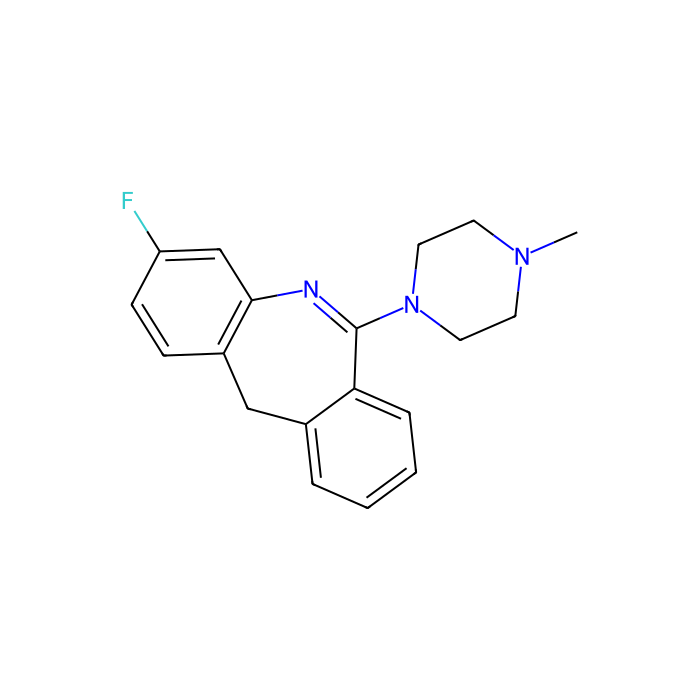
Fluperlapine - Moligand™, ≥95% , Antagonist of 5-HT 6 receptor;Antagonist of 5-HT 7 receptor, CAS No.67121-76-0, Antagonist of 5-HT 6 receptor;Antagonist of 5-HT 7 receptor
Fluperlapine - Moligand™, ≥95% , Antagonist of 5-HT 6 receptor;Antagonist of 5-HT 7 receptor, CAS No.67121-76-0, Antagonist of 5-HT 6 receptor;Antagonist of 5-HT 7 receptor
QUALITÀ & PUREZZAMoligand™?Moligand™ — Aladdin's line of ligands and bioactive small molecules. Use for receptor, pathway, and binding studies needing defined small-molecule tools.≥95%
Fluperlapine is an agonist of the SR-6/SR-7 (serotonin 5-HT|6|/5-HT|7|receptors). Agonism of the 5-HT|6|/5-HT|7|receptors by Fluperlapine has been correlated to sedative effects. Fluperlapine is described to function similarly to Clozapine , and Fluperlapine is also described to be relatively resistant to chemical and biochemical oxidation as compared to Clozapine.
This compound belongs to the class of organic compounds known as benzazepines. These are organic compounds containing a benzene ring fused to an azepine ring (unsaturated seven-membered heterocycle with one nitrogen atom replacing a carbon atom).
External Descriptors
benzazepine
1. Djoumbou Feunang Y, Eisner R, Knox C, Chepelev L, Hastings J, Owen G, Fahy E, Steinbeck C, Subramanian S, Bolton E, Greiner R, and Wishart DS. ClassyFire: Automated Chemical Classification With A Comprehensive, Computable Taxonomy. Journal of Cheminformatics, 2016, 8:61.
Certificati (CoA, COO, BSE/TSE e tabella di analisi)
C of A & Other Certificates(BSE/TSE, COO):
Analytical Chart:
Proprietà chimiche e fisiche
Solubilità
Soluble in DMSO (10 mg/ml), and ethanol (20 mg/ml).
Indice di rifrazione
n20D1.64 (Predicted)
Punto di ebollizione (°C)
~438.74° C at 760 mmHg (Predicted)
Punto di fusione (°C)
~18-20° C
Peso molecolare
309.400 g/mol
XLogP3
2.900
Hydrogen Bond Donor Count
0
Hydrogen Bond Acceptor Count
3
Rotatable Bond Count
1
Exact Mass
309.164 Da
Monoisotopic Mass
309.164 Da
Topological Polar Surface Area
18.800 Ų
Heavy Atom Count
23
Formal Charge
0
Complexity
444.000
Isotope Atom Count
0
Defined Atom Stereocenter Count
0
Undefined Atom Stereocenter Count
0
Defined Bond Stereocenter Count
0
Undefined Bond Stereocenter Count
0
The total count of all stereochemical bonds
0
Covalently-Bonded Unit Count
1
Calcolatori di soluzioni
Molarity Calculator
Determine the necessary mass, volume, or concentration for preparing a solution.
Dilution Calculator
Determine the dilution needed to prepare a stock solution.
Reconstitution Calculator
Recensioni
Recensioni dei clienti
Application Protocols
Tested application details are not provided in the Product Data for this item. The following general procedures are commonly applied to small-molecule ligands in screening:
DMSO stock preparation:
Allow vial to equilibrate to room temperature in a desiccator.
Tare a clean vial; weigh compound quickly; add anhydrous DMSO to target concentration (e.g., 10–50 mM); vortex until fully dissolved.
Aliquot into low-bind tubes or glass autosampler vials; cap tightly and label with lot, concentration, and date.
Plate-based dispensing:
Use acoustic or pin-tool transfer to minimize DMSO volumes; pre-wet tips for liquid handlers.
Normalize final DMSO across all wells; include vehicle controls and, if applicable, a positive control curve.
Analytical verification:
Run LC–MS (and/or LC–UV) on fresh and aged aliquots to confirm identity and assess stability.
These are general recommendations; adapt to your assay platform and consult the CoA/SDS for any item-specific constraints.
Biological Roles
Item-specific biological mechanism or target information is not provided in the Product Data. Accordingly, no claims are made here about biological pathways or pharmacology.
General research context for small-molecule ligands (non-item-specific):
Such compounds are often employed as chemical probes in cellular or biochemical systems to perturb protein targets and infer pathway function. This requires in-lab verification of potency, selectivity, and off-target profiles relevant to the assay.
In phenotypic assays, they can serve as reference tool compounds to benchmark assay sensitivity, dynamic range, and robustness metrics (e.g., Z′ factor).
For omics-enabled deconvolution, compounds may be used alongside chemoproteomic or transcriptomic readouts to suggest putative pathways, followed by orthogonal validation.
Important notes:
Any biological role, if applicable, should be established experimentally under your conditions and supported by qualified reference data. Consult the CoA and primary literature as needed.
No medical, diagnostic, or therapeutic use is intended or permitted. For research use only.
Buffer Applications
Not typically applicable. Fluperlapine is supplied as a research small molecule, not as a buffering agent.
Practical note (general):
When preparing assay buffers that will receive DMSO stocks of small molecules, maintain consistent final DMSO content across controls and treatments and verify buffer compatibility (e.g., avoid precipitation upon addition). Adjust ionic strength and surfactants only after confirming no assay interference.
Green Alternatives
This product is a research small molecule (ligand/probe), not a process solvent or bulk reagent. “Green alternative” selection is generally not applicable.
General considerations to reduce environmental impact when handling small-molecule probes:
Minimize DMSO volumes by using higher-concentration master stocks and accurate low-volume dispensing.
Consolidate waste streams (DMSO/ACN/MeOH) to reduce container counts and improve disposal efficiency in compliance with local regulations.
Right-size packaging and aliquots to limit compound waste due to shelf-life or adsorption losses.
If your workflow nevertheless requires organic solvent choices (for analytics):
Prefer ACN or MeOH over halogenated solvents where chromatographic performance allows.
Use aqueous mobile phases at higher proportions when method sensitivity and peak shape remain acceptable.
No item-specific green metrics (E-factor, life-cycle data) are provided for this product.
Pharmaceutical Uses
No clinical or therapeutic claims are made. The Product Data list this item for research use only.
Potential roles in R&D and analytical settings (general, not item-specific):
Reference standard in method development and validation (e.g., LC–UV/LC–MS calibration, retention factor benchmarking) after qualification of purity and identity for the specific lot.
System suitability or spike-recovery compound for evaluating extraction efficiency and matrix effects in preclinical bioanalytical workflows.
Formulation research probe to study solubilization strategies (cosolvents, cyclodextrins, lipid vehicles) or adsorption to primary containers and device materials.
Regulatory and quality reminders:
If using as a reference standard, document traceability to the lot CoA and apply purity-corrected concentrations where needed.
This material is not accompanied by pharmacopeial certification in the Product Data; any compendial suitability (USP/EP/JP) is not specified and should not be assumed.
Not for human or veterinary use; not for ex vivo diagnostic use. For research use only.
Physical Properties
Item-specific physical constants have not been provided in the Product Data.
Appearance: Not specified for this item; refer to CoA/Spec Sheet.
Melting point (MP): Not specified for this item; refer to CoA/Spec Sheet.
Boiling point (BP): Not specified for this item; refer to CoA/Spec Sheet.
Density: Not specified for this item; refer to CoA/Spec Sheet.
LogP / cLogP: Not specified for this item; refer to CoA/Spec Sheet.
pKa(s): Not specified for this item; refer to CoA/Spec Sheet.
Refractive index: Not applicable to solids; if liquid, value is not specified for this item; refer to CoA/Spec Sheet.
Solubility: Not specified for this item; refer to CoA/Spec Sheet.
Practical guidance (general, non-item-specific):
For heteroaromatic, drug-like compounds, initial dissolution is commonly performed in anhydrous DMSO (e.g., 10–50 mM stock), followed by dilution into assay buffer with appropriate co-solvent limits (typically 0.1–1% DMSO v/v in biological assays).
If ionizable functional groups are present, solubility can sometimes be improved by mild acid/base in water-miscible co-solvents; verify compatibility with your assay and avoid unverified pH adjustments without stability data.
Always verify lot-specific constants and solubility limits on the CoA before scale-up or method transfer.
Quality and Grades
Grade/Purity (item-specific): Moligand™ (as provided). Lot-specific purity and analytical data are provided on the CoA/Spec Sheet. Numeric purity specifications are not listed in the Product Data.
What Moligand™ typically implies (general description, not a specification):
Curated for use as a small-molecule ligand/chemical probe in discovery screening, target profiling, and mechanistic studies.
Identity verification is commonly supported by orthogonal methods (e.g., LC–MS, 1H NMR) and chromatographic purity suitable for screening; please refer to the lot CoA for the exact test set performed.
Packaging intended for ease of dissolution (e.g., screw-cap or crimp vials) and minimal adsorption losses.
How to interpret quality for this item:
Use the CoA for your lot as the controlling document for identity, purity, and any residual solvent/elemental data. If you require additional QC (e.g., quantitative qNMR, water content, salt form confirmation), request it prior to use in GLP workflows.
For quantitative assays (e.g., potency curves, LC–MS reference response factors), perform in-lab qualification (purity correction factors, extinction coefficients) based on your analytical platform.
Storage/Shipping (item-specific from Product Data):
Storage: Room temperature.
Shipped: Normal conditions.
Reaction and Applications
Manufacturer Applications: Not specified in the Product Data. The following are general research uses for Moligand™-grade small molecules such as Fluperlapine (for research use only):
Chemical biology/assay probe: Employ as a defined small-molecule ligand in biochemical binding assays, radioligand displacement, SPR/BLI, electrophysiology readouts, or phenotypic cellular assays, subject to in-lab qualification.
Reference control in screening: Utilize as a positive or mechanistic control in high-throughput/medium-throughput screens, including concentration–response curve fitting and Z′-factor optimization.
Analytical method development: Use as a system suitability compound or retention/mass reference in LC–UV/LC–MS workflows, once response factors are established.
Stability and compatibility studies: Evaluate solution and thermal stability across typical assay diluents (DMSO, aqueous buffers, ACN) and container interactions (glass vs PP) to define handling windows.
Practical tips (general):
Prepare concentrated, anhydrous DMSO stocks (10–50 mM), aliquot to minimize freeze–thaw or moisture ingress, and record exact concentration by weight-in-volume or quantitative NMR when high accuracy is required.
For plate-based assays, pre-wet tips with DMSO and normalize DMSO percent across all wells to reduce edge effects and solvent bias.
Confirm compound integrity by LC–MS before critical experiments, especially after prolonged storage or multiple dispensing cycles.
Reaction Conditions
Not typically applicable. Fluperlapine is supplied as a finished small molecule for biological/analytical assays rather than as a reagent for transformations.
General laboratory handling conditions (non-item-specific) relevant to solution preparation and assay use:
Stock solutions: Prepare 10–50 mM stocks in anhydrous DMSO. Mix thoroughly and, if needed, sonicate briefly to aid dissolution. Record exact concentrations gravimetrically or by qNMR for quantitative work.
Dilutions: Add DMSO stocks to aqueous buffers under vigorous mixing to a final DMSO content compatible with the assay (commonly 0.1–1% v/v). Inspect for haze/precipitation and filter (0.22 µm PTFE) if compatible with the study.
Stability checks: Verify solution stability over the intended assay window by LC–MS. Monitor for degradation or adsorption to plastics; consider glass vials for long incubations or low-concentration work.
Temperature and light: Conduct handling at ambient temperature unless stability studies dictate otherwise; protect from excessive heat and direct light during extended manipulations.
No kinetic, catalytic, or yield data apply here as no synthetic transformation is intended.
Safety and Handling
Safety data in the Product Data are not specified. Always consult the SDS for authoritative information.
GHS classification, signal word, hazard statements, pictograms: Not specified for this item; refer to SDS.
Primary hazards (general guidance): Treat as a laboratory chemical of unknown toxicity profile. Avoid inhalation of dust/aerosols and skin/eye contact.
PPE: Lab coat, safety glasses or splash goggles, and appropriate chemically resistant gloves (e.g., nitrile). Use in a fume hood during weighing, dissolution, and transfers.
First aid (general): If inhaled, move to fresh air; if on skin, wash with soap and water; if in eyes, rinse cautiously with water for several minutes; if ingested, rinse mouth. Seek medical attention if symptoms persist. Defer to SDS for details.
Incompatibilities (general): Avoid strong oxidizers and strong acids/bases unless stability is documented. Protect solutions from prolonged light and heat until stability is confirmed.
Hygiene/housekeeping: Prevent contamination of balances and benches; use weigh boats and antistatic measures for powders. Cap DMSO stock vials promptly to limit moisture ingress.
Waste: Dispose according to institutional and local regulations. Collect organic solutions/contaminated disposables in appropriate halogenated/non-halogenated waste streams as applicable.
Note: No medical or clinical use. For research use only.
Solvent Selection
Item-specific solubility is not provided. The following guidance is general for drug-like, heteroaromatic small molecules used as ligands:
Recommended dissolution strategy (general):
Primary stock solvent: Anhydrous DMSO (high purity, water ≤ residuals per your QA policy) to prepare 10–50 mM master stocks.
Secondary co-solvents (if needed): DMF, ethanol, or acetonitrile for analytical workflows; confirm compatibility with instrumentation and assay.
Aqueous dilution: Introduce DMSO stocks into buffer slowly under vortexing to a final DMSO of 0.1–1% v/v (biological assays) or as required for chromatography.
Polarity/miscibility (general notes):
DMSO is fully miscible with water and many organics, which simplifies serial dilutions and plate-based dispensing.
For poorly soluble compounds, consider co-solvent blends (e.g., DMSO:water:Tween-80 at low surfactant levels) after confirming no assay interference.
Selection considerations:
Choose DMSO for bioassays and HTS to minimize precipitation upon dilution.
Choose ACN/MeOH for LC–MS quantitation and stability studies (mobile-phase compatibility).
If ionizable groups are present, slight pH adjustment of aqueous diluent (±0.5–1 pH unit from neutral) can help, but verify compound stability at adjusted pH.
Item-specific solubility numbers, logS, and pKa: Not specified for this item; refer to CoA/Spec Sheet.
Solvent: Use anhydrous, high-purity DMSO for initial stock solutions (e.g., 10–50 mM). If an alternative solvent is required (DMF, ACN, EtOH), verify solubility and stability first.
Technique: Allow vial to warm to room temperature before opening to prevent moisture condensation. Quickly weigh and cap. Vortex and, if necessary, sonicate gently to achieve full dissolution.
Aliquoting: Prepare single-use aliquots in low-bind polypropylene microtubes or glass vials to minimize adsorption and avoid repeated freeze–thaw.
Light/Moisture: Protect solutions from light and moisture; use desiccants and amber vials as needed.
Working solution handling (general):
Dilute DMSO stocks into assay buffers to desired final concentration, keeping DMSO typically at 0.1–1% v/v for biological assays. Inspect for precipitation.
For long-term storage of stocks, many labs keep DMSO solutions at −20 to −80 °C; confirm stability for your application by periodic LC–MS.
Any item-specific stability, hygroscopicity, or solubility values: Not specified for this item; refer to CoA/Spec Sheet.
Research Use Note: For research use only.
Structure and Identity
A research-grade small molecule supplied for screening and chemical biology workflows.
SKU: F336050
Product Name: Fluperlapine
CAS: 67121-76-0
PubChem CID: 49381 (product data)
InChIKey: 253821 (as provided in Product Data; note this is not a standard-length InChIKey)
SMILES: Not specified for this item; refer to CoA/Spec Sheet.
Molecular Formula: Not specified for this item; refer to CoA/Spec Sheet.
Molecular Weight: Not specified for this item; refer to CoA/Spec Sheet.
Item-specific structural description:
Not specified in the Product Data. Please consult the CoA/SDS for an authoritative structure depiction and identifiers.
General notes (literature-level, not item-specific):
No literature structure is provided here to avoid conflict with catalog data. If you require a confirmed 2D structure for cheminformatics registration or screening library curation, request the latest CoA/Spec Sheet for this lot.
Synthetic Utility
This catalog entry is a finished small molecule intended as a ligand/probe. It is not typically used as a general synthetic reagent or building block.
General considerations if derivatization is desired in a medicinal chemistry context (non-item-specific):
Scaffold modification/SAR: Researchers may prepare analogs to explore structure–activity relationships; however, the parent compound’s reactive handles (if any) are not provided in the Product Data. Obtain the confirmed structure first (CoA) before planning any functionalization.
Analytical characterization: For any derivatives, confirm identity and purity via LC–MS, NMR (1H/13C), and, if needed, HRMS. Establish impurity profiles if the derivatives will be used as internal standards or controls.
Reference comparator: The parent compound can serve as a comparator in assays to benchmark potency, selectivity, permeability, and stability against new analog series once your lab has established baseline properties.
Item-specific functional groups, protecting strategies, or coupling tactics are not described here to avoid conflict with the missing structural data in the Product Data.
Target Specificity
Target/epitope specificity, clone/isotype, and species reactivity are applicable to biologics/antibodies and not to this small-molecule product.
Item-specific target information:
Not provided in the Product Data for this item. If you require target engagement or binding data, consult the primary literature and verify under your assay conditions.
Use case reminder:
For research use only. Establish selectivity and off-target profiles experimentally with appropriate controls (e.g., counterscreens, orthogonal assay formats).
Domande frequenti
What is the purity of this product?
This product is supplied at ≥95% purity (chemical assay). Lot-specific values are stated on the Certificate of Analysis.
What is Moligand??
Moligand? is one of Aladdin Scientific's premium product lines, formulated for high-purity applications across multiple workflows. Compared to standard grades in the same workflow, Moligand? products typically offer tighter specifications, more rigorous QC, and stronger lot-to-lot consistency.
How should this product be stored?
Store at room temperature.
How is this product shipped?
This product ships under standard ambient conditions. No temperature-controlled packaging is required.
What are the CAS number, molecular formula and molecular weight?
The CAS Number is 67121-76-0, the molecular formula is C19H20FN3, and the molecular weight is 309.4 g/mol. InChIKey OBWGMKKHCLHVIE-UHFFFAOYSA-N.
What documentation is provided?
Available product documentation, including Certificates of Analysis (COA), Safety Data Sheets (SDS), and specification sheets, is shown in the product document area. Document availability and access follow the current site policy.
Hai bisogno di aiuto per scegliere la qualità?
La nostra guida alla selezione delle qualità copre purezza, stato dello stabilizzatore e idoneità all'applicazione per tutte le varianti del nostro catalogo.
Utilizziamo i cookie per garantire il corretto funzionamento del sito web e, ove consentito, per migliorare la tua esperienza. Puoi gestire le tue preferenze in qualsiasi momento nelle Impostazioni. Per saperne di più, consulta la nostra Cookie Policy.
Desidera che le inviamo un messaggio quando avremo sconti disponibili?
Ricordamelo più tardi
Grazie! Controlli la sua casella di posta per confermare.
Products are supplied to verified businesses, institutions, and qualified professionals for research and development use only. Not for use in humans, animals, diagnosis, or therapy.