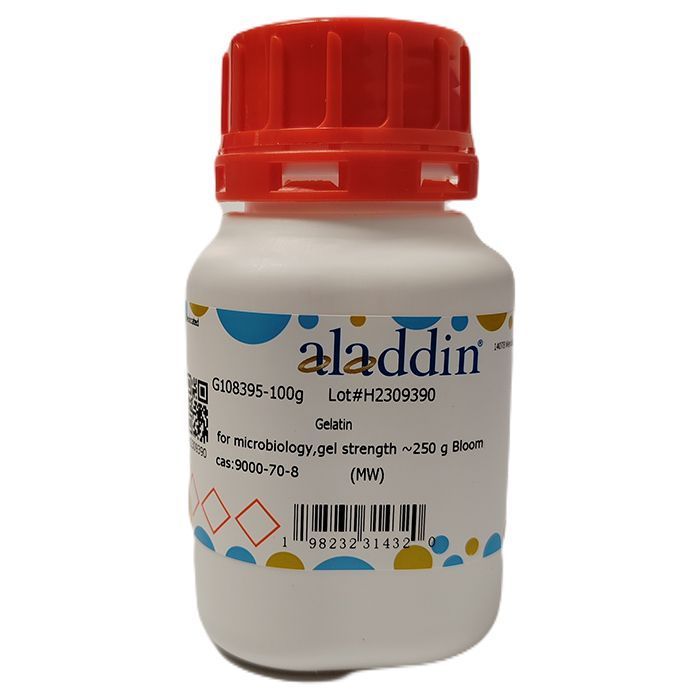
Gelatin - Suitable for microbiology, gel strength ~250 g Bloom , CAS No.9000-70-8

CAS: 9000-70-8 Cat. No.: G108395 Numero EC: 232-554-6
Disponibile su ordine
GRADE & PURITY Suitable for microbiology ? Microbiology grade — suited to culturing and testing microorganisms. Use in microbial media, identification, and susceptibility work. gel strength ~250 g Bloom
Synonyms
Adrenaline chloride | Adrenalin chloride | Adrenaline hydrochloride | Epinephrine chloride | Adrenalin hydrochloride | Epinephrine hydrochloride | Epinephrine HCl | l-Epinephrine chloride | l-Adrenaline chloride | l-Epinephrine hydrochloride | l-Epinephri
Storage
Room temperature,Desiccated
Shipped In
Normal
★
Size
Germania (EU)
USA*
Price
Qty
100g
G108395-100g
—
5 Disponibile

17,27€

20,74€
Salva 3,47 € (16.74%)
500g
G108395-500g
—
3 Disponibile

64,99€

82,35€
Salva 17,35 € (21.07%)
Enter a quantity for the sizes you want to add.
🧪
Why this grade

Suitable for microbiology, gel strength ~250 g Bloom Suitable for microbiology for sensitive chromatographic and analytical workflows requiring minimal baseline interference.

🌡

Storage & shipping

Room temperature,Desiccated Ships Normal Check lot-specific COA for exact specifications.

📋

Quality documents

SDS, COA, datasheet, and spec sheet available for download. Lot-specific COA accessible via lot number lookup.

📚

Literature proof

Cited in 1202 peer-reviewed publications across chromatography, organic synthesis, and cross-coupling reactions.

Panoramica

A mixture of high molecular weight water-soluble proteins, almost odorless and tasteless, can absorb water in cold water and expand to 5-10 times its original weight. Soluble in hot water, glycerol, and acetic acid, insoluble in organic solvents such as ethanol, ether, chloroform, etc. Odorless and odorless. Dissolve in hot water, cool, and freeze into gel shape. It can be stored for a long time in dry conditions, but when exposed to humid air, it is easily spoiled by bacterial action.

Specifications

Sinonimi
Adrenaline chloride | Adrenalin chloride | Adrenaline hydrochloride | Epinephrine chloride | Adrenalin hydrochloride | Epinephrine hydrochloride | Epinephrine HCl | l-Epinephrine chloride | l-Adrenaline chloride | l-Epinephrine hydrochloride | l-Epinephri
Specifiche e purezza
Suitable for microbiology, gel strength ~250 g Bloom
Condizioni di conservazione di stoccaggio
Room temperature,Desiccated
Spedito in
Normal
Grado
Suitable for microbiology
Nomi e identificatori
Pubchem Sid
Pubchem Sid Url
https://pubchem.ncbi.nlm.nih.gov/substance/508813663
Sorrisi canonici
CNCC(C1=CC(=C(C=C1)O)O)O.Cl
IUPAC Name
4-[(1R)-1-hydroxy-2-(methylamino)ethyl]benzene-1,2-diol;hydrochloride
InChIKey
ATADHKWKHYVBTJ-FVGYRXGTSA-N
INCHI
1S/C9H13NO3.ClH/c1-10-5-9(13)6-2-3-7(11)8(12)4-6;/h2-4,9-13H,5H2,1H3;1H/t9-;/m0./s1
Isomeri SMILES
CNC[C@@H](C1=CC(=C(C=C1)O)O)O.Cl
WGK Germania
3
RTECS
LX8580000
Reaxy-Rn
4019338
Reaxys-RN_link_address
https://www.reaxys.com/reaxys/secured/hopinto.do?context=S&query=IDE.XRN=4019338&ln=

Documentazione

📋 Safety Data Sheet (SDS)

Comprehensive hazard, handling, storage, and regulatory compliance document.

Download SDS →

✅ Certificate of Analysis (COA)

Lot-specific quality data. Enter your lot number to retrieve the exact COA.

Look up COA →

📊 Datasheet

Quick-reference summary of product specifications and applications.

View datasheet →

🔬 Specification Sheet

Full quality attributes and acceptance criteria for this grade.

View spec sheet →

Advanced Data

Taxonomic Classification

Taxonomy Tree

KingdomOrganic compounds
SuperclassBenzenoids
ClassePhenols
SubclassBenzenediols
Intermediate Tree Nodes Not available
Direct ParentCatechols
Alternative Parents Aralkylamines  1-hydroxy-4-unsubstituted benzenoids  1-hydroxy-2-unsubstituted benzenoids  Benzene and substituted derivatives  Secondary alcohols  1,2-aminoalcohols  Dialkylamines  Organopnictogen compounds  Hydrochlorides  Hydrocarbon derivatives  Aromatic alcohols  
Molecular FrameworkAromatic homomonocyclic compounds
Substituents Catechol - 1-hydroxy-4-unsubstituted benzenoid - 1-hydroxy-2-unsubstituted benzenoid - Aralkylamine - Monocyclic benzene moiety - 1,2-aminoalcohol - Secondary alcohol - Secondary aliphatic amine - Secondary amine - Alcohol - Hydrocarbon derivative - Organooxygen compound - Organonitrogen compound - Organic nitrogen compound - Organopnictogen compound - Organic oxygen compound - Amine - Aromatic alcohol - Hydrochloride - Aromatic homomonocyclic compound
DescrizioneThis compound belongs to the class of organic compounds known as catechols. These are compounds containing a 1,2-benzenediol moiety.
External Descriptors hydrochloride
Struttura 3D
Modello di struttura chimica interattiva


Meccanismi d'azione
Certificati (CoA, COO, BSE/TSE e tabella di analisi)
C of A & Other Certificates(BSE/TSE, COO):
Analytical Chart:

Find and download the COA for your product by matching the lot number on the packaging.

39 results found

Lot NumberCertificate TypeDataOggetto
F2626256Certificate of AnalysisMay 25, 2026 G108395
F2626255Certificate of AnalysisMay 25, 2026 G108395
F2626254Certificate of AnalysisMay 25, 2026 G108395
I2505345Certificate of AnalysisAug 19, 2025 G108395
I2505276Certificate of AnalysisAug 19, 2025 G108395
I2505346Certificate of AnalysisAug 19, 2025 G108395
I2526031Certificate of AnalysisFeb 28, 2025 G108395
J2524130Certificate of AnalysisFeb 28, 2025 G108395
C2620108Certificate of AnalysisFeb 28, 2025 G108395
C2513506Certificate of AnalysisFeb 28, 2025 G108395
C2513405Certificate of AnalysisFeb 28, 2025 G108395
C2513404Certificate of AnalysisFeb 28, 2025 G108395
A2513485Certificate of AnalysisDec 27, 2024 G108395
A2513486Certificate of AnalysisDec 27, 2024 G108395
A2513504Certificate of AnalysisDec 27, 2024 G108395
A2513487Certificate of AnalysisDec 27, 2024 G108395
A2513510Certificate of AnalysisDec 27, 2024 G108395
A2513505Certificate of AnalysisDec 27, 2024 G108395
I2414404Certificate of AnalysisSep 03, 2024 G108395
I2414368Certificate of AnalysisSep 03, 2024 G108395
I2414367Certificate of AnalysisSep 03, 2024 G108395
C2504264Certificate of AnalysisJul 05, 2024 G108395
F2419475Certificate of AnalysisJun 07, 2024 G108395
F2419477Certificate of AnalysisJun 07, 2024 G108395
F2419476Certificate of AnalysisJun 07, 2024 G108395
E2420072Certificate of AnalysisMay 13, 2023 G108395
H2309390Certificate of AnalysisMay 13, 2023 G108395
H2309600Certificate of AnalysisMay 13, 2023 G108395
H2309612Certificate of AnalysisMay 13, 2023 G108395
C23181107Certificate of AnalysisMar 14, 2023 G108395
C23181101Certificate of AnalysisMar 14, 2023 G108395
C23181105Certificate of AnalysisMar 14, 2023 G108395
C23181106Certificate of AnalysisMar 14, 2023 G108395
A2305184Certificate of AnalysisJan 17, 2023 G108395
L2214031Certificate of AnalysisDec 21, 2022 G108395
F2209154Certificate of AnalysisJun 13, 2022 G108395
F2228263Certificate of AnalysisJun 07, 2022 G108395
F2228262Certificate of AnalysisJun 07, 2022 G108395
F2228261Certificate of AnalysisJun 07, 2022 G108395
Proprietà chimiche e fisiche
Sensibilitàmoisture & air sensitive
Domande frequenti e articoli
Stimulus-responsive materials for intelligent drug delivery systems
Overview of Organs-on-Chips
Reagents Suitable for Microbiology
Structural Characteristics, Biological Functions, and Application Prospects of Mussel Adhesive Proteins
A Practical Guide to Fragrance Compositions: Turning a Black-Box Formula into an Engineerable System—Compatibility, Stability, Controlled Release, Traceability, and Selection
Papain (Papaya Cysteine Protease): Composition, Structure, Manufacturing, and Application Guidance
Understanding Hydrophilic Polymers in Aqueous Systems: Hydration Mechanisms, Structural Knobs, and Task-Oriented Selection Guide (Including Tables 1–3)
Biomedical Polymer Insights: Role-Based Task Map, Six Key Material Levers, and a Risk-Driven Evidence Chain (including the Product Navigation Guide and Product Tables 1–3)
Beneath the Skin: Protein- and Peptide-Based Actives in Skincare and Aesthetic Medicine
Bromelain: Enzymological Properties and Key Points for Food, Pharmaceutical, and Industrial Applications
Glutaraldehyde-mediated Microbial Inactivation: Chemical Mechanisms, Determinants, and Key Validation Considerations
Review of Collagenase: Enzymological Features, Type Systems, and Research Applications
Review of the Structural Characteristics, Biological Functions, and Application Advances of Lycopene
Technical Comparison and Method Selection for Hydroxyproline Determination
Selection Logic, Operating Parameters, and Application Boundaries of Common Cell Culture Coating Solutions
Key Judgments in Medical Hydrogel R&D: From Polymer Source and Crosslinking Strategy to Sterilization Planning, Scale-Up Feasibility, and Quality Control
Injectable Thermosensitive Gels: Gelation Behavior, Rheological Properties, and Drug Release Characteristics
Comparative Analysis and Selection Strategies for Mounting Media in Immunological Experiments
Significance of CK, CK-MB, and CK-MM Testing in the Interpretation of Tissue Injury
Applications of Enzymatic Protein Crosslinking Systems in Gel Construction and Functional Evaluation
Designing Hydrogel Scaffolds as Programmable Cell Microenvironments: From Click-Chemistry Functionalization to 3D Cell Culture Experimental Design
The Role of Tannins in Astringency, Precipitation, and Antioxidant Activity of Plant Extracts
Structure, Properties, and Mechanisms of Powdered Fragrances and Fragrance Delivery Materials: Stability, Release Mechanisms, and Selection Logic
Bacterial Strain Cryopreservation Methods: Glycerol Preservation, Ultra-Low Temperature Storage, and Recovery Quality Control
R&D Selection and Experimental Evaluation of Common Food Hydrocolloids
Evaluation of Blood-Brain Barrier Permeability: Tracer Extravasation, TEER Measurement, and Interpretation of In Vitro Model Results
How Do Collagen Peptides Act on the Skin? From Surface Hydration and Percutaneous Delivery to Fibroblasts and Collagen Homeostasis
How Palmitoyl Pentapeptide-4 Acts on the Skin: From the KTTKS Sequence and Skin Delivery to Collagen Matrix Responses
How Does Collagen Tripeptide Act on the Skin: Stratum Corneum Delivery, Matrix Protection, and Regulation of Collagen Homeostasis
What Determines Collagen Function: From Triple-Helix Formation to Hierarchical Assembly, Crosslink Maturation, and Dynamic Remodeling
What Is “Plant Collagen”? Distinguishing Ingredient Types, Structural Differences, Production Methods, and Skincare Effects
The Combination Logic of Palmitoyl Tripeptide-1 and Palmitoyl Pentapeptide-4: Skin Delivery, Matrix Signaling, and Regulation of Collagen Homeostasis
Differences Between Animal-Derived Collagen and Recombinant Collagen in Skincare: Sequence and Structure, Safety, Skin Effects, and Evidence Evaluation
Citations of This Product
Calcolatori di soluzioni
Recensioni

Recensioni dei clienti

Need help choosing the grade?

Our grade selection guide covers purity, stabilizer status, and application suitability for all variants in our catalog.

View Suitable for microbiology grade guide →

Shall we send you a message when we have discounts available?

Remind me later

Thank you! Please check your email inbox to confirm.

Oops! Notifications are disabled.