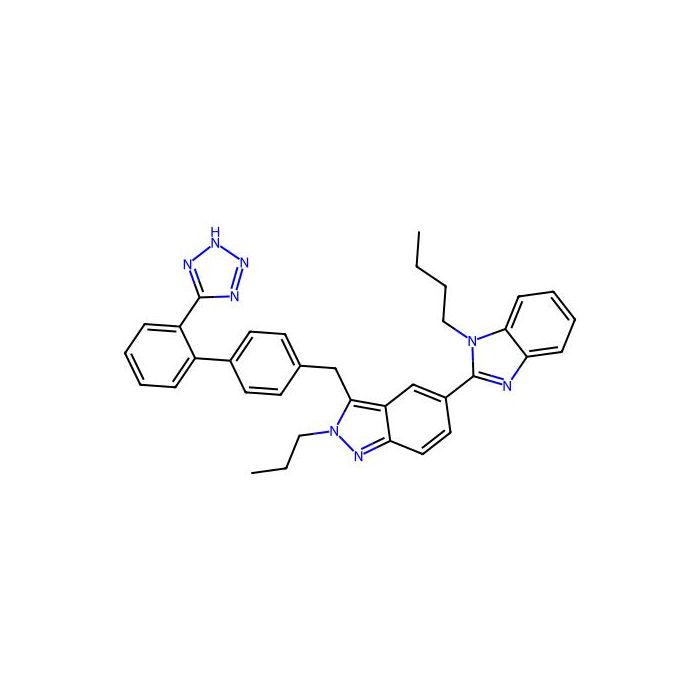
GSK1820795A, as a telmisartan analog, is a selective hGPR132a antagonist. GSK1820795A blocks activation of yeast cells expressing hGPR132a by N-acylamides GSK1820795A is also a angiotensin II antagonists and partial PPARγ agonists (compound 38) .
In Vitro
GSK1820795A blocks responses of yeast expressing hGPR132a to agonists NPGly, NLGly, linoleamide, and SB-583831. MCE has not independently confirmed the accuracy of these methods. They are for reference only.
GSK1820795A, as a telmisartan analog, is a selective hGPR132a antagonist. GSK1820795A blocks activation of yeast cells expressing hGPR132a by N-acylamides. GSK1820795A is also a angiotensin II antagonists and partial PPARγ agonists (compound 38)
Condizioni di conservazione di stoccaggio
Store at -20°C
Spedito in
Ice chest + Ice pads
Questo prodotto richiede spedizione a catena fredda. I servizi di terra e altri servizi economici non sono disponibili.
Tipo di azione
INHIBITOR
Purezza
≥98%
Nomi e identificatori
Peso molecolare
566.70
Dati avanzati
Certificati (CoA, COO, BSE/TSE e tabella di analisi)
C of A & Other Certificates(BSE/TSE, COO):
Analytical Chart:
Proprietà chimiche e fisiche
Solubilità
DMSO : 100 mg/mL (176.46 mM; Need ultrasonic)
Calcolatori di soluzioni
Molarity Calculator
Determine the necessary mass, volume, or concentration for preparing a solution.
Dilution Calculator
Determine the dilution needed to prepare a stock solution.
Reconstitution Calculator
Recensioni
Recensioni dei clienti
Application Protocols
No tested applications, recommended dilutions, or control conditions are provided for this product.
Validated uses: Not specified for this item; refer to CoA/Spec Sheet.
Suggested approach: Develop in-house protocols tailored to your assay format (biochemical, biophysical, cellular), controlling for vehicle (DMSO) and potential assay interference. Include appropriate positive/negative controls unrelated to this compound.
Note: Only general guidance is provided here; follow your institutional SOPs and consult the SDS and CoA.
Biological Roles
No biological target, pathway, or mechanistic information is provided for this item.
Defined biological roles: Not specified for this item; refer to CoA/Spec Sheet or primary literature if available.
Use context: This compound is supplied strictly for research use; no clinical, diagnostic, or therapeutic claims are made or implied.
General considerations for exploratory use:
If biological testing is planned, characterize purity and identity by orthogonal methods (HPLC/UPLC, MS, NMR) and confirm the absence of pan-assay interference behaviors under your conditions.
Determine cytotoxicity windows, assay interference (e.g., absorbance/fluorescence overlap), and DMSO tolerance in relevant systems before hypothesis testing.
Buffer Applications
This product is not a buffering agent. No specific buffer system is associated with this compound.
Practical guidance when dosing from DMSO stocks (general):
Prepare assay buffers (e.g., HEPES, PBS, Tris) appropriate to your biology and maintain constant final DMSO across wells/conditions (commonly 0.1–1% v/v).
Pre-wet tips and add compound last with thorough mixing to avoid local supersaturation and precipitation.
If precipitation is observed, consider small amounts of co-solvent, surfactant compatible with your assay, or adjust pH if the compound is ionizable (structure not provided here).
Green Alternatives
With no structure-specific solvent or process constraints provided, greener practice primarily involves solvent and waste optimization around stock preparation, dilution, and analysis.
Greener choices (general guidance):
Prefer ethanol or isopropanol over methanol when assay-compatible (lower toxicity), recognizing potential impacts on protein stability.
Use water-based buffers with minimal organic co-solvent where solubility permits.
For chromatographic methods, consider water-rich UHPLC gradients and volatile buffers (ammonium formate/acetate) to reduce solvent footprint.
Illustrative comparison (general):
DMSO vs. Cyrene/PolarClean: DMSO has unmatched compatibility for discovery screens; alternatives may be greener but can limit solubility or assay scope.
ACN vs. EtOH/H2O gradients: ACN offers superior chromatographic performance; partial substitution with EtOH can lower environmental impact but may increase backpressure and change selectivity.
Operational measures:
Minimize stock volumes by right-sizing aliquots; reduce freeze–thaw waste.
Consolidate analytical runs; use shorter UHPLC columns to cut solvent consumption.
Segregate waste streams to enable energy-efficient disposal.
Note: Any switch in solvent should be validated for compound solubility, chemical stability, and assay performance.
Pharmaceutical Uses
No pharmacopeial status, excipient role, or manufacturing use is provided for this item.
Formulation/CMC status: Not specified for this item; refer to CoA/Spec Sheet.
Regulatory: For research use only; not for human or veterinary use, clinical diagnostics, or as an API/excipient.
Discovery/development context (general):
Compounds of this type may be used in preclinical research workflows for SAR exploration, target validation, and method development. Any developability assessments (solubility, permeability, stability) should be generated de novo for this item as no such data are supplied here.
Physical Properties
Item-specific physical data are not provided in the current listing. Where values are required for method development or formulation, please consult the CoA/Spec Sheet.
Appearance: Not specified for this item; refer to CoA/Spec Sheet.
Melting point (MP): Not specified for this item; refer to CoA/Spec Sheet.
Boiling point (BP): Not specified for this item; refer to CoA/Spec Sheet.
Density: Not specified for this item; refer to CoA/Spec Sheet.
Solubility profile: Not specified for this item; refer to CoA/Spec Sheet.
LogP/logD: Not specified for this item; refer to CoA/Spec Sheet.
pKa(s): Not specified for this item; refer to CoA/Spec Sheet.
Refractive index/UV cutoff: Not specified for this item; refer to CoA/Spec Sheet.
General guidance (non–item-specific):
For unknown solubility, start with high-purity anhydrous DMSO to prepare a 10–50 mM stock, then test serial dilutions into assay buffers while monitoring for precipitation.
If aqueous compatibility is needed, evaluate co-solvents (MeOH, EtOH, ACN), pH adjustment (if ionizable), or cyclodextrin solubilization. Filter through 0.22 µm PVDF/nylon if particulates form.
Record any observed crystallization/precipitation temperatures to set handling limits for assay logistics.
Quality and Grades
Item-specific quality metrics are not listed.
Grade/Purity: Not specified for this item; refer to CoA/Spec Sheet.
Guidance on typical grades for library compounds (general information):
Screening/Discovery grade: Typically ≥90–95% purity by HPLC/UPLC with supporting MS, sometimes NMR. Suitable for primary screening and SAR triage.
Reference/Analytical grade: Often ≥98% purity with detailed characterization (1H/13C NMR, HRMS, water/volatile content). Preferred for secondary assays, mechanistic biophysics, and quantitation.
What to look for on the CoA:
Purity method and conditions (column, gradient, detection wavelength) and whether purity is area% or weight%.
Identity confirmation: MS (m/z, adduct), NMR diagnostic signals, and, if relevant, chiral purity (ee/er by chiral HPLC).
Residual solvents, water content (KF), and counterion/stoichiometry if supplied as a salt.
Stabilizers/additives:
Not specified for this item; refer to CoA/Spec Sheet.
Process control:
For reproducible biology, lock a single lot with documented purity and characterization. Record solvent systems and storage history to mitigate drift (e.g., slow hydration or solvent loss).
Reaction and Applications
This product is offered as a research small molecule, not as a general-purpose synthetic reagent. Without structural information, specific reaction chemistry cannot be advised for this item.
Research applications (general for library compounds):
Tool compound in discovery: Use as a test article in biochemical, biophysical, or cell-based screening to probe hypotheses. Validate activity and liabilities independently—no target information is provided in this listing.
Analytical reference: Calibrate and validate LC/LC–MS assays (retention time, response factor) once purity and identity are confirmed.
Orthogonal assays: If an effect is observed, perform counter-screens (e.g., fluorescence interference, redox cycling, detergent sensitivity) to rule out assay artifacts.
Practical tips:
Prepare a concentrated DMSO stock (e.g., 10–50 mM), aliquot in single-use portions, and avoid repeated freeze–thaw cycles.
Verify solution stability by re-injecting LC or LC–MS after storage (e.g., 1–2 weeks at −20°C) to detect degradation or adsorption losses.
If mechanistic chemistry is intended, obtain structural data first (SMILES, functional groups) to assess reactivity and stability.
Reaction Conditions
No reaction conditions are provided for this item, and it is not positioned as a general synthetic reagent.
General guidance for preparing test solutions and assay dilutions:
Stock preparation: Dissolve to 10–50 mM in anhydrous DMSO. Vortex and, if needed, sonicate briefly to aid dissolution. Record exact concentration.
Working solutions: Dilute stocks into assay buffer with vigorous mixing to achieve final DMSO typically 0.1–1% v/v, maintaining equal DMSO across all wells.
Stability checks: Assess solution stability by LC/LC–MS at t0 and after intended storage (e.g., 24–72 h at 4°C; 1–2 weeks at −20°C). Discard if new peaks or precipitation appear.
Light/moisture sensitivity: Unknown for this item; protect from light and moisture as a precaution until characterized.
If chemical reactions with this compound are planned, obtain full structural information first to define conditions, catalysts, and compatible solvents.
Safety and Handling
Authoritative safety data should be taken from the product SDS. Hazard classifications for this specific item are not provided in the listing.
Item-specific safety fields:
Signal word: Not specified for this item; refer to SDS.
H-statements: Not specified for this item; refer to SDS.
GHS classification: Not specified for this item; refer to SDS.
Pictograms: Not specified for this item; refer to SDS.
Best practices for small-molecule library compounds (general):
PPE: Wear lab coat, safety glasses, and nitrile gloves. Avoid skin contact, inhalation of dust, and ingestion. Handle powders in a fume hood.
Storage: Store at −20°C as specified. Keep tightly sealed, desiccated, and protected from prolonged exposure to ambient humidity. Allow vials to equilibrate to room temperature in a desiccator before opening to minimize moisture uptake/condensation.
Incompatibilities: Until structure is known, avoid strong oxidizers/reducers, strong acids/bases, and reactive metals. Segregate from food and incompatible chemicals.
First aid (general): If on skin, wash with soap and water; if in eyes, rinse with water for several minutes; if inhaled, move to fresh air; if ingested, seek medical attention. Provide SDS to responders.
DMSO considerations: DMSO enhances dermal absorption; avoid skin contact with DMSO solutions of the compound.
Waste: Collect solid and solution waste as organic hazardous waste. Defer to institutional EHS guidelines and local regulations.
Solvent Selection
Given that structure and solubility are not provided, adopt a tiered solvent exploration focused on assay compatibility and compound integrity.
Primary stock solvent: DMSO (anhydrous, ≥99.9%) is usually preferred for small-molecule library stocks due to broad solubilizing power and biochemical assay compatibility at 0.1–1% v/v.
Secondary solvents for screening solubility: Methanol, ethanol, and acetonitrile can be evaluated for co-solvency. Avoid excessive protic solvent in enzyme assays when possible.
Aqueous delivery: Pre-dilute DMSO stocks 10–100× into buffer while vortexing to avoid local supersaturation; consider adding 0.01–0.05% nonionic surfactant (e.g., Pluronic F-68) if precipitation occurs (assay-permitting).
pH leverage: If the compound is ionizable (unknown here), modest pH adjustments (±1 unit from neutral) can markedly change solubility; verify stability versus hydrolysis.
Quick comparison (general):
DMSO: Broad solubility; good assay tolerance at low %.
MeOH/EtOH: Good co-solvents; can affect protein stability at higher %.
ACN: Strong eluent; lower viscosity; may perturb some biological assays.
PEG400/propylene glycol: Higher-boiling co-solvents for pre-formulation work; limited assay use.
Recommendations:
Establish a robust stock concentration that remains clear after 1:100 dilution into your assay buffer.
Document solvent history per vial to ensure reproducibility across campaigns.
Storage and Reconstitution
Item-specific conditions:
Storage Conditions: Store at −20°C.
Shipped In: Ice chest + ice pads.
Reconstitution (general guidance; no item-specific solubility is provided):
Allow the vial to warm in a desiccator to room temperature before opening to avoid moisture condensation.
Prepare concentrated stocks in anhydrous DMSO (commonly 10–50 mM). If aqueous use is required, make stepwise dilutions into buffer under vigorous mixing.
If insoluble at desired concentration, explore alternative co-solvents (MeOH, EtOH, ACN) or modest pH adjustments (if ionizable). Do not exceed assay-compatible organic percentages.
Aliquoting and handling:
Aliquot into single-use portions (amber vials or well plates) to avoid repeated freeze–thaw cycles.
Store aliquots at −20°C in sealed containers with desiccant. Record preparation date, concentration, and solvent system on each aliquot.
Inspect visually for precipitation or color change; confirm by LC/LC–MS if critical.
Stability notes:
Long-term stability, hygroscopicity, and photolability are not specified for this item; refer to CoA/Spec Sheet and verify empirically under your conditions.
Structure and Identity
Brief overview: GSK1820795A is a cataloged small-molecule research compound (GlaxoSmithKline code) offered for screening and discovery workflows. Item-specific structural identifiers are not provided in the current listing.
SKU: G651121
Product Name: GSK1820795A
CAS: 2650253-86-2
Category: Small molecules and compound library (research use)
Item-specific identifiers (from Product Data):
Molecular formula: Not specified for this item; refer to CoA/Spec Sheet.
Molecular weight: Not specified for this item; refer to CoA/Spec Sheet.
SMILES: Not specified for this item; refer to CoA/Spec Sheet.
InChIKey: Not specified for this item; refer to CoA/Spec Sheet.
Structural description:
Structural features, ring systems, functional groups, and stereochemistry: Not specified for this item; refer to CoA/Spec Sheet.
Notes for researchers:
If needed for cheminformatics or LIMS registration, request structure (SMILES/SDF), exact mass, and stereochemistry from the accompanying CoA/specification sheet.
Use the provided CAS and internal code to cross-reference any external literature; however, no target or mechanism details are supplied in this listing.
Synthetic Utility
This catalog entry represents a finished small molecule for research rather than a building block. Without structural information, no specific synthetic transformations can be recommended.
Potential roles (general, non–item-specific):
Analytical standard: Use to benchmark chromatographic methods or to support quantitative bioanalysis after full identity/purity verification.
Derivatization (conditional on structure): If functional handles are present (unknown here), analog generation, biotinylation, or photoaffinity tagging may be feasible; obtain structural data first and evaluate IP constraints.
If synthetic modification is intended:
Request the structure (SMILES/SDF) and characterization package.
Map liabilities (e.g., hydrolyzable motifs, redox-active moieties) before planning routes.
Confirm chiral information and absolute configuration if stereochemistry is relevant to activity.
Target Specificity
No biological target, selectivity profile, or mechanism of action is provided in the Product Data.
Target/epitope: Not specified for this item; refer to CoA/Spec Sheet.
Species selectivity: Not specified for this item; refer to CoA/Spec Sheet.
Off-target screening: Not specified for this item; users should perform their own profiling as needed.
Domande frequenti
What is the purity of this product?
This product is supplied at ≥98% purity (chemical assay). Lot-specific values are stated on the Certificate of Analysis.
How should this product be stored?
Store at ?20 °C. Freezer storage is required to maintain the specified shelf life.
How is this product shipped?
This product ships in an insulated container with ice pads. Unpack on arrival and transfer it to the storage condition stated above.
What are the CAS number, molecular formula and molecular weight?
The CAS Number is 2650253-86-2, the molecular formula is C35H34N8, and the molecular weight is 566.70 g/mol.
What documentation is provided?
Available product documentation, including Certificates of Analysis (COA), Safety Data Sheets (SDS), and specification sheets, is shown in the product document area. Document availability and access follow the current site policy.
Utilizziamo i cookie per garantire il corretto funzionamento del sito web e, ove consentito, per migliorare la tua esperienza. Puoi gestire le tue preferenze in qualsiasi momento nelle Impostazioni. Per saperne di più, consulta la nostra Cookie Policy.
Desidera che le inviamo un messaggio quando avremo sconti disponibili?
Ricordamelo più tardi
Grazie! Controlli la sua casella di posta per confermare.
Products are supplied to verified businesses, institutions, and qualified professionals for research and development use only. Not for use in humans, animals, diagnosis, or therapy.