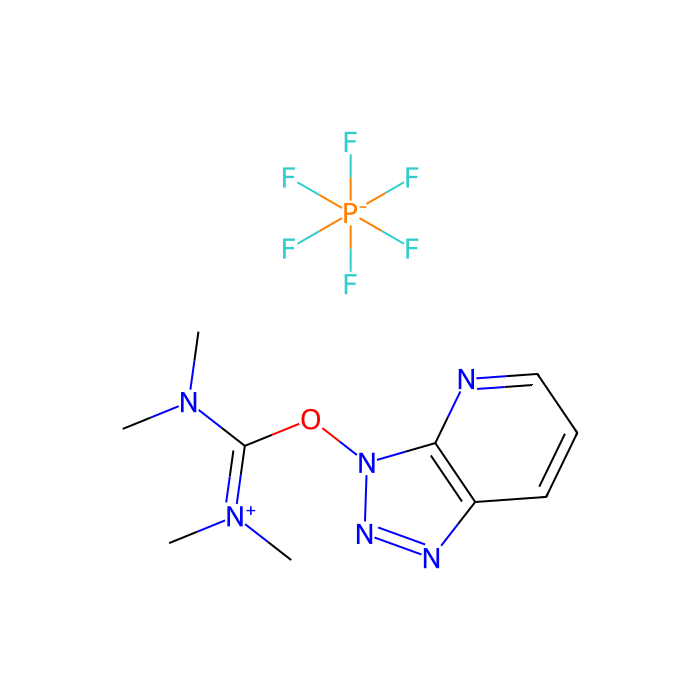
HATU - ≥99% , CAS No.148893-10-1

CAS: 148893-10-1 Cat. No.: H109327 Formula: C10H15F6N6OP Peso molecolare: 380.23 Numero EC: 604-662-7 PubChem CID: 9886157
Disponibile su ordine
GRADE & PURITY ≥99%
Synonyms
HATU | 2-(7-Aza-1H-Benzotriazole -1-yl)-1,1,3,3-tetramethyluronium hexafluorophosphate | MFCD00274639 | 0-(7-Azabenzotriazol-1-yl)-N,N, N',N'-tetramethyluronium hexafluorophosphate | NSC 165796 | SCHEMBL63612 | 0-(7-Azabenzotriazol-1-yl)-N,N,N',N'-tetrame
Storage
Store at 2-8°C,Argon charged
Shipped In
Wet ice
★
Size
Germania (EU)
USA*
Price
Qty
1g
H109327-1g
—
5 Disponibile
8,59€
5g
H109327-5g
—
2 Disponibile
9,46€
10g
H109327-10g
—
3 Disponibile

10,33€

15,53€
Salva 5,21 € (33.52%)
25g
H109327-25g
Su ordinazione · 8–12 settimane

19,00€

28,55€
Salva 9,55 € (33.43%)
100g
H109327-100g
—
1 Disponibile

57,18€

85,82€
Salva 28,64 € (33.37%)
500g
H109327-500g
—
2 Disponibile
355,69€
Enter a quantity for the sizes you want to add.
🧪
Why this grade

≥99% for sensitive chromatographic and analytical workflows requiring minimal baseline interference.

🌡

Storage & shipping

Store at 2-8°C,Argon charged Ships Wet ice Check lot-specific COA for exact specifications.

📋

Quality documents

SDS, COA, datasheet, and spec sheet available for download. Lot-specific COA accessible via lot number lookup.

📚

Literature proof

Cited in 112 peer-reviewed publications across chromatography, organic synthesis, and cross-coupling reactions.

Panoramica

HATU is useful as a peptide coupling agent and a catalyst for selective acylation. It is also a reagent for reactions involving amide bond formations.

Specifications

Sinonimi
HATU | 2-(7-Aza-1H-Benzotriazole -1-yl)-1,1,3,3-tetramethyluronium hexafluorophosphate | MFCD00274639 | 0-(7-Azabenzotriazol-1-yl)-N,N, N',N'-tetramethyluronium hexafluorophosphate | NSC 165796 | SCHEMBL63612 | 0-(7-Azabenzotriazol-1-yl)-N,N,N',N'-tetrame
Specifiche e purezza
≥99%
Condizioni di conservazione di stoccaggio
Store at 2-8°C,Argon charged
Spedito in
Wet ice
Questo prodotto richiede spedizione a catena fredda. I servizi di terra e altri servizi economici non sono disponibili.
Purezza
≥99%
Nomi e identificatori
Pubchem Sid508811032
Pubchem Sid Urlhttps://pubchem.ncbi.nlm.nih.gov/substance/508811032
Sorrisi canoniciCN(C)C(=[N+](C)C)ON1C2=C(C=CC=N2)N=N1.F[P-](F)(F)(F)(F)F
IUPAC Name[dimethylamino(triazolo[4,5-b]pyridin-3-yloxy)methylidene]-dimethylazanium;hexafluorophosphate
InChIKeyJNWBBCNCSMBKNE-UHFFFAOYSA-N
INCHI1S/C10H15N6O.F6P/c1-14(2)10(15(3)4)17-16-9-8(12-13-16)6-5-7-11-9;1-7(2,3,4,5)6/h5-7H,1-4H3;/q+1;-1
Isomeri SMILES CN(C)C(=[N+](C)C)ON1C2=C(C=CC=N2)N=N1.F[P-](F)(F)(F)(F)F
WGK Germania 3
PubChem CID 9886157
Peso molecolare 380.23
Reaxy-Rn 11805773

Documentazione

📋 Safety Data Sheet (SDS)

Comprehensive hazard, handling, storage, and regulatory compliance document.

Download SDS →

✅ Certificate of Analysis (COA)

Lot-specific quality data. Enter your lot number to retrieve the exact COA.

Look up COA →

📊 Datasheet

Quick-reference summary of product specifications and applications.

View datasheet →

🔬 Specification Sheet

Full quality attributes and acceptance criteria for this grade.

View spec sheet →

Advanced Data

Taxonomic Classification

Taxonomy Tree

KingdomOrganic compounds
SuperclassOrganoheterocyclic compounds
ClasseTriazolopyridines
SubclassNot available
Intermediate Tree Nodes Not available
Direct ParentTriazolopyridines
Alternative Parents Pyridines and derivatives  Triazoles  Heteroaromatic compounds  Propargyl-type 1,3-dipolar organic compounds  Carboximidic acids and derivatives  Carboximidamides  Azacyclic compounds  Organopnictogen compounds  Organooxygen compounds  Organic salts  Hydrocarbon derivatives  
Molecular FrameworkAromatic heteropolycyclic compounds
Substituents Triazolopyridine - Pyridine - Azole - 1,2,3-triazole - Heteroaromatic compound - Carboximidic acid derivative - Carboximidamide - Propargyl-type 1,3-dipolar organic compound - Organic 1,3-dipolar compound - Azacycle - Hydrocarbon derivative - Organopnictogen compound - Organic oxygen compound - Organic nitrogen compound - Organonitrogen compound - Organic salt - Organooxygen compound - Aromatic heteropolycyclic compound
DescrizioneThis compound belongs to the class of organic compounds known as triazolopyridines. These are compounds containing a triazole ring fused to a pyridine ring. Triazole is a five-membered ring consisting of two carbon atoms and three nitrogen atoms. Pyridine is a 6-membered ring consisting of five carbon atoms and one nitrogen center.
External Descriptors Not available
Struttura 3D
Modello di struttura chimica interattiva


Certificati (CoA, COO, BSE/TSE e tabella di analisi)
C of A & Other Certificates(BSE/TSE, COO):
Analytical Chart:

Find and download the COA for your product by matching the lot number on the packaging.

45 results found

Lot NumberCertificate TypeDataOggetto
L2209575Certificate of AnalysisSep 01, 2026 H109327
L2209611Certificate of AnalysisSep 01, 2026 H109327
I2617794Certificate of AnalysisAug 31, 2026 H109327
I2617795Certificate of AnalysisAug 31, 2026 H109327
I2617796Certificate of AnalysisAug 31, 2026 H109327
I2617797Certificate of AnalysisAug 31, 2026 H109327
I2617798Certificate of AnalysisAug 31, 2026 H109327
G2608749Certificate of AnalysisMay 28, 2026 H109327
F2624359Certificate of AnalysisMay 28, 2026 H109327
F2624367Certificate of AnalysisMay 28, 2026 H109327
F2624370Certificate of AnalysisMay 28, 2026 H109327
L2518366Certificate of AnalysisNov 27, 2025 H109327
L2518367Certificate of AnalysisNov 27, 2025 H109327
L2518368Certificate of AnalysisNov 27, 2025 H109327
L2518379Certificate of AnalysisNov 27, 2025 H109327
E2522078Certificate of AnalysisApr 28, 2024 H109327
K2428180Certificate of AnalysisApr 28, 2024 H109327
G2501084Certificate of AnalysisApr 28, 2024 H109327
G2521025Certificate of AnalysisApr 28, 2024 H109327
E2512038Certificate of AnalysisApr 28, 2024 H109327
J2527154Certificate of AnalysisApr 28, 2024 H109327
H2528097Certificate of AnalysisApr 28, 2024 H109327
E2414086Certificate of AnalysisApr 28, 2024 H109327
E2414085Certificate of AnalysisApr 28, 2024 H109327
E2414084Certificate of AnalysisApr 28, 2024 H109327
E2414083Certificate of AnalysisApr 28, 2024 H109327
I2306491Certificate of AnalysisJul 24, 2023 H109327
I2306493Certificate of AnalysisJul 24, 2023 H109327
I2306492Certificate of AnalysisJul 24, 2023 H109327
I2306494Certificate of AnalysisJul 24, 2023 H109327
G2304038Certificate of AnalysisNov 01, 2022 H109327
L2209608Certificate of AnalysisNov 01, 2022 H109327
L2209617Certificate of AnalysisNov 01, 2022 H109327
L2209715Certificate of AnalysisNov 01, 2022 H109327
K2205235Certificate of AnalysisOct 27, 2022 H109327
K2205236Certificate of AnalysisOct 27, 2022 H109327
J2217630Certificate of AnalysisSep 30, 2022 H109327
H1830097Certificate of AnalysisJun 24, 2022 H109327
G2201312Certificate of AnalysisJun 04, 2022 H109327
G2201308Certificate of AnalysisJun 04, 2022 H109327
G2201309Certificate of AnalysisJun 04, 2022 H109327
G2201310Certificate of AnalysisJun 04, 2022 H109327
G2201311Certificate of AnalysisJun 04, 2022 H109327
D2228160Certificate of AnalysisMar 09, 2022 H109327
D2228163Certificate of AnalysisMar 09, 2022 H109327
Proprietà chimiche e fisiche
SolubilitàSoluble in Acetone and DMSO
SensibilitàHeat Sensitive,Hygroscopic
Punto di fusione (°C)183-186°C
Peso molecolare380.230 g/mol
XLogP3
Hydrogen Bond Donor Count0
Hydrogen Bond Acceptor Count11
Rotatable Bond Count3
Exact Mass380.095 Da
Monoisotopic Mass380.095 Da
Topological Polar Surface Area59.100 Ų
Heavy Atom Count24
Formal Charge0
Complexity351.000
Isotope Atom Count0
Defined Atom Stereocenter Count0
Undefined Atom Stereocenter Count0
Defined Bond Stereocenter Count0
Undefined Bond Stereocenter Count0
The total count of all stereochemical bonds0
Covalently-Bonded Unit Count2
Domande frequenti e articoli
Fluid chemistry: Lighting the fire of hope for the large-scale production of anticancer drugs
A bridge to protein science——Aladdin@Polypeptide
Solid-Phase Peptide Synthesis (SPPS) — Efficient Strategies and Innovative Techniques
A Complete Guide to Choosing Resins for SPPS (Solid-Phase Peptide Synthesis): Fmoc/Boc Routes, C-Terminal Acid/Amide, and a Key-Parameter Navigator
From Piperidine to Pyridine: The “Most Common N-Heterocycle” Shift in FDA Small-Molecule New Drugs (2013–2023) and a Selection Guide (Tables 1–4)
β-Acyloxy Alkenyl Amides (AAAs): A New Approach to Amide Bond and Peptide Bond Construction Worth Attention
DAST-Mediated Amidation at Room Temperature: Method Features, Practical Value, and Scope of Applicability
From High Reactivity to Comprehensive Evaluation: Using CTSOAt as an Example to Understand the Design Logic of New Coupling Reagents
From Analytical Instrument to Synthetic Platform: A New Strategy for Reconstructing Automated Flow Solid-Phase Peptide Synthesis with Standard Analytical HPLC
New Progress in the Solid-Phase Synthesis of Sterically Hindered Peptides: Background, Core Breakthroughs, and Implications for Automation Compatibility of the RMMR Strategy
TCFH–NMI Amidation in Highly Aqueous Media: Research Value, Methodological Understanding, and Experimental Insights
A New Balance in Coupling Reagents: How DMT-TU Balances Reactivity, Racemization Control, and Thermal Hazard
The Positioning of TBTU in Practice: Racemization Risk, Extended Uses, and Selection Criteria
From “High Yield” to “Configuration Retention”: Activation-Stage Risks, Route Differences, and Selection Principles for Coupling Systems
The Methodological Value of HATU in Difficult Couplings: Reactivity Advantages, Stereochemical Retention, and Condition Management
The Methodological Value of Boc-Oxyma: Low-Racemization Coupling, Route Continuity, and Extended Applications
Low Racemization in Peptide Synthesis Is Not Just About Reagent Choice: Stereochemical Risk During the Activation Stage and Practical Strategies for Experimental Control
The Methodological Value of TCFH: Advantages in Challenging Amidation and the Switching Logic of Carboxylic Acid Activation Pathways
Ynamide Coupling Reagents: From Low-Epimerization Activation Pathways to More Practically Usable N→C Inverse Peptide Synthesis
Decision Logic for Peptide Synthesis Routes: Applicability and Criteria for Choosing among SPPS, LPPS, and Recombinant Expression
Decision Logic for Selecting Coupling Reagents in Amide Bond Formation: Activation Pathways, Side Reactions, Epimerization, Workup, and Safety
Experimental Judgment in Oxyma Coupling Systems: Coupling Efficiency, Racemization Control, and the HCN Risk in DIC-Based Systems
Experimental Judgment for CMPI in Carboxylic Acid Activation: Applicable Tasks, Base Matching, and Workup Burden
Experimental Judgment for TFPN in Carboxylic Acid Activation: Suitable Scenarios, Intermediate Distribution, and Nucleophile Compatibility
Reaction Selection in Small-Molecule Synthesis: From Transformation-Type Assessment to Experimental Route Screening
How to Determine Whether a Protein Is Suitable for Targeted Degradation: From Degradation Pathway and Molecular Design to Mechanism Validation
How to Troubleshoot Abnormal Impurities in Peptide Synthesis? Locating Process Issues Through Amino-Related Side Reactions
Peptide Intermediates Difficult to Dissolve and Separate? Route Design and Workup Strategies for Tag-Assisted Liquid-Phase Peptide Synthesis (TAG-LPPS)
AITF-Mediated Carboxylic Acid Activation for the Synthesis of Amides, Peptides, and Esters: Activation Mechanism and Applicable Scenarios
Structural Features, Property Modulation, and Typical Applications of Triazole Compounds
Formation and Control of Carboxyl- and Hydroxyl-Related Impurities in Peptide Synthesis — Using Asp/Glu and Ser/Thr Residue Side Reactions as Examples
Synthetic Application Logic of Triazoles and Related Compounds: Structural Introduction, Reactive Sites, and Target Molecule Construction
CTSOBt Benzotriazole–Sulfonate Coupling Reagent: Carboxylic Acid Activation and Synthetic Application Value
Acetyl Tetrapeptide-2 and Elastic Fiber Formation: Research on Fibulin-5, LOXL1, and Skin Firmness
How Palmitoyl Pentapeptide-4 Acts on the Skin: From the KTTKS Sequence and Skin Delivery to Collagen Matrix Responses
How Cyclization Changes Peptide Behavior: Conformational Preorganization, Skin Delivery, and Integrin Binding, Using Cyclopeptide-5 as an Example
The Combination Logic of Palmitoyl Tripeptide-1 and Palmitoyl Pentapeptide-4: Skin Delivery, Matrix Signaling, and Regulation of Collagen Homeostasis
Mechanistic Basis of Acetyl Hexapeptide-8 in the Management of Expression Lines: SNARE Complex Interference, Constraints on Percutaneous Delivery, and Combination Strategies
Copper Tripeptide GHK-Cu and Skin Repair: From Copper Coordination Chemistry to Extracellular Matrix Remodeling
Citations of This Product
Calcolatori di soluzioni
Recensioni

Recensioni dei clienti

Shall we send you a message when we have discounts available?

Remind me later

Thank you! Please check your email inbox to confirm.

Oops! Notifications are disabled.