QUALITÀ & PUREZZACarrier Free?Carrier-free — supplied without added carrier protein/stabilizer. Use when carriers (e.g. BSA) would interfere with conjugation or sensitive assays.ExactAb™?ExactAb™ — Aladdin's antibody line emphasizing precision and validated quality. Use for reliable, specificity-validated antibody applications.Azide Free?Azide-free — without sodium azide preservative. Use in conjugations, cell work, or assays where azide is toxic or inhibitory.Validated?Validated grade — performance confirmed in defined applications before release. Use when you want documented assurance the reagent works as stated.High Performance?High-performance grade with optimized purity and performance characteristics. Use for sensitive analyses where ordinary grades fall short.See COA
Mouse anti Human Hsp27 Antibody, Monoclonal (D2), could be used for WB and so on.
Application:
WB: 0.01-2µg/mL
Protein Function
Involved in stress resistance and actin organization.
Specifiche
Product Name
Hsp27 Mouse mAb - Anticorpo primario, specific to HSPB1, Mouse IgG2b
Sinonimi
Heat shock 27kDa protein antibody|28 kDa heat shock protein antibody|CMT2F antibody|DKFZp586P1322 antibody|epididymis secretory protein Li 102 antibody|Estrogen regulated 24 kDa protein antibody|Estrogen-regulated 24 kDa protein antibody|Heat shock 25kDa protein 1 antibody|Heat shock 27 kDa protein antibody|Heat shock 27kD protein 1 antibody|Heat shock 27kDa protein 1 antibody|Heat shock 28kDa protein 1 antibody|Heat Shock Protein 27 antibody|Heat shock protein beta 1 antibody|Heat shock protein beta-1 antibody|heat shock protein family B (small) member 1 antibody|HEL-S-102 antibody|HMN2B antibody|HS.76067 antibody|Hsp 25 antibody|HSP 27 antibody|Hsp 28 antibody|Hsp B1 antibody|Hsp25 antibody|HSP27 antibody|Hsp28 antibody|HspB1 antibody|SRP27 antibody|Stress responsive protein 27 antibody|Stress-responsive protein 27 antibody|Monoclonal Antibody to Heat Shock Protein 27 (Hsp27)|Estrogen-regulated 24 kDa protein|Heat shock 27 kDa protein|HSP 27|HspB1|SRP27|Stress-responsive protein 27
Specifiche e purezza
Carrier Free, ExactAb™, Azide Free, Validated, High Performance, See COA
Specie ospite
Mouse
Specificità
HSPB1
Immunogeno
Recombinant Hsp27 expressed in E.coli (AA 2-205)
Controllo positivo
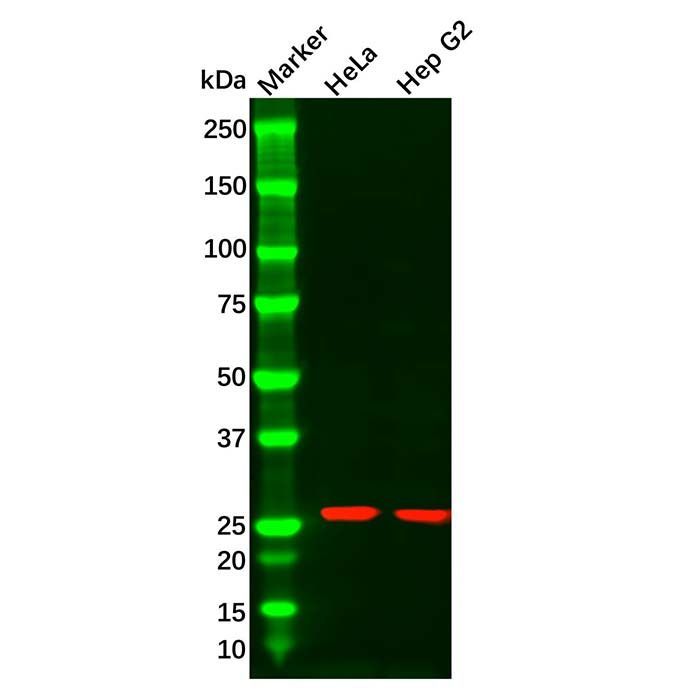
WB: HeLa and HepG2 cell lysates.
Coniugazione
Unconjugated
Grado
Azide Free, Carrier Free, ExactAb™, High Performance, Validated
Isotipo
Mouse IgG2b
Tipo di catena leggera
kappa
SDS-PAGE
150 kDa
Metodo di purificazione
Protein A + Protein G purified
Concentrazione
See COA
Product Line
Prodotti biologici
Stoccaggio e spedizione
Forma
Liquid
Condizioni di conservazione di stoccaggio
Store at -20°C,Avoid repeated freezing and thawing
Spedito in
Ice chest + Ice pads
Stabilità e conservazione
Store at 4℃ short term (1-2 weeks). Store at -20℃ long term (24 months). Upon receipt, it is recommended to aliquot. Avoid freeze/thaw cycle.
Immagini
Hsp27 Mouse mAb (Ab108837) - Western Blot All lanes: Hsp27 Mouse mAb (Ab108837) at 1/1000 dilution Samples: Lysates at 20 µg per lane Secondary: Goat Anti-Mouse IgG H&L (HRP) (Ab138040) at 1/20000 dilution
Predicted band size: 37 kDa Observed band size: 37 kDa Exposure time: 1.35 s
Applicazione
Applicazione
Dilution info
WB
0.01-2 µg/mL
Dati avanzati
Obiettivi associati (umani)
HSPB1TchemHeat shock protein beta-1 (0 Activities)
Determine the necessary mass, volume, or concentration for preparing a solution.
Dilution Calculator
Determine the dilution needed to prepare a stock solution.
Reconstitution Calculator
Recensioni
Recensioni dei clienti
Application Protocols
Item-specific tested applications and recommended dilutions: Not specified for this item; refer to product datasheet/CoA.
General guidance (literature/general knowledge; not item-specific recommendations):
Western blot: Start-range screening often spans 1:500–1:2,000 for primary antibodies, adjusting by antigen abundance and detection sensitivity. Confirm for this SKU before use.
IHC/IF: Optimization typically involves antigen retrieval choice, permeabilization conditions, and primary antibody titration across 1:100–1:800. Tissue/cell context dictates optimal conditions.
IP/Co-IP: Pilot titrations based on lysate protein load and desired pull-down efficiency; use gentle lysis buffers to preserve chaperone complexes.
Because no validated applications are listed for Ab108837, users should establish assay-specific conditions empirically and document the workflow for reproducibility. Always include appropriate positive/negative controls.
Biological Roles
The antibody targets Hsp27 (HSPB1) (target details are general literature information; item-specific epitope/clone are not provided).
General biology of Hsp27/HSPB1 (literature/general knowledge):
Hsp27 is a small heat shock protein functioning as an ATP-independent molecular chaperone. It forms dynamic oligomers that assist in protein folding and prevent aggregation under cellular stress (heat, oxidative, proteotoxic stress).
It interacts with elements of the cytoskeleton (actin, intermediate filaments), influencing cell shape and motility. Oligomerization state correlates with chaperone activity and is modulated by phosphorylation (e.g., at Ser15, Ser78, Ser82 in human HSPB1) via MAPKAPK2/3 downstream of p38 MAPK.
Roles in proteostasis: sequestration of unfolded proteins, facilitation of autophagic and proteasomal pathways, and regulation of apoptosis through interactions with apoptotic mediators.
Expression is inducible by heat shock factor pathways (HSF1). Basal and stress-induced levels vary by tissue and cell type.
Utility of anti-Hsp27 antibodies (general):
Enable detection and quantification of Hsp27 expression dynamics in cell and tissue lysates.
Facilitate studies of stress responses, cytoskeletal regulation, and proteostasis networks.
Note: Species reactivity, cross-reactivity, and application validation for SKU Ab108837 are not specified and must be confirmed experimentally or via the product datasheet.
Buffer Applications
As a protein reagent, the product is used within biological buffer systems rather than serving as a buffer itself.
Item-specific buffer details: Not specified for this item; refer to CoA/Spec Sheet.
General buffer guidance for monoclonal antibodies (literature/general knowledge):
Working buffers: PBS (pH 7.2–7.4) or TBS (pH 7.4–8.0). Include 0.05–0.1% Tween-20 for wash steps in immunoassays to minimize nonspecific binding.
Blocking solutions: 1–5% nonfat dry milk or 1–3% BSA for Western blot; serum or commercial protein blockers for IHC/IF as appropriate. For Carrier Free antibodies, prepare blockers fresh to avoid introducing carriers unless desired.
Storage buffers: If maintaining in liquid form, consider adding 10–50% glycerol and stabilizers (sugar/polyols) and store at ≤-20°C. Ensure additives are compatible with downstream assays (e.g., avoid azide for HRP-based detection or live-cell applications).
Antigen retrieval (IHC): Choice of citrate (pH ~6) or Tris-EDTA (pH ~9) buffers depends on tissue fixation and epitope; optimization is required per antibody/epitope and is not specified for this SKU.
Always validate buffer composition in pilot experiments and document any changes for reproducibility.
Green Alternatives
Green chemistry comparisons are typically applied to solvents and reagents used in synthesis. For antibodies, sustainability considerations center on formulation, handling, and waste reduction.
General considerations (literature/general knowledge):
Use minimal volumes and right-size experiment scale to reduce protein waste.
Prefer phosphate- or Tris-based aqueous buffers over organic co-solvents that may require special disposal.
Choose non-azide preservatives compatible with your assay (e.g., low concentrations of ProClin alternatives) if preservation is necessary; validate for environmental and safety profiles. Note: This item is Azide Free by design.
Implement reusable cold packs and insulated shippers, and consolidate orders to reduce shipping footprint. The item ships on cold packs as specified.
Decontaminate and recycle plasticware where institutional programs allow, after appropriate bio-deactivation.
Trade-offs:
Adding stabilizers (glycerol, sugars) can improve longevity and reduce waste from degradation, but may impact downstream enzymatic assays or require different disposal routes. Balance stability benefits against assay compatibility.
Pharmaceutical Uses
For research use only (as stated in Product Data). Not for diagnostic or therapeutic use.
General formulation context (literature/general knowledge; not a claim for this item):
Monoclonal antibodies used in pharmaceutical development typically require stringent control of attributes such as glycosylation, charge variants, aggregation, and endotoxin. Stabilizing excipients may include sugars (trehalose, sucrose), amino acids (histidine, arginine), and surfactants (polysorbates) under aseptic manufacturing and cGMP.
Relevance to this SKU:
The grades “Carrier Free” and “Azide Free” indicate flexibility for custom conjugation and cell-based research workflows but do not imply any cGMP status or suitability for clinical applications. No pharmacopeial compliance or clinical-use designation is provided for this item.
Physical Properties
Item-specific facts (from Product Data)
Appearance: Not specified for this item; refer to CoA/Spec Sheet.
Concentration: Not specified for this item; refer to CoA/Spec Sheet.
Formulation/buffer: Not specified for this item; refer to CoA/Spec Sheet.
General properties for antibodies (literature/general knowledge; not item-specific specs)
Typical molecular mass: ~150 kDa for full-length IgG; actual value varies with isotype and glycosylation.
Isoelectric point (pI): commonly ~6–9 depending on sequence and glycosylation.
Solubility: Monoclonal antibodies are water-soluble proteins; high solubility in physiological buffers (e.g., PBS, TBS) with added stabilizers (e.g., sugars, amino acids) when needed. Solubility and stability are sequence- and formulation-dependent.
Stability considerations: Freeze–thaw cycles can induce aggregation; storage at -20°C or below minimizes proteolysis and deamidation. For short-term use, 2–8°C storage can be appropriate if formulation supports it; follow item-specific guidance when available.
Notes: Any specific values (pH, excipients, protein concentration, UV A280 extinction coefficient) are not provided for this SKU and should be confirmed from the Certificate of Analysis (CoA) or Specification Sheet.
Quality and Grades
Item-specific grades (from Product Data)
Carrier Free: Formulation contains no added carrier proteins (e.g., BSA), improving signal-to-noise in sensitive assays and enabling downstream conjugations or functional studies without carrier interference.
ExactAb™: Denotes a high-performance, precisely engineered/validated antibody offering lot-to-lot consistency. (Brand/line attribute; consult product brochure for exact criteria.)
Azide Free: Lacks sodium azide preservative—compatible with live-cell assays, enzymatic reactions, or downstream conjugation chemistries where azide would be inhibitory or reactive.
Validated; High Performance: Indicates this antibody has undergone performance verification in relevant applications. Specific validated applications, species reactivity, and clone data are not specified for this item; refer to the datasheet.
Implications for users (general guidance)
The absence of carrier protein and azide increases flexibility for labeling (e.g., HRP, fluorophores) and functional assays but necessitates stricter aseptic technique and potentially the addition of user-selected stabilizers (e.g., trehalose) if long-term storage in liquid form is intended.
For regulated workflows, retain CoA/Spec documentation for the exact lot. Do not assume isotype, concentration, or endotoxin levels—these are not specified for this item and must be verified on the CoA.
Reaction and Applications
This product is an analytical/biological reagent (mouse monoclonal antibody) rather than a small-molecule reactant or catalyst.
Item-specific applications: Not specified for this item; refer to the product datasheet for validated techniques and species.
General use contexts for anti-Hsp27 antibodies (literature/general knowledge; not item-specific claims):
Immunoblotting (Western blot) to detect HSPB1 levels and phosphorylation-state changes when paired with appropriate phospho-specific antibodies or treatments.
Immunofluorescence/ICC and IHC to monitor Hsp27 localization and expression patterns under stress conditions.
Immunoprecipitation and co-IP to study Hsp27-containing chaperone complexes.
Because no validated application list or conditions are provided for this SKU, users should perform in-house optimization (antibody dilution, incubation times, antigen retrieval) and consult the CoA/Spec Sheet for any lot-specific recommendations.
Reaction Conditions
Not typically applicable to antibodies. There are no chemical reaction conditions specified for this SKU.
General handling conditions for immunoassays (literature/general knowledge; not item-specific):
Incubation temperatures: Commonly 4°C overnight or room temperature for 1–2 h for binding steps, depending on assay format (WB, IHC, IF, IP). Optimize empirically.
Buffers: PBS or TBS with appropriate blocking agents and detergents. Maintain isotonicity and pH ~7–8 to preserve protein structure.
Avoid harsh conditions (high organic content, extreme pH) that denature antibodies unless purposefully applied for elution in affinity workflows, followed by immediate neutralization.
Because no validated applications or conditions are provided for Ab108837, consult the product datasheet and perform pilot optimizations.
Safety and Handling
Item-specific hazard data
GHS classification: Not specified for this item; refer to SDS.
Signal word / H-statements / Pictograms: Not specified for this item; refer to SDS.
General safety guidance for antibodies (literature/general knowledge)
Antibodies are proteinaceous, non-volatile materials and generally present low inherent chemical hazard. However, treat all laboratory reagents as potentially hazardous and handle according to good laboratory practice (GLP).
Personal protective equipment (PPE): Lab coat, gloves (nitrile), and safety glasses. Use biological safety cabinet when handling in cell culture or potentially biohazardous matrices.
Avoid repeated freeze–thaw cycles (explicitly noted in Product Data) to prevent aggregation and loss of activity.
Storage incompatibilities: Avoid microbial contamination (use sterile technique); do not mix with oxidants, strong acids/bases, or proteases. Carrier Free/Azide Free format lacks antimicrobial preservative—exercise aseptic handling to prevent bioburden.
First-aid overview: In case of contact with eyes/skin, rinse with water. If inhaled (aerosols), move to fresh air. If ingested, rinse mouth. Seek medical advice as needed. These are general precautions; consult the SDS for authoritative instructions.
Waste disposal: Dispose of antibody solutions and consumables according to institutional biosafety and local regulations. Decontaminate surfaces with appropriate disinfectants.
Always defer to the Safety Data Sheet (SDS) accompanying the lot for definitive hazard classification and response measures.
Solvent Selection
This product is a protein reagent (mouse monoclonal antibody) and is not used as a conventional solvent. Selection considerations instead focus on reconstitution and dilution buffers.
Item-specific buffer/formulation: Not specified for this item; refer to CoA/Spec Sheet.
General buffer selection (literature/general knowledge):
Preferred: Isotonic, near-neutral buffers such as PBS (10–50 mM phosphate, 150 mM NaCl, pH 7.2–7.4) or TBS (Tris-buffered saline, pH 7.4–8.0).
Additives (if compatible with your assay): 0.1–1% recombinant HSA or BSA, 10–50% glycerol, 0.02–0.05% non-ionic surfactant (e.g., Tween-20) to reduce nonspecific adsorption and freeze–thaw damage. Since this SKU is Carrier Free and Azide Free, any additives must be user-supplied and assay-compatible.
Avoid: Strong oxidants, extremes of pH (<5 or >9) unless required by protocol; organic solvents that denature proteins; azide in peroxidase-based assays or live-cell work.
Sterility: Use sterile, low-protein-binding plasticware and 0.22 µm filtration where appropriate to maintain bioburden control in the absence of azide.
Comparison (general):
PBS vs TBS: PBS is widely used for immunoassays; TBS can reduce phosphate-mediated interactions in certain systems (e.g., alkaline phosphatase detection). Choose based on downstream detection chemistry and sample matrix.
Storage and Reconstitution
Item-specific storage (from Product Data)
Store at -20°C.
Avoid repeated freezing and thawing.
Shipped in: Ice chest + Ice pads.
Formulation and reconstitution instructions: Not specified for this item; refer to CoA/Spec Sheet.
General guidance (literature/general knowledge; not item-specific specifications):
Upon receipt: Inspect for container integrity and, if lyophilized, allow to equilibrate to room temperature before opening to minimize condensation. If in solution, keep cold and minimize time at ambient temperature.
Reconstitution (if lyophilized): Use sterile, neutral pH buffer (e.g., PBS or tris-buffered saline). Gentle mixing—avoid vortexing which can cause aggregation. Final concentration and volume should match your assay needs.
Aliquoting: Prepare single-use aliquots in low-protein-binding tubes to eliminate freeze–thaw cycles. Label with lot, concentration, and date.
Long-term storage: -20°C or below; for liquid storage, addition of cryoprotectants (e.g., 10–50% glycerol) and stabilizers can improve stability. Ensure compatibility with downstream applications (e.g., avoid azide for live-cell or peroxidase-based assays). For storage ≤-80°C, avoid frost-free freezers that cycle temperatures.
Thawing: Thaw on ice; mix gently by pipetting. Do not refreeze partially thawed vials—use fresh aliquots.
Always prioritize any lot-specific instructions provided in the CoA/Spec Sheet over general guidance.
Structure and Identity
Item-specific facts (from Product Data)
SKU: Ab108837
Product name: Hsp27 Mouse mAb
Category: Antibody (monoclonal), host: mouse
Grade/Purity: Carrier Free; ExactAb™; Azide Free; Validated; High Performance
Molecular formula: Not specified for this item; refer to CoA/Spec Sheet.
Molecular weight: Not specified for this item; refer to CoA/Spec Sheet.
SMILES: Not applicable for proteins/antibodies.
InChIKey: Not applicable for proteins/antibodies.
General structural description (literature/general knowledge)
A mouse monoclonal antibody (mAb) is an immunoglobulin protein composed of two identical heavy chains and two identical light chains forming a Y-shaped quaternary structure stabilized by disulfide bonds.
Typical domains: variable regions (VH/VL) that determine antigen binding; constant regions (CH/CL) that define isotype and Fc-mediated properties. Isotype, light-chain type, and clonality details are not specified for this item.
Target antigen: Hsp27 (also known as HSPB1), a small heat shock protein; epitope and clone information are not specified for this item.
2D/functional features (literature/general knowledge)
Antigen-binding sites reside at the tips of the Fab arms; Fc region mediates effector interactions and influences purification and detection strategies.
Because this listing is Carrier Free and Azide Free, formulation lacks protein carriers (e.g., BSA) and sodium azide preservatives—beneficial for downstream conjugation or cell-based assays sensitive to azide.
Synthetic Utility
Not typically applicable. This product is a mouse monoclonal antibody used as a biological detection or capture reagent, not a synthetic building block or catalyst.
For users planning chemical modification (general guidance):
Antibody conjugation chemistries (literature/general knowledge): NHS-ester labeling of lysines, maleimide coupling to reduced cysteines, click chemistry (azide–alkyne; note: this SKU is Azide Free, facilitating SPAAC if azide is introduced on the antibody by the user), enzymatic tagging (e.g., sortase, glycan remodeling).
Optimization focuses on maintaining antigen-binding affinity and minimizing over-labeling that can impair solubility or Fc interactions.
No item-specific functional group counts, extinction coefficients, or conjugation protocols are provided for this SKU.
Target Specificity
Item-specific target data
Antigen/epitope, clone designation, isotype, and species reactivity: Not specified for this item; refer to CoA/Spec Sheet.
General context (literature/general knowledge):
The product name indicates specificity for Hsp27 (HSPB1). However, without item-specific validation data, cross-reactivity profiles, epitope mapping, and species coverage cannot be assumed. Verify suitability with positive controls relevant to your system and consult the datasheet for any available validation evidence.
Domande frequenti
What does ExactAb? mean?
ExactAb? indicates the product has been validated for use in rigorous antibody validation workflows. Validation may include positive/negative control samples, signal-to-noise testing, and protocol-specific QC. Lot-specific test data is published on the Certificate of Analysis where available.
What does Carrier Free mean?
Carrier Free indicates that the material has been processed and tested for specialty industrial processing. Specifications focus on the impurities that affect performance in that application — for example, metal content for electronics, particle size for batteries, refractive index for optics, or moisture content for moisture-sensitive processes.
How should this product be stored?
Store at ?20 °C. Avoid repeated freeze–thaw cycles. Aliquot into single-use volumes before freezing.
How is this product shipped?
This product ships in an insulated container with ice pads. Unpack on arrival and transfer it to the storage condition stated above.
What documentation is provided?
Available product documentation, including Certificates of Analysis (COA), Safety Data Sheets (SDS), and specification sheets, is shown in the product document area. Document availability and access follow the current site policy.
Which species reactivity has this antibody been validated against?
Validated reactivity is listed on the PDP and on each lot's datasheet. We validate against the most commonly tested species for the target (Hsp27 Mouse mAb); cross-reactivity in untested species may exist but is not guaranteed. Contact technical support for specific species inquiries.
Hai bisogno di aiuto per scegliere la qualità?
La nostra guida alla selezione delle qualità copre purezza, stato dello stabilizzatore e idoneità all'applicazione per tutte le varianti del nostro catalogo.
Utilizziamo i cookie per garantire il corretto funzionamento del sito web e, ove consentito, per migliorare la tua esperienza. Puoi gestire le tue preferenze in qualsiasi momento nelle Impostazioni. Per saperne di più, consulta la nostra Cookie Policy.
Desidera che le inviamo un messaggio quando avremo sconti disponibili?
Ricordamelo più tardi
Grazie! Controlli la sua casella di posta per confermare.
Products are supplied to verified businesses, institutions, and qualified professionals for research and development use only. Not for use in humans, animals, diagnosis, or therapy.

 ZJ24F1011807