QUALITÀ & PUREZZAExactAb™?ExactAb™ — Aladdin's antibody line emphasizing precision and validated quality. Use for reliable, specificity-validated antibody applications.Validated?Validated grade — performance confirmed in defined applications before release. Use when you want documented assurance the reagent works as stated.1.0 mg/mL
Mouse anti Human Hsp40 Antibody, Monoclonal antibody (5H5-D6-H3), could be used for WB and so on. Application: WB: 1/500-1/1000 Protein Function Interacts with HSP70 and can stimulate its ATPase activity. Stimulates the association between HSC70 and HIP.
Specifiche
Product Name
Hsp40 Mouse mAb - Anticorpo primario, specific to DNAJB1, Mouse IgG1
Sinonimi
hDj-1|Heat shock 40 kDa protein 1|Heat shock protein 40|HSP40|Human DnaJ protein 1|DnaJ (Hsp40) homolog subfmaily B member 1 antibody|DNAJ 1 antibody|DNAJ B1 antibody|DnaJ heat shock protein family (Hsp40) member B1 antibody|DnaJ homolog subfamily B member 1 antibody|DnaJ protein homolog 1 antibody|DNAJ1 antibody|DNAJB 1 antibody|Dnajb1 antibody|DNAJB1 protein antibody|HDJ-1 antibody|HDJ1 antibody|Heat shock 40 kDa protein 1 antibody|Heat shock 40kD protein 1 antibody|Heat shock protein 40 antibody|Hsp 40 antibody|HSP40 antibody|HSPF 1 antibody|HSPF1 antibody|Human DnaJ protein 1 antibody|Radial spoke 16 homolog B antibody|RSPH16B antibody|Sis1 antibody|DnaJ (Hsp40) homolog, subfamily B, member 1|DnaJ (Hsp40) homolog, subfmaily B, member 1|dnaJ homolog subfamily B member 1|DNAJ1|DNAJB1|Hdj1|heat shock 40kD protein 1|HSPF1|HSPF1Hdj1|radial spoke 16 homolog B|RSPH16B|Sis1
Specifiche e purezza
ExactAb™, Validated, 1.0 mg/mL
Specie ospite
Mouse
Specificità
DNAJB1
Immunogeno
Recombinant Protein of Hsp40.
Controllo positivo
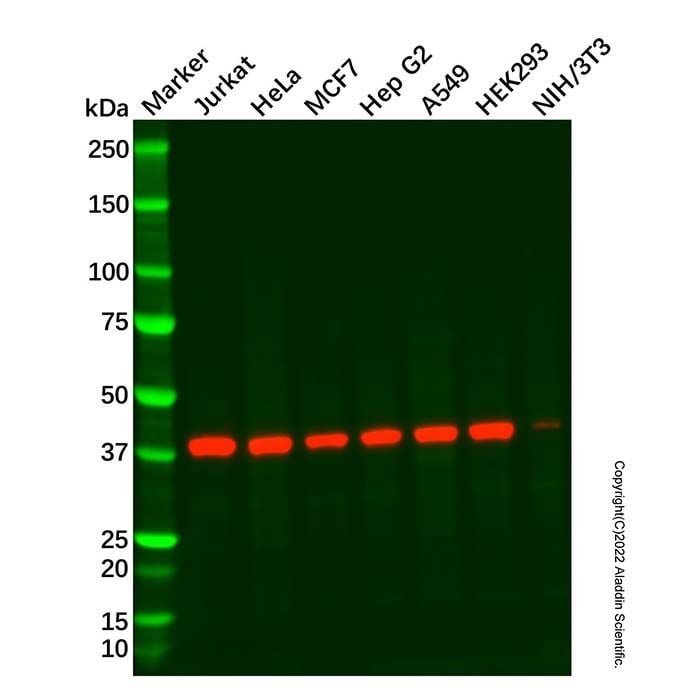
WB: Jurkat, HeLa, MCF7, Hep G2, A549, HEK293 and NIH/3T3 cell lysates.
Coniugazione
Unconjugated
Grado
ExactAb™, Validated
Isotipo
Mouse IgG1
Tipo di catena leggera
kappa
SDS-PAGE
150 kDa
Metodo di purificazione
Protein G purified
Concentrazione
1.0 mg/mL
Product Line
Prodotti biologici
Stoccaggio e spedizione
Forma
Liquid
Condizioni di conservazione di stoccaggio
Store at -20°C,Avoid repeated freezing and thawing
Spedito in
Ice chest + Ice pads
Stabilità e conservazione
Store at 4°C short term (1-2 weeks). Store at -20°C long term (24 months). Upon receipt, it is recommended to aliquot. Avoid freeze/thaw cycle.
Immagini
Hsp40 Mouse mAb (Ab108854) - Western Blot All lanes: Hsp40 Mouse mAb (Ab108854) at 1/1000 dilution Samples: Lysates at 20 µg per lane Secondary: Goat Anti-Mouse IgG H&L (HRP) (Ab179001) at 1/20000 dilution
Predicted band size: 38 kDa Observed band size: 40 kDa Exposure time: 36.9 s
Applicazione
Applicazione
Dilution info
WB
1/500-1/1000
Dati avanzati
Obiettivi associati (umani)
DNAJB1TbioDnaJ homolog subfamily B member 1 (0 Activities)
Determine the necessary mass, volume, or concentration for preparing a solution.
Dilution Calculator
Determine the dilution needed to prepare a stock solution.
Reconstitution Calculator
Recensioni
Recensioni dei clienti
Application Protocols
Item-specific, tested applications
Manufacturer Applications: Not specified for this item; refer to CoA/Spec Sheet.
General protocol outlines (literature/general; adapt to your assay and verify against datasheet)
Western Blot (WB):
Prepare lysates (RIPA or appropriate buffer with protease inhibitors). 2) Run SDS-PAGE and transfer to PVDF or nitrocellulose. 3) Block 1 h in 5% BSA or milk in TBS-T/PBS-T. 4) Incubate with primary antibody at optimized dilution for 1 h RT or overnight 4°C. 5) Wash 3–5× in TBS-T/PBS-T. 6) Incubate with species-matched secondary. 7) Develop chemiluminescently or fluorescently.
Immunofluorescence (IF)/ICC:
Fix cells (4% PFA), permeabilize (0.1–0.3% Triton X-100) if needed. 2) Block with serum/BSA. 3) Incubate with primary (1–16 h, 4–25°C). 4) Wash and add fluorophore-conjugated secondary. 5) Mount with antifade; image promptly.
IHC (FFPE):
Deparaffinize/rehydrate. 2) Antigen retrieval (citrate pH ~6 or Tris-EDTA pH ~9; optimize). 3) Block endogenous peroxidase if using HRP. 4) Block nonspecific sites. 5) Primary incubation. 6) Detection with HRP/DAB or fluorescence. 7) Counterstain and mount.
IP/Co-IP:
Incubate lysate with antibody. 2) Capture on protein A/G beads. 3) Wash stringently. 4) Elute and analyze by WB/MS as appropriate.
Note
Optimize dilutions, incubation times, and retrieval/permeabilization for your sample type. Use the CoA/Spec Sheet for any item-specific recommendations.
Biological Roles
Scope
The following summarizes general biology of Hsp40/DNAJ family proteins and is not a claim about this specific product’s target epitope or performance.
General/literature overview of Hsp40 (DNAJ family)
Function: Hsp40 (DNAJ) proteins are co-chaperones that stimulate Hsp70 ATPase activity, facilitating protein folding, refolding of stress-denatured proteins, and triage of misfolded proteins to degradation pathways.
Diversity: The DNAJ family comprises multiple isoforms (DNAJA, DNAJB, DNAJC subfamilies) with distinct domain architectures (J-domain, G/F-rich regions, and various C-terminal motifs) that confer client selectivity and subcellular localization.
Pathways: Involved in proteostasis networks, ER-associated degradation (ERAD), mitochondrial protein import/folding, and stress responses (heat shock, oxidative stress).
Interactions: Hsp40 binds client proteins and delivers them to Hsp70, regulating folding cycles via its conserved HPD motif in the J-domain.
Experimental readouts: Changes in Hsp40 levels or localization are commonly used as markers for cellular stress and proteostasis capacity.
Application relevance
Antibodies against Hsp40 family members enable assessment of chaperone expression dynamics, complex formation (with Hsp70 and co-factors), and subcellular distribution under defined perturbations.
Note
Isoform-specific roles can vary widely; verify the exact isoform/epitope recognized by this SKU on the CoA/Spec Sheet before drawing biological conclusions.
Buffer Applications
Applicability
This section focuses on practical buffer systems for typical antibody workflows. Item-specific buffer composition/diluents are not provided and should be confirmed on the CoA/Spec Sheet.
General buffer systems (literature/general)
Western Blot: Transfer/wash in TBS-T or PBS-T (0.05–0.1% Tween-20). Block with 3–5% BSA or nonfat dry milk (optimize to reduce background). Primary antibody diluted in blocking buffer or TBS-T/PBS-T.
Immunohistochemistry (FFPE): Antigen retrieval in citrate buffer pH ~6.0 or Tris-EDTA pH ~9.0 (optimize). Wash in TBS-T/PBS-T. Blocking with serum or protein blockers to control non-specific binding.
Immunofluorescence: PBS or HBSS for washes; permeabilization with 0.1–0.3% Triton X-100 or saponin as needed. Include 1–5% serum or BSA to reduce background.
ELISA: Coating in carbonate–bicarbonate buffer pH 9.4–9.6 or PBS; blocking with BSA/casein; sample/antibody diluents in PBS/TBS with detergent to reduce nonspecific binding.
Compatibility notes
Sodium azide: Interferes with HRP activity; use azide-free buffers for HRP-based detection and live-cell work.
Divalent cations: Some assays (e.g., lectin interactions or nucleases in crude extracts) can be influenced by Mg2+/Ca2+; generally keep antibody buffers chelator-free unless required.
Recommendation
Titrate antibody and adjust salt/detergent levels empirically to maximize signal-to-noise for your specific sample matrix.
Green Alternatives
Context
As an aqueous antibody reagent, conventional solvent substitution is not a primary concern. Environmental impact focuses on cold-chain logistics, plastic consumables, and buffer/preservative choices.
Greener practices (general)
Shipping and storage: Consolidate orders to reduce cold-chain shipments. Use energy-efficient freezers and maintain proper inventory to minimize unnecessary door openings.
Buffer selection: Use phosphate- or Tris-based buffers prepared with high-purity water. Avoid excessive biocides; adopt azide-free, single-use aliquots where feasible to reduce hazardous waste.
Waste minimization: Right-size experiments and aliquots to cut consumable waste. Employ reusable, autoclavable racks and minimize single-use plastic when biosafety allows.
Detection systems: Consider substrate and fluorophore choices with lower hazard classifications and aqueous, non-aromatic mounting media.
Comparison table (general)
Azide-preserved stock vs azide-free aliquots: Azide preserves multi-use vials but generates hazardous waste and is incompatible with live-cell/HRP systems. Azide-free aliquots improve compatibility and reduce hazardous waste at the expense of shorter open-vial stability.
Note
No item-specific formulation or preservative data are provided; refer to the CoA/Spec Sheet for this SKU before implementing changes.
Pharmaceutical Uses
Applicability
This product is labeled For research use only and is not intended for diagnostic, therapeutic, or clinical use.
General context (literature/general)
Monoclonal antibodies can serve as analytical reagents in biopharmaceutical development workflows, including process monitoring (e.g., Western blotting of stress markers) and characterization assays in preclinical research.
Formulation considerations for therapeutic antibodies (buffer selection, stabilizers, excipients) are not applicable to this research reagent and should not be inferred from it.
Notes for regulated environments
If used in QC-relevant research settings, document lot numbers, storage history, and qualification data under your institution’s research-quality system.
This SKU provides no pharmacopeial status or cGMP compliance claims.
Item-specific claims
None. No clinical or diagnostic suitability is claimed or implied for this product.
Physical Properties
Item-specific facts (from Product Data)
Physical state/appearance, concentration, buffer composition, and exact molecular weight: Not specified for this item; refer to CoA/Spec Sheet.
General/literature characteristics for monoclonal antibodies
Apparent molecular mass (SDS-PAGE, reducing): Heavy chain ~50 kDa, light chain ~25 kDa; intact IgG ~150 kDa (literature, typical).
Solubility: Readily soluble in aqueous buffers (e.g., PBS, TBS) (general).
Isoelectric point (pI): Commonly ~6–9 depending on isotype and sequence (literature range).
Stability: Enhanced by neutral pH buffers, protein stabilizers (e.g., BSA), sugars (e.g., trehalose), and cryoprotectants (e.g., glycerol) (general guidance; not item-specific unless stated on CoA).
Aggregation: Can occur upon repeated freeze–thaw or exposure to extremes of pH, temperature, or mechanical stress; filter (0.22 µm) cautiously if required to remove particulates.
Handling implications
Avoid vigorous vortexing or foaming to limit denaturation.
For accurate assay performance, match diluent ionic strength and pH to the intended application (WB/IHC/IF/FC).
Notes
No item-specific refractive index, density, pKa, or logP are applicable to antibodies.
Where concentration (mg/mL) or formulation (e.g., PBS, 0.05% sodium azide) matters for your protocol, consult the CoA/Spec Sheet for this SKU.
Quality and Grades
Item-specific facts (from Product Data)
Grade/Purity: ExactAb™, Validated.
Additional specifications (clone, isotype, host, light chain type, antigen/epitope, purity method, concentration): Not specified for this item; refer to CoA/Spec Sheet.
Meaning of the designations (general)
ExactAb™: Vendor designation indicating a high-quality monoclonal antibody meeting defined internal standards for identity and performance. Specific criteria (e.g., purity, binding qualification, lot-to-lot consistency) should be confirmed on the CoA.
Validated: Indicates the antibody has undergone application-specific verification (e.g., WB, IHC, IF, ELISA) by the manufacturer or internal QC. The precise validated applications, sample types, and expected bands/staining patterns must be checked on the product datasheet.
Practical implications
Batch-to-batch consistency: Monoclonal production supports consistent epitope recognition; nonetheless, verify lot performance in your assay matrix.
Purity and formulation: Purification methods (Protein A/G, size-exclusion) and additives (e.g., BSA, glycerol, azide) affect downstream compatibility (e.g., mass spectrometry, live-cell staining). Confirm on the CoA before sensitive applications.
Documentation: Use the CoA to capture lot number, concentration (mg/mL), storage buffer, and recommended dilution ranges for traceability and reproducibility.
Recommendation
When transferring methods or comparing data across labs, lock the lot and document storage history (freeze–thaw cycles, aliquot dates) to preserve the benefits of the ExactAb™, Validated grade.
Reaction and Applications
Not a chemical reagent for synthetic transformations.
Item-specific facts (from Product Data)
Manufacturer Applications: Not specified for this item; refer to CoA/Spec Sheet.
General/literature applications for anti-Hsp40 (DNAJ family) antibodies
Western blot (WB): Detection of Hsp40 family proteins in cell/tissue lysates to monitor chaperone expression under heat shock or proteotoxic stress conditions.
Immunofluorescence (IF)/Immunocytochemistry (ICC): Cellular localization studies (e.g., cytosolic vs organellar DNAJ isoforms) following fixation and permeabilization protocols optimized per cell type.
Immunohistochemistry (IHC): Tissue-level distribution of Hsp40 isoforms in formalin-fixed paraffin-embedded (FFPE) or frozen sections with antigen retrieval conditions tuned to the epitope.
Immunoprecipitation (IP)/Co-IP: Enrichment of Hsp40 complexes to study interactions with Hsp70 and client proteins.
ELISA: Quantification of Hsp40 in samples using capture/detection pairs when available.
Practical tips (general)
Validate species reactivity and isoform specificity with positive/negative controls and siRNA/CRISPR knockout where possible.
Stress induction (e.g., heat shock) can be used to upregulate chaperones as positive controls.
Note
The exact tested/validated applications for this particular SKU are not provided here; consult the product datasheet.
Reaction Conditions
Not a chemical reaction reagent
This antibody is not intended to participate in chemical reactions in the synthetic sense.
General assay conditions (literature/general)
Western Blot: Primary incubations typically 1–16 h at 4–25°C in blocking buffer; gentle agitation recommended. Washes with TBS-T/PBS-T (3–5 cycles, 5–10 min each). Optimize antibody dilution empirically.
IHC (FFPE): Primary incubation 1–16 h at room temperature or 4°C, following optimized antigen retrieval (citrate pH ~6 or Tris-EDTA pH ~9). Use appropriate secondary and detection chemistry (HRP/DAB or AP/fluorescence) compatible with buffer composition.
IF/ICC: Incubate primary 1–2 h at room temperature or overnight at 4°C; permeabilize/fix as required for epitope exposure. Protect fluorophores from light.
IP/Co-IP: Incubate lysates with antibody 1–4 h (or overnight) at 4°C; capture with protein A/G resin suited to the antibody isotype; wash stringently to reduce nonspecific binding.
Caveats
The above are general conditions and not validated for this specific SKU. Exact tested conditions, recommended dilutions, and positive controls are Not specified for this item; refer to CoA/Spec Sheet.
Always verify species reactivity, isotype compatibility with secondary reagents, and the presence/absence of preservatives (e.g., azide) for enzyme-based detections.
Safety and Handling
Item-specific hazard data (from Product Data)
GHS Classification, Signal Word, H-Statements, Pictograms: Not specified for this item; refer to SDS.
Storage Conditions: Store at -20°C; avoid repeated freezing and thawing.
Shipping: Ice chest + Ice pads (cold pack).
General safety guidance for antibody reagents (literature/general)
Typical hazards: Antibody solutions are generally considered low hazard but may contain preservatives (e.g., sodium azide) or buffers requiring standard lab precautions. Always review the SDS for the specific lot/formulation.
PPE: Laboratory coat, gloves, and safety glasses are recommended during handling and dispensing to avoid exposure or contamination.
Incompatibilities: Avoid contact with strong oxidizers. Do not mix with disinfectants that can react with azide-containing buffers. Prevent microbial contamination by using sterile tools.
First aid (general): If skin contact occurs, wash with soap and water. If eye contact, rinse cautiously with water for several minutes. If inhaled as aerosol, move to fresh air. If ingested, rinse mouth and seek medical advice. Follow institutional EHS procedures.
Spill response: Absorb liquid with inert material (e.g., paper towel), clean area with appropriate laboratory disinfectant. Dispose according to local regulations.
Special risks: Repeated freeze–thaw can generate aggregates and reduce performance. Aliquot upon first thaw to minimize cycles.
Authoritative source
For definitive classification, component hazards, and disposal considerations, consult the product SDS and your institutional guidelines.
Solvent Selection
Applicability to this product
This is an aqueous biological reagent (mouse monoclonal antibody). Traditional organic solvent “selection” is not typically applicable.
General guidance (literature/general)
Preferred diluents: Isotonic aqueous buffers such as PBS or TBS at neutral pH (7.2–7.6) are commonly used for dilution and storage. Include carrier proteins (e.g., 0.1–1% BSA) and mild detergents (e.g., 0.05–0.1% Tween-20) when appropriate for assay background reduction.
Avoid: High percentages of organic solvents (acetone, acetonitrile, methanol, DMSO) that can denature proteins. Trace amounts of DMSO present in antigen stocks usually do not affect antibody integrity if diluted sufficiently.
Special cases: For IHC/IF, detergents influence membrane permeability and epitope exposure; select buffers accordingly (e.g., TBS-T for WB, PBS with 0.1% Triton X-100 for permeabilization if compatible with the epitope).
Comparison (general considerations)
PBS vs TBS: TBS may reduce background in phosphoprotein blots and when phosphate interferes with detection chemistries. PBS is widely compatible with most immunoassays and cell-associated antigens.
Azide presence: Sodium azide preserves liquid formulations but quenches HRP and is toxic to cells. For live-cell staining or HRP-based detection, use azide-free buffers.
Note
For this SKU’s exact buffer compatibility and formulation, consult the CoA/Spec Sheet.
Storage and Reconstitution
Item-specific facts (from Product Data)
Storage Conditions: Store at -20°C; avoid repeated freezing and thawing.
Shipping: Ice chest + Ice pads (cold pack).
Appearance, formulation buffer, concentration, and preservatives: Not specified for this item; refer to CoA/Spec Sheet.
General handling recommendations (literature/general)
Upon receipt: Inspect for container integrity and note lot number and arrival condition. Spin briefly to collect contents before first use.
Aliquoting: To prevent performance loss from freeze–thaw cycles, aliquot into single-use volumes on first thaw. Use sterile, low-protein–binding tubes.
Storage options: For long-term storage, -80°C often provides improved stability versus -20°C, especially for azide-free formulations. For working stocks, 4°C short-term (days to a week) may be acceptable if preservative is present; verify on datasheet.
Stabilizers: If compatible with downstream assays, consider adding carrier protein (e.g., 0.1–1% BSA), sugars (e.g., 5–10% trehalose), or glycerol (up to 50%) to enhance freeze–thaw stability. Only adjust formulation if permitted by your assay and after consulting the CoA.
Thawing: Thaw on ice. Mix gently by inversion; avoid foaming. Do not vortex aggressively.
Reconstitution
If supplied lyophilized (not specified here), reconstitute with sterile water or buffer as directed on the CoA to the desired concentration. Allow to fully dissolve on ice; gently mix to homogenize.
Documentation
Record aliquot maps, storage temperatures, and number of freeze–thaw events to maintain reagent integrity over the life of the lot.
Structure and Identity
Item-specific facts (from Product Data)
Product: Hsp40 Mouse mAb (SKU: Ab108854)
Type: Mouse monoclonal antibody
Grade: ExactAb™, Validated
CAS, CID, InChIKey, SMILES, Molecular Formula, Molecular Weight: Not specified for this item; refer to CoA/Spec Sheet.
General notes (antibody identity; literature/general)
Monoclonal antibodies are Y-shaped immunoglobulins composed of two heavy and two light chains with defined variable regions that recognize a specific epitope.
“Hsp40” commonly refers to the DNAJ/Hsp40 co-chaperone family that partners with Hsp70; however, the precise isoform/epitope for this item is not provided here.
Mouse mAb typically denotes a defined clone produced from a single B-cell–derived hybridoma, conferring batch-to-batch epitope specificity and affinity.
2D/structural description in words (general for IgG-type mAbs)
The antibody consists of two identical Fab arms (antigen-binding) and one Fc region (effector/constant) held by disulfide bonds. Variable domains (VH/VL) at the tips of each Fab provide epitope recognition; constant domains (CH/CL) define isotype and effector function. Glycosylation on the Fc is common and can influence stability and binding to Fc receptors.
Notes
As a biologic macromolecule, small-molecule identifiers (SMILES, InChI) are typically not applicable. For clone, isotype, and antigen details, consult the CoA/Spec Sheet.
Synthetic Utility
Not applicable
This is a biological reagent (mouse monoclonal antibody) and is not used as a building block, catalyst, or reagent in chemical synthesis.
Related laboratory utility (general)
Functional utility resides in target recognition and immunoassay signal generation rather than chemical reactivity. Antibodies may be conjugated (enzymes, fluorophores, biotin) for detection; conjugation strategies (e.g., NHS-ester labeling of lysines, site-specific Fc glycan remodeling) are general techniques but are not item-specific to this SKU unless explicitly stated on the datasheet.
Note
No item-specific conjugation, labeling degree (DOL), or reactive tag information is provided; consult the CoA/Spec Sheet if a conjugated version exists.
Target Specificity
Item-specific facts (from Product Data)
Target antigen, clone ID, epitope mapping, isotype, and species reactivity: Not specified for this item; refer to CoA/Spec Sheet.
General context (for orientation only)
“Hsp40” typically refers to members of the DNAJ/Hsp40 co-chaperone family that regulate Hsp70 ATPase activity. However, without item-specific data, no assertions can be made about which isoform or epitope this antibody recognizes.
Recommendation
Consult the product CoA/Spec Sheet for: antigen (isoform and species), immunogen description (peptide/protein domain), validated species, predicted cross-reactivity, and positive control tissues/cell lines.
Domande frequenti
What does ExactAb? mean?
ExactAb? indicates the product has been validated for use in rigorous antibody validation workflows. Validation may include positive/negative control samples, signal-to-noise testing, and protocol-specific QC. Lot-specific test data is published on the Certificate of Analysis where available.
What does Validated mean?
Validated indicates the product has been validated for use in rigorous antibody validation workflows. Validation may include positive/negative control samples, signal-to-noise testing, and protocol-specific QC. Lot-specific test data is published on the Certificate of Analysis where available.
How should this product be stored?
Store at ?20 °C. Avoid repeated freeze–thaw cycles. Aliquot into single-use volumes before freezing.
How is this product shipped?
This product ships in an insulated container with ice pads. Unpack on arrival and transfer it to the storage condition stated above.
What documentation is provided?
Available product documentation, including Certificates of Analysis (COA), Safety Data Sheets (SDS), and specification sheets, is shown in the product document area. Document availability and access follow the current site policy.
Which species reactivity has this antibody been validated against?
Validated reactivity is listed on the PDP and on each lot's datasheet. We validate against the most commonly tested species for the target (Hsp40 Mouse mAb); cross-reactivity in untested species may exist but is not guaranteed. Contact technical support for specific species inquiries.
Hai bisogno di aiuto per scegliere la qualità?
La nostra guida alla selezione delle qualità copre purezza, stato dello stabilizzatore e idoneità all'applicazione per tutte le varianti del nostro catalogo.
Utilizziamo i cookie per garantire il corretto funzionamento del sito web e, ove consentito, per migliorare la tua esperienza. Puoi gestire le tue preferenze in qualsiasi momento nelle Impostazioni. Per saperne di più, consulta la nostra Cookie Policy.
Desidera che le inviamo un messaggio quando avremo sconti disponibili?
Ricordamelo più tardi
Grazie! Controlli la sua casella di posta per confermare.
Products are supplied to verified businesses, institutions, and qualified professionals for research and development use only. Not for use in humans, animals, diagnosis, or therapy.

 ZJ24F0505908