QUALITÀ & PUREZZACarrier Free?Carrier-free — supplied without added carrier protein/stabilizer. Use when carriers (e.g. BSA) would interfere with conjugation or sensitive assays.ExactAb™?ExactAb™ — Aladdin's antibody line emphasizing precision and validated quality. Use for reliable, specificity-validated antibody applications.Validated?Validated grade — performance confirmed in defined applications before release. Use when you want documented assurance the reagent works as stated.1.0 mg/mL
Rabbit anti Human IgA Antibody, Polyclonal, could be used for IHC and so on. Application IHC: 1/50-1/100 Relevance Ig alpha is the major immunoglobulin class in body secretions. It may serve both to defend against local infection and to prevent access of foreign antigens to the general immunologic system.
Specifiche
Product Name
IgA Antibody - Anticorpo primario, specific to IgA, Rabbit IgG
Sinonimi
FLJ14473 antibody|FLJ35065 antibody|FLJ35500 antibody|FLJ36402 antibody|FLJ39698 antibody|FLJ40001 antibody|FLJ41548 antibody|FLJ41552 antibody|FLJ41789 antibody|FLJ43248 antibody|FLJ43594 antibody|FLJ44293 antibody|FLJ46028 antibody|FLJ46621 antibody|FLJ46724 antibody|IgA1 antibody|Igh2 antibody|IGHA1 antibody|IGHA2 antibody|Immunoglobulin heavy constant alpha 1 antibody|Immunoglobulin heavy constant alpha 2 (A2m marker) antibody|Immunoglobulin heavy constant alpha 2 antibody|IgA|Immunoglobulin A
Specifiche e purezza
ExactAb™, Validated, Carrier Free, 1.0 mg/mL
Specie ospite
Coniglio
Specificità
IgA
Immunogeno
Full length protein corresponding to Human IgA.
Controllo positivo
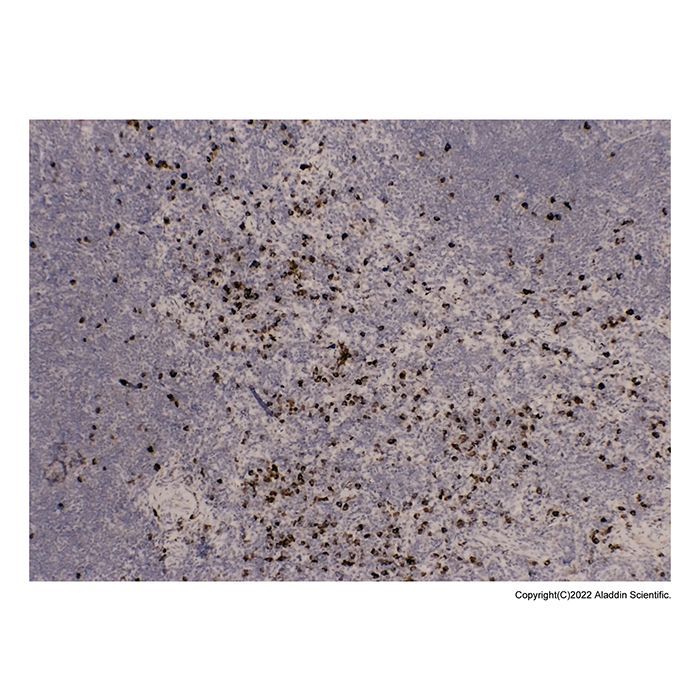
IHC: Human tonsil tissue.
Coniugazione
Unconjugated
Grado
Carrier Free, ExactAb™, Validated
Isotipo
Rabbit IgG
SDS-PAGE
150 kDa
Metodo di purificazione
Protein A purified
Concentrazione
1.0 mg/mL
Product Line
Prodotti biologici
Stoccaggio e spedizione
Forma
Liquid
Condizioni di conservazione di stoccaggio
Store at -20°C,Avoid repeated freezing and thawing
Spedito in
Ice chest + Ice pads
Stabilità e conservazione
Store at 4℃ short term (1-2 weeks). Store at -20℃ long term (12 months). Upon receipt, it is recommended to aliquot. Avoid freeze/thaw cycle.
Immagini
IgA Antibody (Ab008383) - IHC Immunohistochemistry analysis of paraffin-embedded human tonsil tissue labelling IgA with IgA Antibody (Ab008383) at 1/100 dilution. The section was incubated with Ab008383 for 30 mins at room temperature. Perform heat mediated antigen retrieval with Tris/EDTA buffer pH 9.0 was used for antigen retrieval.
Applicazione
Applicazione
Dilution info
IHC
1/50-1/100
Dati avanzati
Obiettivi associati (umani)
IGHA1TbioImmunoglobulin heavy constant alpha 1 (0 Activities)
Determine the necessary mass, volume, or concentration for preparing a solution.
Dilution Calculator
Determine the dilution needed to prepare a stock solution.
Reconstitution Calculator
Recensioni
Recensioni dei clienti
Application Protocols
Item-specific tested applications and recommended conditions
Not specified for this item; refer to the product datasheet/CoA.
General note
Because no validated applications, dilutions, or controls are provided in the Product Data, users should establish assay-specific conditions empirically and consult standard protocols matched to the confirmed target and format of this antibody.
Biological Roles
General biology of IgA (literature; not item-specific claims)
Immune function: IgA is the predominant immunoglobulin at mucosal surfaces, neutralizing pathogens and toxins without robust complement activation. Secretory IgA (sIgA) crosses epithelial layers via the polymeric Ig receptor (pIgR), acquiring the secretory component that protects it from proteolysis.
Subclasses: Humans possess IgA1 and IgA2; IgA1 has a longer hinge and is more protease-sensitive. Distribution varies across serum and mucosal compartments.
Receptors: FcαRI (CD89) on myeloid cells mediates phagocytosis, oxidative burst, and cytokine responses upon IgA immune complex engagement; interactions depend on glycosylation and subclass.
Glycosylation: Multiple N-glycans impact stability, mucosal transport, and effector functions. O-glycosylation in the hinge of IgA1 contributes to subclass-specific properties.
Experimental use: IgA-class antibodies are valuable probes for studying mucosal immunity, transcytosis via pIgR, and antibody effector pathways distinct from IgG.
Item-specific note
The antigen specificity, species, and subclass for SKU Ab008383 are not specified. Users should verify these attributes on the datasheet to align biological interpretations with their experimental system.
Buffer Applications
Item-specific status
Formulation/buffer composition for SKU Ab008383 is not specified; refer to the datasheet.
General buffer practices for IgA antibodies (literature; not item-specific specs)
Working buffers: PBS or TBS at pH ~7.2–7.4. Include 0.01–0.05% Tween-20 for wash buffers in ELISA/Western to reduce nonspecific binding.
Blocking agents: BSA, casein, or serum can block nonspecific sites in immunoassays; avoid carriers/additives if they interfere with downstream conjugations or quantitation.
Storage buffers: neutral pH with optional stabilizers (e.g., 5–10% trehalose) when compatible; sodium azide (0.02–0.05%) for antimicrobial control in non–cell-based uses (avoid if peroxidase assays or click chemistry are planned). Not item-specific—verify compatibility.
pH considerations: maintain near-neutral pH to preserve tertiary structure; transient exposure to mildly basic pH (8.0–8.5) may be used for NHS-ester conjugations, followed by immediate neutralization.
Practical notes
For buffer exchange, use size-exclusion columns or centrifugal ultrafiltration (MWCO 30–100 kDa) pre-equilibrated in target buffer.
Record conductivity and pH before and after exchange to ensure consistency across lots and assays.
Green Alternatives
Context
For antibody reagents, environmental impact is influenced more by cold-chain logistics, single-use plastics, and hazardous labeling chemistries than by solvent choice.
Greener practice options (general; not item-specific specs)
Cold-chain optimization: consolidate shipments and select lyophilized formats when available to reduce ice packs/dry ice usage. For SKU Ab008383, formulation/lyophilization status is not specified.
Buffer systems: use phosphate or TRIS buffers prepared from concentrated stocks to minimize waste; avoid azide where incompatible with downstream bioconjugation or biological disposal streams.
Conjugation chemistries: prefer aqueous, catalyst-free methods (e.g., NHS esters, activated carbonates) over solvent-intensive protocols; use high-atom-economy click reactions (SPAAC) instead of copper-catalyzed protocols when copper waste is a concern.
Consumables: employ reusable chill blocks, recyclable ice packs, and low-plastic workflows (multiuse reservoirs) where practical.
Trade-offs
Stabilizers that enhance shelf-life (sugars, polymers) can complicate certain assays and purification steps; weigh stability benefits against downstream purification requirements.
Azide improves microbial control in storage buffers but is hazardous in metal plumbing and incompatible with peroxidase-based assays—consider thimerosal-free/bioburden-controlled alternatives.
Note
No item-specific environmental certifications or green format claims are provided for this product.
Pharmaceutical Uses
Scope limitation
This product is designated For research use only and is not intended for human or clinical use.
General roles of IgA antibodies in pharma/bioprocess settings (literature; not item-specific claims)
Analytical reagents: qualified capture/detection reagents in QC assays for biotherapeutics and vaccines.
Diagnostic development: components in in vitro diagnostic prototypes (e.g., ELISA calibrators, controls) pending appropriate validation and regulatory pathways.
Conjugate development: starting materials for generating labeled probes (enzymes, fluorophores, nanoparticles) for non-clinical imaging and assay development.
Process analytics: immunoaffinity columns or ligands for enrichment/clearance studies of target proteins in upstream/downstream development.
Regulatory/quality considerations
For any use beyond RUO, additional documentation is typically required (e.g., IVD, GMP-grade production, stability studies). No such designations are specified for SKU Ab008383.
Note
No pharmacopeial monograph or excipient role is specified for this item.
Physical Properties
Item-specific facts (from Product Data)
Physical state/appearance: Not specified for this item; refer to CoA/Spec Sheet.
Molecular weight, formula: Not specified for this item; refer to CoA/Spec Sheet.
General/literature values for IgA antibodies (for context; not item-specific specs)
Typical monomeric IgA molecular mass: ~150 kDa; dimeric secretory IgA: ~385–420 kDa including J chain and secretory component (literature).
Isoelectric point (pI): often ~6.5–8.5 depending on species, subclass (IgA1/IgA2), and glycosylation (literature).
Solubility: highly soluble in aqueous buffers (PBS, TBS) at neutral pH; stability enhanced by protein-friendly excipients (e.g., sugars, amino acids) when present (literature).
Stability considerations: sensitive to repeated freeze–thaw cycles; aggregation risk increases at extremes of pH, high ionic strength, or elevated temperature (literature).
UV characteristics: proteins typically ε280 ≈ 1.4–1.5 (mg/mL)−1·cm−1 for IgG; IgA is similar in order of magnitude but sequence- and glycan-dependent (literature; do not use as item-specific spec).
Practical notes
Avoid vigorous agitation and interfacial stress; use low-protein-binding plastics and gentle mixing.
If concentration is required, use centrifugal filters with appropriate MWCO (typically 30–100 kDa) under chilled conditions to minimize aggregation.
Quality and Grades
Item-specific quality notes (from Product Data)
Grade/Purity: Carrier Free; ExactAb™; Validated.
What this means (general definitions; not item-specific specs)
Carrier Free: formulated without protein carriers (e.g., BSA, gelatin). Advantages include lower background in conjugations (NHS esters, maleimides), reduced interference in functional assays, and cleaner mass/sequence analytics. Users may need to add compatible stabilizers upon receipt if long-term storage is planned (consult datasheet).
ExactAb™: branded designation indicating a controlled, highly characterized antibody format. Typical implications include defined construct (e.g., minimal excipients), lot-to-lot consistency, and suitability for conjugation and quantitation. Refer to the product datasheet for exact scope under this mark for SKU Ab008383.
Validated: the antibody has undergone internal performance verification. Because target, host, and tested applications are not specified in the Product Data, consult the CoA/Spec Sheet for validation scope (e.g., assay types, species cross-reactivity, positive controls).
Practical guidance
If performing critical assays (e.g., quantitative flow cytometry, ligand capture), request and review lot-specific CoA including concentration, purity assessment (SDS-PAGE, SEC), endotoxin (if relevant), and residual aggregates.
For conjugation workflows, carrier-free status minimizes side reactions and improves dye-to-protein control; confirm buffer constituents (amines, azides) prior to NHS/Click chemistries.
Reaction and Applications
Item-specific applications
Manufacturer Applications: Not specified in Product Data for SKU Ab008383. Use cases below are general for IgA-class antibodies and should be confirmed against the product datasheet.
General research applications for IgA antibodies (literature; not item-specific claims)
Immunodetection: capture/detection reagents in ELISA, CLIA, and multiplex assays, especially for quantifying antigen-specific responses involving mucosal immunity.
Immunocapture and pull-down: coupling to beads (Protein L or antigen affinity) for target enrichment from complex matrices.
Flow cytometry and immunofluorescence: when appropriately conjugated, used for cell surface or intracellular antigen detection; FcαRI engagement can be relevant in functional studies.
Western blotting: less common than IgG but applicable when the primary antibody is of IgA isotype and species-specific secondaries are available.
Conjugation: Carrier-free status facilitates labeling with fluorophores, enzymes, metals (for mass cytometry), or oligonucleotides (for spatial assays).
Practical tips
Validate species reactivity and cross-adsorption of secondary antibodies when detecting IgA primaries.
For solid-phase capture, orient via Protein L or antigen to preserve Fab accessibility; Protein A/G binding to IgA is subtype- and species-dependent.
Minimize aggregation during conjugation by maintaining moderate concentrations (e.g., 0.5–2 mg/mL) and gentle mixing; verify by SEC or DLS post-labeling.
Reaction Conditions
Item-specific conditions
No reaction or assay conditions are specified for SKU Ab008383; refer to the datasheet/CoA.
General conditions for common antibody conjugations (literature; not item-specific specs)
NHS-ester dye labeling: 1–10 molar equivalents of dye per Ab; 30–60 min at room temperature or 4–8°C for 2–4 h in amine-free buffer (e.g., 50 mM sodium bicarbonate, pH 8.3). Quench with Tris or glycine; purify by desalting/SEC.
Maleimide–thiol coupling: reduce accessible disulfides mildly (e.g., TCEP 0.5–2 mM, brief, chilled) or use engineered cysteines; react at pH 6.5–7.0 for 1–2 h. Remove excess reagents by SEC.
Click chemistry (SPAAC): react azide-functional dye/linker (2–10 eq) with DBCO-modified antibody in PBS at RT for 1–4 h; copper-free, aqueous.
Enzymatic ligation (Sortase A): LPXTG-tagged antibody fragment with GGG-modified cargo; Ca2+-dependent; typically 1–4 h at 25–37°C; remove enzyme and unreacted components by affinity/SEC.
Verification and QC
Monitor by UV–Vis (A280, dye Amax), SDS-PAGE (shift with conjugate), SEC (aggregate check), and functional binding assays (ELISA, BLI/SPR). Maintain low endotoxin if needed for cell-based assays.
Note
Optimize stoichiometry and temperature to balance activity retention with desired labeling density.
Safety and Handling
Item-specific hazards (from Product Data)
GHS Classification, Signal Word, H-Statements, Pictograms: Not specified for this item; refer to SDS.
General laboratory safety for protein antibodies (guidance; defer to SDS)
PPE: laboratory coat, gloves (nitrile), and safety glasses.
Handling: treat as a non-volatile aqueous biological reagent. Avoid aerosol generation. Work on ice or at 2–8°C when feasible to preserve activity.
Incompatibilities: avoid strong acids/bases, oxidizing agents, and organic solvents that denature proteins. Do not mix with proteases.
First aid (general): in case of contact with eyes/skin, rinse with water. If inhaled as aerosol, move to fresh air. If ingested, rinse mouth. Seek medical attention as needed. Always follow institutional biosafety procedures.
Spills: absorb with inert material, clean the area with aqueous detergent, and dispose of waste as nonhazardous biological laboratory waste unless otherwise required by local regulations.
Special risks: repeated freeze–thaw can cause aggregation and loss of binding activity. Use aliquots to minimize freeze–thaw cycles.
Authoritative source
For definitive hazard, toxicological, and disposal information, consult the product-specific SDS and institutional EHS guidance.
Solvent Selection
Applicability to this product
As a protein biologic, this IgA Antibody is used in aqueous buffers rather than organic solvents.
General guidance (literature; not item-specific specs)
Preferred media: neutral pH buffers such as PBS (10–50 mM phosphate, 150 mM NaCl, pH ~7.2–7.4) or TBS. Low ionic strength can reduce nonspecific interactions; physiological ionic strength can enhance stability.
Additives: low concentrations of non-ionic detergents (e.g., 0.01% Tween-20) may reduce nonspecific binding in immunoassays; sugars (trehalose, sucrose) and amino acids (arginine) are commonly used as stabilizers for storage. Presence/amounts for this item are not specified.
Avoid: denaturing solvents (acetone, methanol, acetonitrile) and extremes of pH that disrupt tertiary structure. High DMSO (>10%) can compromise structure.
When to choose alternative buffers
For conjugation chemistries (NHS ester labeling), use amine-free buffers (e.g., 50 mM sodium bicarbonate, pH 8.3) to avoid competing nucleophiles.
For maleimide–thiol coupling, maintain pH 6.5–7.0 in degassed buffers and avoid primary amines and reducing agents (DTT) that can consume maleimides.
Note
Exact buffer composition for SKU Ab008383 is not specified; check the datasheet before adjusting buffer or performing buffer exchange.
Storage and Reconstitution
Item-specific instructions (from Product Data)
Storage Conditions: Store at -20°C. Avoid repeated freezing and thawing.
Shipment: Shipped in ice chest with ice pads.
Additional guidance (general best practices; not item-specific specs)
Upon receipt: inspect for container integrity; briefly centrifuge to collect contents. If liquid, aliquot into low-binding tubes to minimize freeze–thaw. If lyophilized (not specified), reconstitute gently with sterile, neutral pH buffer (e.g., PBS) to the desired concentration; avoid vigorous vortexing.
Working aliquots: keep on ice during use; short-term storage at 2–8°C may be acceptable for a few days depending on formulation—verify on datasheet. For long-term storage, -20°C or below as specified; -80°C can further mitigate degradation for some formulations.
Light and agitation: protect from light if conjugated to photosensitive labels (not specified here). Minimize foaming and surface exposure.
Documentation: record freeze/thaw count, buffer composition, and concentration for each aliquot.
Note
Exact formulation (buffers, stabilizers, concentration) and reconstitution volume for SKU Ab008383 are not specified for this item; refer to the CoA/Spec Sheet before preparing working solutions.
Structure and Identity
Item-specific facts (from Product Data)
Product: IgA Antibody (SKU: Ab008383)
Class: Immunoglobulin A (IgA)
Grade/Purity: Carrier Free; ExactAb™; Validated
CAS, CID, InChIKey, SMILES, molecular formula, molecular weight: Not specified for this item; refer to CoA/Spec Sheet.
General/literature description (for context; not item-specific specs)
IgA is an antibody isotype characterized by two heavy (α) chains and two light chains (κ or λ), arranged in a Y-shaped heterotetramer; secretory forms can occur as dimers linked by J chain and associated with secretory component.
Structural features: two antigen-binding Fab arms (VH–CH1–CL) and an Fc region (Cα2–Cα3). Many IgA preparations used in research are monomeric serum IgA unless otherwise noted.
Post-translational features: multiple N-linked glycosylation sites on heavy chains; glycoform heterogeneity is common and influences Fc receptor (FcαRI/CD89) interactions.
2D “verbal” depiction: a symmetric Y-shaped protein, each arm containing a variable domain for antigen recognition; the stem (Fc) mediates effector interactions. If dimeric (secretory) IgA, two Y-shaped units are bridged near the Fc by a J chain.
Notes
Clone, host species, isotype subclass (e.g., IgA1 vs IgA2), and antigen specificity are not specified for this item and should be confirmed on the product datasheet before experimental design.
Synthetic Utility
Applicability
While not a small-molecule building block, IgA antibodies are versatile biomacromolecules for bioconjugation and surface functionalization workflows.
General utility in chemical biology (literature; not item-specific specs)
Site-nonspecific labeling: NHS-ester modification of lysines; isothiocyanates for amines; maleimides for reduced cysteines. Useful for fluorescent, enzymatic, or drug-linker attachments.
Site-selective strategies: glycan engineering (periodate oxidation of Fc glycans followed by oxime/hydrazone ligation), enzymatic tagging (Sortase A, microbial transglutaminase), or Fc-engineered aldehyde tags (FGE). These approaches can preserve antigen-binding.
Surface immobilization: passive adsorption on polystyrene (ELISA plates) or covalent coupling to activated surfaces (NHS- or epoxide-functional resins) for affinity capture.
Conjugate formats: HRP/AP enzyme conjugates for ELISA/Western; fluorophore conjugates for IF/FC; metal chelator tags (DOTA/NOTA) or polymer tags (DNA barcodes) for advanced readouts.
Practical guidance
Maintain protein integrity during modification (4–8°C, neutral buffers). Confirm conjugation degree (e.g., Amax/A280 for dyes; ICP-MS for metals) and verify activity by antigen-binding assays post-conjugation.
Carrier-free formulation of SKU Ab008383 is advantageous for clean, controlled conjugation; verify buffer components before initiating coupling.
Target Specificity
Item-specific information
Antigen/epitope specificity: Not specified for this item; refer to datasheet.
Species reactivity: Not specified for this item; refer to datasheet.
Clone, isotype subclass (IgA1/IgA2), and host: Not specified for this item; refer to datasheet.
General note
For experimental planning, confirm antigen, affinity (KD), cross-reactivity, and tested applications from the product-specific documentation before use.
Domande frequenti
How should this product be stored?
Store at ?20 °C. Avoid repeated freeze–thaw cycles. Aliquot into single-use volumes before freezing.
How is this product shipped?
This product ships in an insulated container with ice pads. Unpack on arrival and transfer it to the storage condition stated above.
What does ExactAb? mean?
ExactAb? indicates the product has been validated for use in rigorous antibody validation workflows. Validation may include positive/negative control samples, signal-to-noise testing, and protocol-specific QC. Lot-specific test data is published on the Certificate of Analysis where available.
What does Carrier Free mean?
Carrier Free indicates that the material has been processed and tested for specialty industrial processing. Specifications focus on the impurities that affect performance in that application — for example, metal content for electronics, particle size for batteries, refractive index for optics, or moisture content for moisture-sensitive processes.
What documentation is provided?
Available product documentation, including Certificates of Analysis (COA), Safety Data Sheets (SDS), and specification sheets, is shown in the product document area. Document availability and access follow the current site policy.
Which species reactivity has this antibody been validated against?
Validated reactivity is listed on the PDP and on each lot's datasheet. We validate against the most commonly tested species for the target (IgA Antibody); cross-reactivity in untested species may exist but is not guaranteed. Contact technical support for specific species inquiries.
Hai bisogno di aiuto per scegliere la qualità?
La nostra guida alla selezione delle qualità copre purezza, stato dello stabilizzatore e idoneità all'applicazione per tutte le varianti del nostro catalogo.
Utilizziamo i cookie per garantire il corretto funzionamento del sito web e, ove consentito, per migliorare la tua esperienza. Puoi gestire le tue preferenze in qualsiasi momento nelle Impostazioni. Per saperne di più, consulta la nostra Cookie Policy.
Desidera che le inviamo un messaggio quando avremo sconti disponibili?
Ricordamelo più tardi
Grazie! Controlli la sua casella di posta per confermare.
Products are supplied to verified businesses, institutions, and qualified professionals for research and development use only. Not for use in humans, animals, diagnosis, or therapy.

 ZJ24F0505366