QUALITÀ & PUREZZAMoligand™?Moligand™ — Aladdin's line of ligands and bioactive small molecules. Use for receptor, pathway, and binding studies needing defined small-molecule tools.≥99%
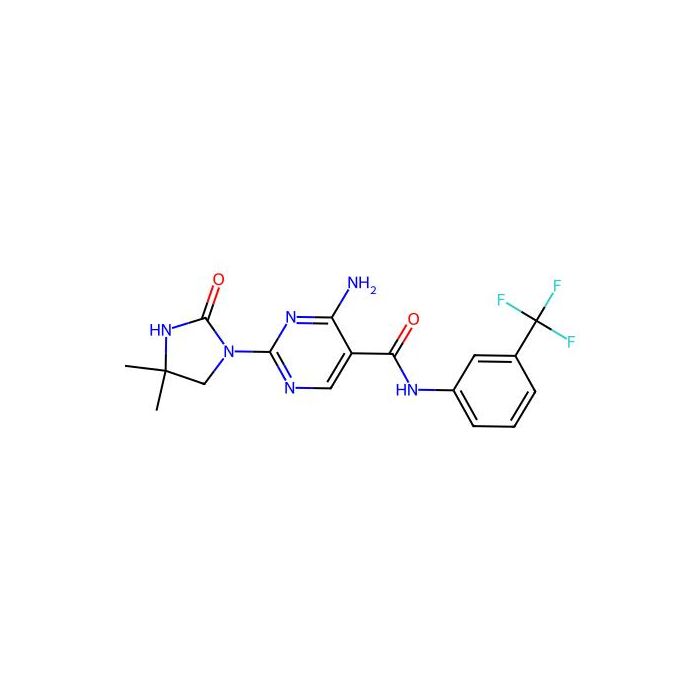
Imanixil (HOE-402 free base) is an inducer of the LDL receptor (LDLR). Imanixil (HOE-402 free base) is also a potent cholesterol-lowering compound, which inhibits very low density-lipoprotein (VLDL) production, and consequently attenuates atherosclerosis development.
Imanixil (HOE-402 free base) is an inducer of the LDL receptor (LDLR). Imanixil (HOE-402 free base) is also a potent cholesterol-lowering compound, which inhibits very low density-lipoprotein (VLDL) production, and consequently attenuates atherosclerosis
Condizioni di conservazione di stoccaggio
Store at -20°C
Spedito in
Ice chest + Ice pads
Questo prodotto richiede spedizione a catena fredda. I servizi di terra e altri servizi economici non sono disponibili.
This compound belongs to the class of organic compounds known as aromatic anilides. These are aromatic compounds containing an anilide group in which the carboxamide group is substituted with an aromatic group. They have the general structure RNC(=O)R', where R= benzene, and R = aryl group.
External Descriptors
Not available
1. Djoumbou Feunang Y, Eisner R, Knox C, Chepelev L, Hastings J, Owen G, Fahy E, Steinbeck C, Subramanian S, Bolton E, Greiner R, and Wishart DS. ClassyFire: Automated Chemical Classification With A Comprehensive, Computable Taxonomy. Journal of Cheminformatics, 2016, 8:61.
Certificati (CoA, COO, BSE/TSE e tabella di analisi)
C of A & Other Certificates(BSE/TSE, COO):
Analytical Chart:
Proprietà chimiche e fisiche
Solubilità
DMSO : 62.5 mg/mL (158.49 mM; Need ultrasonic)
Peso molecolare
394.400 g/mol
XLogP3
2.000
Hydrogen Bond Donor Count
3
Hydrogen Bond Acceptor Count
8
Rotatable Bond Count
3
Exact Mass
394.137 Da
Monoisotopic Mass
394.137 Da
Topological Polar Surface Area
113.000 Ų
Heavy Atom Count
28
Formal Charge
0
Complexity
614.000
Isotope Atom Count
0
Defined Atom Stereocenter Count
0
Undefined Atom Stereocenter Count
0
Defined Bond Stereocenter Count
0
Undefined Bond Stereocenter Count
0
The total count of all stereochemical bonds
0
Covalently-Bonded Unit Count
1
Calcolatori di soluzioni
Molarity Calculator
Determine the necessary mass, volume, or concentration for preparing a solution.
Dilution Calculator
Determine the dilution needed to prepare a stock solution.
Reconstitution Calculator
Recensioni
Recensioni dei clienti
Application Protocols
No vendor-validated application protocols are provided for Imanixil. The following outlines general, non–item-specific workflows commonly used for small‑molecule screening compounds.
Preparing stock solutions
Dissolve compound to 10–50 mM in anhydrous DMSO. If undissolved, warm to 25–37°C, vortex/sonicate briefly, and, if compatible, sterile-filter through 0.2 µm PTFE. Record exact concentration by weight or qNMR if critical.
Enzyme inhibition assay (general template)
Serially dilute stock (1:3 or 1:2) to span expected potencies; keep final DMSO ≤1% v/v.
Include positive control inhibitor and vehicle control. Run in duplicate/triplicate.
Analyze with appropriate kinetic model; report IC50 with confidence intervals.
Thermal shift (DSF) binding assay
Mix protein (1–5 µM) with dye (e.g., SYPRO Orange) and compound at multiple concentrations; ramp temperature 20–95°C; calculate ΔTm relative to vehicle.
Cell-based assay considerations
Check cytotoxicity independently (e.g., ATP luminescence). Maintain constant vehicle across doses and controls. Monitor precipitation/micelles.
Data integrity
Confirm pre/post‑assay integrity by LC–MS. Archive plate maps, raw data, and environmental conditions (temperature, humidity).
These are generalized procedures; optimize to your target/assay. For research use only.
Biological Roles
Item-specific biological data
No target assignment, mode of action, or pathway annotation is provided in the Product Data for Imanixil. Any biological role must be determined empirically in your assay context. Target specificity and potency: Not specified for this item; refer to your screening results and any available literature once the structure is verified on the CoA.
General perspective for Moligand‑grade compounds
These small molecules are typically explored as chemical probes or tool compounds. Early efforts focus on confirming identity, purity, and stability, then assessing in vitro activity, selectivity, and basic ADME properties (solubility, permeability, stability in microsomes/plasma) as appropriate for research use.
Off‑target risk: Aggregation, redox cycling, PAINS/IMPS liabilities, and fluorescence interference can confound biological readouts. Employ orthogonal assays and counterscreens.
Recommended practices (not item-specific)
Start with biophysical binding or enzyme inhibition to estimate KD/IC50; validate with orthogonal readouts (e.g., SPR vs. enzymology).
Evaluate basic liabilities: colloidal aggregation (detergent sensitivity), metal chelation (add metal rescue), redox activity (H2O2 generation assays), and luciferase interference if using ATP‑coupled assays.
Establish compound integrity during assays by LC–MS pre/post incubation.
No clinical or therapeutic claims are made. For research use only.
Buffer Applications
Imanixil is a small-molecule screening ligand, not a buffering agent. Buffer preparation guidance does not typically apply to this item.
Applicability
This compound is not used to maintain pH; instead, it is dosed into pre‑made buffers for biochemical or cellular assays.
Practical pointer (general)
Prepare assay buffers (e.g., PBS, HEPES, Tris, MOPS) at required pH/ionic strength independently, then add Imanixil from a DMSO stock ensuring constant final vehicle percentage across controls and treatments.
Green Alternatives
Green chemistry considerations focus on solvent systems and assay formats rather than on the molecule itself (structure not specified).
Solvent strategy (general, greener options)
Replace or reduce DMSO where feasible with:
2‑Pyrrolidone or N‑methyl‑2‑pyrrolidone alternatives: Often less volatile but with their own EH&S concerns—evaluate carefully.
PEG‑400 or propylene glycol: Useful co‑solvents for preformulation/biology with lower VOC emissions; viscosity can complicate liquid handling.
Aqueous buffers with cyclodextrins (e.g., HP‑β‑CD, 1–10% w/v): Enhance apparent solubility and reduce organic solvent content.
Microdosing of solvents via acoustic dispensing reduces total solvent mass per screen.
Operational improvements
Miniaturize assays (1536‑well) to reduce solvent and compound usage.
Reuse solvent-resistant plates where validated; employ sealed plates to curb evaporation and emissions.
Tradeoffs
DMSO remains the most predictable and biologically tolerated vehicle at low percentages; greener substitutes may alter assay performance, binding equilibria, or plastic compatibility.
Waste minimization
Consolidate residual stocks, segregate halogenated/non‑halogenated waste, and adopt on‑demand dissolution to avoid expired solutions.
Item-specific greener synthesis or manufacturing routes cannot be proposed without the compound’s defined structure.
Pharmaceutical Uses
No pharmaceutical/excipient status or compendial listing is provided for Imanixil. This product is supplied strictly for research use.
Item-specific (from Product Data)
Research Use Note: For research use only. No claims for therapeutic, diagnostic, or clinical application.
General R&D context (not item-specific)
In discovery settings, small molecules like this may serve as reference ligands or tool compounds in preclinical assays. If formulation research is pursued for in vitro work, typical vehicles include DMSO, ethanol, or solubilizers (cyclodextrins, PEG‑400) strictly for laboratory experiments.
Preformulation studies (solubility, stability vs. pH, light, and oxidants) can inform storage and dosing in nonclinical assays but do not imply suitability for human/animal administration.
Documentation
No pharmacopeial monograph, DMF, or GMP status is stated: Not specified for this item; refer to CoA/Spec Sheet if additional documentation is needed for regulated environments.
All usage must remain within research laboratory protocols.
Physical Properties
Item-specific physical constants are not provided in the Product Data. Do not assume values for screening compounds without supplier confirmation.
Item-specific (from Product Data)
Appearance: Not specified for this item; refer to CoA/Spec Sheet.
Molecular weight: Not specified for this item; refer to CoA/Spec Sheet.
Molecular formula: Not specified for this item; refer to CoA/Spec Sheet.
Literature/computed values (not item-specific)
No literature physical property set is cited here because the exact structure, protonation state, and solid form (salt/solvate/polymorph) are not confirmed. Any external property data should be reconciled with the supplier’s CoA prior to use.
General considerations for small-molecule ligands (literature guidance)
Solubility: Many screening ligands are stocked at 10–50 mM in anhydrous DMSO; aqueous assay concentrations are typically ≤1% DMSO v/v to minimize vehicle effects.
pKa/logP: Lead‑like compounds often fall within pKa 3–10 and logP 1–4 ranges, but these are class‑level, not item-specific.
Solid form: Library compounds may be provided as free bases/acids or as pharmaceutically acceptable salts; hydrate/solvate content can affect massing and solubility.
Always defer to the item’s CoA/SDS for definitive BP/MP, density, refractive index, UV cutoff, water/peroxide/metals, and solubility. Where not provided: “Not specified for this item; refer to CoA/Spec Sheet.”
Quality and Grades
Item-specific (from Product Data)
Grade/Purity: Moligand™ (Aladdin screening library grade). Specific numeric purity, residual solvent, water, metals, and spectral conformity: Not specified for this item; refer to CoA/Spec Sheet.
What Moligand™ implies (general guidance)
Intended use: Discovery screening, target deconvolution, SAR exploration, and chemical biology. Emphasis on structural identity and fitness for in vitro assays rather than chromatographic or trace‑analysis applications.
Typical documentation: CoA providing identity confirmation (e.g., 1H NMR and/or LC–MS), lot number, and storage guidance. Some lots may include HPLC purity and exact mass confirmation—verify per CoA.
UV background/LC compatibility: If low-UV impurities are critical (e.g., HPLC detection at 210–254 nm), request CoA chromatograms. Absent explicit “HPLC grade” claims, assume normal research-grade background.
Practical implications for users
For HTS: Consistent identity and manageable DMSO solubility are prioritized. Validate plate stability (edge effects, adsorption) in your assay matrix.
For analytical work: If quantitative potency/PK in vitro correlations are needed, consider in‑house repurification or orthogonal purity checks (qNMR, LC–CAD/UV, HRMS).
Stabilizers: None stated. If the structure contains oxidation‑labile motifs (unknown here), consider inert-atmosphere storage and addition of radical scavengers only after confirming compatibility.
Always treat any unspecified specification as: “Not specified for this item; refer to CoA/Spec Sheet.”
Reaction and Applications
Item-specific use case (from Product Data)
Category: Small molecules and compound libraries (Moligand™). No synthetic/reagent application is claimed; primary use is as a screening ligand/chemical probe candidate. Manufacturer-provided applications: Not specified.
Applicability to chemical reactions (general guidance)
Without structural information, Imanixil should not be assumed to function as a reagent, catalyst, or solvent. It is typically deployed as a test article in biochemical/cellular assays, biophysical binding studies (e.g., SPR, DSF), or target engagement workflows.
Research workflows where such ligands are commonly applied (general)
In vitro target assays: Enzyme inhibition/activation panels; determine IC50/Ki with appropriate kinetic models (Morrison tight-binding when applicable).
Biophysical profiling: Thermal shift (DSF), nanoDSF, MST/SPR to estimate KD and rank SAR.
Cellular readouts: Reporter assays or phenotypic screens with careful control of vehicle, cytotoxicity (e.g., CellTiter-Glo), and compound carryover.
Informatics: Docking/MD refinement when a putative target is hypothesized; use the verified structure file from CoA rather than external approximations.
Practical tips
Plate management: Prepare DMSO stocks in inert‑gas headspace to limit moisture uptake; map serial dilutions; incorporate interleaved reference controls.
Aggregation control: Include 0.01–0.1% nonionic detergent and 0.1% BSA where appropriate; run detergent sensitivity controls to flag colloidal artifacts.
No named synthetic reactions are recommended for this item absent structural data; treat as a test compound rather than a reagent.
Reaction Conditions
No synthetic reaction conditions are provided or recommended for Imanixil. This product is positioned as a screening ligand rather than as a reagent or substrate.
Item-specific (from Product Data)
None.
General guidance (not item-specific)
If derivatization or tagging is contemplated post‑purchase (e.g., biotinylation/fluorophore conjugation for pull‑down/assay development), obtain the exact structure and confirm available functional handles; then apply standard coupling conditions (e.g., NHS‑ester to primary amines in pH 7.5–8.5 buffers; click chemistry for azide/alkyne motifs) with rigorous analytical confirmation (LC–MS, NMR).
Maintain mild temperatures and neutral pH when structural stability is uncertain; run small‑scale scouting reactions and include stability-indicating analytics.
Absent structure, temperatures, catalysts, yields, and times cannot be responsibly specified for this item.
Safety and Handling
Safety information for Imanixil is not specified in the Product Data. Handle conservatively as a research chemical of unknown hazard profile and consult the SDS supplied with the shipment for authoritative guidance.
Item-specific (from Product Data)
GHS Classification, Signal word, H‑statements, and pictograms: Not specified for this item; refer to SDS.
Storage: Store at −20°C. Shipped in ice chest with ice pads.
Research use: For research use only.
General laboratory precautions (best practice)
PPE: Lab coat, safety glasses, and appropriate chemically resistant gloves (e.g., disposable nitrile). Use in a fume hood to avoid inhalation of dust/aerosols.
Avoid: Ingestion, inhalation, skin/eye contact; do not pipette by mouth. Prevent environmental release.
First aid (overview; follow SDS): Eye/skin contact—rinse with water for ≥15 min; inhalation—move to fresh air; ingestion—rinse mouth, seek medical attention; provide SDS to responders.
Handling & hygiene
Open vials at ambient humidity minimized; many small molecules are hygroscopic or light‑sensitive. Work rapidly; reseal under dry inert gas if feasible.
Use clean, dry tools; avoid cross‑contamination between screening wells/plates.
Incompatibilities/special risks (general)
Unknown for this item. Until clarified, avoid strong oxidizers/reductants, strong acids/bases, and reactive metals. Protect from light if chromophoric.
Dispose according to institutional hazardous organic waste procedures. Always defer to the SDS for substance‑specific controls.
Solvent Selection
With no structure/solubility data specified for Imanixil, select solvents according to standard practices for small‑molecule screening compounds and confirm empirically.
Item-specific (from Product Data)
No solubility/solvent preference provided. Storage at −20°C suggests preparing frozen aliquots once dissolved.
General guidance for screening ligands (literature/practice)
Primary stock solvent: Anhydrous DMSO (typical 10–50 mM stocks) due to broad solubilizing power and assay compatibility at ≤0.5–1.0% v/v.
Alternates: DMF, ethanol, or 1:1 DMSO:water cosolvent when DMSO alone is insufficient; confirm assay tolerance to vehicles.
Aqueous use: Dilute DMSO stocks into buffered media (e.g., PBS, HEPES, assay buffer) with vigorous mixing; minimize precipitation by adding stock last and keeping final DMSO constant across wells.
Insolubility cues: Opalescence or settled particulates after dilution indicate precipitation—optimize with surfactants (e.g., 0.01–0.1% Tween‑20) or adjust pH if compound is ionizable (general strategy, not item-specific).
Practical tips
Pre-warm difficult stocks to 25–37°C, sonicate briefly, and filter (0.2 µm PTFE) if compatible. Avoid adsorption losses by using low‑bind plastics or glass vials.
Record exact solvent, lot, and concentration on plate maps; keep vehicle controls identical.
Because item-specific solubility is unknown, confirm solubility boundaries experimentally and consult the CoA for any lot‑specific recommendations.
Storage and Reconstitution
Item-specific (from Product Data)
Storage conditions: Store at −20°C.
Shipping: Ice chest with ice pads.
Appearance: Not specified for this item; refer to CoA/Spec Sheet.
General best practices for small‑molecule screening compounds (not item-specific)
Upon receipt: Allow the sealed container to warm to room temperature before opening to avoid moisture condensation. Record lot number and date.
Reconstitution: Prepare concentrated stocks in anhydrous DMSO (typ. 10–50 mM) only after confirming solubility. If aqueous stocks are required, consider co‑solvents or cyclodextrins and verify stability.
Aliquoting: Dispense single‑use aliquots in low‑bind tubes or microplates to avoid repeated freeze–thaw. Overlay with inert gas (N2/Ar) if oxidation‑sensitive; protect from light if chromophoric.
Storage of solutions: Store DMSO stocks at −20°C or −80°C as appropriate. Avoid frost‑free freezers (temperature cycling). Label with concentration, solvent, and date.
Stability monitoring: Periodically assess by LC–MS/HPLC for degradation or precipitation; discard if purity or potency drifts.
Thawing/handling
Thaw on ice or at room temperature; vortex to ensure homogeneity. Minimize time at ambient conditions and recap promptly. Maintain consistent vehicle concentration in assays.
For any unspecified attributes, treat as: “Not specified for this item; refer to CoA/Spec Sheet.”
Structure and Identity
Concise identity overview for a small‑molecule screening ligand supplied under Aladdin’s Moligand grade.
Item-specific (from Product Data)
Product name: Imanixil (SKU: I651771)
CAS: 75689-93-9
CID: 216289
InChIKey: 92715 (as provided; note that this string is shorter than a standard 27-character InChIKey; verify against CoA/Spec Sheet)
SMILES: Not specified for this item; refer to CoA/Spec Sheet.
Molecular formula: Not specified for this item; refer to CoA/Spec Sheet.
Molecular weight: Not specified for this item; refer to CoA/Spec Sheet.
Structural features (general guidance)
Without a provided SMILES/InChI, detailed functional groups, ring systems, and stereochemistry cannot be enumerated for this specific item. Consult the CoA/SDS for the definitive structure depiction and identifiers.
For Moligand‑grade library actives, structures typically comprise drug‑like scaffolds (aromatic/heteroaromatic cores, H‑bond donors/acceptors, and solubilizing substituents) consistent with fragment-/lead‑like chemical space (general literature observation, not item‑specific).
2D structure description (general)
The 2D line diagram, when provided on the CoA, should be used to assess protonation states, potential tautomers, and reactive liabilities (e.g., Michael acceptors, anilides). In absence of structural data here, no item‑specific 2D description can be given.
Cross-referencing
If you use external databases (e.g., PubChem via CID), verify that the entry exactly matches the CAS and supplier identity before transposing any properties into your records.
Synthetic Utility
Without a confirmed structure for Imanixil in the Product Data, specific retrosynthetic analysis or reagent behavior cannot be provided.
Item-specific status
Intended use: screening/test compound (Moligand™), not advertised as a synthetic building block or reagent.
General considerations (not item-specific)
If structural information (SMILES/InChI) becomes available, evaluate:
Functional group handles for diversification (e.g., aryl halides for cross‑coupling, amines/acids for amide coupling, heteroaryl nitrogens for N‑oxidation/quaternization).
Stability liabilities (e.g., hydrolysis of esters/carbamates, oxidation of anilines, tautomerism in heterocycles) that influence handling and storage.
Protecting‑group strategy if analog synthesis is planned for SAR.
Use standardized reactions (Buchwald–Hartwig, Suzuki–Miyaura, amide couplings via HATU/EDC) guided by the verified structure.
Practical note
Because this catalog entry targets biological screening rather than synthesis, treat Imanixil as a terminal test article. For synthetic campaigns, procure building blocks corresponding to its core scaffold once identified from the CoA.
Target Specificity
Target specificity is not provided in the Product Data for Imanixil.
Item-specific
Target(s), pathway(s), and binding constants: Not specified for this item; refer to CoA/Spec Sheet and in‑house screening results.
General guidance for establishing specificity (not item-specific)
Use orthogonal assays (biochemical vs. biophysical vs. cellular) and appropriate counterscreens to identify off‑target activities.
Apply concentration–response profiling with constant vehicle; evaluate Hill slopes for evidence of nonspecific effects (aggregation, multi‑site binding).
Employ chemoproteomics or CETSA/DARTS to confirm target engagement in cells or lysates when applicable.
No claims are made regarding biological targets or selectivity.
Domande frequenti
What is the purity of this product?
This product is supplied at ≥99% purity (chemical assay). Lot-specific values are stated on the Certificate of Analysis.
How should this product be stored?
Store at ?20 °C. Freezer storage is required to maintain the specified shelf life.
What is Moligand??
Moligand? is one of Aladdin Scientific's premium product lines, formulated for high-purity applications across multiple workflows. Compared to standard grades in the same workflow, Moligand? products typically offer tighter specifications, more rigorous QC, and stronger lot-to-lot consistency.
How is this product shipped?
This product ships in an insulated container with ice pads. Unpack on arrival and transfer it to the storage condition stated above.
What are the CAS number, molecular formula and molecular weight?
The CAS Number is 75689-93-9, the molecular formula is C17H17F3N6O2, and the molecular weight is 394.35 g/mol. InChIKey FUSNOPLQVRUIIM-UHFFFAOYSA-N.
What documentation is provided?
Available product documentation, including Certificates of Analysis (COA), Safety Data Sheets (SDS), and specification sheets, is shown in the product document area. Document availability and access follow the current site policy.
Hai bisogno di aiuto per scegliere la qualità?
La nostra guida alla selezione delle qualità copre purezza, stato dello stabilizzatore e idoneità all'applicazione per tutte le varianti del nostro catalogo.
Utilizziamo i cookie per garantire il corretto funzionamento del sito web e, ove consentito, per migliorare la tua esperienza. Puoi gestire le tue preferenze in qualsiasi momento nelle Impostazioni. Per saperne di più, consulta la nostra Cookie Policy.
Desidera che le inviamo un messaggio quando avremo sconti disponibili?
Ricordamelo più tardi
Grazie! Controlli la sua casella di posta per confermare.
Products are supplied to verified businesses, institutions, and qualified professionals for research and development use only. Not for use in humans, animals, diagnosis, or therapy.