QUALITÀ & PUREZZACarrier Free?Carrier-free — supplied without added carrier protein/stabilizer. Use when carriers (e.g. BSA) would interfere with conjugation or sensitive assays.Azide Free?Azide-free — without sodium azide preservative. Use in conjugations, cell work, or assays where azide is toxic or inhibitory.Validated?Validated grade — performance confirmed in defined applications before release. Use when you want documented assurance the reagent works as stated.PBS Only?PBS-only formulation — supplied in phosphate-buffered saline with no other additives. Use when you need a clean PBS buffer free of stabilizers/carriers.≥95%(SDS-PAGE)See COA
Privo di carrier, privo di azide, convalidato, ≥95% (SDS-PAGE), Vedere COA Azide Free,Carrier Free,PBS Only,Validated per flussi di lavoro cromatografici e analitici sensibili che richiedono un'interferenza minima della linea di base.
🌡
Stoccaggio e spedizione
Conservare a 2-8°C, vietato congelare Spedizione Ghiaccio umido. Consultare il COA specifico del lotto per le specifiche esatte.
📋
Documenti di qualità
SDS, COA, scheda tecnica e scheda delle specifiche disponibili per il download. COA specifico del lotto accessibile tramite ricerca per numero di lotto.
📚
Prova documentale
Citato in 0 pubblicazioni peer-reviewed su cromatografia, sintesi organica e reazioni di accoppiamento incrociato.
Panoramica
L'anticorpo di ratto contro l'integrina beta 7 umana/topo, monoclonale (FIB504), può essere utilizzato per il flusso, l'IP, il WB, il blocco in vivo dell'integrina β7 e così via.
Applicazione
Flusso: utilizzare una concentrazione dipendente dal dosaggio.
IP: utilizzare a una concentrazione dipendente dal dosaggio.
WB: utilizzare a una concentrazione dipendente dal dosaggio.
blocco in vivo dell'integrina β7: utilizzare a una concentrazione dipendente dal dosaggio. Funzione della proteina L'integrina alfa-4/beta-7 (recettore LPAM-1 per l'homing specifico delle patch di Peyer) è una molecola di adesione che media la migrazione e l'homing dei linfociti nel tessuto linfoide associato all'intestino (GALT). L'integrina alfa-4/beta-7 interagisce con la molecola di adesione della superficie cellulare MADCAM1, normalmente espressa dall'endotelio vascolare del tratto gastrointestinale. Interagisce anche con VCAM1 e con la fibronectina, un componente della matrice extracellulare. Riconosce uno o più domini all'interno della regione CS-1 della fibronectina, sottoposta a splicing alternativo. Le interazioni coinvolgono il tripeptide L-D-T in MADCAM1 e L-D-V in fibronectina. Si lega alla gp120 dell'HIV-1, permettendo così al virus di entrare nella GALT, che si ritiene sia il principale fattore scatenante della malattia dell'AIDS. L'interazione coinvolgerebbe un tripeptide L-D-I nell'HIV-1 gp120. L'integrina alfa-E/beta-7 (HML-1) è un recettore per la E-caderina.
Specifiche
Product Name
Integrina beta 7 mAb di ratto - Anticorpo primario, specific to Integrin beta 7, Rat IgG2a
Privo di carrier, privo di azide, convalidato, ≥95% (SDS-PAGE), Vedere COA
Specie ospite
consiglio
Specificità
Integrin beta 7
Immunogeno
TK1 cells
Coniugazione
Unconjugated
Grado
Azide Free, Carrier Free, PBS Only, Validated
Isotipo
Rat IgG2a
Tipo di catena leggera
kappa
SDS-PAGE
150 kDa
Metodo di purificazione
Protein G purified
Concentrazione
See COA
Product Line
Prodotti biologici
Stoccaggio e spedizione
Forma
Liquido
Condizioni di conservazione di stoccaggio
Conservare a 2-8°C, vietato congelare
Spedito in
Ghiaccio umido
Stabilità e conservazione
Spedito a 4°C. Conservare a 4°C a lungo termine (12 mesi). Non congelare. Al momento del ricevimento, si consiglia di effettuare un'aliquota.
Immagini
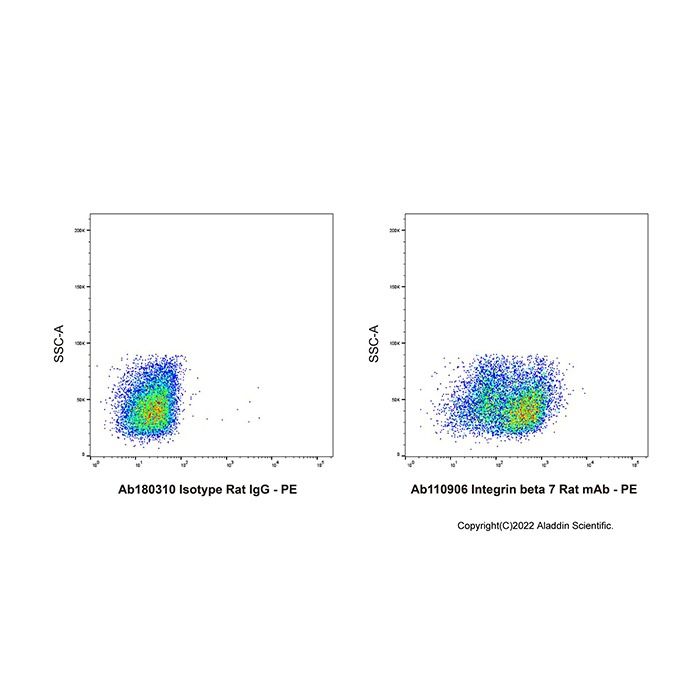
Integrin beta 7 Rat mAb (Ab110906) - Flow Cytometry Flow Cytometry analysis of human peripheral blood lymphocytes labelling Integrin beta 7 with Integrin beta 7 Rat mAb (Ab110906) conjugated with biotin (right panel) at 0.5 μg/mL for 1 hour at 4°C, compared with Rat IgG Isotype Control Antibody (Biotin) (Ab180310) (left panel) and detected with SA-PE (rp156150).
Integrin beta 7 Rat mAb (Ab110906) - Flow Cytometry Flow Cytometry analysis of human peripheral blood lymphocytes labelling Integrin beta 7 (red) with Integrin beta 7 Rat mAb (Ab110906) conjugated with biotin at 0.5 μg/mL for 1 hour at 4°C, and detected with SA-PE (rp156150). Blue - Rat IgG Isotype Control Antibody (Biotin) (Ab180310). Black - Unlabelled control, cells without incubation with primary antibody.
Applicazione
Applicazione
Dilution info
WB
Use at an assay dependent concentration.
IP
Use at an assay dependent concentration.
Flow Cytometry
Use at an assay dependent concentration.
in vivo blocking of integrin β7
Use at an assay dependent concentration
Documentazione
📋 Scheda di dati di sicurezza (SDS)
Documento completo su pericoli, manipolazione, stoccaggio e conformità normativa.
Determine the necessary mass, volume, or concentration for preparing a solution.
Dilution Calculator
Determine the dilution needed to prepare a stock solution.
Reconstitution Calculator
Recensioni
Recensioni dei clienti
Application Protocols
Item-specific, tested applications and recommended dilutions
Not specified for this item; refer to CoA/Spec Sheet.
General protocol outlines (non-item-specific; to be optimized by the user)
Flow cytometry (surface staining):
Prepare single-cell suspension; block Fc receptors.
Incubate cells with serial dilutions of primary Rat anti-ITGB7 mAb for 20–30 min at 4°C in staining buffer.
Wash, then detect with species-appropriate secondary if unconjugated; acquire data with proper compensation controls.
Immunofluorescence (cell or tissue):
Fixation/permeabilization only if epitope is preserved; many integrin epitopes are conformational—prefer non-denaturing conditions.
Block, incubate with primary, wash, and detect with labeled secondary.
Immunoprecipitation:
Lyse under mild, non-denaturing conditions (e.g., NP-40, digitonin) to preserve integrin complexes.
Couple antibody to Protein G/A matrix as compatible with Rat isotype; capture, wash, and elute under gentle conditions.
Important note
Because clone, isotype, and validation data are not provided for this item, the above are general templates only. Empirically determine optimal conditions and include appropriate controls.
Biological Roles
General/literature knowledge about the target (Integrin β7)
Integrin β7 (ITGB7) is a β integrin subunit that pairs with α4 (forming α4β7) or αE (forming αEβ7, CD103). These heterodimers mediate leukocyte adhesion and homing.
α4β7 binds to MAdCAM-1, directing lymphocyte trafficking to gut-associated lymphoid tissue. αEβ7 binds E-cadherin on epithelial cells, promoting lymphocyte retention at mucosal sites.
Signaling: Ligation triggers outside-in signaling that influences cell migration, survival, and activation; inside-out signaling via chemokines modulates integrin affinity and avidity.
Expression: Prominent on subsets of T cells, B cells, and dendritic cells involved in mucosal immunity.
Relevance for antibody use (general)
Phenotyping: Antibodies against β7 help define gut-homing T-cell subsets and regulatory populations.
Functional blocking/activation: Certain clones can block ligand binding or report activation state; functional attributes for this specific item are not specified.
Item-specific note
This product is a Rat mAb against Integrin β7; species reactivity, clone, and functional characterization are Not specified for this item; consult the CoA/Spec Sheet for details before designing experiments.
Buffer Applications
Item-specific facts (from Product Data)
Formulation: PBS only; Azide Free; Carrier Free.
Practical buffer guidance (general)
Working buffer: Use PBS (e.g., 10 mM phosphate, 137 mM NaCl, 2.7 mM KCl, pH ~7.4) for routine dilutions. Filter-sterilize (0.22 µm) to minimize bioburden.
Blocking/assay buffers: For immunoassays where carriers are permissible, add 0.1–1% inert protein (e.g., serum albumin) and/or 0.05–0.1% non-ionic surfactant (e.g., Tween-20) to reduce nonspecific binding. Note: The stock is Carrier Free; additions apply to user-prepared working buffers only.
Live-cell compatibility: Azide-free formulation is suitable for live-cell exposure; maintain isotonicity and neutral pH. Avoid azide and other metabolic inhibitors in live-cell assays.
Storage buffer considerations: Because this item is Do not freeze and lacks cryoprotectants, keep at 2–8°C. For short-term aliquots, maintain sterility and minimize headspace to reduce oxidation.
Recipe hints (general)
PBS (1×): Dissolve commercial PBS tablets per manufacturer instructions or prepare from sodium phosphate dibasic/monobasic, NaCl, and KCl; adjust pH 7.2–7.4; filter-sterilize.
For flow cytometry staining buffer: PBS + 1–2% serum (species-matched) + 2 mM EDTA (optional) to reduce cell clumping; omit serum for serum-sensitive readouts.
Green Alternatives
Context
As a PBS-formulated, Azide Free, Carrier Free antibody, this product already avoids hazardous sodium azide and organic solvent carriers, reducing environmental and safety burdens relative to azide-preserved reagents.
Greener handling options (general)
Preservatives: If antimicrobial control is needed, consider short-term sterile filtration and aseptic handling rather than adding azide, particularly for cell-based work.
Packaging and waste: Use right-sized aliquots to minimize waste from expired material. Rinse empty vials to remove protein residues before recycling where allowed.
Buffer exchange: If buffer modification is required, use low-waste spin concentrators rather than dialysis with large buffer volumes.
Comparison of preservative strategies (general)
Sodium azide: Effective antimicrobial but acutely toxic and incompatible with many enzymatic assays and live cells.
ProClin/biocides: Provide preservation but can pose aquatic toxicity; assess compatibility and disposal requirements.
Aseptic technique + cold-chain: Eliminates chemical preservatives; relies on rigorous sterile handling and refrigerated storage—aligned with this item’s Do not freeze requirement.
Trade-offs
Azide-free and carrier-free formats demand more careful aseptic technique and may have shorter in-use shelf life; they provide cleaner backgrounds and higher compatibility with sensitive assays and live systems.
Pharmaceutical Uses
Applicability
This is a research-grade Rat monoclonal antibody. No pharmacopeial status or clinical/formulation claims are made. For research use only.
General information (non-item-specific)
Monoclonal antibodies in pharmaceutical contexts require stringent GMP manufacturing, defined isotype, glycosylation control, and validated stability profiles—none of which are specified for this research reagent.
Excipient considerations for therapeutic mAbs (for context): Formulations often include buffers (histidine, acetate), stabilizers (sugars, polyols), surfactants (polysorbates), and tonicity agents. This product is PBS only and Carrier Free, Azide Free, which is suitable for laboratory research but not equivalent to GMP formulations.
Practical lab utility
Useful as a reference reagent in preclinical assay development (e.g., ligand-binding assays, cell-based assays, analytical controls), subject to verification of performance characteristics in the intended method.
Item-specific note
Any use in manufacturing or clinical settings would require separate qualification and is outside the scope of this product. Specific excipient profile beyond PBS and absence of preservatives/carriers is Not specified for this item; refer to CoA/Spec Sheet.
Physical Properties
Item-specific facts (from Product Data)
Formulation: PBS only; Carrier Free; Azide Free.
Appearance: Not specified for this item; refer to CoA/Spec Sheet.
Concentration, protein content, extinction coefficient: Not specified for this item; refer to CoA/Spec Sheet.
General/literature values (for antibodies; provided as context, not item specifications)
Approximate molecular mass: Full-length IgG antibodies are typically ~150 kDa; fragment antibodies (Fab/F(ab')2) differ. Specific MW for this mAb is not specified.
Isoelectric point (pI): Most IgGs pI ~6–9 (broadly variable); not specified for this item.
Solubility: Antibodies are water-soluble in isotonic buffers (e.g., PBS). Stability and solubility can be sensitive to pH, ionic strength, and excipients.
pH range for stability: Many mAbs are handled near neutral pH (6.8–7.4). Exact pH/specification for this item is not provided.
Storage temperature: 2–8°C (per Product Data). Do not freeze.
Notes for use
Because this material is Carrier Free and Azide Free, viscosity and density are similar to aqueous PBS solutions. Absent protein carriers, non-specific adsorption to plastics can occur at low concentrations; pre-wet or use low-bind plastics to minimize loss.
Carrier Free: No added stabilizing proteins (e.g., BSA) or carrier peptides. Advantages—avoids carrier-derived background in assays, compatible with downstream conjugation/labeling. Considerations—greater propensity for adsorption losses at low concentration; use low-bind plastics and minimize dilutions.
Azide Free: No sodium azide preservative. Advantages—compatible with live-cell applications, cell-based assays, and enzyme-mediated detection systems where azide is inhibitory or toxic. Considerations—higher risk of microbial growth; maintain aseptic handling and store strictly at 2–8°C.
Validated: Indicates that the product has undergone manufacturer validation. Specific validated applications, species reactivity, and performance metrics are Not specified for this item; refer to CoA/Spec Sheet for details.
PBS Only: Formulated solely in phosphate-buffered saline without additional excipients. Advantages—well-defined buffer system, compatible with most immunoassays. Considerations—lack of cryoprotectants means Do not freeze, and absence of surfactants may increase surface adsorption at low concentrations.
Recommended QC checks by end-users (general guidance)
Verify protein content (e.g., A280) and integrity (SDS-PAGE, reducing/non-reducing) upon receipt when feasible.
Confirm application-specific performance (e.g., titration curves in your assay format) since application details are not specified here.
Reaction and Applications
Item-specific facts (from Product Data)
Application details are not provided. Manufacturer Applications: Not specified.
General/literature context for Integrin β7 antibodies (non-item-specific guidance)
Use cases: Frequently employed to detect, quantify, or perturb ITGB7 on lymphocytes and gut-homing T cells in immunology research.
Assay modalities: Commonly used in flow cytometry (cell-surface staining), immunofluorescence (IF), immunohistochemistry (IHC) on frozen sections, immunoprecipitation (IP), and occasionally Western blot (WB) depending on epitope exposure. For functional studies, azide-free formulations (as here) are compatible with cell-based assays.
Practical tips:
Titration: Determine the optimal antibody-to-cell ratio empirically (e.g., serial 2-fold dilutions in flow cytometry) to balance signal and background.
Blocking: Use Fc-blocking reagents appropriate to the sample species to reduce non-specific Fc receptor binding.
Compensation/controls: Include isotype controls, fluorescence-minus-one (FMO) controls, and viability dyes when using conjugated secondary antibodies.
Antigen stability: Integrin epitopes can be conformational; non-denaturing conditions favor recognition. For WB, native or mild denaturation protocols may be required; verify in pilot tests.
Conjugation: Carrier-free format facilitates direct conjugation to enzymes or fluorophores; confirm preservation of binding after conjugation by running a small-scale pilot.
Note: Specific working dilutions, clones, and validated applications for this item are not provided; consult the CoA/Spec Sheet.
Reaction Conditions
Not typically applicable in the chemical-synthesis sense.
General assay-condition guidance for antibodies (non-item-specific)
Temperature: Perform binding assays at 2–8°C (to minimize internalization) or room temperature depending on modality; avoid elevated temperatures that promote denaturation.
Incubation times: 15–60 minutes for cell-surface staining in flow cytometry; 1–2 hours (or overnight at 2–8°C) for IF/IHC/ELISA capture-detection steps—optimize empirically.
Buffers: PBS or other isotonic buffers at pH ~7.2–7.4; include blockers/surfactants in working buffers if compatible with your assay readout.
Secondary detection: For unconjugated primaries, use species-appropriate secondary antibodies; confirm Rat host compatibility and potential cross-reactivity with sample species.
Item-specific note
Clone, isotype, concentration, and validated modalities for this product are Not specified; refer to CoA/Spec Sheet for any recommended conditions if available.
Safety and Handling
Item-specific facts (from Product Data)
Storage: Store at 2–8°C; Do not freeze. Shipped on wet ice; Do not freeze.
GHS/SDS: Signal word, H-statements, pictograms, and GHS classification: Not specified for this item; refer to SDS.
Research Use Note: For research use only.
General safety guidance (defer to SDS for authoritative information)
Hazards: Protein antibody solutions in PBS are generally of low acute hazard; however, handle as a biological reagent. Avoid ingestion, inhalation of aerosols, or contact with eyes/skin. Individuals with animal protein sensitivities should minimize exposure.
PPE: Laboratory coat, disposable nitrile gloves, and safety glasses. Use a biosafety cabinet when generating aerosols or when sterility is required.
Incompatibilities: Avoid microbial contamination (no azide present). Do not mix with oxidizing disinfectants that can denature proteins. Avoid metal surfaces that may catalyze protein oxidation.
First aid (general): Eye/skin contact—rinse with water. Ingestion—rinse mouth, seek medical attention. Inhalation of aerosols—move to fresh air; seek medical advice if symptoms persist. Always report incidents per institutional policy.
Spill response: Absorb with inert material, clean with aqueous detergent, then disinfect workspace. Dispose per institutional and local regulations for laboratory biological materials.
Special risks: Repeated freeze–thaw cycles can cause aggregation and loss of activity; this item is explicitly labeled Do not freeze.
Solvent Selection
Applicability
This product is an aqueous antibody preparation. Traditional organic solvent selection is not applicable.
Buffer/medium considerations (item-specific and general)
Formulation: PBS only (item-specific). Neutral pH buffers minimize antibody denaturation and preserve antigen-binding.
Additives: This item is Carrier Free and Azide Free. If long-term storage or frequent handling is expected, users may optionally prepare working dilutions with low levels of stabilizers (e.g., inert proteins or non-ionic surfactants) as appropriate for the assay; do not add azide to live-cell applications.
Miscibility and compatibility (general)
Miscible with other physiological buffers (e.g., HBSS, Tris-buffered saline), but buffer exchange can shift binding behavior for some antibodies—validate after buffer changes.
Avoid organic solvents, strong acids/bases, or high concentrations of chaotropes, which can denature Ig proteins.
When to choose PBS vs alternatives (general guidance)
PBS: Default for most immunoassays and flow cytometry; isotonic and maintains near-physiological ionic strength.
Tris-buffered saline (TBS): Preferred when phosphate interferes with detection chemistries (e.g., certain ALP-based systems) or metal-dependent interactions.
HEPES-buffered saline: Useful for CO2-independent live-cell work due to superior pH buffering near physiological pH.
Storage and Reconstitution
Item-specific facts (from Product Data)
Storage: Store at 2–8°C. Do not freeze.
Shipping: Shipped on wet ice. Do not freeze during transit.
Formulation: PBS only; Carrier Free; Azide Free.
Practical guidance
Receipt inspection: Confirm cold-chain integrity upon arrival. If signs of warming or contamination are present, assess by A280 and/or SDS-PAGE where feasible.
Handling: Work aseptically to mitigate bioburden (no azide present). Minimize time at room temperature. Avoid vigorous vortexing or foaming to reduce aggregation risk.
Aliquoting: If frequent access is expected, prepare sterile, single-use aliquots in low-bind tubes and maintain at 2–8°C. Do not freeze aliquots (no cryoprotectants; freezing may cause irreversible aggregation and loss of activity).
Light sensitivity: If conjugated by the user with fluorophores, protect from light. The supplied product is unlabeled per Product Data.
Reconstitution
The product is indicated as PBS Only and shipped on wet ice, consistent with a liquid formulation. Any reconstitution instructions (if provided for specific lots) are Not specified for this item; refer to CoA/Spec Sheet.
Stability
Shelf life and expiry are not specified for this item; refer to the product label/CoA. Maintain continuous storage at 2–8°C and avoid microbial contamination to preserve performance.
Structure and Identity
Item-specific facts (from Product Data)
Product: Integrin beta 7 Rat mAb (SKU: Ab110906)
Category: Antibody (monoclonal); Host species: Rat mAb (isotype not specified)
Grade/Purity: Carrier Free, Azide Free, Validated, PBS Only
Small-molecule identifiers (CAS, CID, InChIKey, SMILES): Not applicable to antibodies; not specified for this item; refer to CoA/Spec Sheet.
Molecular class: Protein biologic (immunoglobulin). Monoclonal antibodies are typically ~150 kDa for full-length IgG; actual MW and isotype for this item: Not specified.
Structure: Composed of two heavy and two light chains with disulfide bonds forming a Y-shaped quaternary structure. Variable domains (VH/VL) form the antigen-binding site recognizing Integrin β7 (ITGB7) epitopes.
Epitope/clone information: Not specified for this item; refer to CoA/Spec Sheet.
Post-translational features: Antibodies may be glycosylated at conserved Fc Asn residues; specific glycoform for this item: Not specified.
2D structure description (qualitative)
Unlike small molecules, antibodies lack a single defined 2D chemical structure. Functionally, the Fab arms (variable regions) confer specificity to Integrin β7, while the Fc domain mediates effector functions depending on isotype (isotype not provided here).
Synthetic Utility
Not typically applicable.
As a monoclonal antibody reagent, this product is not used as a synthetic building block or reagent in chemical synthesis. For practical guidance, see the sections on Reaction & Applications, Buffer Applications, and Application Protocols.
Target Specificity
Item-specific facts (from Product Data)
Target: Integrin beta 7 (ITGB7)
Host: Rat monoclonal antibody (Rat mAb)
Clone, isotype, epitope, and species reactivity: Not specified for this item; refer to CoA/Spec Sheet.
General/literature context (non-item-specific)
Integrin β7 partners with α4 or αE to form α4β7 or αEβ7, respectively. Antibody clones may recognize conformational or linear epitopes on the β7 extracellular domain. Cross-reactivity profiles vary by clone; always verify reactivity with the species/tissue of interest.
Domande frequenti
How should this product be stored?
Store at 2–8 °C. Do not freeze. Freezing may cause irreversible damage to this material.
How is this product shipped?
This product ships chilled on wet ice. Unpack on arrival and transfer it to the storage condition stated above.
What documentation is provided?
Available product documentation, including Certificates of Analysis (COA), Safety Data Sheets (SDS), and specification sheets, is shown in the product document area. Document availability and access follow the current site policy.
Which species reactivity has this antibody been validated against?
Validated reactivity is listed on the PDP and on each lot's datasheet. We validate against the most commonly tested species for the target (Integrin beta 7 Rat mAb); cross-reactivity in untested species may exist but is not guaranteed. Contact technical support for specific species inquiries.
What is the purity of this product, and how is it determined?
This product is supplied at ≥95% purity, determined by SDS-PAGE. Lot-specific values are stated on the Certificate of Analysis.
What does Azide Free mean?
Azide Free indicates that the material has been processed and tested for specialty industrial processing. Specifications focus on the impurities that affect performance in that application — for example, metal content for electronics, particle size for batteries, refractive index for optics, or moisture content for moisture-sensitive processes.
What does Carrier Free mean?
Carrier Free indicates that the material has been processed and tested for specialty industrial processing. Specifications focus on the impurities that affect performance in that application — for example, metal content for electronics, particle size for batteries, refractive index for optics, or moisture content for moisture-sensitive processes.
Hai bisogno di aiuto per scegliere la qualità?
La nostra guida alla selezione delle qualità copre purezza, stato dello stabilizzatore e idoneità all'applicazione per tutte le varianti del nostro catalogo.
Utilizziamo i cookie per garantire il corretto funzionamento del sito web e, ove consentito, per migliorare la tua esperienza. Puoi gestire le tue preferenze in qualsiasi momento nelle Impostazioni. Per saperne di più, consulta la nostra Cookie Policy.
Desidera che le inviamo un messaggio quando avremo sconti disponibili?
Ricordamelo più tardi
Grazie! Controlli la sua casella di posta per confermare.
Products are supplied to verified businesses, institutions, and qualified professionals for research and development use only. Not for use in humans, animals, diagnosis, or therapy.

 ZJ24F0607437