≥98%(HPLC) per flussi di lavoro cromatografici e analitici sensibili che richiedono un'interferenza minima della linea di base.
🌡
Stoccaggio e spedizione
Store at -20°C Spedizione Ice chest + Ice pads. Consultare il COA specifico del lotto per le specifiche esatte.
📋
Documenti di qualità
SDS, COA, scheda tecnica e scheda delle specifiche disponibili per il download. COA specifico del lotto accessibile tramite ricerca per numero di lotto.
📚
Prova documentale
Citato in 0 pubblicazioni peer-reviewed su cromatografia, sintesi organica e reazioni di accoppiamento incrociato.
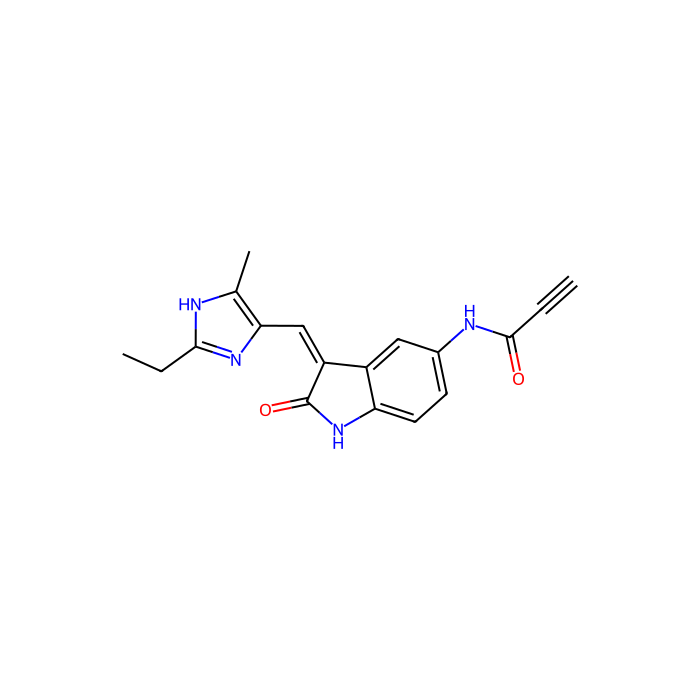
Irreversible Nek2 inhibitor (IC50=770 nM). Inhibits Nek2 via alkylation of residue Cys22. Displays 5-fold selectivity for Nek2 over Cdk1. Exhibits no significant effect on Aurora B or Plk1 kinases, bipolar spindle assembly or spindle assembly checkpoint.
Condizioni di conservazione di stoccaggio
Store at -20°C
Spedito in
Ice chest + Ice pads
Questo prodotto richiede spedizione a catena fredda. I servizi di terra e altri servizi economici non sono disponibili.
This compound belongs to the class of organic compounds known as indolines. These are compounds containing an indole moiety, which consists of pyrrolidine ring fused to benzene to form 2,3-dihydroindole.
External Descriptors
Not available
1. Djoumbou Feunang Y, Eisner R, Knox C, Chepelev L, Hastings J, Owen G, Fahy E, Steinbeck C, Subramanian S, Bolton E, Greiner R, and Wishart DS. ClassyFire: Automated Chemical Classification With A Comprehensive, Computable Taxonomy. Journal of Cheminformatics, 2016, 8:61.
Certificati (CoA, COO, BSE/TSE e tabella di analisi)
C of A & Other Certificates(BSE/TSE, COO):
Analytical Chart:
Proprietà chimiche e fisiche
Solubilità
Solvent:DMSO, Max Conc. mg/mL: 32.03, Max Conc. mM: 100
Peso molecolare
320.300 g/mol
XLogP3
2.000
Hydrogen Bond Donor Count
3
Hydrogen Bond Acceptor Count
3
Rotatable Bond Count
3
Exact Mass
320.127 Da
Monoisotopic Mass
320.127 Da
Topological Polar Surface Area
86.900 Ų
Heavy Atom Count
24
Formal Charge
0
Complexity
605.000
Isotope Atom Count
0
Defined Atom Stereocenter Count
0
Undefined Atom Stereocenter Count
0
Defined Bond Stereocenter Count
1
Undefined Bond Stereocenter Count
0
The total count of all stereochemical bonds
1
Covalently-Bonded Unit Count
1
Calcolatori di soluzioni
Molarity Calculator
Determine the necessary mass, volume, or concentration for preparing a solution.
Dilution Calculator
Determine the dilution needed to prepare a stock solution.
Reconstitution Calculator
Recensioni
Recensioni dei clienti
Application Protocols
No tested application protocols are provided in the Product Data for JH 295. Recommended dilutions, assay conditions, and positive controls are not specified for this item; refer to the CoA/Spec Sheet.
General advice (process guidance only; not product-specific protocols):
Upon receipt, verify package integrity and temperature. Record lot/expiration.
If lyophilized: briefly centrifuge to collect material before opening. Reconstitute with sterile buffer appropriate for your downstream use; mix gently to avoid foaming.
If in solution: mix by gentle inversion; avoid vortexing if foaming/denaturation is a concern.
Prepare small test aliquots to evaluate performance in your assay (e.g., ELISA standard curve, binding assay, or activity test) before committing bulk material.
For validated, product-specific application parameters, please consult Aladdin Scientific with SKU J287640 for the current lot documentation.
Biological Roles
Item-specific biological role, origin, and mechanism of action for JH 295 are not provided in the Product Data.
General context for protein reagents (literature/general):
Proteins function as enzymes, receptors, scaffolds, signaling ligands, transporters, and structural elements. Their roles depend on primary sequence, post-translational modifications, and higher-order structure.
Binding interactions are governed by complementary surfaces and noncovalent forces (electrostatics, hydrogen bonding, hydrophobic effect). Affinity is typically quantified by KD (SPR/ITC/MST).
Activity is sensitive to environmental factors: pH, ionic strength, cofactors (e.g., metal ions), redox state (disulfide formation), and temperature.
Stability modifiers include osmolytes (trehalose, glycerol) and crowding agents (PEG, Ficoll) — often used to preserve function during storage and assays.
Use limitations: Without JH 295’s identity and specifications, no assumptions should be made about its biological activity, binding partners, or cellular effects. Confirm via the CoA and, where relevant, perform preliminary activity and specificity assays under your experimental conditions.
Buffer Applications
Item-specific buffer recommendations are not provided for JH 295. The following are general buffer strategies for protein handling (literature/practice):
Neutral pH systems: PBS (10–50 mM phosphate, 150 mM NaCl, pH 7.2–7.4) and HEPES (10–50 mM, pH 7.0–7.6) support most proteins.
Basic pH systems: Tris-HCl (20–100 mM, pH 7.5–8.5) for proteins favoring slightly alkaline conditions; avoid during NHS-ester labeling due to primary amine reactivity.
Acidic systems: Sodium acetate or citrate buffers (pH 4–6) for proteins with higher pI or when enhanced stability/activity occurs at lower pH.
Additives for stability: 5–10% glycerol, 0.1–0.5 M arginine, 0.1–0.5 M sucrose/trehalose, and 0.5–2 mM DTT/TCEP (for reducing environments; avoid if disulfides are required). Always assess impacts on downstream assays.
Sterility and preservatives: 0.02–0.05% sodium azide for long-term storage (not for HRP-based assays or mammalian cell work). For cell culture compatibility, specify endotoxin limits and use sterile filtration (0.22 µm).
Recipe hints (general): Prepare buffers with high-purity water, degas if needed, filter-sterilize for cell-based work, and record lot/batch details to maintain reproducibility.
Consult JH 295’s CoA for any mandatory buffer composition or stabilizers if supplied in solution.
Green Alternatives
For protein reagents such as JH 295, environmental impact considerations center on buffer systems, preservatives, and cold-chain logistics rather than organic solvent choice.
General greener practice suggestions (not item-specific):
Prefer aqueous, near-neutral buffers (PBS, HEPES) and avoid volatile organic co-solvents. If a co-solvent is necessary (e.g., DMSO for conjugation reagents), minimize to the lowest effective percentage.
Choose preservatives with lower hazard profiles when compatible with assays: e.g., low-level ProClin or thimerosal alternatives instead of sodium azide for peroxidase-based applications. Always verify compatibility.
Optimize storage to reduce waste: aliquot to avoid repeated freeze–thaw, thereby decreasing reagent loss and re-orders/shipping impact.
Cold-chain efficiency: consolidate orders to reduce shipments; select shipping windows that minimize dry-ice/ice-pack consumption while maintaining required temperature.
Illustrative comparison (general):
Sodium azide vs no preservative: Azide offers robust microbial control but is toxic and incompatible with HRP assays; preservative-free buffers reduce hazard but require strict aseptic handling and refrigeration.
Tris vs HEPES for amine-labeling: Tris can quench NHS-esters (chemical waste, lower yields); HEPES avoids this side reaction, reducing reagent overuse.
These are best-practice considerations; defer to JH 295’s CoA for mandatory excipients and constraints.
Pharmaceutical Uses
No pharmaceutical or clinical formulation roles are specified for JH 295. This product is provided strictly for research use only (per Product Data) and is not intended for human or animal diagnostic or therapeutic applications.
General context (not item-specific):
Research-grade proteins may be employed in pharmaceutical development laboratories as analytical standards, reference materials, or process development controls (e.g., method suitability, system suitability) when specifications are appropriate.
Excipient interactions: If a protein is to be formulated (e.g., as a model protein), common excipients include buffers (phosphate, histidine), tonicity agents (NaCl), stabilizers (sucrose/trehalose), and surfactants (polysorbate 20/80). Such uses require GMP-grade materials and extensive characterization; JH 295’s grade is not specified.
Regulatory status: Pharmacopeial monographs exist for a few specific proteins/enzymes; absent an explicit grade/monograph reference, assume non-pharmacopoeial, research-only status.
Please consult your QA/RA team and request a formal CoA if considering any regulated application; Aladdin Scientific supplies this item for research use only.
Physical Properties
Item-specific physico-chemical data are not provided in the Product Data for JH 295.
Appearance: Not specified for this item; refer to CoA/Spec Sheet.
Molecular weight (MW): Not specified for this item; refer to CoA/Spec Sheet.
Molecular formula: Not specified for this item; refer to CoA/Spec Sheet.
pI/pKa: Not specified for this item; refer to CoA/Spec Sheet.
Solubility: Not specified for this item; refer to CoA/Spec Sheet.
Extinction coefficient: Not specified for this item; refer to CoA/Spec Sheet.
Refractive index/logP/boiling/melting points: Not typically applicable for proteins; not specified for this item.
General literature guidance for proteins (non-item-specific):
Solubility is governed by ionic strength, pH relative to the isoelectric point (pI), and presence of stabilizers (e.g., salts, sugars, polyols). Proteins are generally water-soluble; many precipitate near their pI (literature).
Proteins have no sharp melting/boiling points; they denature over temperature ranges. Thermal unfolding midpoints (Tm) vary widely (literature).
UV absorbance at 280 nm is commonly used for concentration determination; extinction coefficient depends on Trp/Tyr/Cys content (literature).
Practical note: without item-specific data, determine solubility and stability empirically on small scale or consult the CoA for the recommended buffer and concentration range.
Quality and Grades
Grade/Purity: Not specified for this item; refer to CoA/Spec Sheet for exact purity, assay method, and any stabilizers.
General notes on protein reagent quality (contextual; not item-specific):
Common QC metrics: SDS-PAGE purity (% by densitometry), SEC-HPLC for aggregation, LC-MS for mass confirmation, endotoxin (EU/mg) for cell culture compatibility, residual host-cell proteins/DNA for recombinant proteins, and activity assays for enzymes or ligands.
Stabilizers: Proteins may be supplied with salts (e.g., PBS), sugars (trehalose, sucrose), polyols (glycerol), carrier proteins (BSA), or preservatives (e.g., NaN3). Presence of any such excipients affects downstream applications (e.g., azide inhibits peroxidases) — check the CoA.
Low-UV/analytical grades (for chromatography) are not typically relevant to proteins; instead, sterility, low endotoxin, and activity retention are key.
Batch-to-batch consistency: For sensitive assays, verify lot-specific concentration (by A280 or amino acid analysis) and bioactivity if applicable. Retain CoA for traceability.
If you require specific specifications (purity %, buffer composition, endotoxin level, activity), please contact Aladdin Scientific with the SKU J287640 for the current lot CoA.
Reaction and Applications
Manufacturer application notes are not provided for JH 295. The following are general research applications for protein reagents (not item-specific; confirm suitability before use):
Biochemical assays: use as enzyme, substrate-binding protein, or interaction partner in kinetics and binding studies (ITC, SPR, MST). Conditions typically near neutral pH with salt to minimize nonspecific binding.
Analytical standards: calibration/controls for SDS-PAGE/Western blot/ELISA, provided concentration and purity are known (verify via CoA/A280).
Structural biology: if sufficiently pure and monodisperse, proteins may be used for crystallography, cryo-EM, or NMR; requires stringent buffer control and aggregation assessment (DLS/SEC) — general guidance only.
Bioconjugation: coupling to fluorophores, enzymes, or polymers via NHS-ester (Lys), maleimide (Cys), click chemistry (azide/alkyne-modified proteins), or enzymatic tags (Sortase, BirA). Carefully choose buffers to avoid side reactions.
Cell-based assays: contingent on endotoxin and sterility; proteins serve as ligands, growth factors, or controls. Only if specifications support such use (not provided here).
Practical notes:
Perform small-scale pilot reactions to assess stability at intended pH/temperature.
Remove excess reagents after conjugation via SEC or dialysis to maintain activity.
Minimize proteolysis by adding protease inhibitors when handling in crude mixtures.
Please verify JH 295’s intended use and compatibility with your workflow via the lot-specific CoA.
Reaction Conditions
No item-specific reaction conditions are provided for JH 295. Below are general, literature-based conditions for common protein modification and handling steps (verify compatibility):
NHS-ester labeling (Lys): 10–50 mM HEPES or phosphate buffer, pH 7.5–8.3; protein 0.5–5 mg/mL; reagent molar ratio 3–10×; 30–90 min at RT; quench with Tris or glycine; purify by SEC.
Maleimide-thiol coupling (Cys): 50 mM phosphate, 150 mM NaCl, pH 6.5–7.2; protein 0.5–2 mg/mL; optional TCEP 0.2–1 mM; 30–60 min at RT; avoid excess reducing agent during coupling.
Oxime/hydrazone ligation (aldehyde-modified proteins): 50–100 mM acetate or phosphate, pH 4.5–6.5; aniline catalyst (10–50 mM) can accelerate; 1–4 h at RT.
Disulfide rebridging: Mild reducing conditions (TCEP 0.5–5 mM) followed by bis-alkylating linkers; perform at pH ~7.
Enzymatic ligations: Sortase A at pH 7.5–8.0, Ca2+ 5–10 mM, 4–25°C; BirA biotinylation with ATP/biotin at pH ~8.0.
Handling/analysis:
Maintain proteins on ice and avoid repeated freeze–thaw. Assess aggregation via DLS/SEC and integrity by SDS-PAGE. Determine concentration by A280 with an appropriate extinction coefficient (item-specific value required).
These conditions are general guidance. For JH 295, verify sequence/reactivity and optimize on small scale before preparative work.
Safety and Handling
Safety information provided for this item is limited.
GHS classification: Not specified for this item; refer to SDS.
Signal word / H-statements / pictograms: Not specified for this item; refer to SDS.
Research use: For research use only (from Product Data); not for diagnostic or therapeutic use.
General laboratory handling guidance for proteins (defer to SDS/PI for JH 295):
PPE: wear lab coat, nitrile gloves, and safety glasses. Avoid inhalation of powders/aerosols and contact with skin/eyes.
Avoid repeated freeze–thaw cycles; aliquot solutions upon first thawing to maintain integrity.
Incompatibilities: strong oxidants, extreme pH, and elevated temperatures can denature or degrade proteins. Reduce exposure to proteases; work on ice where feasible.
Engineering controls: handle lyophilized material in a clean area; minimize dust generation. Use biosafety cabinet if sterility is required for cell-based work (general guidance).
First aid (general): rinse skin/eyes with water for several minutes if contact occurs; obtain medical attention as appropriate. If inhaled, move to fresh air. If ingested, rinse mouth and seek medical advice. Always follow institutional SOPs.
Disposal: Follow local regulations for non-hazardous biological/chemical waste. Autoclaving is generally not appropriate for preserving reagent integrity but may be used for decontamination of waste; consult EHS.
Solvent Selection
For proteins like JH 295, solvent selection is effectively buffer selection. Item-specific buffer recommendations are not provided.
General guidance (literature/practice):
Aqueous buffers: PBS (pH 7.2–7.4), Tris-HCl (pH 7.5–8.5), HEPES (pH 7.0–7.6) are common. Choose pH away from the protein’s pI to enhance solubility.
Ionic strength: 50–300 mM NaCl often improves solubility and reduces nonspecific interactions; optimal salt depends on the protein.
Additives: 5–10% glycerol, 0.1–0.5 M arginine, or 0.5–2% nonionic detergents (e.g., Tween-20, Triton X-100) can reduce aggregation for some proteins (application-dependent).
Avoid denaturants (urea/guanidine) unless intentional unfolding is desired; remove by dialysis before functional assays.
Organic solvents: generally avoided. If required for conjugation chemistry (e.g., DMSO as a co-solvent for hydrophobic reagents), keep DMSO ≤10% and verify protein stability empirically.
Quick comparison (general):
PBS: isotonic, compatible with most bioassays; phosphate may interfere with certain metal-dependent reactions.
Tris: good pH capacity near neutral; primary amine can react with NHS-esters — avoid during amine labeling.
HEPES: zwitterionic, minimal interference in amine coupling; suitable for live-cell work due to low CO2 sensitivity.
For JH 295, consult the CoA/spec sheet for the recommended storage and working buffer if supplied.
Storage and Reconstitution
Storage conditions (from Product Data): Store at -20°C. Shipped in an ice chest with ice pads to maintain the cold chain.
Not specified for this item; refer to CoA/Spec Sheet for:
Supplied form (lyophilized or in solution), buffer composition, concentration, preservative (if any), and exact reconstitution instructions.
General guidance (not item-specific; align with your QA/SDS):
Short-term: If frequent use is anticipated (≤1–2 weeks), 2–8°C storage may be acceptable for many proteins, preferably with preservative and sterile conditions. Confirm item compatibility.
Long-term: Store aliquots at -20°C or -80°C to minimize freeze–thaw. Avoid frost-free freezers. Use low-protein-binding tubes.
Reconstitution: Use sterile, chilled buffer (e.g., PBS, HEPES, or recommended buffer) to achieve the desired concentration. Gently pipette to dissolve; avoid vigorous vortexing. Allow complete hydration (5–15 min) for lyophilized material.
Aliquoting: Prepare single-use aliquots immediately after initial thaw/reconstitution. Label with lot, concentration, and date.
Thawing: Thaw on ice or at 4°C. Mix gently to ensure homogeneity before use.
Stability: Monitor clarity and activity over time; discard if precipitates, discoloration, or microbial growth appear.
Always defer to the lot-specific CoA/SDS for binding instructions and any mandatory stabilizers or preservatives for JH 295.
Structure and Identity
Brief overview: JH 295 (SKU J287640) is listed under Proteins. Item-specific structural identifiers beyond the registry numbers are not provided.
CAS: 1311143-71-1 (from Product Data)
PubChem CID: 53262909 (from Product Data)
InChIKey: 265421 (from Product Data; note: atypical length for InChIKey; verify on CoA/SDS)
SMILES: Not specified for this item; refer to CoA/Spec Sheet.
Molecular formula: Not specified for this item; refer to CoA/Spec Sheet.
Molecular weight: Not specified for this item; refer to CoA/Spec Sheet.
Structural features (general protein guidance — not item-specific):
Proteins/peptides consist of α-amino acid residues linked by peptide bonds, with side chains imparting charge, hydrophobicity, and reactivity.
Conformation: proteins may adopt secondary (α-helix/β-sheet) and tertiary structures that are buffer-, pH-, and temperature-dependent (literature/general).
2D description (general): a linear polypeptide backbone with repeating –NH–CH(R)–CO– units; side chains R vary by residue and define physicochemical behavior. Exact sequence/length for JH 295 is not provided.
Synthetic Utility
As a protein reagent, JH 295 is not a classical small-molecule building block; however, proteins are versatile substrates for chemical modification. Item-specific reactivity is not provided; the following are general strategies (literature/practice):
Lysine amines: React with NHS-esters, isothiocyanates, or aldehydes (via reductive amination) for labeling/conjugation. Control pH ~7.5–8.5; avoid primary-amine buffers (e.g., Tris) during coupling.
Cysteine thiols: Highly nucleophilic; target with maleimides, haloacetamides, or disulfide exchange at pH 6.5–7.5. Beware of native disulfide patterns; include mild reducing agents only if appropriate.
N-terminus/C-terminus: Chemo-selective strategies (e.g., N-terminal transamination, oxazoline formation; enzymatic tags like sortase LPXTG or intein-mediated ligation) enable site-specific modifications.
Aromatics (Tyr/Trp): Electrophilic aromatic substitution or diazonium coupling (Tyr) under controlled conditions for specialized labeling.
Fluorophore/biotin/PEG conjugation, enzyme-antibody fusions, immobilization on solid supports (NHS-activated resins), and drug–protein conjugates in discovery research.
Caveats:
Preserve structure and function: verify activity post-modification and minimize over-labeling.
Purify conjugates by SEC or affinity chromatography; confirm by MS and SDS-PAGE.
For JH 295, consult the CoA for sequence/functional groups that guide optimal conjugation choices.
Target Specificity
Target specificity and binding information are not provided for JH 295. No antigen/epitope, sequence, isotype, or species reactivity data are available in the Product Data.
Item-specific details: Not specified for this item; refer to CoA/Spec Sheet.
Note: This section is typically applicable to antibodies or ligands with defined targets. If JH 295 is used as a binding protein or receptor/ligand, confirm specificity experimentally (e.g., ELISA/SPR) and consult the lot-specific documentation.
Domande frequenti
What is the purity of this product, and how is it determined?
This product is supplied at ≥98% purity, determined by HPLC. Lot-specific values are stated on the Certificate of Analysis.
How should this product be stored?
Store at ?20 °C. Freezer storage is required to maintain the specified shelf life.
How is this product shipped?
This product ships in an insulated container with ice pads. Unpack on arrival and transfer it to the storage condition stated above.
What are the CAS number, molecular formula and molecular weight?
The CAS Number is 1311143-71-1, the molecular formula is C18H16N4O2, and the molecular weight is 320.35 g/mol. InChIKey ORKOHXAJFGRZCL-LCYFTJDESA-N.
What documentation is provided?
Available product documentation, including Certificates of Analysis (COA), Safety Data Sheets (SDS), and specification sheets, is shown in the product document area. Document availability and access follow the current site policy.
Utilizziamo i cookie per garantire il corretto funzionamento del sito web e, ove consentito, per migliorare la tua esperienza. Puoi gestire le tue preferenze in qualsiasi momento nelle Impostazioni. Per saperne di più, consulta la nostra Cookie Policy.
Desidera che le inviamo un messaggio quando avremo sconti disponibili?
Ricordamelo più tardi
Grazie! Controlli la sua casella di posta per confermare.
Products are supplied to verified businesses, institutions, and qualified professionals for research and development use only. Not for use in humans, animals, diagnosis, or therapy.