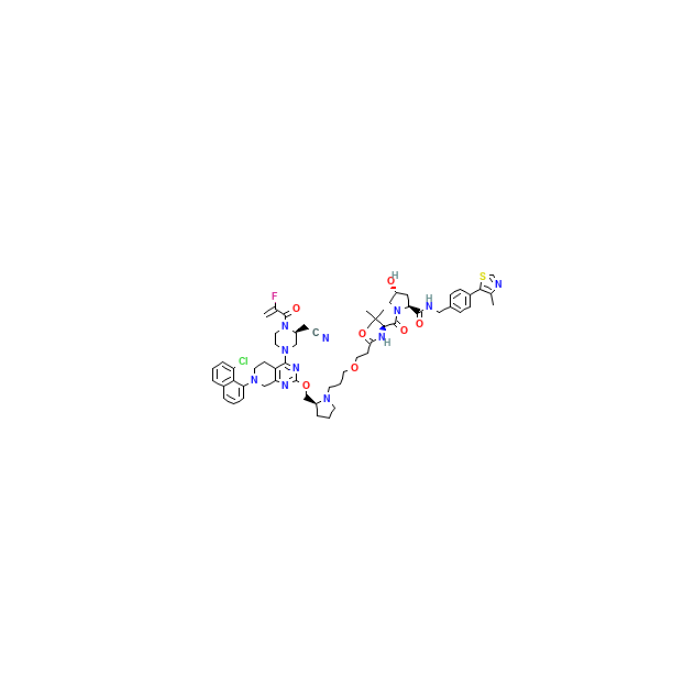
LC-2 is an effective first-class PROTAC capable of degrading endogenous KRAS G12C, with DC50s between 0.25 and 0.76 μM. LC-2 covalently binds KRAS G12C with a MRTX849 warhead and recruits the E3 ligase VHL, inducing rapid and sustained KRAS G12C degradation leading to suppression of MAPK signaling in both homozygous and heterozygous KRAS G12C cell lines.
Specifiche
Sinonimi
LC2 | LC 2 | PROTAC KRASG12C Degrader-LC-2
Specifiche e purezza
≥98%
Meccanismi biochimici e fisiologici
LC-2 is an effective first-class PROTAC capable of degrading endogenous KRAS G12C, with DC50s between 0.25 and 0.76 μM. LC-2 covalently binds KRAS G12C with a MRTX849 warhead and recruits the E3 ligase VHL, inducing rapid and sustained KRAS G12C degradation leading to suppression of MAPK signaling in both homozygous and heterozygous KRAS G12C cell lines.
Condizioni di conservazione di stoccaggio
Store at -20°C
Spedito in
Ice chest + Ice pads
Questo prodotto richiede spedizione a catena fredda. I servizi di terra e altri servizi economici non sono disponibili.
Assess primary readout and cytotoxicity in parallel. Validate compound solubility/absence of precipitation in media.
Analytical QC
Verify working solutions by LC–MS or UPLC immediately before use for sensitive assays.
Note
Adjust specifics (buffers, cofactors, incubation times) to the biology of your intended target. These are templates only.
Biological Roles
Item-specific
No target, pathway, or mechanism information is provided for LC-2. Any biological role is therefore undefined in this listing; consult the CoA, SDS, or literature linked to the CAS (2502156-03-6) or CID (154727765) for details.
General considerations for small-molecule library members
Potential roles can span modulators of enzymes, receptors, ion channels, transporters, or protein–protein interactions, depending on chemotype.
In cell-based contexts, assess cytotoxicity (e.g., ATP-based viability assays) across a relevant concentration range to establish non-toxic windows before mechanistic experiments.
Evaluate stability in assay buffer and in microsomal/plasma matrices if ADME-relevant screening is anticipated; determine logD, solubility, and plasma protein binding to contextualize activity.
Assay design tips
Include counterscreens to exclude assay interference (fluorescence quenching/inner filter effects, redox cycling, aggregation). Use detergents (0.01–0.05% Triton X-100 or 0.01–0.1% Tween-20) to mitigate colloidal aggregation where appropriate.
Note
No clinical, diagnostic, or therapeutic claims are made. This material is provided strictly for research use only.
Buffer Applications
Not typically applicable
LC-2 is a small-molecule library member, not a buffering agent. No pKa or buffering range is provided.
Use a validated assay buffer suited to your target biology (e.g., 25–50 mM HEPES or PBS, pH 7.2–7.5; ionic strength 100–150 mM NaCl; 0.01–0.05% detergent if aggregation is a concern).
Maintain low final organic content (≤0.5–1% DMSO v/v) unless higher levels are shown not to perturb the assay readout.
Specifications
Any buffer composition or pH values relevant to LC-2 performance are not specified for this item; refer to your in-house assay protocols.
Green Alternatives
Context
Without a defined solvent requirement or synthetic role for LC-2, greener considerations focus on handling solvents for stock preparation, analytics, and any optional transformations.
Greener handling options (general)
Prefer water-based assay buffers with minimal DMSO (≤0.1–0.5% v/v final) when compatible with solubility and assay performance.
When making intermediate dilutions, consider ethanol or PEG-400:water cosolvent systems as greener alternatives to DMF/NMP, verifying biological compatibility.
For chromatography, optimize to higher aqueous content and use ethanol as a greener modifier where feasible in place of acetonitrile/methanol, noting impacts on selectivity and viscosity.
Tradeoffs (literature/general)
DMSO vs ethanol: DMSO dissolves broader chemical space but has higher persistence; ethanol is greener but may limit solubility for hydrophobic scaffolds.
ACN vs MeOH vs EtOH in LC: ACN gives lower backpressure and sharper peaks; MeOH is greener than ACN; EtOH is greener still but increases viscosity and may require elevated temperature or lower flow rates.
Recommendation
Start with DMSO stocks for robustness, then reduce organic content at the point-of-use by serial dilution into buffered aqueous media, maintaining compound in solution (use surfactants or cyclodextrins if validated).
Pharmaceutical Uses
Not applicable for this listing
No pharmacopeial status, excipient role, or GMP grade is provided. LC-2 is sold for research use only.
General information (context only, not item-specific)
When small molecules transition toward development, materials may be qualified under compendial monographs (USP/EP/JP) or manufactured under GMP with tight controls on purity, residual solvents, elemental impurities, and stability-indicating methods. None of these claims are made here.
Recommendation
If you intend to use LC-2 in preclinical formulation research, perform full preformulation profiling (solid form, solubility–pH profile, pKa/logD, hygroscopicity) and source documentation from the CoA/SDS. No medical or clinical use is implied or permitted.
Physical Properties
Item-specific (from Product Data)
Appearance: Not specified for this item; refer to CoA/Spec Sheet.
Literature/general property notes (not specific to this item)
Without a molecular formula/structure, properties such as melting point, boiling point, density, pKa, logP, refractive index, and solubility cannot be assigned. Typical small-molecule library members are often provided as dry solids or DMSO solutions and are commonly soluble in high-polarity organic solvents (e.g., DMSO, DMF, acetonitrile), but this is not guaranteed for LC-2.
Practical guidance for unknowns
If the item is supplied as a solid: perform a small-scale solvent screen (DMSO, DMF, MeOH, ACN, water with cosolvent) at room temperature, then with gentle warming (≤40 °C) as needed.
Document exact solvent system and concentration at which clear solutions are achieved to ensure reproducibility across assays.
Caution
Do not treat the above as specifications. For authoritative values, consult the CoA/SDS or experimentally determine properties on a retained sub-aliquot.
Quality and Grades
Item-specific (from Product Data)
Grade/Purity: Not specified for this item; refer to CoA/Spec Sheet.
Guidance on grades (general knowledge)
Screening/compound-library grade typically prioritizes identity confirmation (LC–MS, NMR) and assay-ready purity (often ≥90% by HPLC/UPLC), while minimizing interfering residues (residual solvents, inorganics). Exact acceptance criteria vary by supplier and lot; confirm on the CoA.
If HPLC/UPLC area% purity and water/volatile content are critical for your application (e.g., biophysical binding, crystallography), request the most recent CoA and, if needed, perform in-house verification (Karl Fischer, GC residual solvents, quantitative NMR for assay).
Stabilizers & form
Stabilizer/additive content is not specified for this item; refer to CoA/SDS. If the compound contains oxidizable or hydrolyzable motifs (unknown here), stabilizers, inert-atmosphere packaging, or desiccants may be used in some lots.
Traceability & documentation
Ensure your internal records capture: SKU (L413701), CAS (2502156-03-6), lot number, receipt date, storage location (−20 °C), and any in-house QC data collected after receipt.
Reaction and Applications
Applicability to LC-2
LC-2 is listed under “small molecules and compound libraries.” Without structural information or a declared function, it is best treated as a screening compound/chemical probe candidate rather than a synthetic reagent.
Common research applications for library members (general)
Analytical characterization: orthogonal confirmation by LC–MS, HRMS, 1H/13C NMR, and purity assessment by HPLC/UPLC.
Practical tips
Prepare concentrated DMSO stocks (e.g., 10–50 mM) and store at −20 °C in single-use aliquots to minimize freeze–thaw.
Filter 0.22 µm if particulates are observed after dilution; verify no adsorption losses by UV/LC–MS.
Include vehicle controls and, if available, positive/negative reference compounds to benchmark responses.
Limitations
In the absence of target/chemotype information, avoid mechanistic assertions. If LC-2’s target class is known in your program, align assay conditions (cofactors, pH, redox state) accordingly and verify stability under those conditions.
Reaction Conditions
Not directly applicable
Reaction conditions (solvent, temperature, catalysts) for chemical transformations of LC-2 cannot be specified without structural information. This product is not marketed here as a reagent for named reactions.
General note (if chemical modification is attempted)
Select conditions based on known functional groups once structure is confirmed. Begin with mild conditions and monitor by LC–MS/UPLC.
Assess stability across pH (2–10), redox environment, and temperature (4–60 °C) prior to scale-up.
Analytical conditions (general, not item-specific)
LC–MS-friendly eluents: water/acetonitrile or water/methanol with 0.1% formic acid or 5–10 mM ammonium acetate; typical gradients 5–95% organic over 5–15 min.
Safety and Handling
Item-specific (from Product Data)
GHS classification / pictograms / signal word / H-statements: Not specified for this item; refer to SDS.
Storage conditions: Store at −20 °C.
Shipped in: Ice chest + ice pads.
General laboratory safety (not specific to this item)
Handle in a fume hood wearing appropriate PPE: lab coat, safety glasses, and chemical-resistant gloves (e.g., nitrile). Avoid inhalation of dust/aerosols and direct skin contact.
For unknown hazards, adopt a conservative approach: avoid heating above 60 °C, segregate from strong oxidizers/reductants and strong acids/bases until compatibility is known.
If in DMSO, remember DMSO can facilitate dermal absorption of solutes—prevent skin contact.
First-aid overview (consult SDS for specifics)
Inhalation: Move to fresh air; seek medical attention if symptoms persist.
Skin/eye contact: Rinse with water for at least 15 minutes; remove contaminated clothing.
Ingestion: Rinse mouth; seek medical advice.
Waste & spills
Collect spills with inert absorbent and dispose via approved chemical waste streams. Do not discharge to drains.
Authoritative source
Always defer to the item’s SDS for definitive hazard, toxicological, and transport information.
Solvent Selection
Item-specific status
Solubility profile and polarity for LC-2 are not specified; consult the CoA or test empirically.
General strategy for small-molecule library compounds (literature/practice)
Primary stock solvent: DMSO is the default for many diverse small molecules due to broad solvency and biological assay compatibility at low final %.
Secondary options: DMF, NMP, acetonitrile, methanol, ethanol; aqueous buffers with co-solvent or surfactant for poorly soluble compounds.
Sequence for solvent screening (recommendation):
Try anhydrous DMSO (5–20 mg/mL target). If insoluble, gently warm (<40 °C) and vortex/sonicate.
If partial solubility: prepare mixed cosolvent (e.g., DMSO:ACN 1:1) or DMSO:water with 0.5–1% Tween-80/Pluronic F-127 for biological assays, validating assay compatibility.
For analytical work (HPLC): ACN/H2O or MeOH/H2O with 0.1% formic acid or ammonium acetate are typical starting mobile phases.
Comparison note (general)
DMSO is preferred for stability and solvency; MeOH/EtOH are greener and more volatile but may not dissolve lipophilic or H-bond-rich scaffolds. Select based on your end-use (assay, synthesis, or analytics).
Storage and Reconstitution
Item-specific (from Product Data)
Storage: Store at −20 °C.
Shipping: Ice chest + ice pads.
Reconstitution guidance (general, not item-specific)
Solvent: Not specified for this item; refer to CoA/Spec Sheet. In the absence of guidance, DMSO is a common first choice for small molecules.
Concentration: Start at 10–50 mM for DMSO stocks where solubility allows. Document exact achieved concentration via weight-in or quantitative NMR if critical.
Aliquoting: Prepare single-use aliquots (e.g., 10–50 µL) in inert, low-bind tubes; exclude headspace where oxidation/moisture sensitivity is suspected.
Freeze–thaw: Minimize cycles. Thaw at room temperature, vortex briefly, and inspect for precipitation before use. If precipitated, warm gently and sonicate; avoid >40 °C unless stability is verified.
Stability monitoring
Track storage history and any visual/analytical changes (color, particulates, new LC–MS peaks). For long-term storage, consider desiccation and protection from light if the chemotype is photosensitive (unknown here).
Compliance
For research use only. Consult the SDS and CoA for any batch-specific instructions and stability data.
Structure and Identity
Item-specific (from Product Data)
Product name: LC-2 (SKU: L413701)
CAS: 2502156-03-6
PubChem CID: 154727765
InChIKey: 453138 (as provided)
SMILES: Not specified for this item; refer to CoA/Spec Sheet.
Molecular formula: Not specified for this item; refer to CoA/Spec Sheet.
Molecular weight: Not specified for this item; refer to CoA/Spec Sheet.
Notes on structure (general guidance)
The detailed 2D/3D structure, functional groups, stereochemistry, and ring systems cannot be described without a structural descriptor (SMILES/InChI) or formula. Please consult the CoA, SDS, or database entry (CAS or CID) for definitive structural features.
Interpretation & best practices
For compound library members with limited front‑label details, confirm identity by referencing the CAS/CID in a trusted database and cross‑checking the certificate of analysis (CoA) for batch-specific structural confirmation (e.g., 1H NMR, LC–MS).
Synthetic Utility
Applicability
LC-2 is supplied as a screening compound, not as a general-purpose synthetic reagent or building block. Functional group content and reactivity are not disclosed in the provided data.
General perspective (not item-specific)
Some library members can be leveraged as reference standards or as substrates/ligands in mechanistic studies, but such uses require confirmed structure and compatibility.
If derivatization is desired (e.g., biotinylation/fluorophore tagging for pull-downs), obtain structural details and assess reactive handles (amines, carboxylates, halides) before planning coupling chemistry.
Best practices
Verify identity and purity by orthogonal methods (LC–MS, NMR) prior to any synthetic modification.
For SAR exploration, consider ordering related analog sets where available to avoid de novo synthesis.
Target Specificity
Item-specific
No target, binding partner, or selectivity profile is provided for LC-2 in the Product Data. There are no claims of activity against specific enzymes, receptors, or pathways.
Guidance (general)
If LC-2 is being evaluated for target engagement, employ orthogonal readouts (biochemical potency, biophysical binding, and cellular target engagement) to triangulate specificity and exclude artifacts.
Panel screening (e.g., broad kinase or receptor panels) and counterscreens can help establish selectivity landscapes.
Disclaimer
Any target specificity must be established experimentally by the user or sourced from peer-reviewed literature associated with the CAS/CID. No medical or diagnostic use is claimed.
Domande frequenti
What is the purity of this product?
This product is supplied at ≥98% purity (chemical assay). Lot-specific values are stated on the Certificate of Analysis.
How should this product be stored?
Store at ?20 °C. Freezer storage is required to maintain the specified shelf life.
How is this product shipped?
This product ships in an insulated container with ice pads. Unpack on arrival and transfer it to the storage condition stated above.
What are the CAS number, molecular formula and molecular weight?
The CAS Number is 2502156-03-6, the molecular formula is C59H71ClFN11O7S, and the molecular weight is 1132.78 g/mol. InChIKey ZCGQZLKPUVGCBQ-HLMPTVQRSA-N.
What documentation is provided?
Available product documentation, including Certificates of Analysis (COA), Safety Data Sheets (SDS), and specification sheets, is shown in the product document area. Document availability and access follow the current site policy.
Utilizziamo i cookie per garantire il corretto funzionamento del sito web e, ove consentito, per migliorare la tua esperienza. Puoi gestire le tue preferenze in qualsiasi momento nelle Impostazioni. Per saperne di più, consulta la nostra Cookie Policy.
Desidera che le inviamo un messaggio quando avremo sconti disponibili?
Ricordamelo più tardi
Grazie! Controlli la sua casella di posta per confermare.
Products are supplied to verified businesses, institutions, and qualified professionals for research and development use only. Not for use in humans, animals, diagnosis, or therapy.