Determine the necessary mass, volume, or concentration for preparing a solution.
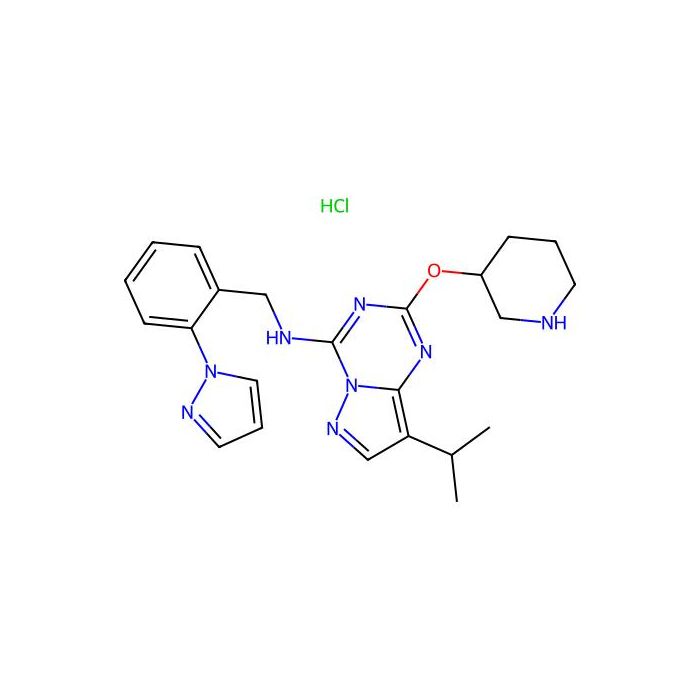
LDC4297 hydrochloride is a selective inhibitor of CDK7 with an IC 50 value of 0.13 nM. LDC4297 hydrochloride inhibits human cytomegalovirus (HCMV) replication with an EC 50 value of 24.5 nM. LDC4297 hydrochloride shows broad antiviral activities to Herpesviridae , Adenoviridae , Poxviridae , Retroviridae and Orthomyxoviridae with EC 50 values of 0.02-1.21 μM. LDC4297 hydrochloride can be used for the research of infection
In Vitro
LDC4297 hydrochloride (0-10 μM; 6 d) dose-dependently inhibits HCMV replication with an EC 50 value of 24.5 nM. LDC4297 hydrochloride (0-10 μM; 4 d) shows anti-proliferative activity to primary cultures of fibroblasts derived from human (HFF) with a GI 50 value of 4.5 μM. LDC4297 hydrochloride (20 μM; 12-96 h) shows anti-HCMV activity through a multifaceted mode of action that involves an interference with virus-induced Rb phosphorylation. LDC4297 hydrochloride (0-10 μM; 7 d) shows broad antiviral activities to HCMV, GPCMV, MCMV, HVV-6A, HSV-1, HSV-2, VZV, EBV, HAdV-2, Vaccinia virus, HIV-1 (nl4-3), HIV-1 (4LIG7) and Influenza A virus with EC 50 values of 0.02, 0.05, 0.07, 0.04, 0.02, 0.27, 0.06, 1.21, 0.25, 0.77, 1.04, 1.13 and 0.99 μM, respectively. MCE has not independently confirmed the accuracy of these methods. They are for reference only. Western Blot AnalysisCell Line: Primary cultures of fibroblasts derived from human (HFF) with virus infection Concentration: 20 μM Incubation Time: 12, 24, 48 and 96 hours Result: Showed inhibitory effect towards viral protein synthesis at the stage of immediate early (IE) gene expression and the drug-mediated reduction of IE1p72 levels partially recovered over time. Exerted an inhibitory effect on human cytomegalovirus (HCMV) induced an up-regulation of protein expression or protein phosphorylation, and reduced Rb expression in the uninfected control cells at 24 h.
In Vivo
LDC4297 hydrochloride (100 mg/kg; p.o. once) shows promising pharmacokinetic analyses . MCE has not independently confirmed the accuracy of these methods. They are for reference only. Animal Model: CD1 mice Dosage: 100 mg/kg Administration: Oral gavage; 100 mg/kg once Result: Showed a half-life (t1/2z) of 1.6 h, and the time to a mean peak plasma concentration of 1297.6 ng/mL is reached 0.5 h after administration with a continued presence in plasma for at least 8 h and a bioavailability of 97.7%.
Form:Solid
IC50& Target:CDK7 0.13 nM (IC 50 ) 166v VP22-GFP 0.02 μM (EC 50 ) 01-6332 0.27 μM (EC 50 ) HIV-1 (NL4.3 strain) 1.04 μM (EC 50 ) 4LIG7 1.13 μM (EC 50 )
Validated application types, recommended dilutions, and positive controls are not provided for this item.
General protocol guidance for small-molecule screening (not item-specific):
For biochemical, cellular, or biophysical protocols specific to LDC4297, consult primary literature or internal SOPs once the compound’s target and properties are confirmed.
Item-specific biological targets, pathways, or modes of action for LDC4297 hydrochloride are not provided in this listing.
General considerations for small-molecule research compounds (not item-specific):
This product is provided strictly for laboratory research use; no claims are made regarding physiological roles or therapeutic utility. For mechanistic use, consult primary literature specific to LDC4297 and confirm identity and purity from the CoA.
This item is not a buffering reagent and is not typically used to formulate buffers.
Practical guidance (general for handling in buffers):
For recipes and buffering capacity, refer to standard biological buffers (PBS, HEPES, Tris, MOPS); these are unrelated to the present compound.
As a defined screening compound rather than a process solvent or reagent, “green alternatives” focus on the handling workflow, not substitution of the compound itself.
Greener handling strategies (general guidance):
Illustrative comparison (general):
For scale-up synthesis or route design (outside the scope of this catalog item), apply green chemistry principles (solvent selection guides, reduced protecting groups, catalytic steps).
No pharmacopeial status, excipient role, or formulation use is specified for this item.
Context (general; not item-specific):
Conclusion: This catalog item is intended for discovery and laboratory research only and is not accompanied by GMP documentation or pharmacopoeial monographs.
General (literature/typical for organic hydrochloride salts; not item-specific):
Practical notes for use (general):
For definitive numerical specifications and release criteria (e.g., water content, residual solvents), consult the CoA/Spec Sheet.
For regulatory or GMP contexts, this product is offered for research use only and is not accompanied by GMP documentation or pharmacopeial compliance statements.
This product is positioned under a small-molecule and compound library category and is intended for research and screening workflows.
Typical research applications (general; not item-specific):
Practical tips:
Note: No manufacturer application text or biological target is provided for this item in the current listing.
No item-specific reaction conditions are provided because this product is a finished research compound rather than a reagent.
General handling conditions for solutions (not item-specific):
If you intend to perform chemical reactions on the scaffold (e.g., prodrug derivatization), first convert to the free base under controlled conditions and confirm identity by LC–MS/NMR. Without structure disclosure, specific catalysts, temperatures, or yields cannot be recommended.
Always consult the product’s SDS for definitive hazard, exposure limits, and emergency procedures.
LDC4297 hydrochloride is an organic hydrochloride salt; actual solubility is scaffold-dependent. In absence of item-specific solubility data, select solvents strategically and verify experimentally.
Comparison (general guidance):
Always corroborate solvent choice with a small-scale solubility test and consult the CoA for any provided solubility notes.
Always consult the batch CoA/Spec Sheet for any additional stability or solubility notes specific to your lot. For long-term projects, verify stability by LC–MS/HPLC after storage.
A small-molecule research compound supplied as the hydrochloride salt.
2D structure description (general context): Most amine hydrochlorides present as the protonated amine center paired with chloride; without the exact structure, specific functional groups (aryl, heteroaryl, aliphatic) cannot be detailed here.
Notes:
As supplied, LDC4297 hydrochloride is a finished small molecule salt intended for screening; it is not positioned as a general synthetic building block. Item-specific functional groups are not disclosed in this listing.
General synthetic considerations for organic amine hydrochlorides (not item-specific):
For route development or SAR expansion, obtain the exact structure from the CoA/Spec Sheet or literature to plan compatible transformations and protecting-group strategies.
No target, pathway, or selectivity profile is specified for LDC4297 hydrochloride in this product listing.
Users should establish activity and specificity in their own assay context, employing appropriate positive/negative controls and orthogonal modalities.