≥99.995% metals basis, lumps,10mm max. lump size,weight 50g per flussi di lavoro cromatografici e analitici sensibili che richiedono un'interferenza minima della linea di base.
🌡
Stoccaggio e spedizione
Room temperature Spedizione FedEx DG Service. Consultare il COA specifico del lotto per le specifiche esatte.
📋
Documenti di qualità
SDS, COA, scheda tecnica e scheda delle specifiche disponibili per il download. COA specifico del lotto accessibile tramite ricerca per numero di lotto.
📚
Prova documentale
Citato in 2193 pubblicazioni peer-reviewed su cromatografia, sintesi organica e reazioni di accoppiamento incrociato.
Panoramica
Application: Lithium fluoride can be used: As an additive to fabricate SiO@C/graphite composite anode materials for Li-ion batteries. LiF stabilizes solid electrolyte interphase (SEI) and enhances initial coulombic efficiency. As a critical component in SEI for stabilizing the SEI layer and improving the cycling efficiency of Li metal batteries. To fabricate electron contacts for high-efficiency n-type crystalline silicon solar cells. To prepare solid-state light sources for radiation imaging detectors. To synthesize highly crystalline MXene for asymmetric supercapacitor applications. And also, lightweight, flexible, and hydrophobic MXene foam with reasonable strength, high electrical conductivity, and an outstanding EMI-shielding performance. As an electron-injection layer to fabricate ITO/PEDOT:PSS/perovskite/B3PYMPM/ LiF/Al OLED device with a quantum efficiency of 20%.
Alkali metal fluoride - Inorganic lithium salt - Inorganic salt
Descrizione
This compound belongs to the class of inorganic compounds known as alkali metal fluorides. These are inorganic compounds in which the largest halogen atom is fluorine, and the heaviest metal atom is an alkali metal.
External Descriptors
Not available
1. Djoumbou Feunang Y, Eisner R, Knox C, Chepelev L, Hastings J, Owen G, Fahy E, Steinbeck C, Subramanian S, Bolton E, Greiner R, and Wishart DS. ClassyFire: Automated Chemical Classification With A Comprehensive, Computable Taxonomy. Journal of Cheminformatics, 2016, 8:61.
Determine the necessary mass, volume, or concentration for preparing a solution.
Dilution Calculator
Determine the dilution needed to prepare a stock solution.
Reconstitution Calculator
Recensioni
Recensioni dei clienti
Application Protocols
No application protocols are provided for this item. As a materials reagent and inorganic salt, it is not used in assays such as WB, IHC, IF, or FC. For process guidance, refer to domain-specific literature on molten-salt electrochemistry, ceramic flux syntheses, or optical crystal growth involving LiF.
Biological Roles
This product is intended for research use only. No clinical/medical use is implied.
General biochemical context (literature; not item-specific):
Fluoride ion can interact with metalloenzymes and alter mineralization processes; at sufficient concentrations it can inhibit certain phosphatases and enolase by metal–fluoride complexation. These effects are highly concentration- and system-dependent and are typically studied using soluble fluoride salts.
Lithium ion is widely studied for its effects on cellular signaling pathways in research contexts; however, such studies generally employ soluble lithium salts (e.g., LiCl), not LiF, due to LiF’s low aqueous solubility.
Relevance to this material:
Given LiF’s sparing solubility in water at ambient temperature, it is not commonly selected for biological assays where defined ionic concentrations are required. Alternative lithium or fluoride sources with higher solubility are typically preferred.
Buffer Applications
Lithium fluoride is not used as a buffering agent. Its very low water solubility and lack of conjugate acid/base pairs preclude conventional buffer preparation. For fluoride-containing buffers (e.g., to inhibit phosphatases), more soluble salts such as NaF or KF are typically employed.
Green Alternatives
Selecting a fluoride source has meaningful EHS and process implications. LiF is thermally stable and nonvolatile at ambient conditions, but its low solubility limits its use as a green substitute for homogeneous fluorination.
Comparison (literature; general guidance):
LiF vs KF/CsF:
EHS: all are inorganic salts with relatively low vapor pressure and manageable dust hazards; KF/CsF can be more irritating due to higher solubility.
Performance: KF/CsF offer higher solubility/reactivity in polar media or with PTCs, enabling lower temperatures and shorter times; LiF better for high‑T, solid-state, or molten-salt environments.
Sustainability: potassium salts are often preferred over cesium on resource/criticality grounds. Lithium availability is increasingly constrained by battery demand—consider K-based alternatives where feasible.
LiF vs TBAF/TMAF:
TBAF provides powerful, homogeneous fluoride in organics but poses toxicity, persistence, and waste burdens; LiF avoids quaternary ammonium waste but is not an adequate drop-in replacement for most homogeneous fluorinations.
Greener process tips:
Favor heterogeneous KF on alumina or KF/PEG systems for SNAr/Halex over TBAF when possible.
In molten-salt operations, use eutectic mixtures (e.g., LiF–NaF–KF) to reduce operating temperatures and energy consumption.
Implement closed handling and dust suppression to minimize worker exposure and environmental release.
Pharmaceutical Uses
No item-specific pharmacopeial status or excipient role is provided. This product is supplied for research use only.
General context (literature; not item-specific):
LiF is not commonly used as a pharmaceutical excipient due to its low solubility and the regulatory considerations around fluoride exposure. Where fluoride ion is desired (e.g., certain dentifrice formulations), more soluble and regulated salts (e.g., NaF, SnF2) are used.
In solid dosage manufacturing research, inorganic fluorides may occasionally be explored as process aids or for material property modification in specialized studies, but LiF is atypical.
Physical Properties
Item-specific specifications (bp, mp, density, UV cutoff, trace metals, water content) are not provided in the Product Data for this SKU. Consult the CoA/Spec Sheet for authoritative values.
Literature/general reference values (for LiF; not item-specific):
Appearance: white crystalline solid; hygroscopicity is low compared with other fluorides.
Melting point: ~845 °C (literature).
Boiling/sublimation: ~1675–1681 °C (literature) with significant volatility only at very high T.
Density: ~2.64 g/cm³ at 25 °C (literature).
Refractive index (single crystal): nD ≈ 1.39 (589 nm) (literature); wide UV transparency window down to ~105–110 nm (optical-grade crystals).
Solubility: sparingly soluble in water (≈0.27 g per 100 g H2O at 25 °C; increases with T); essentially insoluble in common organic solvents (literature).
Dielectric/ionic: electrically insulating as a solid at ambient T; becomes highly conductive when molten due to mobile ions (literature).
Crystal structure: rock-salt (NaCl-type), space group Fm-3m, a ≈ 4.02 Å (literature).
Practical notes:
The low aqueous solubility and high lattice energy influence its reactivity and utility as a fluoride source. For homogeneous fluoride in organic media, more soluble fluorides (KF/CsF, TBAF) are often chosen.
Quality and Grades
Item-specific grade/purity and stabilizers: Not specified for this item; refer to CoA/Spec Sheet.
Context for this material (general, not item-specific):
Common commercial grades:
Technical/industrial grade: suitable for fluxes, ceramics, and metallurgy; broader impurity profile.
High-purity/electronic grade: low alkali/alkaline earth and transition-metal contaminants; used for thin-film deposition, ionic conduction studies, and battery/materials R&D.
Optical grade (single-crystal LiF): controlled low color-center density and high transmittance in VUV–IR; used for windows/prisms and scintillators after appropriate doping.
Impurity considerations for research:
Trace alkali/alkaline earth metals, Si/Al (from processing), and moisture/adsorbed HF can affect conductivity in molten salts and defect chemistry in crystals.
For electrochemical/melt work, water and oxide contamination must be minimized; pre-drying and handling under dry inert gas are common.
Recommendations:
Verify assay, major trace metals, and loss on drying on the CoA for your lot if your application is sensitive (e.g., optoelectronic, molten-salt electrochemistry, thin films).
Reaction and Applications
This salt’s principal value lies in materials processes, molten-salt chemistry, and as a thermally robust fluoride source rather than as a conventional homogeneous reagent.
Materials and processing (literature):
Flux/mineralizer in ceramic and phosphor synthesis to lower sintering temperatures and promote grain growth.
Component of molten fluoride mixtures (e.g., LiF–NaF–KF eutectics) for high-temperature electrochemistry, metal refining, and surface treatments.
Precursor/constituent for optical LiF crystals used as UV‑transparent windows and prisms; also relevant to scintillating materials upon suitable doping (e.g., Eu, Ce) during crystal growth.
Additive in certain cross-coupling protocols where fluoride can modulate catalyst speciation or assist transmetalation; however, KF/CsF are more common for such roles.
Fluoride source in solid-state metathesis to generate metal fluorides (e.g., MFx via salt exchange at elevated temperature) when high lattice energy is desired in products.
Desiccant/fluoride scavenger at high temperature in inorganic syntheses.
Practical considerations:
Reactivity is typically observed under elevated temperatures or in molten/solid-state contexts due to low solubility.
Use inert atmospheres for high-temperature work to limit hydrolysis and HF formation.
Reaction Conditions
No item-specific protocols or performance specifications are provided; consult the literature for conditions relevant to your application.
General literature guidance (not item-specific):
Solid-state/flux syntheses: mix precursors with 1–20 wt% LiF as a flux; heat to 600–1100 °C depending on system; dwell for hours to tens of hours. Post-wash unreacted salts with water or dilute acid (caution: HF risk if strong acids contact fluorides).
Molten-salt electrochemistry: LiF combined with NaF/KF to form eutectics (e.g., LiF–NaF–KF, mp ~454 °C); operate typically at 450–750 °C under dry inert gas; pre-dry all salts (200–300 °C under vacuum) to minimize hydrolysis.
Heterogeneous additive use in organics: when used, loadings often 1–3 equiv relative to substrate; polar aprotic solvents and elevated T (80–150 °C) with vigorous stirring. Efficacy varies; KF/CsF often superior.
Practical tips:
Employ ceramic or nickel-based reactors for high-temperature fluoride work; avoid aluminum in fluoride-rich molten environments.
Verify compatibility of glassware at high T; at ambient conditions, standard borosilicate is acceptable.
Always evaluate for HF evolution risk when acids/moisture are present, and use appropriate scrubbing.
Safety and Handling
Item-specific GHS data (signal word, hazard statements, pictograms, classification) are not provided in the Product Data. Always consult the SDS for this SKU before use.
General safety considerations for lithium fluoride (literature; not item-specific):
Hazards: fluoride salts can be harmful if ingested or inhaled; may cause irritation to skin, eyes, and mucosa. Chronic excessive fluoride exposure can affect bones and teeth. Toxicity profile varies by route and dose.
Incompatibilities: strong acids (risk of HF generation); avoid contact with glassware at very high temperatures only (not an issue at ambient). Avoid mixing with oxidizers in molten-salt operations unless specifically engineered.
PPE: laboratory coat, safety goggles, and appropriate gloves (e.g., nitrile). Use dust control, handle powders in a fume hood or glovebox when charging reactors.
First aid (overview; defer to SDS):
Inhalation: move to fresh air; seek medical attention if symptoms persist.
Skin/eye contact: rinse with water for at least 15 minutes; remove contaminated clothing; seek medical advice.
Ingestion: rinse mouth; do not induce vomiting; seek immediate medical attention.
Thermal operations: molten salts are corrosive and cause severe thermal burns—use high‑temperature PPE and engineered containment.
Waste: collect fluoride-containing waste separately; neutralize/complex as per institutional protocols and local regulations.
Shipping/storage from Product Data:
Storage Conditions: Room temperature.
Shipped In: FedEx DG Service (handle as dangerous goods per carrier requirements).
Solvent Selection
Lithium fluoride is a sparingly soluble, highly ionic inorganic salt. Conventional “solvent selection” is typically not applicable in the same way as for molecular organics.
Polarity/miscibility profile (literature):
Water: very low solubility at ambient temperature (~0.27 g/100 g at 25 °C); increases with temperature.
Organic solvents: essentially insoluble in common polar aprotic (DMF, DMSO, MeCN) and protic (alcohols) solvents; negligible solubility in nonpolar media.
Molten salts/ionic liquids: fully miscible and conductive in appropriate molten fluoride matrices (eutectic LiF–NaF–KF, etc.).
When to choose LiF versus alternatives (general):
Choose LiF when a thermally stable fluoride is needed in high‑temperature fluxes or molten-salt systems, or as a robust, non-hygroscopic fluoride component for ceramic synthesis.
For homogeneous nucleophilic fluoride in organic synthesis, consider more soluble fluorides:
KF or CsF (often with crown ethers/phase-transfer agents) for SNAr/Halex.
TBAF/TMAF in aprotic media for desilylations and silicon activation (note: different safety/green profiles).
Practical tips:
For heterogeneous reactions using LiF, vigorous stirring, high surface area, and elevated temperatures may be required to observe rate enhancements.
In electrochemical melts, rigorously dry all components and vessels to suppress HF formation.
Storage and Reconstitution
Storage (from Product Data): Room temperature. Keep container tightly closed in a dry, well-ventilated place. Protect from moisture and acids.
Shipping (from Product Data): FedEx DG Service; handle as dangerous goods per carrier/SDS.
Handling and preparation (general guidance; not item-specific):
Drying: for moisture-critical applications (e.g., molten salts), pre-dry LiF at 200–300 °C under vacuum or dry inert gas purge for several hours; cool and transfer under inert atmosphere.
Atmosphere: store and handle in a dry environment; for high-temperature operations, use inert gas (N2/Ar) to suppress hydrolysis.
Reconstitution/solutions: due to low water and organic solubility, true solutions at ambient temperature are limited. If an aqueous fluoride solution is required, consider more soluble fluorides (NaF, KF). For melts, blend with eutectic partners to reduce operating temperature.
Containers: use polyethylene or compatible metal containers; avoid acid-contaminated caps or liners to prevent HF formation.
Always consult the lot-specific CoA and SDS for definitive storage and handling requirements.
Structure and Identity
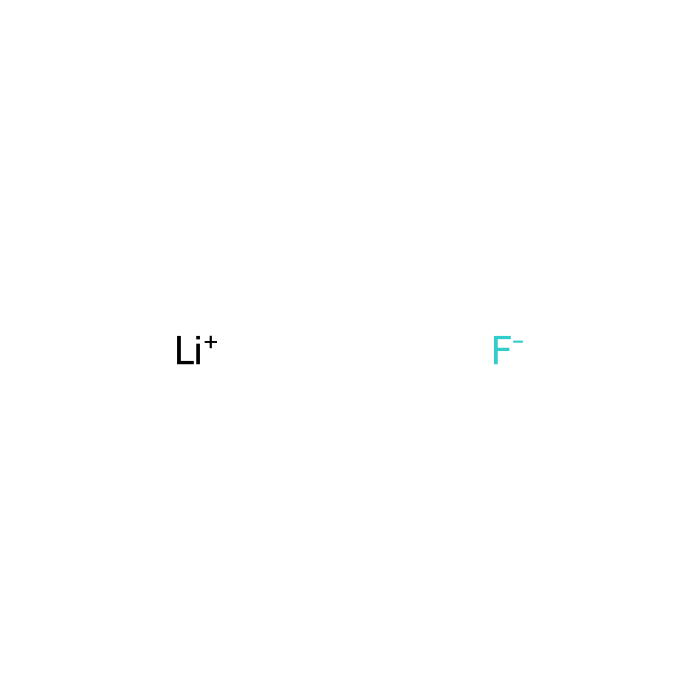
Lithium fluoride is an inorganic ionic compound composed of lithium cations and fluoride anions; a hard, high–lattice-energy salt widely used in materials science and molten-salt chemistry.
Item-specific (from Product Data):
SKU: L485396
Product Name: Lithium fluoride
CAS: 7789-24-4
CID: 224478
InChIKey: 284761 (as listed in Product Data)
SMILES: Not specified for this item; refer to CoA/Spec Sheet.
Molecular Formula: Not specified for this item; refer to CoA/Spec Sheet.
Molecular Weight: Not specified for this item; refer to CoA/Spec Sheet.
Literature identity (for reference; not item-specific):
Empirical formula: LiF
Formula weight: ~25.94 g/mol (Li 6.94 + F 18.998)
SMILES: [Li+].[F-]
Typical 2D description: discrete Li+ and F− ions arranged (in the solid) in a rock-salt (NaCl-type) face-centered cubic lattice; no stereocenters, no covalent functional groups.
Structural features: highly ionic M–X bond; six-coordinate octahedral environment for each ion in the crystal; very high lattice enthalpy relative to other alkali fluorides.
Notes:
The literature identifiers are provided for scientific context and may differ from item-specific documentation. Always confirm identifiers via the product CoA/SDS for regulated uses.
Synthetic Utility
Functional/ionic features: LiF provides hard, non-nucleophilic fluoride under many conditions, with a high lattice energy that disfavors dissolution. It is thermally stable and can be mixed with other salts to tailor melts and fluxes.
Roles in synthesis and materials (literature; not item-specific):
Flux/mineralizer to facilitate solid-state reactions (e.g., oxides, phosphors) by enhancing mass transport and lowering sintering temperatures.
Component or precursor for other metal fluorides via salt metathesis at elevated T.
Additive in some cross-coupling and silicon-mediated reactions where fluoride modulates catalyst or substrate activation; however, KF/CsF or quaternary ammonium fluorides are more routinely effective.
Source of Li+ in mixed-salt systems (with MF salts) to tune melting points, viscosity, and ionic conductivity in electrochemical melts and baths.
Retrosynthetic/value considerations:
Choose LiF when the target transformation benefits from a high-temperature, fluoride-rich environment or when fabricating fluoride-containing ceramics or optical materials. For solution-phase nucleophilic fluorination or desilylation, select more soluble fluoride sources.
Target Specificity
Not applicable. This product is an inorganic salt, not a biological targeting reagent. No antigen/epitope specificity, species reactivity, clone, or isotype data are relevant.
Domande frequenti
What does the trace-metals specification mean?
This product is specified at ≥99.995% on a trace-metals basis. That figure describes metallic impurity content rather than overall chemical assay, so it is the relevant specification for ICP-MS, semiconductor and battery applications. Lot-specific values are stated on the Certificate of Analysis.
How should this product be stored?
Store at room temperature.
How is this product shipped?
This product is classified as dangerous goods and ships via FedEx DG Service. Ground and other economy services are not available, and delivery to some destinations or address types may be restricted.
What are the CAS number, molecular formula and molecular weight?
The CAS Number is 7789-24-4, the molecular formula is LiF, and the molecular weight is 25.94 g/mol. InChIKey PQXKHYXIUOZZFA-UHFFFAOYSA-M.
What documentation is provided?
Available product documentation, including Certificates of Analysis (COA), Safety Data Sheets (SDS), and specification sheets, is shown in the product document area. Document availability and access follow the current site policy.
Utilizziamo i cookie per garantire il corretto funzionamento del sito web e, ove consentito, per migliorare la tua esperienza. Puoi gestire le tue preferenze in qualsiasi momento nelle Impostazioni. Per saperne di più, consulta la nostra Cookie Policy.
Desidera che le inviamo un messaggio quando avremo sconti disponibili?
Ricordamelo più tardi
Grazie! Controlli la sua casella di posta per confermare.
Products are supplied to verified businesses, institutions, and qualified professionals for research and development use only. Not for use in humans, animals, diagnosis, or therapy.