GRADE & PURITYMoligand™?Moligand™ — Aladdin's line of ligands and bioactive small molecules. Use for receptor, pathway, and binding studies needing defined small-molecule tools.10 mM in DMSO
Certificati (CoA, COO, BSE/TSE e tabella di analisi)
C of A & Other Certificates(BSE/TSE, COO):
Analytical Chart:
Calcolatori di soluzioni
Molarity Calculator
Determine the necessary mass, volume, or concentration for preparing a solution.
Dilution Calculator
Determine the dilution needed to prepare a stock solution.
Reconstitution Calculator
Recensioni
Recensioni dei clienti
Application Protocols
Item-specific tested applications and dilutions: Not specified for this item; refer to CoA/Spec Sheet.
General laboratory protocols (for small-molecule screening/reference standards; not item specifications):
Stock preparation: Weigh the required amount quickly, minimizing light exposure. Dissolve in anhydrous DMSO to prepare a 10–50 mM master stock. Vortex until clear. Aliquot into amber vials/microtubes to avoid repeated freeze–thaw.
Working solutions: Immediately before use, dilute the DMSO stock into assay buffer or culture media to the desired final concentration, keeping DMSO ≤0.5–1% v/v as protocol allows. Include vehicle controls.
Chromatographic reference: Prepare 0.1–1.0 mg/mL solutions in ACN/H2O (with 0.1% formic acid if using LC–MS). Verify retention time and mass; use internal standards as appropriate.
Stability check: Assess solution stability over the experimental timeframe by periodic LC–UV/LC–MS injections; discard solutions that show new peaks or precipitation.
Note: Adjust molarity for counterion mass if using a salt form; confirm form and purity with the product’s CoA before critical experiments.
Biological Roles
General biochemical context (literature; for research use only, no clinical claims):
Target class: Metipranolol is a small-molecule ligand of β-adrenergic receptors (GPCR family). It is commonly employed as an antagonist/functional blocker in receptor-binding and downstream signaling studies.
Pathway context: β-adrenergic signaling modulates cAMP production via adenylyl cyclase activation; tool compounds such as metipranolol are used to interrogate Gs-coupled GPCR cascades, kinase activation profiles, and transcriptional responses in cell-based assays.
Stereochemistry and activity: β-Amino alcohols typically display stereoselective receptor interactions; enantiomeric enrichment can alter potency and selectivity profiles (literature).
Comparative pharmacology: Within the aryloxypropanolamine class, ring substitution and amine N-substitution patterns influence receptor subtype bias (β1/β2) and intrinsic activity; metipranolol provides a distinct SAR point relative to analogs like propranolol or metoprolol.
Experimental usage notes:
Prepare concentrated DMSO stocks and perform serial dilutions into assay buffers; include vehicle controls.
Verify free base vs salt form to ensure consistent molarity; adjust calculations for counterion if present.
Light protection is recommended per item storage guidance to minimize degradation that could confound biological readouts.
Buffer Applications
Not typically applicable. Metipranolol is not a buffering agent and does not constitute a defined buffer system.
Practical guidance for related work:
For biological assays, select a buffer based on the target system (e.g., HEPES, phosphate, Tris) and maintain a pH at least 1–2 units below the amine pKa to keep the compound predominantly protonated and soluble when working with the free base (literature).
Include appropriate surfactants (e.g., 0.01–0.1% Tween 20) only if required by the assay and after verifying they do not affect target function or compound stability.
Always validate compound stability in the chosen buffer over the assay duration (protected from light as indicated for this item).
Green Alternatives
Context: Metipranolol is a solid small molecule, not a process solvent. “Greener alternatives” considerations apply primarily to solvent choices for dissolution, purification, and derivatization.
Replace DMF/DMF-like dipolar aprotics with safer options when feasible: use acetonitrile, propylene carbonate, or Cyrene for reactions requiring polarity.
Prefer bio-derived ethers/esters (2-MeTHF, CPME, ethyl acetate) over chlorinated solvents (DCM, chloroform) for extractions and workups.
For stock solutions, consider PEG-400 or aqueous citrate/phosphate buffers for salt forms to reduce DMSO dependence in some bioassays.
Illustrative comparison (general; not item-specific specs):
DMSO vs PEG-400: DMSO offers higher solvency and inertness; PEG-400 is less hazardous but may affect viscosity and assay readouts.
DCM vs 2-MeTHF/EtOAc: Chlorinated solvents ease phase separations but have higher environmental impact; 2-MeTHF/EtOAc provide greener profiles with adequate solvency for many amine/aryl ether scaffolds.
Operational tips:
Use minimal organic cosolvent when diluting DMSO stocks into buffers (≤1% v/v) to limit environmental load and improve biocompatibility.
Explore in situ salt formation to access water as the primary solvent for crystallization or recrystallization, reducing VOC usage.
Pharmaceutical Uses
No therapeutic or clinical claims are made for this product. For research use only.
Analytical/QC reference: Metipranolol can serve as a reference standard for development and validation of chromatographic assays (HPLC/UPLC, LC–MS) assessing β-adrenergic ligands.
Salt and polymorph studies: Researchers may explore counterion selection, crystalline forms, and hygroscopicity relevant to solid-form screening workflows typical of small-molecule bases.
Excipient interactions: In pre-formulation research, interactions with common excipients (lactose, microcrystalline cellulose, PVP) and antioxidants can be profiled to understand stability—these are internal R&D studies only.
Regulatory notes:
Pharmacopeial status, impurity profiles, and identification tests—if needed—must be confirmed against the appropriate compendia and verified by CoA/Spec Sheet for the specific lot. This listing does not imply compliance with any pharmacopoeia.
Physical Properties
Item-specific physical properties from Product Data: Not specified for this item; refer to CoA/Spec Sheet.
Literature/General values and expectations (for professional context; not specifications for this item):
Ionization/Basicity: Secondary amine of aryloxypropanolamines typically exhibits conjugate acid pKa in the ~9–10.5 range (literature), enabling salt formation with mineral acids for enhanced aqueous solubility.
Lipophilicity: Aryloxypropanolamines often show moderate lipophilicity (typical clogP ~1.5–3, literature), tunable by ring substituents and salt state.
Solubility profile (qualitative): Free base forms are commonly soluble in polar organic solvents (DMSO, methanol, ethanol) and variably soluble in water; their hydrochloride/mesylate salts are generally water-soluble (literature).
Physical state: Many members of this class are crystalline solids at ambient temperature (literature), though actual form may vary with polymorph and salt state.
Optical activity: Contains a single stereocenter; commercial materials may be racemic unless an enantiopure form is specified (literature).
Practical notes:
Hygroscopicity may increase for salt forms; keep containers tightly closed.
Refractive index and UV cutoff are not typically defined for non-volatile solids; characterize by DSC/TGA/VT-NMR if needed.
Quality and Grades
Item-specific grade from Product Data:
Grade/Purity: Moligand™.
What Moligand™ generally indicates (program-level context; not a specification):
Moligand™ is Aladdin’s discovery-chemistry oriented small-molecule line curated for screening, probe development, and SAR workflows. Materials are intended for research use only and are not for human or veterinary use.
Emphasis is placed on identity confirmation and suitability for library screening (e.g., LC-MS/HRMS, NMR verification), with attention to stability (light/temperature) and packaging appropriate for low-volume, high-throughput use.
Implications for users:
Documentation: For exact assay-suitable purity, residual solvents, counterions, and specific impurity limits, consult the item’s CoA/Spec Sheet. Where applicable, enantiomeric composition and salt form will be disclosed on the CoA.
Chromatography-readiness: Many Moligand™ items are provided with low nonvolatile residue and are compatible with analytical HPLC/UPLC; however, UV cutoffs and trace metal specs are not implied unless explicitly listed—verify with the CoA for your lot.
Stabilization: If supplied as a free base, consider in-house conversion to a salt for aqueous work; if supplied as a salt, confirm the counterion and hydrate state on the CoA to ensure mass-accuracy in assays.
Reaction and Applications
Item-specific manufacturer applications: Not specified in Product Data beyond inclusion in a small-molecule/compound library.
Research applications (general, for this scaffold; not clinical):
Ligand and reference standard: Metipranolol is widely used as a β-adrenergic receptor ligand/competitor in binding and functional assays, as well as a system-suitability standard in chromatographic method development (literature).
Probe derivatization: The secondary amine and secondary alcohol provide handles for installing reporter groups (e.g., fluorescein via carbamate/urethane formation, biotin via NHS-esters) for target-engagement or imaging assays.
Salt screening: Formation of pharmaceutically relevant salts (HCl, sulfate, maleate, citrate) for solubility and crystallization studies.
Chiral studies: Resolution of enantiomers by chiral HPLC or diastereomeric salt formation to interrogate stereodependent binding phenomena typical of β-amino alcohols.
Practical notes:
Maintain low light exposure as recommended for this item; aromatic ethers and amines can undergo slow photodegradation.
For coupling on the amine, protect or account for the secondary alcohol; for selective O-acylation, use mild acyl donors and control base equivalents.
Verify free base vs salt state before weighing; adjust for counterion mass in assays and derivatizations.
Reaction Conditions
No item-specific reaction conditions are provided in the Product Data. The following are general literature/practice guidelines for transformations of aryloxy-β-amino alcohols like metipranolol (for method development; not specifications):
N-Acylation/Carbamate formation: Use acyl chlorides/anhydrides or activated carbonates (e.g., p-nitrophenyl chloroformate) with a non-nucleophilic base (DIPEA) in DCM/THF at 0–25°C; monitor by TLC/LC–MS. Typical times 0.5–4 h.
N-Sulfonylation: Sulfonyl chloride (e.g., TsCl) with pyridine or TEA in DCM at 0–25°C; quench with aqueous bicarbonate.
O-Acylation: Prefer mild coupling (DCC/DMAP or EDCI/DMAP) in DCM or MeCN at 0–25°C to minimize N-acylation; protect the amine if high selectivity is required.
Salt formation: Dissolve free base in minimal EtOAc/IPA and add anhydrous HCl in ether or gaseous HCl at 0–10°C; isolate the precipitated hydrochloride; dry under vacuum.
Chiral resolution: Chiral HPLC with immobilized polysaccharide stationary phases (e.g., Chiralpak AD-H) using hexane/IPA or ACN/MeOH; or diastereomeric salt formation with L-(+)-tartaric acid in ethanol/water, crystallize at 0–5°C.
Analytical controls: Verify conversions and purity by LC–MS/NMR; assess enantiomeric ratio by chiral HPLC where stereochemistry matters. Always protect from light as recommended for this item during prolonged reactions or storage between steps.
Safety and Handling
Item-specific hazard data from Product Data:
Signal Word: Not specified for this item; refer to CoA/Spec Sheet.
H-Statements: Not specified for this item; refer to CoA/Spec Sheet.
GHS Classification/Pictograms: Not specified for this item; refer to CoA/Spec Sheet.
General laboratory safety guidance (literature/practice; not a substitute for SDS):
Handle in a fume hood with standard PPE: lab coat, nitrile gloves, safety glasses. Avoid inhalation of dusts/powders and contact with skin/eyes typical of small organic amines.
Secondary amines can be irritants and sensitizers; minimize exposure and wash thoroughly after handling.
Avoid strong oxidizers and acylating agents unless intentionally reacting; amines react with acyl halides/anhydrides and isocyanates.
If preparing salts, add acids slowly with cooling; CO2 evolution is not expected, but exotherm and pH swings can be significant.
First aid (overview): In case of skin/eye contact, rinse with water for at least 15 minutes; remove contaminated clothing. If inhaled, move to fresh air. If ingested, rinse mouth; do not induce vomiting; seek medical attention.
Spill response: Avoid dust generation; collect solids by gentle sweeping and dispose per institutional and local regulations.
Always consult the product-specific SDS for authoritative hazard statements, exposure limits, and transport information.
Solvent Selection
Applicability: Metipranolol is a small-molecule organic base (secondary amine) with an aryloxy-β-amino alcohol scaffold; solvent choices are driven by desired ionization state and assay context.
General solvent behavior (literature/practice):
Polar aprotics: DMSO is the default for stock solutions (e.g., 10–50 mM screening stocks), offering wide compatibility and stability. DMF and acetonitrile also dissolve many aryloxypropanolamines but are less favored for bioassays.
Protic solvents: Methanol and ethanol provide rapid dissolution and are compatible with many analytical methods; isopropanol can help with weigh-and-dissolve workflows.
Aqueous media: The free base has limited water solubility; converting to an acid salt in situ (e.g., with HCl) or using pre-formed salt enhances aqueous solubility (literature). Buffer pH below the amine pKa increases the protonated fraction and solubility.
Nonpolar solvents: Poor solubility is expected in hydrocarbons and weakly polar ethers.
Selection guidance:
For biochemistry/screens: Prepare a concentrated DMSO stock and dilute into assay buffer, limiting final DMSO to ≤0.5–1% v/v as protocol permits.
For synthetic manipulations (derivatization, salt formation): Employ dichloromethane, ethyl acetate, THF, MeOH/EtOH as appropriate; ensure bases/acids are anhydrous for clean conversions.
Small comparison (pros/cons):
DMSO: maximal solubility/stability; but hygroscopic, can interfere in some assays.
MeOH: volatile/easy to remove; but can participate in acyl transfers under strong activating conditions.
Buffered saline (pH 5–6): good for salt forms; risk of precipitation on pH drift.
Storage and Reconstitution
Item-specific conditions from Product Data:
Storage Conditions: Protected from light, Store at -80°C.
Shipped In: Dry ice packs + Cold packs.
Best practices (general guidance complementing item instructions):
Upon receipt: Keep the container sealed and cold. Transfer immediately to a -80°C freezer protected from light (amber vial or foil wrap).
Working aliquots: To avoid freeze–thaw cycles, subdivide into small, single-use aliquots under low light. For hygroscopic salts, handle quickly in a low-humidity environment.
Reconstitution: If no solvent is specified on the label/CoA, typical choices for small-molecule bases include anhydrous DMSO, methanol, or ethanol. For aqueous use, prepare an acidified aqueous solution (e.g., dilute HCl) or use a pre-formed salt to enhance solubility (general practice).
Stability: Solid-state stability is maximized at -80°C with light protection. Solution stability depends on solvent, concentration, and temperature; verify by LC–MS/LC–UV before critical assays.
Disposal: Follow institutional chemical waste procedures; do not discharge to drains.
Notes:
Exact solubility, water content, and impurity limits are not specified for this item; refer to CoA/Spec Sheet.
For research use only.
Structure and Identity
Item-specific identifiers from Product Data: InChIKey: Not specified for this item; refer to CoA/Spec Sheet. SMILES: Not specified for this item; refer to CoA/Spec Sheet. Molecular Formula: Not specified for this item; refer to CoA/Spec Sheet. Molecular Weight: Not specified for this item; refer to CoA/Spec Sheet. CAS: 22664-55-7. PubChem CID: 31477. SKU: M1495372.
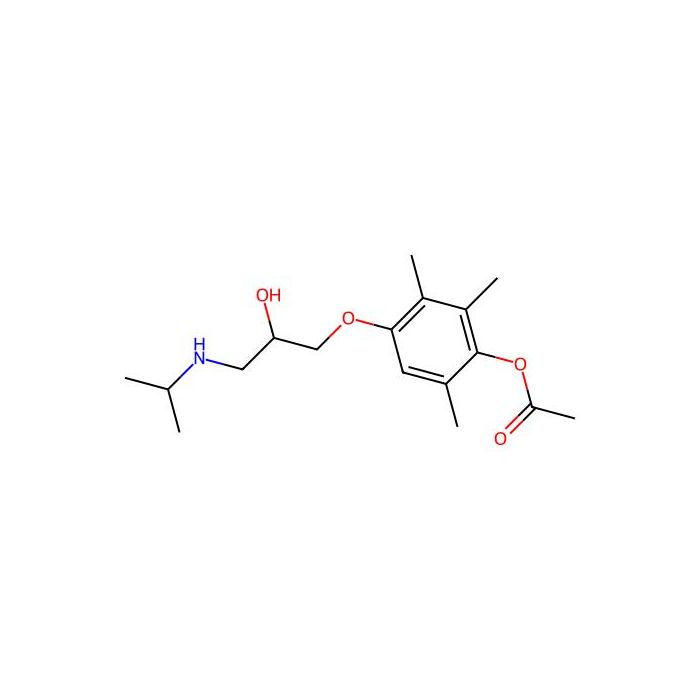
Literature/General chemistry (for context; not item specifications): Metipranolol is a classical aryloxy-2-propanolamine β-adrenergic receptor ligand. The scaffold features:
An aryl–O–CH(OH)–CH2–CH2–NRR' propanolamine core (β-amino alcohol), with the amine typically N-isopropyl substituted (secondary amine).
An aryl ether (phenoxy) ring that bears alkoxy/alkyl substituents characteristic of this class.
One stereogenic center at the β-amino alcohol carbon (CH(OH)), rendering the material potentially racemic unless otherwise specified.
2D structural description (general): A substituted phenyl ring is connected via an ether oxygen to a secondary alcohol carbon; this carbon continues as a two-carbon chain terminating in a secondary isopropylamino group. The amine and hydroxyl are β to each other, forming the hallmark β-amino alcohol motif common to many β-blocker ligands.
Synthetic Utility
Although Metipranolol is primarily used as a finished small-molecule ligand/reference, its functional groups support a range of synthetic manipulations (general literature guidance):
Amine chemistry: The secondary amine undergoes acylation (carbamates, amides), sulfonylation (sulfonamides), reductive amination (tertiary amines), and quaternization (ammonium salts). Careful base selection (e.g., DIPEA, TEA) and acyl transfer agents (anhydrides, activated carbonates) enable selective N-functionalization.
Alcohol chemistry: The secondary alcohol can be transformed into carbonates, esters, or activated leaving groups (tosylates/mesylates) for further substitution. Neighboring amine requires protection or control to avoid competing reactions.
Ether/aryl chemistry: While the aryl ether is typically inert under mild conditions, electrophilic aromatic substitutions (if ring-activated) or cross-couplings from suitably pre-functionalized analogs enable SAR expansion around the aromatic core (for analog development rather than direct modification).
Chiral elaboration: If enantioenriched material is desired, resolution by chiral HPLC or formation of diastereomeric salts (e.g., with tartaric or mandelic acid) can be applied; subsequent derivatization retains stereochemical integrity when conducted under non-racemizing conditions.
Applications: Synthesis of labeled probes (fluorophores, affinity tags), preparation of analytical derivatives to enhance MS response or UV characteristics, and construction of prodrugs for mechanistic studies (research only).
Target Specificity
This section is generally applicable to biological macromolecules (e.g., antibodies, enzymes). For this small-molecule ligand, no clone/isotype/species specificity applies.
Item-specific data from Product Data: Not specified for this item; refer to CoA/Spec Sheet.
General research context (literature): Metipranolol is used as a ligand for β-adrenergic receptors in binding/functional assays. Receptor subtype selectivity and affinity values are assay- and preparation-dependent and should be sourced from primary literature for the specific conditions employed.
Need help choosing the grade?
Our grade selection guide covers purity, stabilizer status, and application suitability for all variants in our catalog.
We use cookies to ensure the website functions properly and, where permitted, to improve your experience. You can manage your preferences at any time in Settings. Learn more in our Cookie Policy.
Shall we send you a message when we have discounts available?
Remind me later
Thank you! Please check your email inbox to confirm.
Products are supplied to verified businesses, institutions, and qualified professionals for research and development use only. Not for use in humans, animals, diagnosis, or therapy.