N-Benzylaniline was used in the separation of tervalent gallium, indium and thallium by solvent extraction method
Product Describtion:
The electropolymerisation of N-benzylaniline at transparent Indium Tin Oxide glass electrodes has been investigated by UV-visible spectroelectrochemistry. N-Benzylaniline on electrochemical oxidation in aqueous sulfuric acid solution produces an adherent conducting polymer film at the platinum electrode.
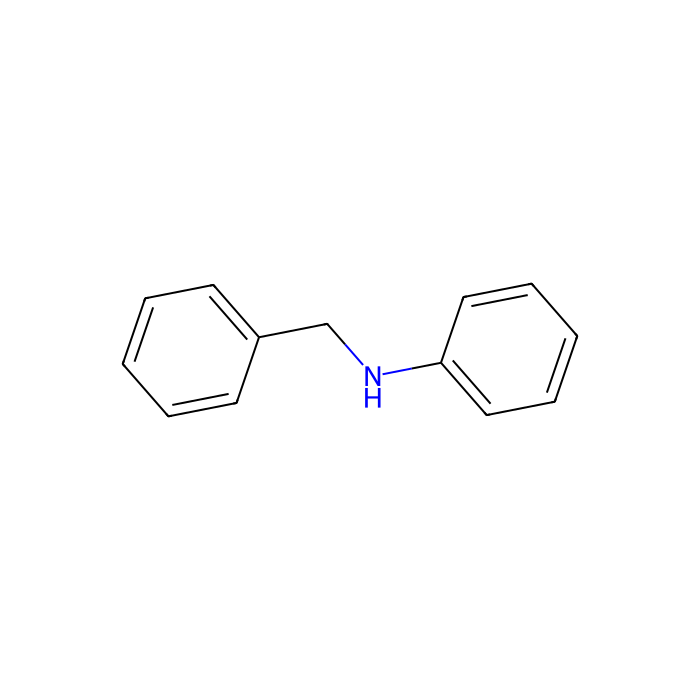
This compound belongs to the class of organic compounds known as phenylbenzamines. These are aromatic compounds consisting of a benzyl group that is N-linked to a benzamine.
External Descriptors
Not available
1. Djoumbou Feunang Y, Eisner R, Knox C, Chepelev L, Hastings J, Owen G, Fahy E, Steinbeck C, Subramanian S, Bolton E, Greiner R, and Wishart DS. ClassyFire: Automated Chemical Classification With A Comprehensive, Computable Taxonomy. Journal of Cheminformatics, 2016, 8:61.
Determine the necessary mass, volume, or concentration for preparing a solution.
Dilution Calculator
Determine the dilution needed to prepare a stock solution.
Reconstitution Calculator
Recensioni
Recensioni dei clienti
Application Protocols
No application protocols are specified for this item. As a small-molecule reagent, it is typically used following standard organic synthesis procedures for acylation, reductive amination, or alkylation. For project-specific protocols, consult peer-reviewed literature and adapt to your substrate and scale.
Biological Roles
This compound is a synthetic aromatic secondary amine with no established physiological role.
General considerations (literature/general):
Aromatic amines can interact with biomolecules through hydrophobic and cation–π interactions when protonated; N-Benzylaniline is a weak base (conjugate acid pKaH typically ~4.5–5.5), thus predominantly neutral at physiological pH and sparingly water-soluble.
Some aromatic amines undergo metabolic N-dealkylation and oxidation in vivo; however, this product is for research use only and not intended for biological administration.
Laboratory relevance:
Occasionally used as a model substrate for studying oxidative N-debenzylation, reductive amination, or iminium chemistry in biocatalysis/catalysis method development.
No clinical or therapeutic claims are made or implied. For research use only.
Buffer Applications
Not typically applicable. N-Benzylaniline is a hydrophobic secondary amine and is not used as a buffering agent. For aqueous workups, it can be protonated with mineral acids to increase water solubility (facilitating acid–base extraction), but it is not part of standardized buffer systems.
Green Alternatives
While N-Benzylaniline is a reagent/intermediate rather than a solvent, greener choices impact both its synthesis and the reaction media used with it.
Greener solvent swaps (literature guidance):
Replace chlorinated solvents (DCM, chloroform) with ethyl acetate or 2-MeTHF for acylations and extractions when feasible.
Use 2-MeTHF or CPME in place of THF for reductive amination and hydrogenation, benefiting from higher boiling points, lower peroxide risk, and bio-based origins (2-MeTHF).
Utilize alcohols (EtOH, iPrOH) as hydrogenation media; they can also serve as hydrogen donors in transfer hydrogenations (e.g., with Pd/C or Ru catalysts).
Process-intensification/benign reagents:
Reductive amination: prefer NaBH(OAc)3 in MeCN/AcOH or solid-supported cyanoborohydrides to minimize cyanide exposure risk compared with NaBH3CN; or adopt catalytic hydrogenation (H2, Pd/C) under mild pressures.
N-Acylation: employ acid anhydrides with catalytic DMAP in greener solvents (EtOAc) instead of acyl chlorides in DCM; or use CDI or EDCI couplings with benign byproducts.
Energy and waste:
Conduct reactions at ambient temperature when selectivity permits; harness flow hydrogenation to reduce solvent and catalyst use.
Comparison snapshot (general):
DCM vs EtOAc: similar polarity for acylations; EtOAc is biodegradable and has lower toxicity.
THF vs 2-MeTHF/CPME: latter offer improved safety profiles and often easier aqueous workups.
Note: Selections should be validated by small-scale trials to confirm kinetics, selectivity, and workup compatibility for your specific substrate set.
Pharmaceutical Uses
No excipient or dosage-form role is specified for this item.
General/industry context (literature/general):
N-Benzylaniline and its derivatives are common intermediates in medicinal chemistry programs, serving as handles for diversification via acylation, alkylation, and cross-couplings.
The N-benzyl group functions as a removable protecting group for anilines; catalytic hydrogenolysis enables late-stage deprotection to unveil free aniline motifs in API intermediates.
Salt formation (e.g., hydrochloride) may be used transiently to improve crystallinity or handling of related amines during process development.
Note: This product is supplied for research and laboratory use only; it is not intended for human or veterinary use and is not covered by pharmacopeial monographs in this listing.
Physical Properties
Item-specific properties: Not specified for this item; refer to CoA/Spec Sheet.
Literature/general (for planning only; not item specifications):
Physical state: typically a colorless to pale yellow liquid or low-melting solid that may darken upon air/light exposure.
Boiling point: often reported near the low 300s °C at 1 atm (literature; values vary by source and purity).
Melting point: reported near room temperature for some samples; often liquid at ambient conditions (literature).
Density: commonly near ~1.0–1.05 g/mL at 20–25 °C (literature range).
Refractive index: frequently around nD ~1.61–1.63 (literature reports).
pKaH (conjugate acid): aromatic secondary amines typically pKaH ≈ 4.5–5.5 in water; increased basicity vs aniline due to benzyl substituent (literature trends).
Solubility: low in water; miscible with many organic solvents (alcohols, ethers, chlorinated, aromatics) (literature).
Notes:
Use the actual CoA from the delivered lot for precise values in method development or regulatory submissions.
Literature values can vary depending on impurity profile and measurement method.
Quality and Grades
Item-specific grade/purity: Not specified for this item; refer to CoA/Spec Sheet.
How to interpret common grades (general guidance):
“AR/ACS/Analytical” grades emphasize low inorganic/organic contaminants suitable for routine analytical and synthetic work.
“Purified” or “Technical” grades may be adequate for screening or non-critical steps but can contain higher UV-active or colored impurities—less suited for photochemical or analytical applications.
“HPLC” or “Spectrophotometric” grades (when applicable to solvents) indicate low UV absorbance; for reagents like this amine, high-purity grades typically specify GC purity and residual solvent/metal limits.
Stabilizers/impurities considerations for this class:
Secondary aromatic amines generally do not employ stabilizers; however, trace peroxides are not typical (unlike ethers). The main concern is slow air/light oxidation causing darkening; inert headspace and amber packaging mitigate this.
Residual benzyl halides or aniline can be common synthetic impurities; GC/HPLC and 1H NMR are standard release tests.
Recommendations
Verify actual assay (e.g., GC ≥98% or NMR ≥98%) and impurity profile on the lot-specific CoA before use in key steps.
For photochemical or catalytic hydrogenation steps, prefer the highest purity available and pre-filter through alumina if color bodies develop.
Reaction and Applications
N-Benzylaniline is a versatile secondary aromatic amine useful as a substrate, intermediate, and protecting-group surrogate in synthesis.
Representative applications (literature/general):
N-Acylation: forms N-benzylanilides with acyl chlorides/anhydrides in the presence of base (Et3N, pyridine). Useful intermediates for further transformations (e.g., Fries-type rearrangements on aryl rings after deprotection).
Alkylation/quaternization: benzylic N can be further alkylated to tertiary amines under SN2 conditions with benzyl/alkyl halides (phase-transfer or solvent-based).
Iminium chemistry: condenses with aldehydes/ketones to give iminium ions; reduction affords tertiary amines (reductive amination using NaBH3CN/NaBH(OAc)3 or catalytic hydrogenation).
Cross-coupling on aryl rings: the two phenyl rings can be further functionalized via electrophilic substitution or, after conversion to aryl halides, via Pd-catalyzed couplings (Suzuki, Heck) enabling late-stage diversification around the amine motif.
Oxidation/functionalization at benzylic C–H: the benzylic position adjacent to N is activated; selective oxidation (e.g., to imines or benzaldehyde derivatives after cleavage) can be achieved under careful conditions.
Protecting-group logic: although this compound is itself N-benzylated, catalytic hydrogenolysis of N–CH2Ph is a standard tactic to regenerate the parent aniline from N-benzyl anilide/amines (H2/Pd-C or transfer hydrogenation). Hence, it serves as a model/handle in protecting-group strategy development.
Practical notes:
Dry reaction media and exclusion of strong oxidants minimize side-oxidation/discoloration.
For acylation, add acylating agent slowly at 0–5 °C to control exotherm, then warm to room temperature.
Monitor by TLC (UV-active) or GC; amines can streak on silica—add 0.1% Et3N to eluent if needed.
Reaction Conditions
General literature guidance for common transformations involving N-Benzylaniline (optimize per substrate and scale):
Reductive amination to tertiary amines:
Typical: carbonyl (1.0 eq), N-benzylaniline (1.2 eq), AcOH (0.5 eq) in MeCN or DCE; add NaBH(OAc)3 (1.5–2.0 eq) at 0–25 °C; 2–16 h. Quench with NaHCO3, extract, purify. Alternative: H2 (1–5 bar) with 5–10 wt% Pd/C in EtOH at RT–40 °C.
N-Acylation (amide formation):
Conditions: acyl chloride (1.1 eq), base (Et3N or pyridine, 2.0 eq) in DCM, 0 °C to RT, 1–4 h. For greener media, use EtOAc or 2-MeTHF with catalytic DMAP.
N-Alkylation to tertiary amines:
Conditions: alkyl bromide (1.1 eq) with K2CO3 (2–3 eq) in MeCN or DMF, 40–80 °C, 4–16 h; or NaH (1.1–1.5 eq) in THF at 0–25 °C for benzylic halides. Monitor to avoid overalkylation/polyalkylation by controlling equivalents.
Benzylic oxidation/iminium formation:
Representative: catalytic TEMPO or metal-catalyzed aerobic oxidation (Cu or Pd) in toluene/MeCN, 25–80 °C to generate imine/enamine adducts—scope and selectivity substrate-dependent.
For N-benzyl deprotection (general): H2 (1–5 bar), 5–10 wt% Pd/C in EtOH/EtOAc, RT–50 °C, 1–6 h; acid additives (HCl/AcOH) can accelerate but control for over-reduction. While this compound contains the N–CH2Ph motif, apply such conditions when removing benzyl from related protected substrates.
Analytical/monitoring:
TLC (UV 254 nm) with 0.1% Et3N in eluent to reduce streaking; GC or LC-MS for precise quantitation.
All conditions are literature-general and should be adapted via small-scale optimization.
Safety and Handling
Item-specific hazard information: Not specified for this item; refer to CoA/Spec Sheet and SDS.
General GHS/SDS guidance for aromatic secondary amines (informational only; consult SDS for this product):
May cause skin and eye irritation; avoid inhalation of vapors/aerosols.
Aromatic amines can undergo air/light oxidation leading to discoloration and potentially sensitizing/byproduct formation; minimize exposure and keep containers tightly closed.
Handling recommendations
Perform transfers in a well-ventilated fume hood; avoid breathing vapors or mists.
Personal protective equipment: lab coat, safety glasses or face shield, and appropriate chemical-resistant gloves (e.g., nitrile). Consider double-gloving for extended contact.
Special risks: benzylic/amine oxidation under air/light; product is shipped argon-charged—maintain inert headspace when practical.
First-aid overview (consult SDS for detailed instructions)
Skin: remove contaminated clothing; wash with soap and water.
Eyes: rinse cautiously with water for several minutes; remove contact lenses if present and easy.
Inhalation: move to fresh air; seek medical attention if symptoms persist.
Ingestion: rinse mouth; do not induce vomiting; seek medical attention.
Spill/Fire response
Absorb small spills with inert material (vermiculite, sand); collect in chemical waste.
Use appropriate extinguishing media (CO2, dry chemical, foam) for surrounding fire.
Solvent Selection
This product is a building-block reagent, not a solvent. Solvent selection pertains to its use in reactions, extractions, and purifications.
General polarity/miscibility (literature):
Moderately nonpolar, aromatic secondary amine; immiscible with water but soluble in common organic solvents (alcohols, ethers, chlorinated solvents, aromatics, and many hydrocarbons).
Forms amine salts in strong acids, increasing polarity and aqueous extractability (useful for acid–base workups).
Typical solvent choices by operation (general guidance):
N-alkylation or reductive amination: polar aprotic (DMF, MeCN) or protic alcohols (MeOH, EtOH) depending on reductant/catalyst.
Acylation: dichloromethane, toluene, or THF with a base (Et3N, pyridine).
Hydrogenolysis (debenzylation of nitrogen is not applicable here; see Reaction & Applications for hydrogenolysis of the benzyl–N bond in protected anilines in general): alcoholic solvents (EtOH, iPrOH) or EtOAc under H2/Pd.
Workup/purification: acid–base extraction (convert to ammonium salt to move to aqueous), followed by basification and extraction back to organic; silica gel chromatography using hexane/EtOAc or toluene/EtOAc systems.
Selection vs alternatives:
For greener practice, see Green Alternatives for solvent swaps (e.g., 2-MeTHF, CPME, EtOAc) compatible with amine chemistry.
Storage and Reconstitution
Item-specific storage (from Product Data):
Store protected from light.
Store at room temperature.
Supplied argon charged; maintain an inert atmosphere in the headspace when practical to minimize air/light oxidation and discoloration.
Shipped under normal conditions.
Reconstitution: Not applicable; typically supplied neat. If solidified at lower temperatures, gently warm to room temperature to liquefy and homogenize before use.
General handling tips:
After opening, purge with inert gas (argon or nitrogen) before resealing; use amber vials where possible.
Avoid repeated long-term exposure to air and light; aliquot for frequent use to reduce headspace oxygen.
If discoloration occurs, pass through a short plug of basic alumina to remove colored oxidized species before sensitive applications.
Stability: Item-specific stability data not specified for this item; refer to CoA/Spec Sheet and SDS. Under recommended storage, secondary aromatic amines are generally stable for routine laboratory timelines.
Structure and Identity
A secondary aromatic amine bearing an aniline ring and an N-benzyl substituent; commonly used as a protected aniline or as a building block in amide, iminium, and cross-coupling chemistry.
Item-specific (from Product Data):
Product name: N-Benzylaniline
CAS: 103-32-2
SKU: N137951
InChIKey: 111387 (as provided)
Storage: Protected from light; Room temperature; Argon charged
Shipped: Normal
Not specified for this item; refer to CoA/Spec Sheet: Grade/Purity, Appearance, Molecular Formula, Molecular Weight, SMILES.
Literature/computed identifiers (for reference; not item specifications):
Common molecular formula (literature): C13H13N
Common molecular weight (literature): 183.25 g/mol
One aniline ring (phenyl directly bound to N) and one benzyl substituent (–CH2–Ph) on the nitrogen, giving a secondary amine (–NH–CH2–Ar) with two aryl groups.
Functional groups: secondary amine; two phenyl rings; benzylic methylene adjacent to nitrogen (activated toward oxidation/functionalization).
2D description: a central sp3 carbon (benzylic CH2) linked to N–H; N is also bonded to an aniline phenyl. No stereocenters; fully achiral.
Synthetic Utility
Key functional group: secondary amine (anilino–benzyl). Its reactivity profile makes it a flexible synthon and protecting-group analog.
Transformations (literature/general):
N-Acylation to amides: with acyl chlorides/anhydrides (Et3N, pyridine, DMAP catalysis) or coupling agents (CDI, EDCI/HOBt) to form diarylacetamides.
Reductive amination: condensation with carbonyls to iminium ions followed by hydride delivery (NaBH(OAc)3, NaBH3CN, H2/Pd) to give tertiary amines.
N-Alkylation: SN2 with primary alkyl/benzyl halides using K2CO3/NaH in polar aprotic solvents to access tertiary amines.
Oxidative pathways: benzylic C–H activation adjacent to N enabling oxidative coupling or dehydrogenation to imines under metal catalysis.
Deprotection logic: as an N-benzylated aniline analogue, it highlights the utility of catalytic hydrogenolysis (H2, Pd/C) for N–CH2Ph cleavage—central to protecting-group strategies for anilines.
Electrophilic aromatic substitution: the aniline ring (when deactivated by acylation for control) can be regioselectively functionalized (nitration, sulfonylation), then N-deacylated to restore amine basicity.
Retrosynthetic value:
Readily accessible by reductive amination of benzaldehyde with aniline or by N-benzylation of aniline with benzyl halides; this modular entry allows late-stage diversification on either ring or at nitrogen.
Target Specificity
Not applicable. This product is a small-molecule reagent, not a biological targeting reagent (e.g., antibody, probe). No target specificity, clone, isotype, or species reactivity is provided.
Domande frequenti
What is the purity of this product, and how is it determined?
This product is supplied at ≥98% purity, determined by gas chromatography (GC). Lot-specific values are stated on the Certificate of Analysis.
How should this product be stored?
Store at room temperature, protected from light, under argon. It is supplied under an argon blanket; reseal under inert gas after each use.
How is this product shipped?
This product ships under standard ambient conditions. No temperature-controlled packaging is required.
What are the CAS number, molecular formula and molecular weight?
The CAS Number is 103-32-2, the molecular formula is C13H13N, and the molecular weight is 183.25 g/mol. InChIKey GTWJETSWSUWSEJ-UHFFFAOYSA-N.
What documentation is provided?
Available product documentation, including Certificates of Analysis (COA), Safety Data Sheets (SDS), and specification sheets, is shown in the product document area. Document availability and access follow the current site policy.
Utilizziamo i cookie per garantire il corretto funzionamento del sito web e, ove consentito, per migliorare la tua esperienza. Puoi gestire le tue preferenze in qualsiasi momento nelle Impostazioni. Per saperne di più, consulta la nostra Cookie Policy.
Desidera che le inviamo un messaggio quando avremo sconti disponibili?
Ricordamelo più tardi
Grazie! Controlli la sua casella di posta per confermare.
Products are supplied to verified businesses, institutions, and qualified professionals for research and development use only. Not for use in humans, animals, diagnosis, or therapy.

 F2102407