GRADE & PURITYMoligand™?Moligand™ — Aladdin's line of ligands and bioactive small molecules. Use for receptor, pathway, and binding studies needing defined small-molecule tools.10 mM in DMSO
Moligand™, 10 mM in DMSO Moligand™ for sensitive chromatographic and analytical workflows requiring minimal baseline interference.
🌡
Storage & shipping
Store at -80°C Ships Dry ice packs + Cold packs Check lot-specific COA for exact specifications.
📋
Quality documents
SDS, COA, datasheet, and spec sheet available for download. Lot-specific COA accessible via lot number lookup.
📚
Literature proof
Cited in 1 peer-reviewed publications across chromatography, organic synthesis, and cross-coupling reactions.
Panoramica
N1-methyl-pseudouridine (1-Methylpseudouridine), a methylpseudouridine, outperforms 5 mC and 5 mC/N1-methyl-pseudouridine in translation. N1-methyl-pseudouridine in mRNA enhances translation through eIF2α-dependent and independent mechanisms by increasing ribosome density.
Specifications
Specifiche e purezza
Moligand™, 10 mM in DMSO
Condizioni di conservazione di stoccaggio
Store at -80°C
Spedito in
Dry ice packs + Cold packs
Questo prodotto richiede spedizione a catena fredda. I servizi di terra e altri servizi economici non sono disponibili.
Determine the necessary mass, volume, or concentration for preparing a solution.
Dilution Calculator
Determine the dilution needed to prepare a stock solution.
Reconstitution Calculator
Recensioni
Recensioni dei clienti
Application Protocols
No validated bioassay protocols are specified for this catalog item. General starting points are offered for common research uses (literature guidance; verify and optimize locally):
Preparing aqueous stocks
Dissolve the solid in nuclease-free water to 10–100 mM. Gentle warming (25–37 °C) and vortexing can assist dissolution. Filter-sterilize (0.22 µm) if sterility is required. Use immediately or aliquot and freeze.
DMSO stock for screening
Prepare 100–500 mM in anhydrous DMSO. Aliquot, minimize headspace, and store at ≤ −20 °C. Dilute into assay buffer to ≤1–2% final DMSO.
Precursor to triphosphate
Follow established phosphorylation/triphosphorylation protocols. Purify nucleotide products by SAX; exchange counterions as needed for enzymatic compatibility. Confirm identity/purity by 31P NMR and LC–MS.
Oligonucleotide synthesis (after conversion to phosphoramidite)
Use standard RNA synthesis cycles with adjusted coupling times for modified bases; deprotect under conditions compatible with the protecting groups selected for m1Ψ.
These are general guidelines only. The product is for research use; consult primary literature and your internal SOPs for definitive protocols.
Biological Roles
General biochemical context (literature; not product-specific claims)
Chemical biology of N1-methylpseudouridine (m1Ψ)
m1Ψ is a methylated derivative of pseudouridine (Ψ), itself the most abundant post-transcriptional RNA modification across tRNA, rRNA, and snRNA. In Ψ, the ribose is linked via a C–C bond to C5 of uracil; N1-methylation further alters hydrogen-bonding and electronic properties of the base.
Consequences of N1-methylation include modification of base pairing potential and changes in stacking/sterics that can influence RNA secondary structure, thermodynamics, and interaction with proteins and enzymes (e.g., polymerases, ribosomes) in vitro.
Metabolic considerations
Free nucleosides can arise from RNA turnover; nucleoside transporters may mediate cellular uptake, while salvage pathways can phosphorylate certain nucleoside analogs. The degree to which native enzymes process m1Ψ relative to U/Ψ varies and is context dependent.
Research relevance
Incorporation of m1Ψ into synthetic RNA (via the corresponding triphosphate) is widely used in biochemical studies to modulate innate sensing, translation efficiency, and RNA stability in cell-free and cell-based systems (literature), enabling mechanistic dissection of RNA–protein interactions and immune recognition pathways.
Note: The product is for research use only. No medical or clinical claims are made. Effects referenced above are general literature observations and should be validated under your specific experimental conditions.
Buffer Applications
This compound is a nucleoside and not a buffering agent. It does not constitute a defined buffering system by itself.
Practical notes
When preparing aqueous stocks, dissolve in a compatible buffer appropriate to downstream use (e.g., nuclease-free water, 1× TE, or low-ionic-strength Tris or HEPES buffers at pH 7.0–8.0). The compound does not provide significant buffering capacity.
Filter-sterilize solutions for cell-free applications as needed. Maintain RNase-free technique to prevent degradation of RNA-related reagents.
For actual buffer formulation guidance, refer to established buffering agents (Tris, HEPES, phosphate, MOPS), selected to match your enzymatic or biophysical assays.
Green Alternatives
While N1-methylpseudouridine itself is the target molecule, greener choices can be made in its processing and use.
Solvent choices (literature/general guidance)
Prefer water or aqueous buffers for dissolution and biochemistry whenever feasible. DMSO is widely used but consider minimizing its percentage in assays to reduce environmental load.
For protection/phosphorylation chemistry, replace chlorinated solvents with greener polar aprotics where compatible (MeCN over DMF; 2-MeTHF over THF for some protection steps), recognizing that rigorous dryness may be more challenging in greener media.
Phosphorylation strategies
Enzymatic or chemoenzymatic phosphorylation (e.g., kinase cascades for mono-/di-/triphosphates) in aqueous media can reduce reliance on phosphorus oxychloride and halophosphates, though scale and enzyme cost are considerations.
Workup and purification
Favor aqueous ion-exchange or membrane-based desalting over large-volume organic extractions. Utilize recyclable eluents and minimize ion-pairing reagents when possible.
Comparison snapshot (general)
Conventional: POCl3/trimethyl phosphate, DMF, dichloromethane; advantages = high reactivity, established protocols; tradeoffs = corrosivity, halogenated waste.
Implement green metrics (E-factor, PMI) to guide route selection; balance sustainability with product quality and reproducibility.
Pharmaceutical Uses
Formulation/manufacturing context only (no therapeutic claims)
Role in process development (literature/general)
N1-Methylpseudouridine is a nucleoside starting material for synthesis of its nucleotide derivatives (e.g., 5′-mono-, di-, and triphosphates). The triphosphate is used in research and manufacturing workflows for in vitro transcription of modified RNA, relevant to process development of RNA-based modalities.
Excipient status
Not recognized as a common pharmaceutical excipient. Any use in regulated manufacturing requires appropriate qualification and supplier documentation (identity, purity, residual solvents, elemental impurities), derived from the CoA and regulatory filings as applicable.
Quality considerations
For upstream manufacturing use, control of isomeric purity (pseudouridine vs uridine), residual protecting groups/solvents, water content, and bioburden/endotoxin (if applicable to the process) may be critical. These are not specified for this item; refer to CoA/Spec Sheet and validate internally.
Handling in GMP-like settings
Implement material traceability, change control, and stability programs suited to low-temperature storage materials. Verify suitability of packaging (moisture/oxygen barrier) and shipping conditions to maintain quality attributes.
All uses are for laboratory research or process development. This listing makes no clinical or therapeutic claims.
Physical Properties
Item-specific physical specifications
Appearance: Not specified for this item; refer to CoA/Spec Sheet.
Molecular weight: Not specified for this item; refer to CoA/Spec Sheet.
Literature/general properties (for context; not item specifications)
Physical state: typically a white to off-white crystalline solid (nucleoside class).
Solubility: good aqueous solubility expected for ribonucleosides; commonly soluble in water and nuclease-free buffers; increased solubility in polar aprotic solvents such as DMSO; limited solubility in nonpolar solvents (literature).
pKa: uracil nucleosides display weakly acidic NH sites; N1-methylation removes the most acidic proton, yielding overall neutral species across physiological pH (literature). Exact pKa values for this specific nucleoside are not universally tabulated.
LogP/logD: strongly hydrophilic due to multiple hydroxyls; logD7.4 typically negative to low positive for ribonucleosides (literature trend).
Hygroscopicity: nucleosides may be mildly hygroscopic and should be protected from moisture to preserve accurate mass and enable reproducible dissolutions (good practice).
Thermal behavior: nucleosides generally have high melting points and decompose rather than boil; exact mp for N1-methylpseudouridine should be obtained from the CoA/Spec Sheet or primary literature.
Notes
Use the item’s CoA for authoritative purity, water content, and any UV cutoff or extinction coefficients. Absent explicit values, treat any numbers in this section as general literature context only.
Quality and Grades
Item-specific grade information
Grade: Moligand™ (per Product Data). This denotes inclusion in a high-quality small-molecule/compound library suitable for research and screening use. It signals tight control over identity and handling but does not, by itself, define analytical specifications (e.g., water, metal content, UV cutoff).
What this means in practice
Identity verification: Typically supported by orthogonal analytical data (e.g., NMR, MS, HPLC). For this specific item, refer to the CoA/Spec Sheet for confirmed analytical methods and acceptance criteria.
Purity reporting: Not specified for this item; refer to CoA/Spec Sheet. When employing the compound in sensitive biochemistry (e.g., enzymatic phosphorylation or oligonucleotide chemistry), confirm purity and residual solvents from the CoA.
Stabilizers and additives
None listed. If stabilizers are present for any lot, they will be disclosed on the CoA. Do not assume presence or absence of any additive.
Fit for purpose
Moligand™-grade nucleosides are suitable for medicinal chemistry exploration, nucleoside derivatization, and as precursors to nucleotides (e.g., 5′-mono-, di-, and triphosphates) used in biochemical assays.
Documentation
For batch-specific details (e.g., residual solvent limits, water content, chromatographic purity), consult the lot CoA. These values are not specified here and should not be inferred.
Reaction and Applications
This nucleoside is a versatile precursor for nucleotide and oligonucleotide chemistry. The following applications and tips reflect literature practice (not item specifications).
Biochemical applications (downstream after derivatization)
Precursor to N1-methylpseudouridine-5′-triphosphate (m1ΨTP), a substrate for in vitro transcription (IVT) with T7/T3/SP6 RNA polymerases. Triphosphorylation may proceed via 5′-monophosphate intermediates (Yoshikawa or one-pot methods) followed by Ludwig–Eckstein triphosphorylation or salicyl phosphorochloridate-based routes.
Formation of phosphoramidites enables solid-phase RNA synthesis of N1-methylpseudouridine-containing oligos.
Synthetic transformations
Protection: transient protection of 2′,3′-diols (e.g., as acetonide, silyl ethers such as TBDMS) and 5′-OH (e.g., DMTr) is routine prior to selective phosphorylation or glycosyl modification.
Phosphorylation: 5′-selective phosphorylation via POCl3/trimethyl phosphate (Yoshikawa) to the 5′-monophosphate; subsequent pyrophosphorylation (e.g., with POCl3 in the presence of pyrophosphate, or using phosphorylating agents such as salicyl phosphorochloridate with tributylammonium pyrophosphate) affords triphosphate.
Derivatization: conjugation at the 5′-position (e.g., 5′-azides/alkynes) or ribose modification for probe design.
Practical tips
Anhydrous technique is critical for high-yield phosphorylation; rigorously dry solvents/reagents and employ inert atmosphere.
Monitor reactions by RP-HPLC and LC–MS; nucleoside/nucleotide products often require ion-pair or anion-exchange chromatography for purification.
For enzymatic phosphorylation routes, optimize Mg2+, pH, and cofactor balance; consider kinase specificity with N1-methyl substitution.
All applications are for laboratory research use only.
Reaction Conditions
General literature guidance for typical transformations (not item specifications). Optimize for your lab’s scale and equipment.
5′-Monophosphorylation (Yoshikawa-type)
Solvent: trimethyl phosphate (TMP) or dry MeCN/TMP mixtures.
Reagents: POCl3 (1.1–1.5 eq), base (e.g., pyridine, 2,6-lutidine), low temperature (−20 to 0 °C) then gradual warming to 0–25 °C; quench into ice-cold aqueous buffer followed by neutralization. Typical reaction times: 0.5–2 h. Monitor by HPLC.
Triphosphorylation (Ludwig–Eckstein variant)
Pre-activation of the 5′-monophosphate with a phosphorimidazolide or use of salicyl phosphorochloridate; coupling with tributylammonium pyrophosphate in DMF/MeCN with tertiary amine bases. Temperatures 0–25 °C, 1–6 h. Purify by SAX.
Protection of 2′,3′-diol
TBDMS protection: imidazole-catalyzed silylation in DMF with TBDMS-Cl, 0–25 °C, 2–16 h; desilylation by TBAF in THF or HF·pyridine under controlled conditions. Alternatively, acetonide formation with acetone/acid catalyst.
Phosphoramidite preparation
5′-DMTr protection in DCM with DMTr-Cl/DIPEA (0–25 °C), followed by 3′-phosphitylation using 2-cyanoethyl N,N-diisopropylchlorophosphoramidite in DCM/DIPEA under anhydrous conditions.
Analytical control
Characterize intermediates/products by 1H/13C NMR, 31P NMR (for phosphorylated species), LC–MS, and RP-HPLC/SAX. Carefully control water content (<1000 ppm often targeted in anhydrous steps; set your own spec).
These are representative conditions from the literature; adjust stoichiometry, temperature, and time based on scale, protecting groups, and desired selectivity.
Safety and Handling
Authoritative safety information resides in the product SDS. The following provides general guidance for laboratory handling of ribonucleosides.
GHS classification and hazard statements
Signal word / Pictograms / H-statements: Not specified for this item; refer to SDS.
In the absence of classification data, handle as a laboratory chemical of unknown hazard potential.
Personal protective equipment (PPE)
Recommended: lab coat, safety glasses, and appropriate chemical-resistant gloves (e.g., nitrile). Use in a well-ventilated area or fume hood to minimize dust/aerosol exposure.
Handling and hygiene
Avoid generating dust; prevent contact with skin and eyes; avoid ingestion and inhalation. Wash hands thoroughly after handling.
Use clean, nuclease-free tools/consumables to prevent biological contamination when preparing biochemical stocks.
Storage incompatibilities and stability (general)
Protect from moisture; store tightly closed under inert headspace if possible. Avoid strong oxidizers and strong acids/bases that may hydrolyze the glycosidic linkage.
Nucleosides are generally stable as dry solids at low temperature; aqueous solutions are susceptible to hydrolysis and enzymatic degradation (RNases/NUCs) and should be prepared with nuclease-free reagents.
First aid overview (general)
Skin/eye contact: rinse with water for several minutes; remove contaminated clothing; seek medical attention if irritation persists.
Inhalation: move to fresh air; obtain medical advice if symptoms occur.
Ingestion: rinse mouth; do not induce vomiting; seek medical advice.
Always consult the current SDS for the definitive hazard classification and response measures.
Solvent Selection
Context: N1-Methylpseudouridine is a polar ribonucleoside with multiple hydrogen-bond donors/acceptors.
Polarity and miscibility (literature/general)
Highly polar; excellent H-bonding capacity. Readily soluble in water and aqueous buffers; freely soluble in DMSO; limited in alcohols beyond MeOH and in aprotic, low-polarity media.
Recommended stock solvents: nuclease-free water (for immediate use), or anhydrous DMSO for higher-concentration stocks and compatibility with screening assays.
Practical guidance
Aqueous stocks: prepare with nuclease-free water or buffer (e.g., 10 mM Tris, pH ~7.5) to desired concentration; filter through 0.22 µm if needed for sterility. Avoid prolonged storage at room temperature.
DMSO stocks: prepare anhydrous, aliquot, and store at ≤ −20 °C to minimize hydrolysis; equilibrate to room temperature before opening to prevent condensation.
Co-solvent strategies: for mixed media assays, small percentages of DMSO (≤1–2%) in buffered saline typically maintain solubility without perturbing most biochemical systems (verify experimentally).
When to choose alternatives
If enzyme compatibility disallows DMSO, use purely aqueous buffers at slightly elevated temperatures (e.g., 25–37 °C) to aid dissolution.
For synthetic transformations (protection/phosphorylation), dry polar aprotic solvents (DMF, MeCN, dioxane) may be used with appropriate bases/catalysts; water content should be rigorously controlled.
Note: No item-specific solubility values are provided; consult CoA or perform a small-scale solubility screen under your exact conditions.
Storage and Reconstitution
Item-specific storage and shipping
Storage Conditions: Store at −80 °C (per Product Data). Keep container tightly closed, desiccated, and protected from light and moisture.
Shipped In: Dry ice packs + Cold packs (per Product Data) to maintain low temperature during transit.
Stability notes (general)
As a dry solid at −80 °C, nucleosides are typically stable for extended periods. Avoid repeated temperature cycling. Record receipt and storage temperatures if operating under QA oversight.
Reconstitution guidance (general; not item-specific specs)
Solvents: nuclease-free water or anhydrous DMSO are commonly used. Start with small volumes to achieve desired concentration; confirm complete dissolution before dilution.
Filtration: if sterile solutions are required, filter through 0.22 µm PVDF or PES into sterile, RNase-free vials.
Aliquoting: prepare single-use aliquots to minimize freeze–thaw. For aqueous aliquots, store at −80 °C; for DMSO stocks, store at ≤ −20 °C in moisture-tight vials.
Freeze–thaw practices
Thaw on ice or at room temperature; mix gently. Avoid more than 3–5 freeze–thaw cycles. Discard aliquots showing precipitation, discoloration, or microbial growth.
Specifications reminder
Appearance, assay/purity, water content, and solubility are not specified for this item; consult the CoA/Spec Sheet for lot-specific guidance.
Research Use Note: For research use only.
Structure and Identity
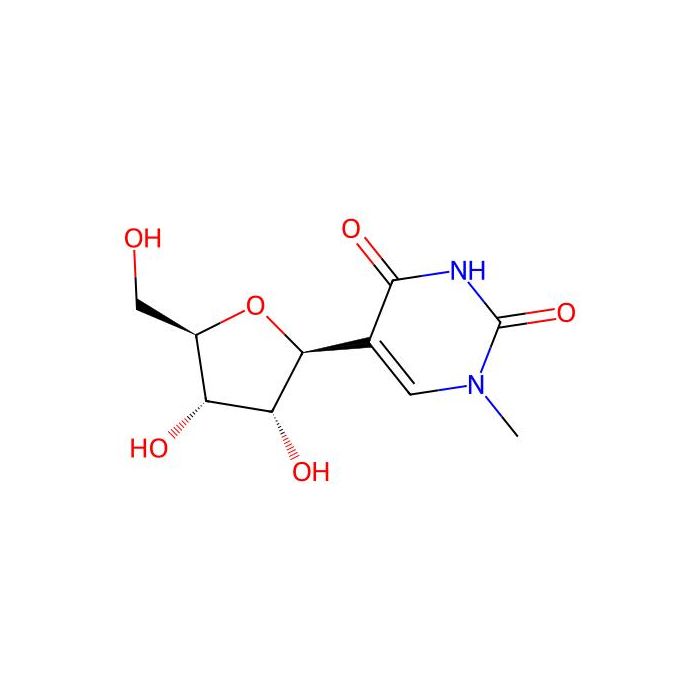
Brief description: N1-Methylpseudouridine is a modified ribonucleoside derived from pseudouridine, featuring an N1-methyl substituent on the uracil ring and a C–C glycosidic linkage to D-ribofuranose.
Item-specific identifiers (from Product Data)
CAS: 13860-38-3
Grade: Moligand™
InChIKey: Not specified for this item; refer to CoA/Spec Sheet.
SMILES: Not specified for this item; refer to CoA/Spec Sheet.
Literature structural features (general)
Core scaffold: pyrimidin-2,4-dione (uracil) base is “pseudouridine-type” with a C5–C1′ C–C glycosidic bond to D-ribofuranose (β-configuration at the anomeric center).
Modification: N1-methyl substitution on the uracil ring (N1-Me), distinguishing it from pseudouridine (Ψ) and uridine (U).
Functional groups: two amide carbonyls on the base (uracil), multiple ribose hydroxyls (2′, 3′, 5′-OH), and one N-methyl tertiary amide nitrogen within the base.
Stereochemistry: ribose typically 1′β, with defined 2′,3′,4′ stereocenters of D-ribose (literature). No additional chiral centers on the base.
Molecular formula and mass: Not specified for this item; refer to CoA/Spec Sheet. (Note: literature reports formula and exact mass for this nucleoside; consult reference databases or the CoA for authoritative identity metrics.)
2D description in words: a five-membered ribofuranose ring bearing three hydroxyls, linked via C1′ to C5 of a uracil ring; the uracil nitrogen at position 1 carries a methyl group.
Synthetic Utility
N1-Methylpseudouridine is a privileged scaffold for nucleotide and oligonucleotide synthesis.
Functional handles and reactivity
5′-Hydroxyl: primary site for selective phosphorylation to mono-/di-/triphosphates (Yoshikawa; Ludwig–Eckstein) or installation of protecting groups (DMTr) and conjugation handles.
2′,3′-Diol: can be differentially protected (e.g., as acetonide or TBDMS ethers) to control regioselectivity in phosphorylation or for solid-phase synthesis via phosphoramidite chemistry.
Base: N1 is methylated (non-nucleophilic); remaining positions follow uracil-like reactivity (electrophilic at C6, carbonyl chemistry), but the pseudouridine C–C glycosidic bond confers enhanced stability against acid-catalyzed cleavage relative to N-glycosides (literature).
Conversions and building blocks
Triphosphates: prepare m1ΨTP for IVT; purification typically by strong anion-exchange (SAX) chromatography, desalting to triethylammonium or sodium salts.
Phosphoramidites: 3′-phosphoramidites with 5′-DMTr and 2′-TBDMS protections for RNA solid-phase synthesis.
Labels/conjugates: install 5′-azido or alkyne groups for click chemistry; generate 5′-biotin or fluorophores via phosphoramidate/ester linkages.
Advantages in synthesis
The C–C glycosidic bond of pseudouridine resists acid hydrolysis, improving handling during protection/deprotection compared with uridine analogs (literature).
N1-methylation eliminates tautomeric proton at N1, simplifying protection strategies and improving base stability under some conditions.
Overall, it serves as a robust entry point to diverse modified RNA constructs and nucleoside-based probes.
Target Specificity
Not applicable. This product is a small-molecule nucleoside, not a biologic or affinity reagent. There are no antigen/epitope targets, species reactivity, clones, or isotypes associated with this item.
We use cookies to ensure the website functions properly and, where permitted, to improve your experience. You can manage your preferences at any time in Settings. Learn more in our Cookie Policy.
Shall we send you a message when we have discounts available?
Remind me later
Thank you! Please check your email inbox to confirm.
Products are supplied to verified businesses, institutions, and qualified professionals for research and development use only. Not for use in humans, animals, diagnosis, or therapy.