OPC 21268 - Moligand™, ≥98%(HPLC) , Antagonist of OT receptor;Antagonist of V 1A receptor;Antagonist of V 2 receptor, CAS No.131631-89-5, Antagonist of OT receptor;Antagonist of V 1A receptor;Antagonist of V 2 receptor
OPC 21268 - Moligand™, ≥98%(HPLC) , Antagonist of OT receptor;Antagonist of V 1A receptor;Antagonist of V 2 receptor, CAS No.131631-89-5, Antagonist of OT receptor;Antagonist of V 1A receptor;Antagonist of V 2 receptor
GRADE & PURITYMoligand™?Moligand™ — Aladdin's line of ligands and bioactive small molecules. Use for receptor, pathway, and binding studies needing defined small-molecule tools.≥98%(HPLC)
Nonpeptide Vasotocin V1receptor antagonist. Displays greater affinity for rat V1than human V1(Kivalues are 25 and 8800 nM respectively). Exhibits 1000-fold selectivity for V1receptors over V2receptors. Orally active.OPC-21268 is one of 2 non-peptide V1a s
Condizioni di conservazione di stoccaggio
Store at -20°C
Spedito in
Ice chest + Ice pads
Questo prodotto richiede spedizione a catena fredda. I servizi di terra e altri servizi economici non sono disponibili.
Grado
Moligand™
Tipo di azione
ANTAGONIST
Meccanismo d'azione
Antagonist of OT receptor;Antagonist of V 1A receptor;Antagonist of V 2 receptor
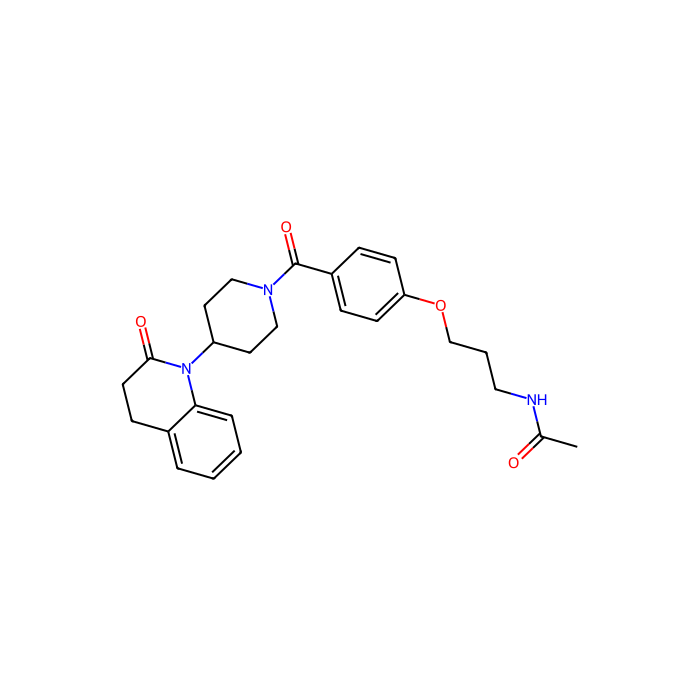
This compound belongs to the class of organic compounds known as 1-benzoylpiperidines. These are compounds containing a piperidine ring substituted at the 1-position with a benzoyl group.
External Descriptors
Not available
1. Djoumbou Feunang Y, Eisner R, Knox C, Chepelev L, Hastings J, Owen G, Fahy E, Steinbeck C, Subramanian S, Bolton E, Greiner R, and Wishart DS. ClassyFire: Automated Chemical Classification With A Comprehensive, Computable Taxonomy. Journal of Cheminformatics, 2016, 8:61.
Solvent:DMSO, Max Conc. mg/mL: 44.95, Max Conc. mM: 100; Solvent:ethanol, Max Conc. mg/mL: 11.24, Max Conc. mM: 25
Peso molecolare
449.500 g/mol
XLogP3
2.600
Hydrogen Bond Donor Count
1
Hydrogen Bond Acceptor Count
4
Rotatable Bond Count
7
Exact Mass
449.231 Da
Monoisotopic Mass
449.231 Da
Topological Polar Surface Area
79.000 Ų
Heavy Atom Count
33
Formal Charge
0
Complexity
683.000
Isotope Atom Count
0
Defined Atom Stereocenter Count
0
Undefined Atom Stereocenter Count
0
Defined Bond Stereocenter Count
0
Undefined Bond Stereocenter Count
0
The total count of all stereochemical bonds
0
Covalently-Bonded Unit Count
1
Calcolatori di soluzioni
Molarity Calculator
Determine the necessary mass, volume, or concentration for preparing a solution.
Dilution Calculator
Determine the dilution needed to prepare a stock solution.
Reconstitution Calculator
Recensioni
Recensioni dei clienti
Application Protocols
No tested application protocols are provided in the Product Data for this item. The following are general, non-item-specific suggestions for small-molecule ligands; adapt to your system.
General stock solution preparation
Allow vial to equilibrate to room temperature in a desiccated environment. Weigh quickly. Dissolve in anhydrous DMSO to 10–50 mM. Vortex and, if needed, sonicate briefly. Filter (0.22 μm) for sensitive assays.
Assay dilution (example workflow)
Prepare serial dilutions in assay buffer maintaining constant final DMSO (e.g., 0.1–0.5% v/v). Include vehicle and appropriate positive/negative controls. Incubate per assay requirements and read out via your detection modality (e.g., fluorescence, luminescence, radiometric).
Stability checks
Assess stability over the assay window by LC–MS at t0 and tend. If instability is observed, use fresh stocks or add stabilizers compatible with your assay.
Documentation
Record lot number, stock concentration, solvent, preparation date, and number of freeze–thaw cycles to ensure reproducibility.
For any target-specific protocol, consult the CoA/Spec Sheet or primary literature for CAS 131631-89-5.
Biological Roles
Item-specific target specificity is not provided in the Product Data for SKU O287257. The following notes are general, literature-level considerations for small-molecule research ligands and should be verified against your intended biological context.
General ligand roles in biochemical research
Receptor/Enzyme modulation: Small molecules are widely used to modulate protein targets in vitro to map signaling pathways, validate targets, and benchmark assay performance.
Probe usage: Chemical probes can help differentiate on-target from off-target effects when used alongside inactive analogs and orthogonal probes.
Assay design: Employ concentration–response curves, appropriate incubation times, and controls (vehicle, positive, negative) to extract potency and efficacy parameters (e.g., IC50/EC50) while controlling for assay artifacts.
Selectivity profiling: Counter-screening across related targets or panels (e.g., GPCRs, kinases, ion channels) is standard to contextualize observed biological effects.
Important caveats
Do not ascribe physiological or therapeutic roles without direct evidence. Verify identity, purity, and stability under the exact assay conditions, as degradation can confound interpretations.
Report solvent content (e.g., final % DMSO) and assay temperature/pH to ensure reproducibility across labs.
For specific target information, consult the CoA/Spec Sheet, primary literature, or validated databases corresponding to CAS 131631-89-5.
Buffer Applications
This product is a small organic research ligand and is not a buffering agent. It does not define or maintain pH in typical laboratory buffers.
Practical notes when using in buffered systems (general guidance)
Prepare concentrated stocks in DMSO or another suitable organic solvent, then dilute into your buffer with vigorous mixing to avoid precipitation.
Verify compatibility of the ligand with buffer components (salts, detergents, proteins) and pH. Assess stability over the assay duration.
Keep final organic cosolvent content as low as your assay tolerates (commonly ≤0.5–1% v/v DMSO) to preserve biological activity and avoid denaturation effects.
Green Alternatives
This product is a small-molecule research ligand rather than a bulk solvent or process reagent; therefore, “green replacement” comparisons are less applicable. Nonetheless, greener practices can be applied when handling and using such compounds.
Practical greener strategies (general guidance)
Solvent minimization: Use microvolume stock solutions (high-concentration DMSO) and miniaturized assay formats to reduce solvent consumption and waste.
Preferred solvents for analytics: Choose MeOH or MeCN over chlorinated solvents where method sensitivity allows; avoid DMF for routine chromatography when feasible.
Energy and cold-chain efficiency: Consolidate shipments and minimize door-open time for −20°C storage; batch your experiments to reduce repeated thawing and re-freezing cycles.
Waste management: Segregate halogenated and non-halogenated solvent waste; label solutions clearly to enable proper end-of-life handling.
Data-first approach: Confirm solubility/stability at small scale before scaling up, reducing material and solvent footprint linked to failed preparations.
Pharmaceutical Uses
No pharmacopeial status, excipient role, or manufacturing specifications are provided for this item. This product is supplied strictly for laboratory research use.
Context for professional users (general, non-clinical)
Reference standard: In pharmaceutical discovery and preclinical research, small-molecule ligands are often used as analytical or bioassay reference materials to benchmark methods (e.g., LC–MS system suitability, in vitro assay controls).
Method development: Useful for validating extraction protocols, stability-indicating methods, and matrix effect studies in bioanalytical workflows.
Regulatory note: Not manufactured under cGMP; not for use in humans, diagnostics, or as a drug substance/excipient. Any translational or regulated application would require separate qualification and documentation.
Physical Properties
Item-specific physical data
Appearance: Not specified for this item; refer to CoA/Spec Sheet.
Commonly referenced physico-chemical fields (not provided for this item)
Melting point, boiling point, density, refractive index, pKa, logP/logD, and UV cutoff: Not specified for this item; refer to CoA/Spec Sheet.
Solubility: Not specified for this item; refer to CoA/Spec Sheet.
General handling guidance (general chemistry knowledge)
Small bioactive ligands are often formulated as solids or films and dissolved in anhydrous DMSO or DMF for stock solutions; aqueous solubility varies widely and should be empirically verified.
When preparing analytical solutions, record exact solvent, concentration, and temperature, as these variables strongly affect apparent solubility and chromatographic behavior.
Use LC–MS (ESI±) to confirm molecular ion and purity in your working solvent system.
If UV quantification is required, acquire a compound-specific spectrum to identify suitable λmax and avoid solvent interferences; do not assume a generic extinction coefficient.
Quality and Grades
Item-specific quality details
Grade/Purity: Moligand™ (as provided in Product Data). No additional numeric purity or impurity profile is specified for this item; refer to CoA/Spec Sheet.
What Moligand™ typically signifies (general explanation)
Moligand™ designations are commonly used for small-molecule ligands selected for biochemical or pharmacological research workflows. Such materials are typically suited for target-binding assays, profiling screens, or reference use in discovery settings, with emphasis on identity and practical working purity.
Quality considerations and how to use them
Verification: Confirm identity and purity in-house via LC–MS and, where applicable, NMR prior to quantitative studies. If low-UV background is required (e.g., HPLC UV quantification), evaluate the chromatographic baseline under your exact conditions.
Trace contaminant limits (e.g., residual solvents, water, metals, peroxides, stabilizers): Not specified for this item; refer to CoA/Spec Sheet.
Batch-to-batch reproducibility: For screening campaigns, lock a single lot for critical data generation and document all handling (solvent, concentration, thaw count) to ensure reproducibility.
Fit-for-purpose: This research grade is not manufactured under cGMP; it is intended for laboratory research only and not for diagnostic, therapeutic, or human/animal consumption uses.
Reaction and Applications
Item-specific synthetic or catalytic applications are not provided. OPC 21268 is supplied as a research ligand (Moligand™), and it is typically used as a reference compound or probe in biochemical/biophysical studies rather than as a synthetic reagent.
Research applications (general guidance for small-molecule ligands)
Target-binding studies: Use in receptor/ligand binding assays (e.g., radioligand displacement, fluorescence polarization, SPR, BLI) after confirming identity and purity.
Functional assays: Evaluate downstream signaling in cell-based or biochemical formats (e.g., second messenger readouts), ensuring solvent controls and concentration–response design.
ADME profiling: Assess solubility, stability, microsomal stability, and permeability as part of comparative ligand characterization.
Analytical reference: Employed as a positive/negative control in screening cascades; document lot and storage history to ensure consistency.
Practical considerations
Prepare fresh DMSO stock solutions and minimize freeze–thaw cycles. Track dilution scheme carefully to avoid cosolvent artifacts.
Confirm absence of assay interference (fluorescence quenching/inner-filter effects, aggregation). Use orthogonal detection methods when feasible.
For SAR or orthogonal benchmarking, run side-by-side with internal standards under identical conditions.
No named synthetic reactions or catalysis are typically associated with this product’s routine use in the lab.
Reaction Conditions
Not typically applicable. OPC 21268 is supplied as a research ligand for biochemical use rather than as a reagent or catalyst.
General advice (if conducting ancillary transformations or analytical sample prep)
Solvents: DMSO, MeCN, or MeOH are commonly used for solution preparation; rigorously dry solvents if moisture sensitivity is suspected.
Temperatures: Conduct stability checks at ambient and assay-relevant temperatures; avoid unnecessary heating without prior stability data.
Atmosphere: If the compound is air- or light-sensitive (unknown for this item), handle under inert atmosphere and reduced light exposure until stability is confirmed.
Because item-specific reactivity and conditions are not provided, verify any proposed reaction or derivatization on a small scale and consult the CoA/Spec Sheet for additional stability notes.
Safety and Handling
Hazard information from Product Data
Signal word: Not specified for this item; refer to SDS.
H-statements: Not specified for this item; refer to SDS.
GHS classification/pictograms: Not specified for this item; refer to SDS.
General laboratory safety guidance (always defer to the product SDS)
PPE: Use lab coat, safety glasses or goggles, and appropriate chemically resistant gloves (e.g., nitrile). Handle powders in a fume hood to avoid inhalation of dust/aerosols.
Avoid ingestion, inhalation, and skin/eye contact. Wash thoroughly after handling. Prevent environmental release; collect waste in compliant organic waste streams.
Incompatibilities: Avoid strong oxidizers and strong acids/bases unless compatibility is known. Keep away from ignition sources when using organic solvents for dissolution.
First aid (overview): In case of eye/skin contact, rinse with water for at least 15 minutes and remove contaminated clothing. If inhaled, move to fresh air. If ingested, rinse mouth; do not induce vomiting. Seek medical attention in all exposure cases.
Spill response: For small spills, absorb with inert material (e.g., vermiculite), collect, and dispose of as hazardous waste. Decontaminate area with suitable solvent followed by detergent/water.
Stability notes: Store tightly closed at the recommended temperature (−20°C). Protect working solutions from light and repeated freeze–thaw to minimize degradation. Always consult the SDS and CoA for definitive hazard and stability guidance.
Solvent Selection
Item-specific solubility data are not provided; refer to the CoA/Spec Sheet. The following guidance is general for small organic research ligands and should be validated experimentally.
Recommended primary solvents (general practice)
DMSO: First-line solvent for hydrophobic ligands; prepare concentrated stocks (e.g., 10–50 mM), then dilute into assay buffer with vigorous mixing to avoid precipitation.
DMF or acetonitrile: Useful alternatives when DMSO is undesirable; ensure assay system compatibility.
Aqueous buffers: Only if the compound is sufficiently polar/ionizable; consider co-solvent strategies (≤1–2% DMSO or MeCN) and surfactants (e.g., 0.01% Tween-20) if permitted.
Practical tips
Determine kinetic and equilibrium solubility in your intended matrix (buffer, pH, ionic strength, temperature). Use sonication and stepwise dilution from a verified DMSO stock.
Filter working solutions (0.22 μm PTFE/nylon) to remove particulates prior to sensitive assays or chromatography.
Avoid plastic adsorption losses with highly lipophilic ligands; pre-rinse plastics with dilute DMSO or use glass where feasible.
Quick comparison (general)
DMSO: Highest solubilizing power; may interfere with certain enzymes/cells above 0.5–1% v/v.
MeCN: Volatile, LC–MS friendly; lower solubilizing power than DMSO.
DMF: Strong solvent; consider toxicity/odor and ensure compatibility.
Validate solvent choice empirically for your assay endpoints.
Storage and Reconstitution
Item-specific instructions (from Product Data)
Storage conditions: Store at −20°C.
Shipping: Ice chest + ice pads.
General best practices for small-molecule ligands
Containers: Keep tightly sealed in original amber vial or equivalent light-protective container. Backfill with inert gas if stability is a concern.
Desiccation: Store with desiccant to limit moisture uptake; avoid condensation by equilibrating to room temperature before opening.
Aliquoting: Upon first opening, prepare single-use DMSO stock aliquots (e.g., 10–50 mM) to minimize freeze–thaw cycles. Store aliquots at −20°C or below.
Freeze–thaw: Avoid repeated cycles; thaw on ice or at room temperature, use promptly, and refreeze only once if necessary.
Reconstitution guidance (general)
Solvent: DMSO is commonly suitable; if aqueous use is intended, dilute the DMSO stock into buffer with vigorous mixing. Confirm solubility and absence of precipitation visually and by analytical methods.
Stability: Working solution stability is assay- and matrix-dependent; verify by LC–MS or HPLC before critical experiments.
Specifications not provided for this item
Water content, residual solvents, stabilizers, peroxide levels, metal content, and exact solubility: Not specified for this item; refer to CoA/Spec Sheet.
Structure and Identity
Item-specific identifiers (from Product Data)
SKU: O287257
Product name: OPC 21268
CAS: 131631-89-5
Grade/Purity: Moligand™
InChIKey: 188458 (as provided)
Storage: Store at -20°C; shipped in ice chest + ice pads
Research use: For research use only
Structure-related fields for this specific item
Molecular formula: Not specified for this item; refer to CoA/Spec Sheet.
Molecular weight: Not specified for this item; refer to CoA/Spec Sheet.
SMILES: Not specified for this item; refer to CoA/Spec Sheet.
General structural notes (literature-level, not item-specific)
OPC 21268 is a named small-molecule research ligand commonly discussed in the GPCR ligand literature. Detailed 2D structure, exact stereochemistry, and functional group annotation should be confirmed against an authoritative database or the item’s CoA/Spec Sheet before use in regulated workflows.
Practical identity guidance
For unambiguous confirmation, verify CAS alignment, exact mass, and spectral fingerprints (1H/13C NMR, HRMS, and LC–MS retention) against the certificate of analysis or a trusted reference standard prior to bioassay deployment.
Synthetic Utility
This product is offered as a finished research ligand (Moligand™) rather than a synthetic building block. No item-specific functional group guidance or reactivity profile is provided.
General considerations if used in synthesis or as a reference intermediate (literature-level guidance)
Protection/compatibility: Unknown sensitivity toward strong acids/bases, oxidants, or reductants; confirm compatibility on milligram scale before attempting any derivatization.
Analytical tracking: Use LC–MS and NMR to monitor any transformations. Establish clear reference spectra from the starting material (this item) to confirm structural integrity post-reaction.
Purification: Reverse-phase preparative HPLC or normal-phase chromatography may be employed depending on polarity; choose eluents compatible with the compound’s stability.
If your intent is semisynthesis or analog preparation, consult primary literature corresponding to CAS 131631-89-5 for validated transformations and functional handles. Absent such data in the Product Data, no specific synthetic uses are asserted here.
Target Specificity
Only include details that are present in the Product Data. For SKU O287257, no target, antigen, clone, isotype, or species reactivity information is provided.
Item-specific target data
Target/Pathway: Not specified for this item; refer to CoA/Spec Sheet.
Species reactivity: Not specified for this item; refer to CoA/Spec Sheet.
Assay validation: Not specified for this item; refer to CoA/Spec Sheet.
Guidance
If you require target-annotated usage (e.g., receptor subtype, enzyme class), please consult primary literature for CAS 131631-89-5 and confirm alignment with your experimental system before use.
Need help choosing the grade?
Our grade selection guide covers purity, stabilizer status, and application suitability for all variants in our catalog.
We use cookies to ensure the website functions properly and, where permitted, to improve your experience. You can manage your preferences at any time in Settings. Learn more in our Cookie Policy.
Shall we send you a message when we have discounts available?
Remind me later
Thank you! Please check your email inbox to confirm.
Products are supplied to verified businesses, institutions, and qualified professionals for research and development use only. Not for use in humans, animals, diagnosis, or therapy.

 G2304771