Determine the necessary mass, volume, or concentration for preparing a solution.
| Activity Type | Activity Value -log(M) | Mechanism of Action | Activity Reference | Publications (PubMed IDs) |
|---|

Moligand™, 10mM in DMSO Moligand™ for sensitive chromatographic and analytical workflows requiring minimal baseline interference.
Store at -80°C Ships Dry ice packs + Cold packs Check lot-specific COA for exact specifications.
SDS, COA, datasheet, and spec sheet available for download. Lot-specific COA accessible via lot number lookup.
Cited in 4 peer-reviewed publications across chromatography, organic synthesis, and cross-coupling reactions.
Information
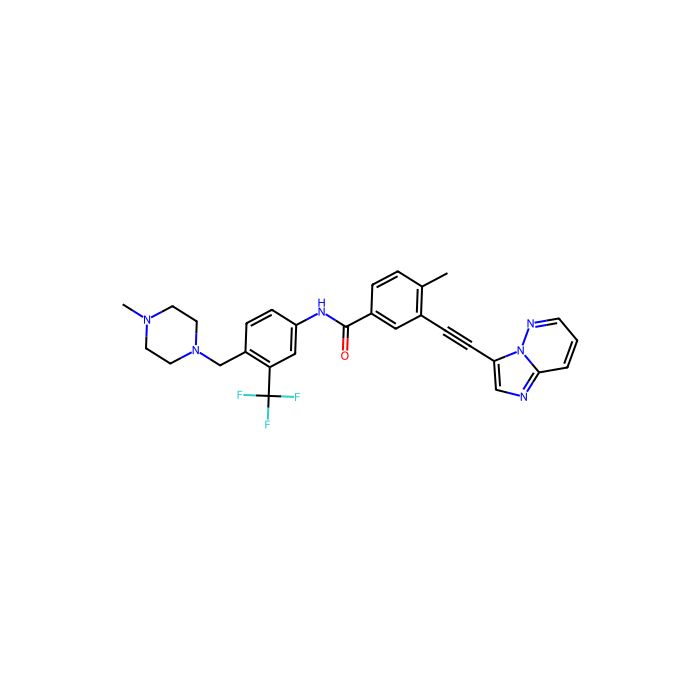
Ponatinib (AP24534) is a novel, potent multi-target inhibitor ofAbl, PDGFRα, VEGFR2, FGFR1 and Src withIC50of 0.37 nM, 1.1 nM, 1.5 nM, 2.2 nM and 5.4 nM in cell-free assays, respectively. Ponatinib (AP24534) inhibitsautophagy.
In vitro
AP24534 potently inhibits native Abl, AblT315I, and other clinically important Abl kinase domain mutants with IC50 of 0.30 nM–2 nM. AP24534 doesn\'t inhibit Aurora kinase family members, nor does it inhibit insulin receptor or CDK2/cyclin E. AP24534 inhibits proliferation of Ba/F3 cells expressing Bcr-Abl with IC50 of 0.5 nM, as well as Ba/F3 cells expressing a range of Bcr-Abl mutants with IC50 of 0.5 nM–36 nM. The inhibition of proliferation by AP24534 is correlated with induction of apoptosis. [1-2] In leukemic cell lines containing activated forms of FLT3, KIT, FGFR1, and PDGFRα receptors, AP24534 potently inhibits receptor phosphorylation and cellular proliferation with IC50 of 0.3 nM to 20 nM. In MV4-11 (FLT3-ITD(+/+)) but not RS4;11 (FLT3-ITD(–/–)) AML cells, AP24534 inhibits FLT3 signaling and induced apoptosis at less than 10 nM. AP24534 inhibits viability of primary leukemic blasts from a FLT3-ITD positive AML patient with IC50 of 4 nM but not those from patients with AML expressing native FLT3. In Ba/F3 cells engineered to express activated FGFR1-4, AP24534 potently inhibits FGFR-mediated signaling and viability with IC50 lower than 40 nM. In cell lines representing multiple tumor types (endometrial, bladder, gastric, breast, lung, and colon), and containing FGFRs dysregulated by a variety of mechanisms, AP24534 inhibits FGFR-mediated signaling with IC50 less than 40 nM and inhibits cell growth with IC50 of 7 nM–181 nM.
In vivo
In a mouse xenograft model of Ba/F3 cells expressing native Bcr-Abl, AP24534 (2.5 mg/kg and 5 mg/kg) prolongs mice median survival. In the xenograft model of Ba/F3 Bcr-AblT315I, AP24534 (10 mg/kg–50 mg/kg) significantly suppresses tumor growth. AP24534 (30 mg/kg) decreases the phosphorylated Bcr-Abl and phosphorylated CrkL levels in the tumors.
Cell Data
cell lines:DLD-1 and H460 cells
Concentrations:0-625 nM
Incubation Time:72 hours
Powder Purity:≥99%
Comprehensive hazard, handling, storage, and regulatory compliance document.
Download SDS →Lot-specific quality data. Enter your lot number to retrieve the exact COA.
Look up COA →Full quality attributes and acceptance criteria for this grade.
View spec sheet →| Activity Type | Activity Value -log(M) | Mechanism of Action | Activity Reference | Publications (PubMed IDs) |
|---|
| Activity Type | Activity Value -log(M) | Mechanism of Action | Activity Reference | Publications (PubMed IDs) |
|---|
| Activity Type | Activity Value -log(M) | Mechanism of Action | Activity Reference | Publications (PubMed IDs) |
|---|
| Activity Type | Activity Value -log(M) | Mechanism of Action | Activity Reference | Publications (PubMed IDs) |
|---|
| Activity Type | Activity Value -log(M) | Mechanism of Action | Activity Reference | Publications (PubMed IDs) |
|---|
| Activity Type | Activity Value -log(M) | Mechanism of Action | Activity Reference | Publications (PubMed IDs) |
|---|
| Activity Type | Activity Value -log(M) | Mechanism of Action | Activity Reference | Publications (PubMed IDs) |
|---|
| Activity Type | Activity Value -log(M) | Mechanism of Action | Activity Reference | Publications (PubMed IDs) |
|---|
| Activity Type | Activity Value -log(M) | Mechanism of Action | Activity Reference | Publications (PubMed IDs) |
|---|
| Activity Type | Activity Value -log(M) | Mechanism of Action | Activity Reference | Publications (PubMed IDs) |
|---|
| Activity Type | Activity Value -log(M) | Mechanism of Action | Activity Reference | Publications (PubMed IDs) |
|---|
| Activity Type | Activity Value -log(M) | Mechanism of Action | Activity Reference | Publications (PubMed IDs) |
|---|
| Activity Type | Activity Value -log(M) | Mechanism of Action | Activity Reference | Publications (PubMed IDs) |
|---|
| Activity Type | Activity Value -log(M) | Mechanism of Action | Activity Reference | Publications (PubMed IDs) |
|---|
| Activity Type | Activity Value -log(M) | Mechanism of Action | Activity Reference | Publications (PubMed IDs) |
|---|
| Activity Type | Activity Value -log(M) | Mechanism of Action | Activity Reference | Publications (PubMed IDs) |
|---|
| Activity Type | Activity Value -log(M) | Mechanism of Action | Activity Reference | Publications (PubMed IDs) |
|---|
| Activity Type | Activity Value -log(M) | Mechanism of Action | Activity Reference | Publications (PubMed IDs) |
|---|
| Activity Type | Activity Value -log(M) | Mechanism of Action | Activity Reference | Publications (PubMed IDs) |
|---|
| Activity Type | Activity Value -log(M) | Mechanism of Action | Activity Reference | Publications (PubMed IDs) |
|---|
| Activity Type | Activity Value -log(M) | Mechanism of Action | Activity Reference | Publications (PubMed IDs) |
|---|
| Activity Type | Activity Value -log(M) | Mechanism of Action | Activity Reference | Publications (PubMed IDs) |
|---|
| Activity Type | Activity Value -log(M) | Mechanism of Action | Activity Reference | Publications (PubMed IDs) |
|---|
| Activity Type | Activity Value -log(M) | Mechanism of Action | Activity Reference | Publications (PubMed IDs) |
|---|
| Activity Type | Activity Value -log(M) | Mechanism of Action | Activity Reference | Publications (PubMed IDs) |
|---|
| Activity Type | Activity Value -log(M) | Mechanism of Action | Activity Reference | Publications (PubMed IDs) |
|---|
| Activity Type | Activity Value -log(M) | Mechanism of Action | Activity Reference | Publications (PubMed IDs) |
|---|
| Activity Type | Activity Value -log(M) | Mechanism of Action | Activity Reference | Publications (PubMed IDs) |
|---|
| Activity Type | Activity Value -log(M) | Mechanism of Action | Activity Reference | Publications (PubMed IDs) |
|---|
| Activity Type | Activity Value -log(M) | Mechanism of Action | Activity Reference | Publications (PubMed IDs) |
|---|
| Activity Type | Activity Value -log(M) | Mechanism of Action | Activity Reference | Publications (PubMed IDs) |
|---|
| Activity Type | Activity Value -log(M) | Mechanism of Action | Activity Reference | Publications (PubMed IDs) |
|---|
| Activity Type | Activity Value -log(M) | Mechanism of Action | Activity Reference | Publications (PubMed IDs) |
|---|
Find and download the COA for your product by matching the lot number on the packaging.
| Lot Number | Certificate Type | Data | Oggetto |
|---|---|---|---|
 L2221021 | Certificate of Analysis | Sep 03, 2026 | P408271 |
| Solubilità | Solubility (25°C) In vitro DMSO: 46 mg/mL (195.97 mM); Water: 46 mg/mL (195.97 mM); Ethanol: 46 mg/mL (195.97 mM); |
|---|---|
| Punto di fusione (°C) | >160°C |
Our grade selection guide covers purity, stabilizer status, and application suitability for all variants in our catalog.
View Moligand™ grade guide →