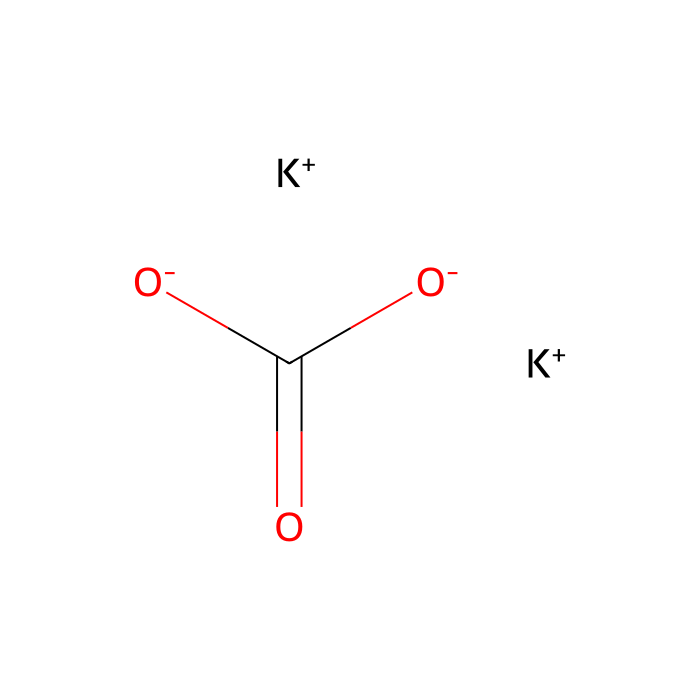
Potassium carbonate - Reagent grade, ≥98%, >325 mesh , CAS No.584-08-7

CAS: 584-08-7 Cat. No.: P432993 Formula: K2CO3 Peso molecolare: 138.21 Beilstein Registry Number: 4267587 Numero EC: 209-529-3
Disponibile su ordine
GRADE & PURITY Reagent Grade ? General reagent-grade purity suitable for most laboratory work. Use as a dependable default when no specific higher grade is required. ≥98% >325 mesh
Synonyms
Potassium carbonate, anhydrous, free-flowing, Redi-Dri(TM), ACS reagent, >=99% | Potassium carbonate, BioXtra, >=99.0% | FOOD-S | INS-501(I) | KALI CARBONICUM [HPUS] | Potassium carbonate (USP) | POTASSIUM CARBONATE [INCI] | POTASSIUM CARBONATE [VANDF] |
Storage
Room temperature
Shipped In
Normal
★
Size
Germania (EU)
USA*
Price
Qty
250g
P432993-250g
—
2 Disponibile

89,29€

104,91€
Salva 15,62 € (14.89%)
Enter a quantity for the sizes you want to add.
🧪
Why this grade

Reagent grade, ≥98%, >325 mesh Reagent Grade for sensitive chromatographic and analytical workflows requiring minimal baseline interference.

🌡

Storage & shipping

Room temperature Ships Normal Check lot-specific COA for exact specifications.

📋

Quality documents

SDS, COA, datasheet, and spec sheet available for download. Lot-specific COA accessible via lot number lookup.

📚

Literature proof

Cited in 1273 peer-reviewed publications across chromatography, organic synthesis, and cross-coupling reactions.

Panoramica

General Description

Potassium carbonate is an inorganic base. It participates as base in the palladacycle catalyzed Heck reaction of chlorobenzene with styrene.


Application

Potassium carbonate was used in the following studies: Synthesis of polysubstituted iodobenzene derivatives. As base for the synthesis of high molecular weight homopolymers and copolymers derived from various bisphenols. As base for the Suzuki coupling of aryl halides with aryl boronic acids. As base for the Heck reaction of styrene and bromobenzene.

Specifications

Sinonimi
Potassium carbonate, anhydrous, free-flowing, Redi-Dri(TM), ACS reagent, >=99% | Potassium carbonate, BioXtra, >=99.0% | FOOD-S | INS-501(I) | KALI CARBONICUM [HPUS] | Potassium carbonate (USP) | POTASSIUM CARBONATE [INCI] | POTASSIUM CARBONATE [VANDF] |
Specifiche e purezza
Reagent grade, ≥98%, >325 mesh
Condizioni di conservazione di stoccaggio
Room temperature
Spedito in
Normal
Grado
Reagent Grade
Purezza
≥98%
Nomi e identificatori
Pubchem Sid
Pubchem Sid Url
https://pubchem.ncbi.nlm.nih.gov/substance/504752121
Sorrisi canonici
C(=O)([O-])[O-].[K+].[K+]
IUPAC Name
dipotassium;carbonate
InChIKey
BWHMMNNQKKPAPP-UHFFFAOYSA-L
INCHI
1S/CH2O3.2K/c2-1(3)4;;/h(H2,2,3,4);;/q;2*+1/p-2
Isomeri SMILES
C(=O)([O-])[O-].[K+].[K+]
WGK Germania
1
RTECS
TS7750000
Peso molecolare
138.21
Beilstein
4267587
Reaxy-Rn
4267587
Reaxys-RN_link_address
https://www.reaxys.com/reaxys/secured/hopinto.do?context=S&query=IDE.XRN=4267587&ln=

Documentazione

📋 Safety Data Sheet (SDS)

Comprehensive hazard, handling, storage, and regulatory compliance document.

Download SDS →

✅ Certificate of Analysis (COA)

Lot-specific quality data. Enter your lot number to retrieve the exact COA.

Look up COA →

📊 Datasheet

Quick-reference summary of product specifications and applications.

View datasheet →

🔬 Specification Sheet

Full quality attributes and acceptance criteria for this grade.

View spec sheet →

Advanced Data

Taxonomic Classification

Taxonomy Tree

KingdomOrganic compounds
SuperclassOrganic acids and derivatives
ClasseOrganic carbonic acids and derivatives
SubclassOrganic carbonic acids
Intermediate Tree Nodes Not available
Direct ParentOrganic carbonic acids
Alternative Parents Carbonate salts  Organic potassium salts  Organic oxides  Hydrocarbon derivatives  Carbonyl compounds  
Molecular FrameworkAliphatic acyclic compounds
Substituents Carbonate salt - Carbonic acid - Organic alkali metal salt - Organic oxygen compound - Organic oxide - Hydrocarbon derivative - Organic potassium salt - Organic salt - Organooxygen compound - Carbonyl group - Aliphatic acyclic compound
DescrizioneThis compound belongs to the class of organic compounds known as organic carbonic acids. These are compounds comprising the carbonic acid functional group.
External Descriptors Not available
Struttura 3D
Modello di struttura chimica interattiva


Obiettivi associati (non umani)
Pseudomonas aeruginosa (123386 Activities)
Activity TypeRelationActivity valueUnitsAction TypeJournalPubMed IddoiAssay Aladdin ID
Meccanismi d'azione
Certificati (CoA, COO, BSE/TSE e tabella di analisi)
C of A & Other Certificates(BSE/TSE, COO):
Analytical Chart:

Find and download the COA for your product by matching the lot number on the packaging.

8 results found

Lot NumberCertificate TypeDataOggetto
A2404371Certificate of AnalysisMar 20, 2023 P432993
B2512071Certificate of AnalysisMar 20, 2023 P432993
C2330098Certificate of AnalysisMar 20, 2023 P432993
C2330142Certificate of AnalysisMar 20, 2023 P432993
C2330533Certificate of AnalysisMar 20, 2023 P432993
C2330536Certificate of AnalysisMar 20, 2023 P432993
D2426051Certificate of AnalysisMar 20, 2023 P432993
G2423044Certificate of AnalysisMar 20, 2023 P432993
Proprietà chimiche e fisiche
Punto di fusione (°C)891°C
Peso molecolare138.205 g/mol
XLogP3
Hydrogen Bond Donor Count0
Hydrogen Bond Acceptor Count3
Rotatable Bond Count0
Exact Mass137.912 Da
Monoisotopic Mass137.912 Da
Topological Polar Surface Area63.200 Ų
Heavy Atom Count6
Formal Charge0
Complexity18.800
Isotope Atom Count0
Defined Atom Stereocenter Count0
Undefined Atom Stereocenter Count0
Defined Bond Stereocenter Count0
Undefined Bond Stereocenter Count0
The total count of all stereochemical bonds0
Covalently-Bonded Unit Count3
Domande frequenti e articoli
Ethanol
How to Choose Reagent Grades in Scientific Research? A Practical Guide to Reagent Grade
One-Stop Handbook for Palladium-Catalyzed Reactions: Catalytic Cycles, Deactivation Troubleshooting, Ligand/Precatalyst Selection, and an Aladdin Reference List
TEMPO-Catalyzed Oxidation Quick Reference (Alcohol Oxidation Focus): Three Regeneration Routes (NaOCl / Cu–O₂ / PIDA) + Selection & Troubleshooting
Strategies and Progress in the Asymmetric Catalytic Synthesis of Chiral 1,2-Bis(boronic) Esters: Route Types, Selectivity Challenges, and Sequential Site Utilization (with Product Selection Navigator and Tables 1–4)
Late-Stage Fluorination Toolbox: “Minimally Invasive Upgrades” for Lead Candidates: Four “Fluorine Knobs” → Two major routes (electrophilic vs nucleophilic) → An ¹⁸F-PET tracer branch → Selection navigation & representative product list
OSF/ASF Dual-Channel Toolbox: Divergent Reactions of Four-Membered Ring Sulfonyl Fluorides, Condition “Knobs,” and Selection Navigation
From Piperidine to Pyridine: The “Most Common N-Heterocycle” Shift in FDA Small-Molecule New Drugs (2013–2023) and a Selection Guide (Tables 1–4)
Light-Emitting Polymers (LEPs): A Practical Panorama - A Core PL/EL Mechanistic Framework, Material Family Map, and Structural “Design Knobs” (including Product Tables 1–4 and a selection guide)
Structural–Functional Analysis of the Methoxy Group (–OCH₃) in Approved Small-Molecule Drugs: Mechanisms, Evidence Chains, and Product-Selection Navigation (with Related Product Tables)
Selection of Common Research Salts: A Task Map for Alkali Metal Salts & Alkaline Earth Metal Salts (with Product Tables 1–6)
Cinchona Alkaloid Chiral Toolbox: Selection & Troubleshooting from Pseudoenantiomer Switching to PTC/Sharpless AD/Chiral Resolution (including Product Tables A–D)
Make “Aryl Chlorides + Low Pd Loading + Scale-Up Reproducibility” Reliable: The Initiation and Durability Logic of Pd–NHC (Palladium–N-Heterocyclic Carbene) Cross-Coupling (with Selection Navigation and Product Tables)
Choosing Boron Sources to Make Reactions Robust: How Boronic Acids, Boronate Esters, BF₃K Salts, and MIDA Improve Suzuki–Miyaura Start-Up and Scale-Up Reproducibility (with Product Tables 1–5)
How to Make the Suzuki–Miyaura Reaction Robust: Pinpoint the Bottleneck and Lock in a Reproducible Operating Window (with Selection Navigation and Product Tables 1–5)
Haloheterocycles and Cross-Coupling: A Research-Oriented Selection Framework from Substrate Identification to Bond-Forming Routes (Including Product Navigation and Tables 1–5)
From “Reduction First, Then Acylation” to “Direct Amidation”: An Unconventional Route to Amide Bond Formation from Nitro and Nitroso Substrates with α-Keto Carboxylic Acids
Reconsidering N-Acyl Amino Protecting Groups: Deprotection Differences, Strategic Roles, and Experimental Selection of Ac, Bz, and Tfa
Selective Deprotection and Sulfonyl Group Migration of N-Aryl Sulfonamides Mediated by TfOH (Trifluoromethanesulfonic Acid): Reaction Patterns and Synthetic Implications
Boc₂O Selection Cannot Be Judged by Protection Installation Alone: Experimental Decision-Making from Substrate Nucleophilicity and Medium Effects to Deprotection Pathways
Experimental Assessment of Fmoc Introduction Routes: Impurity Profile Differences, Raw Material Carryover, and Quality Control
Experimental Judgment for TFPN in Carboxylic Acid Activation: Suitable Scenarios, Intermediate Distribution, and Nucleophile Compatibility
Experimental Selection Logic for Phase-Transfer Catalysts: Choosing Catalysts by Phase-State System, Source of Anionic Species, and Reaction Task
Experimental Decision-Making for Cross-Coupling Reactions: Target Bond Type, Substrate Combination, and Catalytic System Selection
Potassium Fatty Acid Soaps: Structure and Formulation Applications—Production Processes, Alkalinity, Foam Control, and Low-Foam Cleaning
Differences, Functions, and Selection Guidelines for Sodium Hydroxide Flakes, Granules, Liquid Caustic Soda, and Caustic Soda in Household and Personal Care Product Manufacturing: The Functional and Application Logic of Sodium Hydroxide
Why Daily Chemical Formulations Need Alkaline Ingredients: From pH Adjustment and Saponification to Detergency Boosting and Selection Logic
Deoxyfluorination of Hydroxyalkyl-Substituted Aryl/Alkenyl Boronates: C–F Bond Construction and C–B Bond Retention via a BF3K Intermediate
CTSOBt Benzotriazole–Sulfonate Coupling Reagent: Carboxylic Acid Activation and Synthetic Application Value
Medicinal Chemistry Design of the Indazole Scaffold: Tautomerism, Molecular Recognition, Substitution-Site Design, and Synthetic Strategies
Discovery and Structural Optimization of the Noncovalent 3CL Protease Inhibitor S-217622
Overcoming the Electronic-Effect Limitations of Nucleophilic Aromatic Substitution in Fluoroarenes: Anion Activation, Concerted Substitution, and HF Capture by t-Bu-P4
Build the Three-Membered Ring First, or Form the Carbon–Nitrogen Bond First?—Retrosynthetic Strategies, Route Selection, and Stereochemical Control in Cyclopropylamine Synthesis
Route Selection for Thiol Synthesis: C–S Bond Construction, Sulfur Source Forms, and Thiol Release
3,3-Spiro-α-Proline Building Blocks: Structural Features, Complementary Synthetic Routes, and Multigram-Scale Preparation
Direct Construction of Methylsulfonyl-Containing Heterocycles: Synthesis and Applications of Prefunctionalized Three-Carbon Vinamidinium Salts
Synthetic Route Design for Azaheterocyclic Phosphonates: Timing of C–P Bond Formation and Three Route Strategies
Kinetic Matching in Photoredox/Nickel C(sp²)–C(sp³) Coupling: Radical Generation, Nickel-Species Stability, and Photon Flux
Tether Effects in Intramolecular [2+2] Photocycloadditions: Straight and Crossed Regioselectivity and Stepwise C–C Bond Formation
Citations of This Product
Calcolatori di soluzioni
Recensioni

Recensioni dei clienti

Shall we send you a message when we have discounts available?

Remind me later

Thank you! Please check your email inbox to confirm.

Oops! Notifications are disabled.