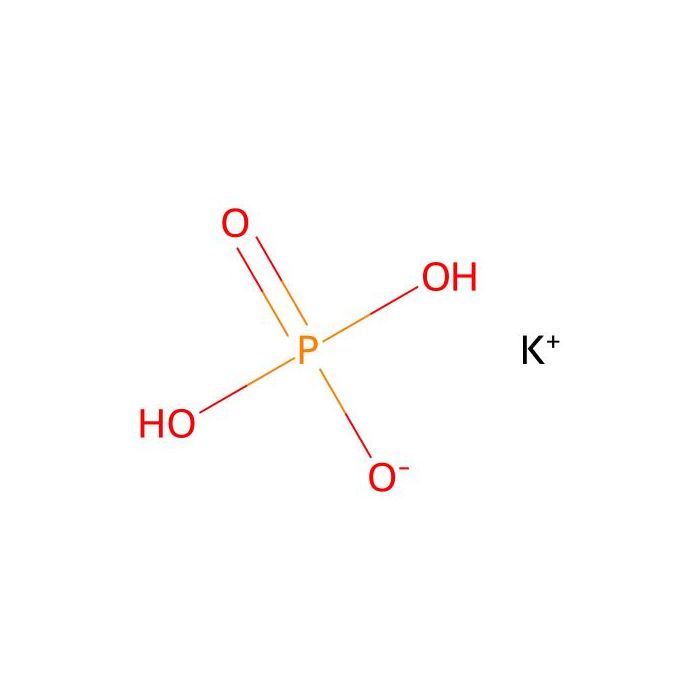
Potassium phosphate monobasic - Suitable for molecular biology, Potassium Phosphate, Monobasic , CAS No.7778-77-0

CAS: 7778-77-0 Cat. No.: P755539 Formula: KH2PO4 Peso molecolare: 136.09 Numero EC: 231-913-4
Disponibile su ordine
QUALITÀ & PUREZZA Suitable for molecular biology ? Molecular-biology grade — free of nucleases and contaminants that degrade DNA/RNA. Use in cloning, PCR, and nucleic-acid work needing clean reagents. Potassium Phosphate, Monobasic
Storage
Room temperature
Shipped In
Normal
★
Dimensione
Germania (EU)
USA*
Prezzo
Qtà
250g
P755539-250g
Su ordinazione · 8–12 settimane
89,29€
Enter a quantity for the sizes you want to add.
🧪
Perché questa qualità

Suitable for molecular biology, Potassium Phosphate, Monobasic Suitable for molecular biology per flussi di lavoro cromatografici e analitici sensibili che richiedono un'interferenza minima della linea di base.

🌡

Stoccaggio e spedizione

Room temperature Spedizione Normal. Consultare il COA specifico del lotto per le specifiche esatte.

📋

Documenti di qualità

SDS, COA, scheda tecnica e scheda delle specifiche disponibili per il download. COA specifico del lotto accessibile tramite ricerca per numero di lotto.

📚

Prova documentale

Citato in 1003 pubblicazioni peer-reviewed su cromatografia, sintesi organica e reazioni di accoppiamento incrociato.

Panoramica

Buffer having a pH of 4.4-4.7 (absorbance: ≤0.01 at 260 nm and 280 nm).

Specifiche

Specifiche e purezza
Suitable for molecular biology, Potassium Phosphate, Monobasic
Condizioni di conservazione di stoccaggio
Room temperature
Spedito in
Normal
Grado
Suitable for molecular biology
Nomi e identificatori
Sorrisi canonici
OP(=O)(O)[O-].[K+]
IUPAC Name
potassium;dihydrogen phosphate
InChIKey
GNSKLFRGEWLPPA-UHFFFAOYSA-M
INCHI
1S/K.H3O4P/c;1-5(2,3)4/h;(H3,1,2,3,4)/q+1;/p-1
Isomeri SMILES
OP(=O)(O)[O-].[K+]
WGK Germania
2
RTECS
TC6615500
Peso molecolare
136.09
Reaxy-Rn
11343563
Reaxys-RN_link_address
https://www.reaxys.com/reaxys/secured/hopinto.do?context=S&query=IDE.XRN=11343563&ln=

Documentazione

📋 Scheda di dati di sicurezza (SDS)

Documento completo su pericoli, manipolazione, stoccaggio e conformità normativa.

<<<<<<< HEAD Scarica SDS → ======= Scarica SDS → >>>>>>> release248-p3

✅ Certificato di analisi (COA)

Dati di qualità specifici del lotto. Inserisci il numero di lotto per recuperare il COA esatto.

Cerca COA →

📊 Scheda tecnica

Riepilogo di riferimento rapido delle specifiche e applicazioni del prodotto.

Visualizza scheda tecnica →

🔬 Scheda delle specifiche

Attributi di qualità completi e criteri di accettazione per questa qualità.

Visualizza scheda delle specifiche →

Dati avanzati

Taxonomic Classification

Taxonomy Tree

KingdomInorganic compounds
SuperclassMixed metal/non-metal compounds
ClasseAlkali metal oxoanionic compounds
SubclassAlkali metal phosphates
Intermediate Tree Nodes Not available
Direct ParentAlkali metal phosphates
Alternative Parents Inorganic salts  Inorganic oxides  
Molecular FrameworkNot available
Substituents Alkali metal phosphate - Inorganic oxide - Inorganic salt
DescrizioneThis compound belongs to the class of inorganic compounds known as alkali metal phosphates. These are inorganic compounds in which the largest oxoanion is phosphate, and in which the heaviest atom not in an oxoanion is an alkali metal.
External Descriptors potassium salt - inorganic phosphate
Struttura 3D
Modello di struttura chimica interattiva


Certificati (CoA, COO, BSE/TSE e tabella di analisi)
C of A & Other Certificates(BSE/TSE, COO):
Analytical Chart:
Proprietà chimiche e fisiche
Solubilitàwater: soluble
Punto di fusione (°C)252.6 °C
Peso molecolare136.086 g/mol
XLogP3
Hydrogen Bond Donor Count2
Hydrogen Bond Acceptor Count4
Rotatable Bond Count0
Exact Mass135.933 Da
Monoisotopic Mass135.933 Da
Topological Polar Surface Area80.600 Ų
Heavy Atom Count6
Formal Charge0
Complexity61.900
Isotope Atom Count0
Defined Atom Stereocenter Count0
Undefined Atom Stereocenter Count0
Defined Bond Stereocenter Count0
Undefined Bond Stereocenter Count0
The total count of all stereochemical bonds0
Covalently-Bonded Unit Count2
Domande frequenti e articoli
Molecular Biology Grade
Common Types of Buffer Solutions
Operational Guide for Fluorescent Labeling of Antibodies Using AF594 NHS Ester
General Principles of Antibody Labeling with NHS-Activated Esters, F/P Calculation, and Troubleshooting Guide
Mag-Fluo-4 AM Magnesium/Calcium Ion Fluorescent Probe: Properties, Experimental Use, and Aladdin Metal Ion Fluorescent Probe Selection Guide
How to Choose a Hydrogen Evolution (HER) Catalyst: Kinetic Barriers in Water Electrolysis, AWE/PEM/AEM Pathways, and a Materials-Family Roadmap (with a Product Map)
Installing a Redox Switch on Biomolecules: Principles, Conjugation Essentials, and an Application Guide for ATTO MB2 NHS ester
Brassinolide Plant Growth Regulator: Mechanism of Action, Application Scenarios, and Use Practices
A Review of Ten Commonly Used Techniques for Detection, Quantification, and Interaction Analysis in Nucleic Acid Research
Selection of Common Research Salts: A Task Map for Alkali Metal Salts & Alkaline Earth Metal Salts (with Product Tables 1–6)
Optical & Optoelectronic Materials Selection Guide:Positioning materials, key metrics, and validation paths along “Generation → Guiding → Control → Readout” (with product navigation and Tables 1–4)
Methodological essentials for mineralization visualization: Alizarin Red S staining vs. Von Kossa silver staining
Glucose Content Determination: A Systematic Review of Detection Principles, Method Validation, and Research Application Frameworks
Phytase: Enzymological Properties, Mechanism of Action, and Applications in Feed and Food
Selection Strategy for PBS, TBS, PBST, and TBST Washing Systems in IHC
Practical Guide to TSA Tyramide Signal Amplification: How to Select Reagents, Optimize the Workflow, and Reduce Background When Detection Signals Are Weak for Low-Abundance Targets
Signal Transduction Mechanism of Graphene Biosensors: From Molecular Recognition to Electrical/Optical Signal Readout and Materials Selection
What Is Synthetic Biology? The Industrialization Pathway from Upstream Reagent Toolchains to Biomanufacturing Applications
Design Logic of Fluorinated 3,3-Disubstituted Oxetane Building Blocks: Structural Construction and Modulation of Amine Basicity, Lipophilicity, and Metabolic Stability
Citations of This Product
Calcolatori di soluzioni
Recensioni

Recensioni dei clienti

Domande frequenti

What does Suitable for molecular biology mean?
Suitable for molecular biology indicates that the product has been processed and tested for molecular biology and proteomics. Typical specifications include low or undetectable nuclease/protease activity, low endotoxin, controlled microbial limits and high lot-to-lot reproducibility.
How should this product be stored?
Store at room temperature.
How is this product shipped?
This product ships under standard ambient conditions. No temperature-controlled packaging is required.
What are the CAS number, molecular formula and molecular weight?
The CAS Number is 7778-77-0, the molecular formula is KH2PO4, and the molecular weight is 136.09 g/mol. InChIKey GNSKLFRGEWLPPA-UHFFFAOYSA-M.
What documentation is provided?
Available product documentation, including Certificates of Analysis (COA), Safety Data Sheets (SDS), and specification sheets, is shown in the product document area. Document availability and access follow the current site policy.

Desidera che le inviamo un messaggio quando avremo sconti disponibili?

Ricordamelo più tardi

Grazie! Controlli la sua casella di posta per confermare.

Ops! Le notifiche sono disabilitate.