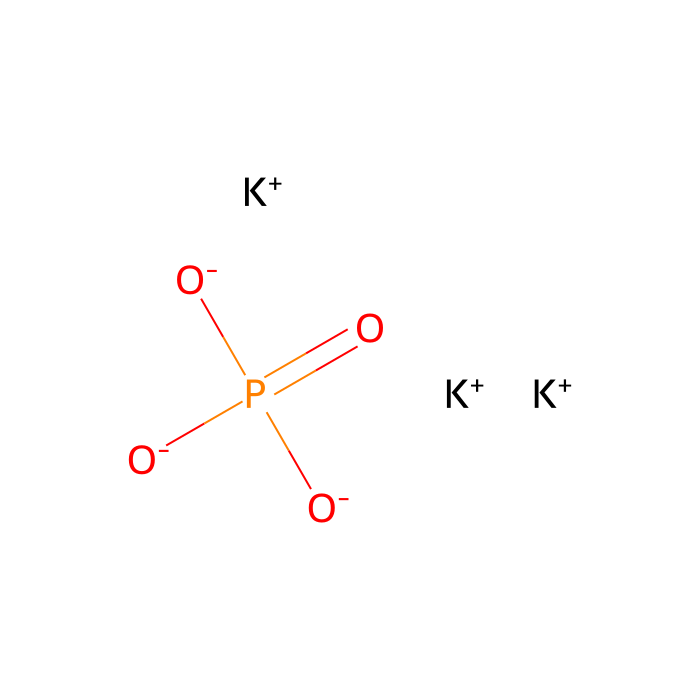
Fosfato di potassio tribasico - ≥95% , CAS No.7778-53-2

CAS: 7778-53-2 Cat. No.: P299360 Formula: K3PO4 Peso molecolare: 212.27 Numero EC: 231-907-1
Disponibile su ordine
QUALITÀ & PUREZZA ≥95%
Synonyms
potassium phosphate, tribasic, n-hydrate|potassium-phosphate|POTASSIUM PHOSPHATE, TRIBASIC ANHYDROUS|Tripotasium phosphate|Tripotassium orthophosphate|tri-Potassium orthophosphate|Potassium phosphate-tribasic|Phosphoric acid, tripotassium salt|Phosphoric acid, potassium salt (1:3)|POTASSIUM PHOSPHATE, TRIBASIC [FCC]|Potassium phosphate|Potassium phosphate tribasic anhydrous|Potassium Phosphate Tri basic|Potassium phosphate, tribasic|Potassium phosphate tribasic|Potassium orthophosphate|Potassium phosphate (K3PO4)|tri potassium phosphate|INS-340(III)|tripotassiurn phosphate|INS NO.340(III)|E-340(III)|potassium phophate|Potassium phosphate, ACS|Potassium phosphate tribasic anhydrous, Trace metals grade|Potassium pentahydrogen bis(phosphate)|POTASSIUM PHOSPHATE, TRIBASIC [MI]|tribasic potassium phosphate|tris-potassium phosphate|potassium phoshate|Potassium phosphate ,anhydrous|Phosphoric acid potassium salt (1:3)|Tripotassium phosphate|tri-potassium phosphate
Storage
Room temperature,Argon charged,Desiccated
Shipped In
Normale
★
Dimensione
Germania (EU)
USA*
Prezzo
Qtà
500g
P299360-500g
—
2 Disponibile

12,93€

19,87€
Salva 6,94 € (34.93%)
6×500g
P299360-6×500g
Su ordinazione · 8–12 settimane

64,99€

97,97€
Salva 32,97 € (33.66%)
20×500g
P299360-20×500g
Su ordinazione · 8–12 settimane

219,45€

329,65€
Salva 110,20 € (33.43%)
Enter a quantity for the sizes you want to add.

Panoramica

Il fosfato di potassio tribasico è un reagente con una capacità tampone molto elevata. È ampiamente utilizzato in biologia molecolare, biochimica e cromatografia. Il fosfato di potassio si presenta in diverse forme: monobasico (KH2PO4), dibasico (K2HPO4) e tribasico (K3PO4). Le soluzioni tampone neutre di fosfato di potassio possono essere preparate con una miscela delle forme monobasica e bibasica in misura variabile, a seconda del pH desiderato. I tamponi di fosfato di potassio sono molto utili in numerose applicazioni, ma presentano le seguenti limitazioni: precipitazione di Ca2+ e Mg2+, inibizione dell'attività degli enzimi di restrizione e interferenza nei protocolli di legatura del DNA o di trasformazione batterica. È stato utilizzato per studiare gli effetti del congelamento e dello scongelamento sulla stabilità delle proteine sensibili ai cambiamenti conformazionali; si è scoperto che i tamponi di fosfato di potassio offrono una migliore stabilità del pH rispetto ai tamponi di fosfato di sodio. Il fosfato di potassio è stato utilizzato anche per l'estrazione della proteina cheratohyalin dal tessuto bovino.

Specifiche

Sinonimi
potassium phosphate, tribasic, n-hydrate | potassium-phosphate | POTASSIUM PHOSPHATE, TRIBASIC ANHYDROUS | Tripotasium phosphate | Tripotassium orthophosphate | tri-Potassium orthophosphate | Potassium phosphate-tribasic | Phosphoric acid, tripotassium salt | Phosphoric acid, potassium salt (1:3) | POTASSIUM PHOSPHATE, TRIBASIC [FCC] | Po Mostra altro
Specifiche e purezza
≥95%
Condizioni di conservazione di stoccaggio
Room temperature,Argon charged,Desiccated
Spedito in
Normale
Purezza
≥95%
Nomi e identificatori
Pubchem Sid
Pubchem Sid Url
https://pubchem.ncbi.nlm.nih.gov/substance/508815680
SMILES
[O-]P(=O)([O-])[O-].[K+].[K+].[K+]
IUPAC Name
tripotassium;phosphate
InChIKey
LWIHDJKSTIGBAC-UHFFFAOYSA-K
InChI
1S/3K.H3O4P/c;;;1-5(2,3)4/h;;;(H3,1,2,3,4)/q3*+1;/p-3
Isomeri SMILES
[O-]P(=O)([O-])[O-].[K+].[K+].[K+]
CAS alternativo
115281-28-2
Peso molecolare
212.27
Reaxys
11343346
Reaxys-RN_link_address
https://www.reaxys.com/reaxys/secured/hopinto.do?context=S&query=IDE.XRN=11343346&ln=

Dati avanzati

Taxonomic Classification

Taxonomy Tree

KingdomInorganic compounds
SuperclassMixed metal/non-metal compounds
ClasseAlkali metal oxoanionic compounds
SubclassAlkali metal phosphates
Intermediate Tree Nodes Not available
Direct ParentAlkali metal phosphates
Alternative Parents Inorganic salts  Inorganic oxides  
Molecular FrameworkNot available
Substituents Alkali metal phosphate - Inorganic oxide - Inorganic salt
DescrizioneThis compound belongs to the class of inorganic compounds known as alkali metal phosphates. These are inorganic compounds in which the largest oxoanion is phosphate, and in which the heaviest atom not in an oxoanion is an alkali metal.
External Descriptors Not available
Struttura 3D
Modello di struttura chimica interattiva


Certificati (CoA, COO, BSE/TSE e tabella di analisi)
C of A & Other Certificates(BSE/TSE, COO):
Analytical Chart:

Find and download the COA for your product by matching the lot number on the packaging.

9 results found

Lot NumberCertificate TypeDataOggetto
C2209455C2209455Certificate of AnalysisDec 10, 2025 P299360
C2209470C2209470Certificate of AnalysisDec 10, 2025 P299360
I2126545I2126545Certificate of AnalysisJul 10, 2025 P299360
L2313127L2313127Certificate of AnalysisDec 26, 2023 P299360
L1902066L1902066Certificate of AnalysisSep 07, 2023 P299360
G23051283G23051283Certificate of AnalysisJul 13, 2023 P299360
G23051285G23051285Certificate of AnalysisJul 13, 2023 P299360
C2317617C2317617Certificate of AnalysisNov 17, 2022 P299360
C2317726C2317726Certificate of AnalysisNov 17, 2022 P299360
Proprietà chimiche e fisiche
SolubilitàSoluble in water (100 mg/mL). Insoluble in alcohol.
Sensibilitàmoisture sensitive
Peso molecolare212.27
XLogP3
Hydrogen Bond Donor Count0
Hydrogen Bond Acceptor Count4
Rotatable Bond Count0
Exact Mass211.845 Da
Monoisotopic Mass211.845 Da
Topological Polar Surface Area86.300 Ų
Heavy Atom Count8
Formal Charge0
Complexity36.800
Isotope Atom Count0
Defined Atom Stereocenter Count0
Undefined Atom Stereocenter Count0
Defined Bond Stereocenter Count0
Undefined Bond Stereocenter Count0
The total count of all stereochemical bonds0
Covalently-Bonded Unit Count4
Sicurezza e pericoli (GHS)
Pictogrammi
GHS05,   GHS07
Segnale
Danger
Indicazioni di pericolo

H315:Causes skin irritation

H318:Causes serious eye damage

H319:Causes serious eye irritation

H335:May cause respiratory irritation

Precauzioni

P261:Avoid breathing dust/fume/gas/mist/vapors/spray.

P264:Wash hands [and …] thoroughly after handling.

P271:Use only outdoors or in a well-ventilated area.

P280:Wear protective gloves/protective clothing/eye protection/face protection.

P321:Specific treatment (see ... on this label).

P302+P352:IF ON SKIN: wash with plenty of water.

P304+P340:IF INHALED: Remove person to fresh air and keep comfortable for breathing.

P305+P351+P338:IF IN EYES: Rinse cautiously with water for several minutes. Remove contact lenses if present and easy to do - continue rinsing.

P362+P364:Take off contaminated clothing and wash it before reuse.

P405:Store locked up.

P403+P233:Store in a well-ventilated place. Keep container tightly closed.

P501:Dispose of contents/container to an approved waste disposal plant.

P264+P265:Wash hands [and …] thoroughly after handling. Do not touch eyes.

P305+P354+P338:IF IN EYES: Immediately rinse with water for several minutes. Remove contact lenses if present and easy to do. Continue rinsing.

P317:Get emergency medical help.

P337+P317:If eye irritation persists: Get medical help.

P332+P317:If skin irritation occurs: Get medical help.

P319:Get medical help if you feel unwell.

Reaxys
11343346
Reaxys-RN_link_address
https://www.reaxys.com/reaxys/secured/hopinto.do?context=S&query=IDE.XRN=11343346&ln=
Domande frequenti e articoli
One-Stop Handbook for Palladium-Catalyzed Reactions: Catalytic Cycles, Deactivation Troubleshooting, Ligand/Precatalyst Selection, and an Aladdin Reference List
Selection of Common Research Salts: A Task Map for Alkali Metal Salts & Alkaline Earth Metal Salts (with Product Tables 1–6)
Make “Aryl Chlorides + Low Pd Loading + Scale-Up Reproducibility” Reliable: The Initiation and Durability Logic of Pd–NHC (Palladium–N-Heterocyclic Carbene) Cross-Coupling (with Selection Navigation and Product Tables)
Choosing Boron Sources to Make Reactions Robust: How Boronic Acids, Boronate Esters, BF₃K Salts, and MIDA Improve Suzuki–Miyaura Start-Up and Scale-Up Reproducibility (with Product Tables 1–5)
How to Make the Suzuki–Miyaura Reaction Robust: Pinpoint the Bottleneck and Lock in a Reproducible Operating Window (with Selection Navigation and Product Tables 1–5)
Haloheterocycles and Cross-Coupling: A Research-Oriented Selection Framework from Substrate Identification to Bond-Forming Routes (Including Product Navigation and Tables 1–5)
Experimental Decision-Making for Cross-Coupling Reactions: Target Bond Type, Substrate Combination, and Catalytic System Selection
Deoxyfluorination of Hydroxyalkyl-Substituted Aryl/Alkenyl Boronates: C–F Bond Construction and C–B Bond Retention via a BF3K Intermediate
Overcoming the Electronic-Effect Limitations of Nucleophilic Aromatic Substitution in Fluoroarenes: Anion Activation, Concerted Substitution, and HF Capture by t-Bu-P4
Air Decomposition of Solid Sodium Methoxide and Sodium Ethoxide—Effects on Cross-Coupling Reaction Optimization and Reproducibility
From Temporary Covalent Assembly to Intramolecular Smiles Aryl Migration: DCPDC-Mediated Phenol–Primary Amine C–N Cross-Coupling
Aminative Suzuki–Miyaura Coupling: Bond-Formation Order and Chemoselectivity Control in the Transformation from Ar–Ar′ to Ar–NH–Ar′
Citations of This Product
Calcolatori di soluzioni
Recensioni

Recensioni dei clienti

Desidera che le inviamo un messaggio quando avremo sconti disponibili?

Ricordamelo più tardi

Grazie! Controlli la sua casella di posta per confermare.

Ops! Le notifiche sono disabilitate.