GRADE & PURITYRecombinant?Recombinant — produced via recombinant expression for defined sequence and consistency. Use for reproducible, animal-free proteins of known origin.ExactAb™?ExactAb™ — Aladdin's antibody line emphasizing precision and validated quality. Use for reliable, specificity-validated antibody applications.Validated?Validated grade — performance confirmed in defined applications before release. Use when you want documented assurance the reagent works as stated.See COA
Recombinant, ExactAb™, Validated, See COA ExactAb™,Recombinant,Validated for sensitive chromatographic and analytical workflows requiring minimal baseline interference.
🌡
Storage & shipping
Store at -20°C,Avoid repeated freezing and thawing Ships Ice chest + Ice pads Check lot-specific COA for exact specifications.
📋
Quality documents
SDS, COA, datasheet, and spec sheet available for download. Lot-specific COA accessible via lot number lookup.
📚
Literature proof
Cited in 0 peer-reviewed publications across chromatography, organic synthesis, and cross-coupling reactions.
Panoramica
Rabbit anti Human Cdc34 Antibody, Recombinant, could be used for WB, ICC, IF and so on. Application: WB: 1/500-1/2000 ICC/IF: 1/50-1/200 Protein Function: Accepts ubiquitin from the E1 complex and catalyzes its covalent attachment to other proteins. In vitro catalyzes 'Lys-48'-linked polyubiquitination. Cooperates with the E2 UBCH5C and the SCF(FBXW11) E3 ligase complex for the polyubiquitination of NFKBIA leading to its subsequent proteasomal degradation. Performs ubiquitin chain elongation building ubiquitin chains from the UBE2D3-primed NFKBIA-linked ubiquitin. UBE2D3 acts as an initiator E2, priming the phosphorylated NFKBIA target at positions 'Lys-21' and/or 'Lys-22' with a monoubiquitin. Cooperates with the SCF(SKP2) E3 ligase complex to regulate cell proliferation through ubiquitination and degradation of MYBL2 and KIP1. Involved in ubiquitin conjugation and degradation of CREM isoform ICERIIgamma and ATF15 resulting in abrogation of ICERIIgamma- and ATF5-mediated repression of cAMP-induced transcription during both meiotic and mitotic cell cycles. Involved in the regulation of the cell cycle G2/M phase throught its targeting of the WEE1 kinase for ubiquitination and degradation. Also involved in the degradation of beta-catenin. Is target of human herpes virus 1 protein ICP0, leading to ICP0-dependent dynamic interaction with proteasomes.
Specifications
Product Name
Recombinant Cdc34 Antibody - Anticorpo primario, specific to Cdc34, Rabbit IgG
A synthetic peptide derived from human Cdc34 (AA 2-236).
Controllo positivo
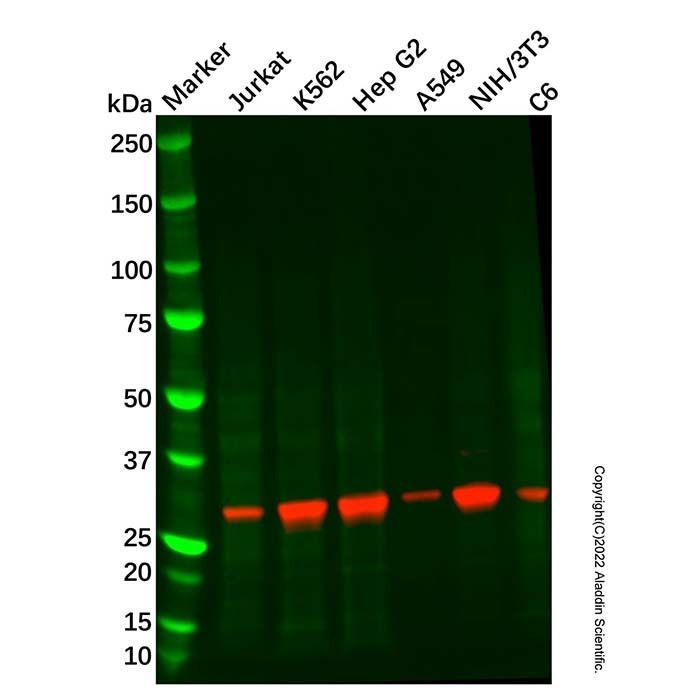
WB: Jurkat, Hep G2, K562, A549, NIH/3T3 and C6 cell lysates. ICC/IF: HeLa cells.
Coniugazione
Unconjugated
Grado
ExactAb™, Recombinant, Validated
Isotipo
Rabbit IgG
Tipo di catena leggera
kappa
SDS-PAGE
150 kDa
Metodo di purificazione
Protein A purified
Concentrazione
See COA
Product Line
Prodotti biologici
Stoccaggio e spedizione
Forma
Liquid
Condizioni di conservazione di stoccaggio
Store at -20°C,Avoid repeated freezing and thawing
Spedito in
Ice chest + Ice pads
Stabilità e conservazione
Store at 4℃ short term (1-2 weeks). Store at -20℃ long term (24 months). Upon receipt, it is recommended to aliquot. Avoid freeze/thaw cycle.
Immagini
Recombinant Cdc34 Antibody (Ab095618) - Western Blot All lanes: Recombinant Cdc34 Antibody (Ab095618) at 1/1000 dilution Samples: Lysates at 20 µg per lane Secondary: Goat Anti-Rabbit IgG H&L (HRP) (Ab170144) at 1/20000 dilution
Predicted band size: 27 kDa Observed band size: 31 kDa Exposure time: 42.7 s
Recombinant Cdc34 Antibody (Ab095618) - IF/ICC Immunofluorescent analysis of HeLa cells, using Recombinant Cdc34 Antibody (Ab095618).
Recombinant Cdc34 Antibody (Ab095618) - IF/ICC Immunofluorescent analysis of HeLa cells, using Recombinant Cdc34 Antibody (Ab095618) at 1/25 dilution.
Recombinant Cdc34 Antibody (Ab095618) - IF/ICC Immunofluorescent analysis of HeLa cells, using Recombinant Cdc34 Antibody (Ab095618) at 1/100 dilution.
Applicazione
Applicazione
Dilution info
WB
1/500-1/2000
IF/ICC
1/50-1/200
Documentazione
📋 Safety Data Sheet (SDS)
Comprehensive hazard, handling, storage, and regulatory compliance document.
Determine the necessary mass, volume, or concentration for preparing a solution.
Dilution Calculator
Determine the dilution needed to prepare a stock solution.
Reconstitution Calculator
Recensioni
Recensioni dei clienti
Application Protocols
Not specified for this item; refer to CoA/Spec Sheet.
Only item-specific, tested applications (e.g., WB, IHC, IF, FC), recommended dilutions, and controls validated by the manufacturer should be followed when provided.
Biological Roles
Target background (literature; general, not item-specific claims):
Cdc34 (also known as UBE2R1) is an E2 ubiquitin-conjugating enzyme central to SCF (SKP1–CUL1–F-box) E3 ligase function. It catalyzes ubiquitin transfer from E1 to substrate-bound complexes, regulating proteasomal degradation of key cell-cycle regulators.
Biological processes: Cell-cycle progression (G1/S transition), DNA replication licensing, and protein quality control via ubiquitin–proteasome system. Cdc34 activity affects the turnover of cyclins and CKIs in various model systems.
Subcellular localization: Predominantly cytosolic/nuclear depending on cell state and species; association with SCF components influences localization.
Orthology: Conserved from yeast Cdc34 to mammalian UBE2R1/R2, enabling cross-species studies with appropriate antibodies.
Reagent relevance:
Antibodies against Cdc34 enable detection/quantitation of protein abundance, assessment of pathway engagement, and immunoprecipitation of complexes for ubiquitination studies.
Item-specific notes: Epitope, species reactivity, clonality, and isotype for Ab095618 are not specified for this item; refer to CoA/Spec Sheet to determine suitability for your system and application.
Buffer Applications
Item-specific buffer composition is not provided; refer to CoA/Spec Sheet. General guidance for antibody handling and assay buffers (literature, not item-specific):
Storage/dilution buffers: PBS (10–50 mM phosphate, 150 mM NaCl, pH 7.2–7.4) or TBS (20–50 mM Tris, 150 mM NaCl, pH 7.4–7.6). Include 0.01–0.05% Tween-20 for washing/dilution in immunoassays to reduce nonspecific binding.
Blocking buffers: 3–5% BSA or nonfat dry milk for Western blot; serum or commercial blockers for IHC/IF depending on species and detection system.
Carrier proteins: 0.1–1% BSA can stabilize dilute antibody solutions and minimize adsorption to plastics; omit carrier for conjugation workflows.
Antimicrobials: 0.02–0.05% sodium azide for long-term refrigerated storage when compatible with downstream enzymes/cells; avoid azide with HRP conjugates in solution or live-cell applications.
Antigen retrieval (IHC): Choice of citrate (pH ~6) vs Tris-EDTA (pH ~9) buffers is target-dependent; optimize empirically for Cdc34 detection.
Note: The precise buffer supplied with Ab095618, presence/absence of azide, protein carriers, and recommended dilutions are not specified here. Validate buffer compatibility for your chosen assay and consult the product datasheet for any item-specific recommendations.
Green Alternatives
While “green alternatives” usually concerns solvent substitution, sustainability principles apply to antibody workflows as well. Consider the following practices (general guidance; not item-specific):
Cold-chain optimization: This product ships cold (ice chest + ice pads). Consolidate orders and select shipping options that minimize transit time and packaging waste while maintaining product integrity.
Freeze–thaw minimization: Product Data advises avoiding repeated freeze–thaw. Aliquot upon receipt to reduce waste and extend usable life, thereby lowering environmental and cost impact.
Buffer choices: Use phosphate- or Tris-based buffers prepared from concentrates to reduce packaging. Avoid unnecessary azide when compatible with downstream use (e.g., live-cell applications), or consider ProClin-type biocides at minimal effective concentrations.
Plastics reduction: Employ reusable glass serological reservoirs where appropriate; choose low-bind, recyclable plastics when single-use is necessary.
Energy use: Store at the warmest validated temperature that preserves stability (−20 °C per Product Data) rather than defaulting to −80 °C unless data support it.
Comparison (general):
Glycerol preservation vs repeated freezing: Glycerol-containing storage at −20 °C often allows nonfreezing storage, improving longevity and reducing freeze–thaw cycles; verify compatibility with downstream assays before use.
Note: No change to the product formulation is recommended without verifying performance on your specific application.
Pharmaceutical Uses
For research use only (per Product Data). Not for diagnostic, clinical, or therapeutic use.
Contextual, non-clinical information (general):
Role in biopharma R&D: Research-grade antibodies to pathway proteins like Cdc34 are commonly used in target validation, mechanism-of-action studies, and development of pharmacodynamic assays in preclinical discovery settings.
Assay development: Antibodies can be integrated into ELISA or immunoassay platforms for in-process controls, potency assays, and biomarker method development. Carrier-free preparations are preferred for conjugation to enzymes or fluorophores in such assay systems.
Quality considerations: For regulated environments, additional documentation (traceability, stability, lot release criteria) is often required; this information is not specified for Ab095618 and should be requested as needed.
Item-specific details such as compliance with pharmacopeial standards, endotoxin levels, bioburden, or residual host-cell protein/DNA are not specified for this item; refer to the CoA/Spec Sheet if such attributes are relevant to your application.
Physical Properties
Item-specific physical data: Not specified for this item; refer to CoA/Spec Sheet.
Appearance: Not specified
Concentration/formulation: Not specified
Molecular weight: Not specified (format-dependent for recombinant antibodies)
pI, extinction coefficient, buffer composition, stabilizers/preservatives: Not specified
General/literature guidance for recombinant antibodies (not item-specific):
Typical molecular mass: ~150 kDa for full-length IgG; ~50 kDa for Fab; ~25–30 kDa for scFv. Actual value depends on format and glycosylation.
Solubility: Highly soluble in aqueous isotonic buffers (e.g., PBS, TBS) with protein carriers (e.g., BSA) to minimize adsorption.
Stability considerations: Sensitive to repeated freeze–thaw; stability enhanced by glycerol (typically 30–50% v/v) and storage at −20 °C or below. Avoid vigorous agitation and elevated temperatures.
pH range for stability: Many IgG formats are stable near neutral pH (6.5–7.5), though this is antibody- and formulation-dependent.
Note: The above are literature norms for antibody reagents and are not specifications for SKU Ab095618. Consult the product CoA/Spec Sheet for exact composition and measured properties.
What these mean in practice (general explanations; not new specs):
Recombinant: Sequence-defined production in a controlled expression system (e.g., mammalian or other host), providing lot-to-lot consistency, reduced background from serum proteins, and the potential for engineered formats/isotypes. Recombinant manufacture typically allows better control over glycosylation and eliminates hybridoma drift.
ExactAb™: Proprietary Aladdin Scientific designation highlighting standardized production and internal QC workflows aimed at reproducibility. The specific QC tests and acceptance criteria for this item are not specified; refer to CoA/Spec Sheet.
Validated: Indicates this clone/preparation has undergone application-specific or target-specific verification. The exact applications, sample types, and validation datasets for SKU Ab095618 are not specified here; consult the datasheet/CoA for supported uses and performance characteristics.
Additional notes:
Purity format (e.g., Protein A/G affinity, SEC polish), buffer composition, and preservatives are not specified for this item. If low background/low UV is important (e.g., in assay development or analytical detection), review the CoA for UV–Vis profiles, residual host-cell proteins/DNA, and endotoxin if relevant to your workflow.
For regulated workflows, request documentation such as CoA, lot traceability, and application validation summaries for the specific lot you receive.
Reaction and Applications
This section is typically oriented to small-molecule reaction chemistry and does not directly apply to antibody reagents. For recombinant antibodies like SKU Ab095618, the relevant use cases are analytical and detection assays (e.g., immunoassays) rather than chemical transformations.
Not applicable: Named organic reactions, catalysts, and synthetic mechanisms do not pertain to this product.
For practical use: See Target Specificity and Application Protocols tabs for antibody-related details. For this item, those specifics are not provided and should be obtained from the CoA/Spec Sheet.
General guidance (literature, not item-specific):
Antibodies are applied in Western blotting, immunofluorescence, immunohistochemistry, ELISA, IP, and flow cytometry when validated. Conditions (e.g., dilution, incubation time, retrieval) are highly target- and antibody-dependent and must be empirically optimized.
Because application validation for Ab095618 is not listed here, consult the lot-specific datasheet before designing experiments.
Reaction Conditions
Not applicable to small-molecule reaction chemistry. For antibody-based assays, conditions are highly application- and antibody-dependent.
General literature guidance for immunoassays (not item-specific):
Western blot: Primary antibody incubations commonly range from 1–16 h at 4–25 °C in blocking buffer; optimal dilution must be empirically determined.
IHC/IF: Incubations typically 1–16 h with appropriate antigen retrieval and blocking; buffer choice (PBS vs TBS) and detergent levels influence background.
ELISA: Coating, blocking, and detection steps require optimization of antibody concentrations, incubation times, and washing stringency.
For SKU Ab095618, validated applications, recommended dilutions, and incubation parameters are not specified; refer to the CoA/Spec Sheet and perform pilot titrations to define optimal conditions.
Safety and Handling
Hazard classification (item-specific): Not specified for this item; refer to SDS.
Signal word, H-statements, GHS classification, pictograms: Not specified for this item; refer to SDS.
General laboratory safety for antibody reagents:
PPE: Wear lab coat, safety glasses, and appropriate gloves. Avoid ingestion, inhalation of aerosols, and skin/eye contact. Use in a clean area to prevent contamination.
Biological origin: Recombinant production reduces variability and adventitious agents relative to hybridoma-derived material; nonetheless, treat as a laboratory reagent and follow institutional biosafety practices.
Incompatibilities: Avoid strong oxidants and extremes of pH that can denature proteins. Do not expose to repeated freeze–thaw cycles (Product Data specifies: Avoid repeated freezing and thawing).
First aid (general): In case of contact, rinse skin/eyes with water. If inhaled, move to fresh air. If ingested, rinse mouth. Seek medical attention as needed. Defer to SDS for authoritative instructions.
Spill/cleanup: Absorb with disposable towels, clean with aqueous detergent, and dispose according to local regulations for biological/chemical waste.
Waste: Dispose of protein solutions and contaminated disposables as laboratory chemical/biological waste per institutional guidelines.
Shipping and storage (item-specific): Shipped in ice chest with ice pads; store at −20 °C. Avoid repeated freeze–thaw (both per Product Data).
Solvent Selection
Item-specific formulation details are not specified for SKU Ab095618; refer to CoA/Spec Sheet. General considerations for handling recombinant antibodies:
Additives: Protein carriers (e.g., 0.1–1% BSA) and nonionic surfactants (e.g., 0.01–0.05% Tween-20) can reduce nonspecific adsorption and improve assay robustness. Glycerol (typically 30–50% v/v) can enable −20 °C storage without freezing, minimizing freeze–thaw.
Avoid: Organic solvents, high salt/chaotropes, or extreme pH unless intentionally used for elution or regeneration steps; these can denature or aggregate antibodies.
Dialysis/exchange: If the supplied buffer is incompatible with your assay, perform buffer exchange (spin columns, SEC, or dialysis) under cold conditions to preserve activity.
Comparison (general):
PBS vs TBS: PBS is widely used in cell-based and immunoassays; TBS may reduce background in certain phospho-protein applications or alkaline phosphatase detection systems where phosphate can interfere.
With vs without carrier protein: Carrier-free formulations facilitate conjugation (e.g., biotinylation) but may adsorb to plastics; BSA-containing buffers enhance stability for routine immunoassays.
Note: The exact solvent/buffer supplied with Ab095618 is not specified; verify on the datasheet before planning dilutions.
Practical guidance (general; not item-specific specifications):
Aliquoting: Upon first thaw, subdivide into single-use aliquots in low-bind tubes to prevent freeze–thaw damage. Size aliquots to typical single experiment usage.
Frozen vs nonfrozen storage: If formulation permits, 30–50% glycerol can enable nonfreezing storage at −20 °C, minimizing ice-crystal damage. Confirm compatibility with your assay and the supplied buffer before adjustment.
Thawing: Thaw on ice, mix gently by inversion; avoid vortexing. Brief, cold centrifugation can collect condensate.
Short-term storage: Kept at 2–8 °C for days to weeks depending on preservative presence; this is not specified for Ab095618. Discard if turbidity or precipitate develops.
Reconstitution: If supplied lyophilized (not specified), reconstitute with sterile, antibody-grade water or buffer to the recommended concentration; allow gentle agitation until fully dissolved, then equilibrate into storage buffer if needed.
Because exact formulation, concentration, and whether the product is liquid or lyophilized are not specified for SKU Ab095618, consult the lot-specific datasheet/CoA for definitive instructions before first use.
Structure and Identity
Item-specific identifiers: Not specified for this item; refer to CoA/Spec Sheet.
Molecular formula: Not applicable for heterogeneous protein preparations; not specified for this item
Molecular weight: Not specified for this item; refer to CoA/Spec Sheet
CAS, CID, InChIKey, SMILES: Not applicable/not assigned for protein biologics; not specified for this item
Structural description (general, literature):
Antibodies are Y‑shaped immunoglobulin proteins composed of two heavy and two light chains (∼150 kDa for full-length IgG; format-dependent). Recombinant formats may include full-length IgG, Fab, scFv, or other engineered scaffolds. Specific format for this item is not specified.
Target: Cdc34 (literature identifiers: also known as UBE2R1) is a ubiquitin-conjugating enzyme (E2) involved in SCF-mediated ubiquitination during cell-cycle control. Epitope, isotype, host species, and clonality are not specified for this item; refer to CoA/Spec Sheet.
2D structure in words (general):
Antibody domains consist of immunoglobulin beta-sandwich folds with variable regions (VH/VL) forming the antigen-binding site and constant regions conferring effector and stability properties. Exact sequence/structure for this recombinant antibody is not provided here.
Synthetic Utility
Not typically applicable. This product is a recombinant antibody intended for analytical and biochemical applications rather than as a synthetic reagent. It does not participate in named organic transformations or serve as a building block in chemical synthesis.
If conjugation chemistry is planned (general guidance; not item-specific):
Common linkages: NHS esters for lysine labeling, maleimides for cysteine-specific conjugation, and click-chemistry handles (azide/alkyne) after mild derivatization.
Considerations: Use carrier-free antibody for controlled degree of labeling, maintain neutral pH for NHS reactions (pH 7.4–8.5), and avoid amine-containing buffers during amine-reactive chemistries. Purify labeled antibody by SEC or desalting to remove unreacted small molecules.
Note: The presence of carrier proteins, amines, or preservatives in Ab095618 (if any) is not specified; consult the datasheet before planning conjugation.
Target Specificity
Not specified for this item; refer to CoA/Spec Sheet.
Only item-specific details such as antigen name/epitope, species reactivity, clone ID, isotype, and cross-reactivity will appear on the product datasheet when available.
Domande frequenti
What does ExactAb? mean?
ExactAb? indicates the product has been validated for use in rigorous antibody validation workflows. Validation may include positive/negative control samples, signal-to-noise testing, and protocol-specific QC. Lot-specific test data is published on the Certificate of Analysis where available.
What does Recombinant mean?
Recombinant is a defined analytical purity tier suitable for workflows requiring a specific validated property. It specifies a minimum assay percentage, controlled limits on common impurities (water, heavy metals, residue on ignition), and lot-to-lot consistency. Recombinant is one of several purity tiers — choose based on the sensitivity and regulatory requirements of your method.
How should this product be stored?
Store at ?20 °C. Avoid repeated freeze–thaw cycles. Aliquot into single-use volumes before freezing.
How is this product shipped?
This product ships in an insulated container with ice pads. Unpack on arrival and transfer it to the storage condition stated above.
What documentation is provided?
Available product documentation, including Certificates of Analysis (COA), Safety Data Sheets (SDS), and specification sheets, is shown in the product document area. Document availability and access follow the current site policy.
Which species reactivity has this antibody been validated against?
Validated reactivity is listed on the PDP and on each lot's datasheet. We validate against the most commonly tested species for the target (Recombinant Cdc34 Antibody); cross-reactivity in untested species may exist but is not guaranteed. Contact technical support for specific species inquiries.
Need help choosing the grade?
Our grade selection guide covers purity, stabilizer status, and application suitability for all variants in our catalog.
Utilizziamo i cookie per garantire il corretto funzionamento del sito web e, ove consentito, per migliorare la tua esperienza. Puoi gestire le tue preferenze in qualsiasi momento nelle Impostazioni. Per saperne di più, consulta la nostra Cookie Policy.
Desidera che le inviamo un messaggio quando avremo sconti disponibili?
Ricordamelo più tardi
Grazie! Controlli la sua casella di posta per confermare.
Products are supplied to verified businesses, institutions, and qualified professionals for research and development use only. Not for use in humans, animals, diagnosis, or therapy.

 ZJ24F0607512