GRADE & PURITYRecombinant?Recombinant — produced via recombinant expression for defined sequence and consistency. Use for reproducible, animal-free proteins of known origin.ExactAb™?ExactAb™ — Aladdin's antibody line emphasizing precision and validated quality. Use for reliable, specificity-validated antibody applications.Validated?Validated grade — performance confirmed in defined applications before release. Use when you want documented assurance the reagent works as stated.High Performance?High-performance grade with optimized purity and performance characteristics. Use for sensitive analyses where ordinary grades fall short.0.2 mg/mL
ExactAb™, High Performance, Recombinant, Validated
Isotipo
Rabbit IgG
SDS-PAGE
150 kDa
Metodo di purificazione
Antigen affinity purified
Concentrazione
0.2 mg/mL
Product Line
Prodotti biologici
Stoccaggio e spedizione
Forma
Liquid
Condizioni di conservazione di stoccaggio
Store at -20°C,Avoid repeated freezing and thawing
Spedito in
Ice chest + Ice pads
Stabilità e conservazione
Store at 4°C short term (1-2 weeks). Store at -20°C long term (24 months). Upon receipt, it is recommended to aliquot. Avoid freeze/thaw cycle.
Immagini
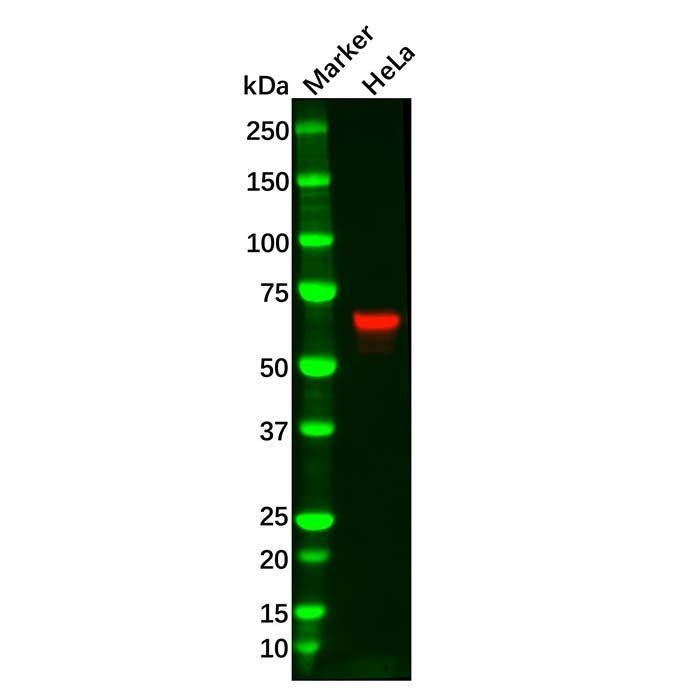
Recombinant Chk2 Antibody (Ab096333) - Western Blot All lanes: Recombinant Chk2 Antibody (Ab096333) at 1/1000 dilution Samples: Lysates at 20 µg per lane Secondary: Goat Anti-Rabbit IgG H&L (HRP) (Ab170144) at 1/20000 dilution
Predicted band size: 61 kDa Observed band size: 63 kDa Exposure time: 6.5 s
Recombinant Chk2 Antibody (Ab096333) - Western Blot All lanes: Recombinant Chk2 Antibody (Ab096333) at 1/4000 dilution Samples: Lysates at 20 µg per lane Secondary: Goat Anti-Rabbit IgG H&L (HRP) (Ab170144) at 1/20000 dilution
Predicted band size: 61 kDa Observed band size: 37-63 kDa Exposure time: 6.5 s
Recombinant Chk2 Antibody (Ab096333) - IF/ICC Immunocytochemistry analysis of Chk2 (green) in HCT116 using Recombinant Chk2 Antibody (Ab096333), and cells were counterstained with DAPI (blue).
Applicazione
Applicazione
Dilution info
IF/ICC
1/50-1/200
WB
1/500-1/4000
Documentazione
📋 Safety Data Sheet (SDS)
Comprehensive hazard, handling, storage, and regulatory compliance document.
Determine the necessary mass, volume, or concentration for preparing a solution.
Dilution Calculator
Determine the dilution needed to prepare a stock solution.
Reconstitution Calculator
Recensioni
Recensioni dei clienti
Application Protocols
Manufacturer-validated applications for this SKU
Not specified for this item; refer to CoA/Spec Sheet.
General guidance (not validated for this item)
If using in WB, IP, IF, IHC, or ELISA, begin with standard starting dilutions (e.g., 1:500–1:2000 for WB, 1–5 µg per IP, 1:100–1:400 for IF/IHC) and optimize empirically. Select positive controls that induce Chk2 activation (e.g., DNA damage treatments) and include negative controls (isotype control, knockdown/knockout lines) to confirm specificity.
Important
Only the CoA/Spec Sheet should be used for definitive, item-specific protocols and validated applications.
Biological Roles
General biology of the target Chk2 (literature/general knowledge)
Function: Chk2 (CHEK2) is a serine/threonine checkpoint kinase activated primarily by ATM in response to DNA double-strand breaks. Activation involves phosphorylation (e.g., at Thr68), dimerization, and trans-autophosphorylation.
Pathways: ATM–Chk2–p53/CDC25 axis orchestrates cell-cycle arrest, DNA repair, and apoptosis under genotoxic stress. Chk2 phosphorylates substrates including CDC25A/C, p53, BRCA1, E2F1, and PML, modulating cell-cycle progression and genome stability.
Regulation: Activation by DNA damage (ionizing radiation, radiomimetics), deactivation by phosphatases, and modulation via scaffold/adaptor proteins. Subcellular localization can shift upon activation.
Biomolecular context: Conserved kinase domain with FHA domain mediating phospho-dependent interactions; multiple post-translational modifications influence activity and interactions.
Relevance to antibody use
Antibodies to Chk2 enable detection/quantification of total or modified (e.g., phospho-Thr68) Chk2 populations, facilitating studies of DNA damage signaling dynamics.
Item-specific note
This product’s epitope (total vs phospho-specific), species reactivity, and clone/isotype are not specified for this item; consult the CoA/Spec Sheet for definitive details.
Buffer Applications
Applicability
As an antibody reagent, this product is not used to prepare chemical buffer systems. Instead, it is formulated in or used with biological assay buffers.
General guidance (literature/general knowledge)
Common working buffers: PBS or TBS at pH ~7.4. For immunoassays, inclusion of 0.05% Tween-20 (PBST/TBST) helps reduce nonspecific binding during wash steps.
Blocking agents: 3–5% BSA, non-fat dry milk, or serum can block nonspecific sites in WB/IHC/ELISA, selected based on assay and target.
Additives: Protease and phosphatase inhibitors during lysis preserve antigen integrity; sodium azide can be used as a preservative for storage but is incompatible with live-cell assays and HRP activity at high concentrations.
Item-specific buffer composition
Not specified for this item; refer to CoA/Spec Sheet.
Green Alternatives
Context
Antibodies are aqueous protein reagents; green chemistry considerations focus on buffer composition, preservative choice, cold-chain efficiency, and waste minimization rather than solvent substitution.
Greener practice suggestions (general guidance)
Buffer systems: Use PBS/TBS without azide where possible to reduce aquatic toxicity; employ sterile filtration and aliquoting to maintain sterility instead of high preservative loads.
Storage strategy: Aliquot to avoid freeze–thaw cycles and reduce waste from degraded material. Consider glycerol-containing formulations for stable −20°C storage to minimize dry ice shipments.
Packaging/waste: Opt for recyclable secondary packaging and combine shipments to reduce transport footprint.
Preservative-free buffers are safer for downstream live-cell applications but require stricter aseptic handling and may shorten open-vial stability.
Glycerol reduces freeze damage but increases solution viscosity and may interfere with certain assays if not diluted appropriately.
Pharmaceutical Uses
Applicability
This product is for research use only (RUO) and is not intended for diagnostic or therapeutic applications.
General roles of antibodies in pharmaceutical R&D (literature/general knowledge)
Analytical tools: Antibodies are widely used in QC and development assays (e.g., Western blot, ELISA, immunocapture LC–MS) to characterize targets, pathway modulation, or biomarker changes in preclinical research.
Process development: Antibodies can be used to track expression/activation of signaling proteins in cell lines used for biologics manufacturing.
Item-specific status
Pharmacopeial status, excipient role, GMP qualification: Not applicable/not specified for this RUO antibody.
Note
For any regulated use, obtain appropriate product documentation and consider qualified, GMP-grade reagents instead of RUO materials.
Physical Properties
Item-specific facts (from Product Data)
Appearance: Not specified for this item; refer to CoA/Spec Sheet.
Concentration, formulation buffer, preservatives, carrier proteins: Not specified for this item; refer to CoA/Spec Sheet.
Literature/general values for antibodies (not item-specific)
Typical IgG molecular mass: ~150 kDa (∼50 kDa heavy chains + ∼25 kDa light chains under reducing SDS-PAGE). Actual mass varies with isotype/glycosylation.
pI: IgG often pI 6–9 depending on sequence/glycoform; exact pI is sequence-dependent.
Solubility: Antibodies are soluble in aqueous buffers (e.g., PBS, TBS) with stabilizers (e.g., 0.02–0.05% sodium azide or other preservatives) when applicable; avoid extreme pH and denaturants unless intended for analysis.
Stability considerations: Sensitive to repeated freeze–thaw; stability enhanced by storage at ≤−20°C or 2–8°C short term, and by inclusion of cryoprotectants (e.g., 10–50% glycerol) when compatible.
Not applicable to proteins
Boiling/melting point, vapor pressure, logP, refractive index: Not applicable for macromolecular protein reagents.
Important
Use the product’s CoA/Spec Sheet for exact buffer composition, concentration, and any additives for this specific lot.
Quality and Grades
Item-specific facts (from Product Data)
Grade/Purity: Recombinant, ExactAb™, Validated, High Performance.
Interpretation (general guidance; not item-specific specifications)
Recombinant: Produced from a defined sequence in a controlled expression system (e.g., mammalian or other host), supporting enhanced batch-to-batch consistency versus hybridoma or polyclonal sources.
ExactAb™: Branded designation indicating a defined, sequence-controlled antibody framework for reproducibility and performance (refer to Aladdin Scientific documentation for program-specific criteria).
Validated: Indicates that the antibody has undergone functional checks; exact assays, species, and validation matrices for this item are not specified—consult the CoA/Spec Sheet.
High Performance: Marketing/quality descriptor suggesting strong signal-to-noise in intended applications; quantitative performance metrics are not specified for this item.
What to verify on receipt (practical checklist)
Clone ID or recombinant sequence identifier (if provided), isotype/subclass, host expression system, concentration, and buffer/additives.
Functional verification data (e.g., WB/IHC/IP/IF), species reactivity, and positive control lysates—Not specified for this item; refer to CoA/Spec Sheet.
Lot-to-lot correlation protocol and any stability/accelerated aging data if available.
Documentation
For precise acceptance criteria and analytical tests (purity by SDS-PAGE/SEC-HPLC, endotoxin, bioburden), refer to the product’s CoA/Spec Sheet.
Reaction and Applications
Applicability
This is an antibody reagent; it is not used as a reactant/solvent in chemical synthesis. The relevant “applications” are immunoassay and protein-detection workflows.
General research applications (literature/general knowledge; not item-specific)
Western blotting (WB): Detection of Chk2 in cell/tissue lysates under reducing/denaturing conditions; common molecular weight band for full-length Chk2 is ~61–65 kDa, with additional bands possible for phosphorylated/processed forms.
Immunoprecipitation (IP)/Co-IP: Enrichment of endogenous Chk2 to interrogate DNA damage response complexes.
Immunofluorescence (IF)/Immunocytochemistry (ICC): Subcellular localization of Chk2 in response to genotoxic stress; fixation/permeabilization conditions influence epitope accessibility.
ELISA/Target engagement: Quantification of Chk2 levels or phospho-forms when validated pairs are available.
Item-specific application validation
Manufacturer-validated applications for this SKU: Not specified for this item; refer to CoA/Spec Sheet.
Practical tips
For phospho-epitopes, ensure appropriate phosphatase inhibition during lysis and processing. Use positive controls (e.g., cells treated with DNA-damaging agents such as doxorubicin or ionizing radiation) and appropriate negative controls (siRNA/CRISPR knockdown) to confirm specificity.
Reaction Conditions
Not chemical reaction conditions; provided as general assay conditions (literature/general knowledge). These are typical starting points and are NOT validated for this specific SKU.
Western blot (WB):
Sample: Denatured/reduced lysates, 20–40 µg total protein per lane.
Transfer: PVDF/nitrocellulose membranes.
Blocking: 3–5% BSA or milk in TBST for 1 h at RT.
Primary incubation: Anti-Chk2 antibody diluted per supplier recommendation (not specified for this item) overnight at 4°C.
Secondary: HRP-conjugated anti-species IgG for 1 h at RT; chemiluminescent detection.
Immunoprecipitation (IP):
Lysate: Non-denaturing buffer with protease/phosphatase inhibitors.
Antibody: 1–5 µg per IP (optimize); incubate 1–4 h at 4°C with rotation; capture with Protein A/G resin; wash; elute for WB/MS.
Immunofluorescence (IF/ICC):
Fixation: 4% paraformaldehyde (or methanol per epitope), permeabilize with 0.1–0.3% Triton X-100, block with 1–5% BSA/serum.
Primary: Anti-Chk2 at optimized dilution; 1–2 h RT or overnight 4°C. Secondary: fluorophore-conjugated anti-species IgG.
Note
Exact dilutions, incubation times, and positive controls for this SKU are not specified; consult the CoA/Spec Sheet and perform titration/optimization.
Safety and Handling
Item-specific hazard data (from Product Data)
GHS classification, pictograms, signal word, H-statements: Not specified for this item; refer to SDS.
General laboratory safety guidance (literature/general knowledge)
Expected hazard profile: Research-grade antibodies are typically classified as non-hazardous mixtures; however, formulations may contain preservatives (e.g., sodium azide) that are acutely toxic and hazardous to aquatic life. Always check the SDS for this SKU.
PPE: Wear lab coat, safety glasses, and appropriate gloves. Avoid inhalation of aerosols and contact with skin/eyes.
Handling: Work using good microbiological practices. Avoid repeated freeze–thaw of the vial. Use clean, low-protein-binding tips/tubes to minimize adsorption losses.
Incompatibilities: Avoid strong oxidizers and proteases. Do not mix with bleach if sodium azide is present (risk of forming explosive metal azides in plumbing).
First aid (overview; defer to SDS):
Skin/eye contact: Rinse with water for several minutes, remove contaminated clothing, seek medical attention if irritation persists.
Ingestion/inhalation: Move to fresh air, rinse mouth, seek medical attention as needed.
Spill response: Absorb with inert material, clean with detergent/water. Dispose according to institutional and local regulations.
Regulatory/use note
For research use only (RUO). Not for diagnostic, clinical, or therapeutic use.
Solvent Selection
Applicability
Not a small-molecule reagent; as a protein biologic, this antibody is supplied/reconstituted in aqueous buffer rather than organic solvents.
General guidance (literature/general knowledge)
Compatible matrices: Phosphate-buffered saline (PBS) or Tris-buffered saline (TBS), typically pH 7.2–7.6. Low levels of detergent (e.g., 0.01% Tween-20) may be used in assay buffers to reduce nonspecific binding where appropriate.
Stabilizers: Glycerol (10–50%) can be included for freeze protection at −20°C. BSA or carrier proteins may reduce adsorption losses for some applications; confirm compatibility with downstream assays.
Incompatible media: Strongly denaturing solutions (e.g., 6–8 M urea, >2–4 M guanidinium HCl), extremes of pH (<5 or >9), or organic solvents (e.g., acetonitrile, DMSO, MeOH) are generally unsuitable unless intentionally used for analytical denaturation.
Selection tips
Choose PBS for most immunoassays and storage; choose TBS for phospho-sensitive systems where phosphate could interfere with certain interactions; add detergents only if validated for your assay system.
Storage and Reconstitution
Item-specific facts (from Product Data)
Storage conditions: Store at −20°C. Avoid repeated freezing and thawing.
Shipping: Shipped in ice chest with ice pads.
General best practices (literature/general knowledge)
Upon receipt: Centrifuge briefly to collect contents. Inspect for any visible precipitate or leakage.
Aliquoting: Divide into single-use aliquots in low-protein-binding tubes to prevent freeze–thaw damage and adsorption losses.
Optional cryoprotection: If compatible and if concentrate permits, add sterile glycerol to a final 30–50% v/v for storage at −20°C (do not freeze at −80°C when high glycerol is present).
Short-term storage: 2–8°C for up to 1–2 weeks may be acceptable if preservative is present; verify stability on the CoA/Spec Sheet.
Reconstitution: If supplied lyophilized, reconstitute with sterile buffer (e.g., PBS) to the recommended concentration; exact diluent/volume for this item is not specified—refer to CoA/Spec Sheet.
Freeze–thaw guidance: Thaw on ice, mix gently without vortexing, and keep on ice during use. Avoid multiple freeze–thaw cycles by aliquoting.
Expiration
Shelf life and open-vial stability: Not specified for this item; refer to CoA/Spec Sheet.
Use restrictions
For research use only (RUO). Not for diagnostic or therapeutic use.
Grade/Purity: Recombinant, ExactAb™, Validated, High Performance
Molecular formula: Not specified for this item; refer to CoA/Spec Sheet.
Molecular weight: Not specified for this item; refer to CoA/Spec Sheet.
CAS, InChIKey, SMILES: Not applicable/Not specified for antibody reagents.
General description (literature/general knowledge)
Target: Chk2 (also known as CHEK2), a serine/threonine protein kinase central to the DNA damage response.
Antibody type: Recombinant antibody (protein biologic; typically an IgG framework unless otherwise stated). Recombinant production supports lot-to-lot consistency versus hybridoma- or polyclonal-derived materials.
Structural features (antibody, 2D/functional description):
Two heavy chains and two light chains arranged in a Y-shaped immunoglobulin architecture with antigen-binding fragments (Fabs) and an effector Fc region (isotype/subclass not specified for this item).
Variable domains (VH/VL) determine specificity for epitopes within Chk2; epitope/clone not specified for this item.
Notes
Stereochemistry/SMILES/InChI conventions do not apply to large protein biologics.
For clone ID, isotype, and sequence details, consult the CoA/Spec Sheet if provided for this SKU.
Synthetic Utility
Not typically applicable
As a protein biologic, this antibody is not used as a synthetic building block or reagent in organic synthesis.
Where it can contribute (general laboratory context)
Analytical enrichment: Immunoprecipitation of Chk2 can enable downstream proteomic analyses (e.g., MS-based phosphoproteomics) but this is an analytical, not synthetic, application.
Item-specific synthetic roles
None; not applicable.
Target Specificity
Item-specific data (limited to Product Data)
Target name from product title: Chk2 (CHEK2; checkpoint kinase 2).
Clone/epitope, isotype/subclass, host species, species reactivity, KD/affinity: Not specified for this item; refer to CoA/Spec Sheet.
General context (not item-specific claims)
Chk2 is a serine/threonine kinase involved in DNA damage signaling, commonly assessed in human and mammalian models. Antibodies may recognize total or phospho-specific epitopes; the specificity class for this SKU is not specified.
Need help choosing the grade?
Our grade selection guide covers purity, stabilizer status, and application suitability for all variants in our catalog.
We use cookies to ensure the website functions properly and, where permitted, to improve your experience. You can manage your preferences at any time in Settings. Learn more in our Cookie Policy.
Shall we send you a message when we have discounts available?
Remind me later
Thank you! Please check your email inbox to confirm.
Products are supplied to verified businesses, institutions, and qualified professionals for research and development use only. Not for use in humans, animals, diagnosis, or therapy.

 ZJ23F1202244