QUALITÀ & PUREZZARecombinant?Recombinant — produced via recombinant expression for defined sequence and consistency. Use for reproducible, animal-free proteins of known origin.ExactAb™?ExactAb™ — Aladdin's antibody line emphasizing precision and validated quality. Use for reliable, specificity-validated antibody applications.Validated?Validated grade — performance confirmed in defined applications before release. Use when you want documented assurance the reagent works as stated.See COA
Recombinant, ExactAb™, Validated, See COA ExactAb™,Recombinant,Validated per flussi di lavoro cromatografici e analitici sensibili che richiedono un'interferenza minima della linea di base.
🌡
Stoccaggio e spedizione
Store at -20°C,Avoid repeated freezing and thawing Spedizione Ice chest + Ice pads. Consultare il COA specifico del lotto per le specifiche esatte.
📋
Documenti di qualità
SDS, COA, scheda tecnica e scheda delle specifiche disponibili per il download. COA specifico del lotto accessibile tramite ricerca per numero di lotto.
📚
Prova documentale
Citato in 0 pubblicazioni peer-reviewed su cromatografia, sintesi organica e reazioni di accoppiamento incrociato.
Panoramica
Rabbit anti Human cIAP2 Antibody, Recombinant, could be used for WB and so on. Application: WB: 1/1000-1/2000 Protein Function: Apoptotic suppressor. The BIR motifs region interacts with TNF receptor associated factors 1 and 2 (TRAF1 and TRAF2) to form an heteromeric complex, which is then recruited to the tumor necrosis factor receptor 2 (TNFR2).
Specifiche
Product Name
Recombinant cIAP2 Antibody - Anticorpo primario, specific to BIRC3, Rabbit IgG
A synthetic peptide derived from human IAP2 (AA 400-450)
Controllo positivo
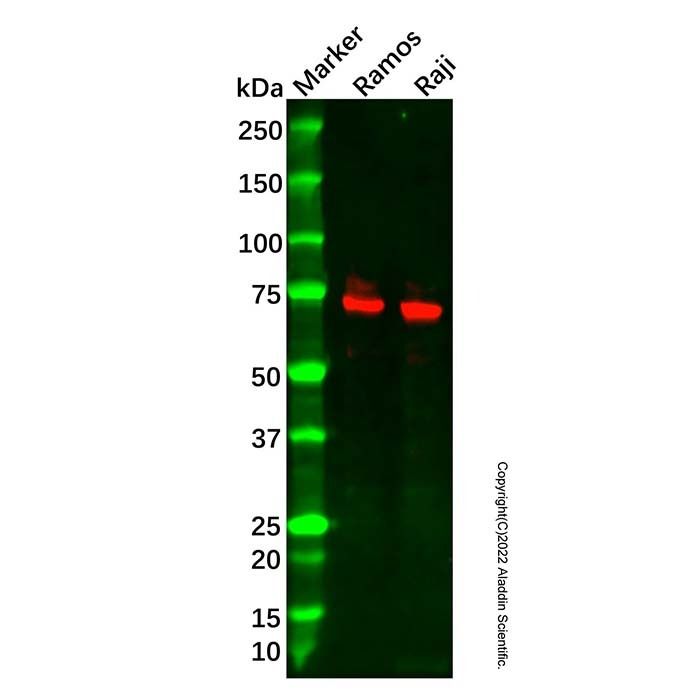
WB: Ramos and Raji cell lysates.
Coniugazione
Unconjugated
Grado
ExactAb™, Recombinant, Validated
Isotipo
Rabbit IgG
Tipo di catena leggera
kappa
SDS-PAGE
150 kDa
Metodo di purificazione
Protein A purified
Concentrazione
See COA
Product Line
Prodotti biologici
Stoccaggio e spedizione
Forma
Liquid
Condizioni di conservazione di stoccaggio
Store at -20°C,Avoid repeated freezing and thawing
Spedito in
Ice chest + Ice pads
Stabilità e conservazione
Store at 4°C short term (1-2 weeks). Store at -20°C long term (24 months). Upon receipt, it is recommended to aliquot. Avoid freeze/thaw cycle.
Immagini
Recombinant cIAP2 Antibody (Ab096513) - Western Blot All lanes: Recombinant cIAP2 Antibody (Ab096513) at 1/1000 dilution Samples: Lysates at 20 µg per lane Secondary: Goat Anti-Rabbit IgG H&L (HRP) (Ab170144) at 1/20000 dilution
Predicted band size: 68 kDa Observed band size: 71 kDa Exposure time: 30.0 s
Applicazione
Applicazione
Dilution info
WB
1/1000-1/2000
Documentazione
📋 Scheda di dati di sicurezza (SDS)
Documento completo su pericoli, manipolazione, stoccaggio e conformità normativa.
Determine the necessary mass, volume, or concentration for preparing a solution.
Dilution Calculator
Determine the dilution needed to prepare a stock solution.
Reconstitution Calculator
Recensioni
Recensioni dei clienti
Application Protocols
No tested/validated applications, dilutions, or protocols are specified in the Product Data for this SKU. The following generic protocols are provided as literature-based guidance only and must be optimized empirically.
General antibody handling
Thaw on ice, mix gently by inversion; avoid vortexing foamy solutions. Spin briefly to collect liquid.
Prepare single-use aliquots to avoid repeated freeze–thaw (explicitly advised for this item).
Example starting points (non-validated, for optimization)
WB: Start with 1:1,000 dilution in TBST + 5% BSA; incubate overnight at 4°C.
IHC/IF: Start at 1–5 µg/mL in blocking buffer; adjust antigen retrieval conditions as needed.
ELISA: Start with 0.5–2 µg/mL as capture or detection; titrate to minimize background.
Include positive controls known to express cIAP2 and negative controls (isotype and no-primary controls) to benchmark specificity and background.
For this SKU, defer to the CoA/Spec Sheet and any vendor-provided validation images when available.
Biological Roles
This section summarizes the target biology of cIAP2 (BIRC3) to inform experimental design. The content below is general literature knowledge and not product-specific validation.
cIAP2 (BIRC3) overview
Member of the inhibitor of apoptosis (IAP) family featuring baculoviral IAP repeat (BIR) domains and a C‑terminal RING finger.
Functions as an E3 ubiquitin ligase, regulating ubiquitination of signaling intermediates in TNF receptor and NF‑κB pathways.
Modulates pro-survival signaling and can influence inflammatory responses through noncanonical NF‑κB activation.
Subcellular localization and expression (literature)
Predominantly cytosolic but may associate with receptor complexes; expression is inducible by NF‑κB signaling.
Expression varies across tissues and cell lines; induction observed upon TNFα or LPS stimulation in some models.
Experimental implications
Antibodies to cIAP2 are commonly used to track pathway activation states, evaluate ubiquitination-associated processes, and assess protein abundance under stress or cytokine treatment.
For perturbation studies, pair detection with pathway modulators (e.g., SMAC mimetics) and appropriate loading/housekeeping controls.
Note: Species reactivity, epitope, and isotype for this product are not specified; confirm compatibility with your model organism and application using the CoA or validation data.
Buffer Applications
While this product is an antibody rather than a buffer component, its performance depends critically on the buffer system used in your assay. The following guidance is general and not item-specific.
Common buffer systems for immunoassays (literature/practice)
PBS or TBS (pH 7.2–7.6) as base buffers for dilutions and washes.
Blocking buffers: 1–5% BSA, nonfat dry milk (for WB), or commercial protein blockers to reduce nonspecific binding.
Detergents: 0.05–0.1% Tween-20 in wash buffers for ELISA/WB; omit detergents for certain binding assays where they may disrupt interactions.
Antigen retrieval (IHC): Citrate buffer pH ~6 or Tris-EDTA pH ~9 (heat-induced) depending on epitope.
Special considerations
Azide-free buffers for live-cell or enzyme-conjugate workflows (e.g., HRP-based detection).
Low-protein binding tubes/plates for work at sub-µg/mL antibody concentrations.
Item-specific note
The exact formulation and any required buffer conditions for this SKU are not specified; consult the CoA/Spec Sheet and optimize empirically for your assay.
Green Alternatives
Green chemistry principles for antibody reagents focus on aqueous systems, waste minimization, and safer preservatives rather than solvent substitution typical of small molecules.
Strategies (general/literature)
Prefer aqueous buffers (PBS/TBS) and avoid organic solvents except where necessary for membrane permeabilization or cleaning.
Use minimal volumes and optimize assay conditions to reduce reagent consumption and waste.
Consider preservative choices: Sodium azide is effective but hazardous; alternatives include ProClin-type isothiazolinones or glycerol refrigeration—tradeoffs depend on application and local regulations. Presence/absence of preservatives for this item is not specified.
Employ reusable, validated containers and low-binding plastics to reduce material waste.
Comparison overview (general)
Azide-containing buffer: Strong antimicrobial preservation; hazardous for aquatic life and plumbing—handle as hazardous waste.
Azide-free with glycerol (e.g., 50% v/v): Safer for HRP-based detection and live-cell contexts; requires cold-chain integrity and adds viscosity.
Lyophilized format: Lowest shipping weight and no liquid preservative; requires careful reconstitution and aliquoting.
For this SKU, exact formulation and preservative system are not specified; refer to the CoA/Spec Sheet and institutional green lab guidelines when planning use and disposal.
Pharmaceutical Uses
This product is designated for research use only and is not intended for clinical or diagnostic applications. No therapeutic or clinical claims are made.
General roles of antibodies in pharmaceutical R&D (literature/practice)
Analytical tools: Antibodies are widely used for target quantification (ELISA), biomarker detection, and mechanism-of-action studies in preclinical research.
Process analytics: In bioprocess development, antibodies can be used in product characterization assays or impurity detection (host cell proteins), though such uses require application-specific validation.
Reagent qualification: For regulated environments, characterization of lot-to-lot consistency, purity, and binding performance must be established; such data are not specified for this item.
Compliance considerations
cGMP/Pharmacopeia status: Not specified for this item; this SKU is not represented as a pharmacopeial-grade material.
Documentation: For any use in regulated workflows, obtain the CoA, SDS, and validation reports and perform fit-for-purpose qualification.
Any formulation or performance attribute not explicitly provided in the Product Data should be verified against the CoA/Spec Sheet before use in pharmaceutical development contexts.
Physical Properties
Item-specific physical properties are not supplied in the Product Data. For antibodies, many small‑molecule properties (bp, mp, logP) do not apply. Where relevant, general literature values are provided for context and clearly labeled.
Item-specific
Concentration, buffer composition, and formulation: Not specified for this item; refer to CoA/Spec Sheet.
Extinction coefficient (A280) and exact MW: Not specified for this item; refer to CoA/Spec Sheet.
General/literature for IgG-class proteins
Physical state: Aqueous solution or lyophilized solid (varies by lot/formulation; consult label).
Apparent molecular mass: ~150 kDa for full-length IgG; fragments (Fab/F(ab')2) are smaller (literature).
Solubility: Freely soluble in common biological buffers (PBS, TBS) at neutral pH (literature).
Isoelectric point (pI): Typically pH ~6–9 depending on sequence and glycosylation (literature).
Stability modifiers: Glycerol (10–50%) or trehalose may be included to enhance freeze–thaw stability; sodium azide may be present as a preservative (literature; not item-specific).
Practical notes
Avoid foaming and vigorous agitation, which can denature proteins at air–liquid interfaces.
If the item is lyophilized, reconstitution volume and diluent should follow the CoA; do not assume standard values.
Any property not explicitly listed in the Product Data should be taken from the CoA/Spec Sheet for this specific SKU.
Recombinant: Produced via sequence-defined expression (e.g., mammalian or other recombinant systems), enabling batch-to-batch consistency versus hybridoma-derived monoclonals or polyclonals.
ExactAb™: Platform designation indicating a controlled recombinant antibody format. Specific platform attributes (host system, Fc engineering, tags) are not specified for this item; refer to CoA/Spec Sheet for details.
Validated: Indicates the antibody has undergone internal performance checks. However, tested applications, species reactivity, affinity/avidity, and validation data are not specified here; consult the CoA, validation images, or lot-specific data.
Lot consistency: Recombinant production typically improves sequence fidelity and reduces drift across lots.
Purity and aggregates: Antibody lots are commonly analyzed by SDS-PAGE and SEC-HPLC to monitor purity/aggregation (not specified for this item). Aggregates can impact assay background and Fc-mediated effects.
Low endotoxin/bioburden: Relevant for cell-based assays; not specified for this item. Check CoA if endotoxin level is critical to your workflow.
Any attribute not explicitly provided above is not specified for this item and should be confirmed by reviewing the CoA/Spec Sheet.
Reaction and Applications
As an antibody reagent, this product is not used in chemical synthesis reactions. Instead, it serves as a binding reagent for immunoassays and detection. The following describes general application domains; these are literature-based and not item-specific validations.
General application spaces (literature/general)
Western blotting (WB): Detection of denatured target proteins in lysates following SDS-PAGE transfer.
Immunohistochemistry (IHC) / Immunocytochemistry (ICC): Localization of target proteins in fixed tissues or cells.
Immunofluorescence (IF): Fluorescent detection in cells or tissues for co-localization studies.
Immunoprecipitation (IP) / Co-IP: Enrichment of the antigen and associated complexes from lysates.
ELISA/Plate assays: Capture or detection of antigen in microplate formats.
Flow cytometry (if epitope is extracellular and antibody is suitable): Quantification of cell-surface or intracellular targets.
cIAP2 (BIRC3) context (literature)
cIAP2 is an inhibitor of apoptosis protein that functions as an E3 ubiquitin ligase via its RING domain and participates in TNF/NF-κB signaling.
Practical tips (general)
Optimize antibody dilution, incubation time, and antigen retrieval (for IHC) empirically.
Include appropriate positive/negative controls (e.g., cells with known cIAP2 expression modulation).
Note: Specific tested applications, working dilutions, and species reactivity are not specified for this item; refer to CoA/validation data.
Reaction Conditions
Not applicable in the context of chemical synthesis. For immunoassay use, conditions are assay-specific and must be optimized empirically. The following are general literature-based starting points and are not item-specific validations:
Western blotting: Primary antibody incubations commonly at 4°C overnight or 1–2 h at room temperature in TBST + 1–5% BSA or milk; working dilutions vary widely (e.g., 1:500–1:5,000), and must be determined empirically for this SKU.
IHC/ICC/IF: Incubations 1–16 h depending on epitope and fixation; buffers may include PBS/TBS with blocking proteins. Antigen retrieval (citrate or Tris-EDTA) as needed by epitope.
ELISA: Coating and detection conditions depend on plate chemistry and antigen format; typical primary dilutions range 1:1,000–1:10,000 but require optimization.
IP/Co-IP: 0.5–5 µg antibody per IP is a common range; lysis buffer composition (detergent type/strength) should preserve the target complex.
For definitive conditions, consult the CoA/Spec Sheet and perform small-scale titrations in your specific system.
Safety and Handling
Regulatory and hazard status
Research Use: For research use only (per Product Data). Not for diagnostic or therapeutic use.
GHS Classification, Signal Word, H-Statements, Pictograms: Not specified for this item; refer to SDS.
General safety guidance for antibody reagents (literature/practice)
PPE: Lab coat, gloves, and eye protection when handling liquid protein solutions. Avoid ingestion, inhalation of aerosols, and contact with skin/eyes.
Engineering controls: Work in a clean area; use a biosafety cabinet if handling in cell culture workflows to prevent contamination.
Preservatives: Some antibody formulations contain sodium azide, which is toxic and can form explosive metal azides in plumbing. Do not dispose of azide-containing solutions down copper/lead drains; collect as hazardous waste. Presence of azide is not specified for this item—consult the SDS/label.
First aid (general)
Skin/eye contact: Rinse with water for several minutes; remove contaminated clothing. Seek medical attention if irritation persists.
Ingestion/inhalation: Rinse mouth; move to fresh air. Obtain medical advice.
Incompatibilities and handling cautions
Avoid repeated freeze–thaw cycles (explicit in Product Data). Aliquot upon first thaw to maintain performance.
Store per label (-20°C for this item). Avoid microbial contamination; use sterile tools and buffers when applicable.
Always consult the product-specific SDS for authoritative safety information.
Solvent Selection
This product is a protein biologic (recombinant antibody), not a small-molecule reagent; conventional organic solvent polarity frameworks are not typically applicable.
Item-specific: Formulation buffer and recommended diluents are not specified for this item; refer to CoA/Spec Sheet.
General guidance for antibody diluents (literature/practice)
Preferred matrices: Aqueous buffers such as PBS or TBS at pH 7.2–7.6.
Stabilizers/blockers: 0.1–5% BSA, 0.05–0.1% Tween-20, and/or 10–50% glycerol can reduce nonspecific binding and improve freeze–thaw stability. Presence or absence of these components for this item is not specified.
Avoid: Strong organic solvents, extremes of pH, and chaotropes unless specifically intended for elution/regeneration steps.
Low-protein binding plastics and pre-blocked surfaces help minimize adsorption losses at low antibody concentrations.
When to choose alternative buffers
Detergent-free buffers for applications sensitive to surfactants (e.g., certain ELISAs or live-cell assays).
Azide-free buffers for peroxidase-based detection or live-cell applications.
Consult the product’s label/CoA for exact buffer composition and any restrictions.
Storage and Reconstitution
Item-specific storage (from Product Data)
Store at -20°C.
Avoid repeated freezing and thawing.
Shipped in an ice chest with ice pads (cold chain maintained).
General handling guidance (literature/practice)
Upon receipt: Verify container integrity and record lot/expiry. If frozen, thaw on ice and mix gently by inversion; briefly centrifuge to collect contents.
Aliquoting: Immediately aliquot into single-use volumes to prevent multiple freeze–thaw cycles. Use low-protein-binding tubes.
Short-term storage: 2–8°C for days to a week may be acceptable for many antibody solutions, especially if preservatives are present; this is not specified for this item—follow the CoA.
Long-term storage: -20°C as specified; some antibodies benefit from -80°C storage for extended periods (general guidance, not item-specific). Inclusion of 10–50% glycerol can enhance freeze–thaw stability (presence not specified here).
Reconstitution
If supplied lyophilized, reconstitute with sterile buffer (e.g., PBS) to the stated concentration on the label. Exact volume and diluent are not specified for this item; refer to the CoA/Spec Sheet.
After reconstitution, allow complete dissolution without vigorous vortexing; gently mix.
Do not expose to repeated temperature cycling. Store in the dark if the antibody is conjugated to light-sensitive labels; conjugation status is not specified for this item.
Always prioritize the instructions on the product label and CoA for this specific SKU.
Structure and Identity
Item-specific identifiers for this recombinant antibody are not provided in the Product Data. The points below distinguish between item-specific facts and general literature information.
Typical architecture: Two identical heavy chains and two identical light chains forming a Y‑shaped immunoglobulin; disulfide-linked heterotetramer.
Approximate mass: IgG1 ~150 kDa (literature).
Functional domains: Variable regions (VH/VL) confer antigen binding; constant regions (CH/CL) determine isotype/effector function.
Target antigen: cIAP2 (also known as BIRC3), an inhibitor of apoptosis protein containing BIR repeats and a C‑terminal RING domain.
2D/structural description (general)
Proteinaceous macromolecule; no small-molecule ring systems or classical functional groups described by SMILES. Antigen-binding sites are located at the complementarity-determining regions (CDRs) in the Fab arms.
Note: Exact clone/isotype/host species and any sequence or tag fusions are not specified for this item; refer to the Certificate of Analysis (CoA) or Spec Sheet for definitive identity attributes.
Synthetic Utility
Not typically applicable. As a recombinant antibody, this product is not used as a synthetic building block or reagent in chemical transformations. Instead, it functions as a selective binding reagent for biochemical and cell-based assays.
For practical guidance on using this product, see the sections on Biological Roles, Reaction & Applications, and Application Protocols.
Target Specificity
Item-specific target details beyond the antigen name are not provided in the Product Data.
Item-specific
Antigen: cIAP2 (BIRC3) — name only.
Epitope/region, affinity (KD), clonality/clone ID, isotype/Fc subclass, host species, conjugation status, and species cross-reactivity: Not specified for this item; refer to CoA/Spec Sheet.
General/literature context
cIAP2 contains multiple BIR domains and a RING domain; antibodies may recognize linear or conformational epitopes within these regions. Cross-reactivity between species depends on epitope conservation and has to be experimentally verified.
Please consult the lot-specific documentation for epitope mapping, validated species, and application data before experimental use.
Domande frequenti
What does ExactAb? mean?
ExactAb? indicates the product has been validated for use in rigorous antibody validation workflows. Validation may include positive/negative control samples, signal-to-noise testing, and protocol-specific QC. Lot-specific test data is published on the Certificate of Analysis where available.
How should this product be stored?
Store at ?20 °C. Avoid repeated freeze–thaw cycles. Aliquot into single-use volumes before freezing.
What does Recombinant mean?
Recombinant is a defined analytical purity tier suitable for workflows requiring a specific validated property. It specifies a minimum assay percentage, controlled limits on common impurities (water, heavy metals, residue on ignition), and lot-to-lot consistency. Recombinant is one of several purity tiers — choose based on the sensitivity and regulatory requirements of your method.
How is this product shipped?
This product ships in an insulated container with ice pads. Unpack on arrival and transfer it to the storage condition stated above.
What documentation is provided?
Available product documentation, including Certificates of Analysis (COA), Safety Data Sheets (SDS), and specification sheets, is shown in the product document area. Document availability and access follow the current site policy.
Which species reactivity has this antibody been validated against?
Validated reactivity is listed on the PDP and on each lot's datasheet. We validate against the most commonly tested species for the target (Recombinant cIAP2 Antibody); cross-reactivity in untested species may exist but is not guaranteed. Contact technical support for specific species inquiries.
Hai bisogno di aiuto per scegliere la qualità?
La nostra guida alla selezione delle qualità copre purezza, stato dello stabilizzatore e idoneità all'applicazione per tutte le varianti del nostro catalogo.
Utilizziamo i cookie per garantire il corretto funzionamento del sito web e, ove consentito, per migliorare la tua esperienza. Puoi gestire le tue preferenze in qualsiasi momento nelle Impostazioni. Per saperne di più, consulta la nostra Cookie Policy.
Desidera che le inviamo un messaggio quando avremo sconti disponibili?
Ricordamelo più tardi
Grazie! Controlli la sua casella di posta per confermare.
Products are supplied to verified businesses, institutions, and qualified professionals for research and development use only. Not for use in humans, animals, diagnosis, or therapy.

 ZJ24F0708387