GRADE & PURITYRecombinant?Recombinant — produced via recombinant expression for defined sequence and consistency. Use for reproducible, animal-free proteins of known origin.ExactAb™?ExactAb™ — Aladdin's antibody line emphasizing precision and validated quality. Use for reliable, specificity-validated antibody applications.Validated?Validated grade — performance confirmed in defined applications before release. Use when you want documented assurance the reagent works as stated.High Performance?High-performance grade with optimized purity and performance characteristics. Use for sensitive analyses where ordinary grades fall short.See COA
Recombinant, ExactAb™, Validated, High Performance, See COA ExactAb™,High Performance,Recombinant,Validated for sensitive chromatographic and analytical workflows requiring minimal baseline interference.
🌡
Storage & shipping
Store at -20°C,Avoid repeated freezing and thawing Ships Ice chest + Ice pads Check lot-specific COA for exact specifications.
📋
Quality documents
SDS, COA, datasheet, and spec sheet available for download. Lot-specific COA accessible via lot number lookup.
📚
Literature proof
Cited in 0 peer-reviewed publications across chromatography, organic synthesis, and cross-coupling reactions.
Panoramica
Rabbit anti Human DACH1 Antibody, Recombinant, could be used for WB and so on.
Specifications
Product Name
Recombinant DACH1 Antibody - Anticorpo primario, specific to DACH1, Rabbit IgG
Recombinant, ExactAb™, Validated, High Performance, See COA
Meccanismi biochimici e fisiologici
Transcription factor that is involved in regulation of organogenesis. Seems to be a regulator of SIX1, SIX6 and probably SIX5. Corepression of precursor cell proliferation in myoblasts by SIX1 is switched to coactivation through recruitment of EYA3 to the
Specie ospite
Coniglio
Specificità
DACH1
Immunogeno
A synthetic peptide derived from human DACH1 (AA 680-758).
Controllo positivo
WB: HeLa, MCF7, Hep G2, A549, K562, NIH/3T3 and C6 cell lysates.
Coniugazione
Unconjugated
Grado
ExactAb™, High Performance, Recombinant, Validated
Isotipo
Rabbit IgG
Tipo di catena leggera
kappa
SDS-PAGE
150 kDa
Metodo di purificazione
Protein A purified
Concentrazione
See COA
Product Line
Prodotti biologici
Stoccaggio e spedizione
Forma
Liquid
Condizioni di conservazione di stoccaggio
Store at -20°C,Avoid repeated freezing and thawing
Spedito in
Ice chest + Ice pads
Stabilità e conservazione
Store at 4℃ short term (1-2 weeks). Store at -20℃ long term (24 months). Upon receipt, it is recommended to aliquot. Avoid freeze/thaw cycle.
Immagini
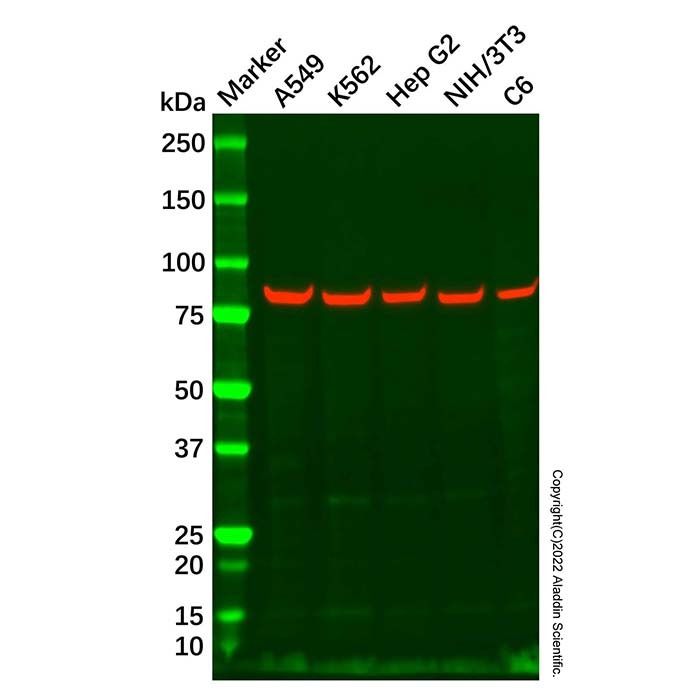
Recombinant DACH1 Antibody (Ab099110) - Western Blot All lanes: Recombinant DACH1 Antibody (Ab099110) at 1/1000 dilution Samples: Lysates at 20 µg per lane Secondary: Goat Anti-Rabbit IgG H&L (HRP) (Ab170144) at 1/20000 dilution
Predicted band size: 79 kDa Observed band size: 83 kDa Exposure time: 1.4 s
Recombinant DACH1 Antibody (Ab099110) - Western Blot All lanes: Recombinant DACH1 Antibody (Ab099110) at 1/1000 dilution Samples: Lysates at 20 µg per lane Secondary: Goat Anti-Rabbit IgG H&L (HRP) (Ab170144) at 1/20000 dilution
Predicted band size: 79 kDa Observed band size: 83 kDa Exposure time: 4.6 s
Applicazione
Applicazione
Dilution info
WB
1/1000-1/5000
Documentazione
📋 Safety Data Sheet (SDS)
Comprehensive hazard, handling, storage, and regulatory compliance document.
Certificati (CoA, COO, BSE/TSE e tabella di analisi)
C of A & Other Certificates(BSE/TSE, COO):
Analytical Chart:
Calcolatori di soluzioni
Molarity Calculator
Determine the necessary mass, volume, or concentration for preparing a solution.
Dilution Calculator
Determine the dilution needed to prepare a stock solution.
Reconstitution Calculator
Recensioni
Recensioni dei clienti
Application Protocols
Item-specific tested applications, recommended dilutions, antigen retrieval conditions, and positive control tissues/cell lines are not specified for this item; refer to the CoA/Spec Sheet.
General, non-item-specific guidance (no dilutions provided)
Western blot (WB): Use appropriate lysis buffer and protease inhibitors; reduce/denature samples as required; include molecular weight markers; validate specificity with positive/negative controls and knockdown/knockout where feasible.
Immunocytochemistry/Immunofluorescence (ICC/IF): Fixation method (PFA vs methanol) and permeabilization can affect nuclear protein detection; optimize blocking and wash conditions to minimize background.
Immunohistochemistry (IHC): Optimize antigen retrieval (heat-induced or enzymatic) and blocking based on tissue; include isotype and no-primary controls.
Immunoprecipitation (IP): Use low-detergent buffers compatible with nuclear proteins when targeting transcription factors; include DNase treatment as appropriate to disrupt DNA-mediated interactions, if required by the study design.
Always verify the antibody’s format, buffer, and any preservatives on the CoA/Spec Sheet before selecting detection reagents or performing conjugations.
Biological Roles
Target overview (literature; general background)
DACH1 (Dachshund family transcription factor 1) is a mammalian homolog of the Drosophila dachshund gene, functioning predominantly as a transcriptional regulator and co-repressor in developmental pathways. It interfaces with EYA/SIX networks and can modulate cell fate, proliferation, and differentiation programs.
Molecular features: contains conserved domains implicated in DNA-binding modulation and protein–protein interactions; participates in chromatin-associated complexes influencing gene expression.
Cellular and pathway context (literature)
Reported roles include regulation of cytoskeletal dynamics, cell cycle checkpoints, and differentiation signals across various tissues during development. In adult tissues, DACH1 expression patterns and regulatory influence are context-dependent and subject to upstream signaling cues.
Research utility of anti-DACH1 antibodies (general)
Antibodies targeting DACH1 are used to study its expression, localization (e.g., nuclear vs cytoplasmic distribution), and interactions in developmental biology and transcriptional regulation research.
Note: Species reactivity, epitope region, and application validation for Ab099110 are not specified for this item; refer to the CoA/Spec Sheet for item-specific details.
Buffer Applications
Not typically applicable as a design topic for this product.
This is an antibody reagent rather than a buffering compound. Optimal assay buffers depend on application (e.g., WB, IHC, IF, IP), antigen properties, and detection system.
For this item, specific formulation/buffer details are not specified; consult the CoA/Spec Sheet and SDS. See Application Protocols and Storage & Reconstitution for handling guidance.
Green Alternatives
Not directly applicable.
Antibody use does not involve selecting between organic solvent systems. Environmental considerations primarily relate to minimizing single-use plastics, selecting lower-impact detergents/buffers where compatible, and responsible cold-chain shipping and energy-efficient storage.
If conjugation or sample prep uses organic solvents or hazardous reagents, consider greener chemistries and aqueous-compatible labeling kits; ensure compatibility with antibody stability (general guidance).
Pharmaceutical Uses
This product is for research use only.
No pharmaceutical or clinical use is claimed or supported. It is not intended for diagnostic, therapeutic, or in vivo applications.
Antibodies can be used as analytical reagents in bioprocess development and QC assays in research settings; any GMP qualification or pharmacopeial status is not specified for this item and should not be assumed.
Physical Properties
Item-specific physical data
Appearance: Not specified for this item; refer to CoA/Spec Sheet.
Concentration/formulation: Not specified for this item; refer to CoA/Spec Sheet.
Molecular weight: Not specified for this item; refer to CoA/Spec Sheet.
pH, buffer, preservatives: Not specified for this item; refer to CoA/Spec Sheet.
Not applicable to proteins
Boiling/melting point, density, refractive index, logP, SMILES/InChI are not typically defined for macromolecular antibody products.
General literature values (for context, not item-specific)
Typical IgG molecular mass: ~150 kDa (∼50 kDa heavy chain, ∼25 kDa light chain under reducing SDS-PAGE).
Isoelectric point (pI): commonly in the pH 6–9 range, isotype- and sequence-dependent.
Solubility: antibodies are water-soluble in physiological buffers (e.g., PBS, HEPES) with enhanced stability in the presence of stabilizing proteins/sugars (not specified for this item).
Note: For exact composition (buffer, pH, stabilizers), concentration, and any lyophilized vs liquid format details, consult the product CoA/Spec Sheet for Ab099110.
Quality and Grades
Item-specific grade statements
Grade/Purity: Recombinant, ExactAb™, Validated, High Performance.
What these mean (general explanations)
Recombinant: produced in a defined expression system, delivering lot-to-lot genetic consistency versus hybridoma-derived monoclonals; minimizes variability and eliminates ascites-derived contaminants.
ExactAb™ (platform descriptor): typically denotes a recombinant antibody manufactured to a fixed amino-acid sequence with controlled production parameters for high reproducibility. Refer to the CoA for sequence/lot controls specific to Ab099110.
Validated: indicates the antibody has undergone internal testing against its intended antigen/assay types. Specific tested applications, species reactivity, and validation datasets are not specified for this item; consult the CoA/Spec Sheet.
High Performance: indicates stringent quality expectations on specificity, background, and robustness under recommended conditions; exact acceptance criteria and QC assays (e.g., purity by SDS-PAGE, endotoxin, binding titer, ELISA/Western blot performance) are not specified for this item.
Practical implications
Recombinant format supports reproducible results across lots and facilitates long-term method qualification.
Validation scope and any stabilizers/preservatives that affect downstream workflows (e.g., conjugation, live-cell assays) should be verified on the CoA/Spec Sheet before critical experiments.
For certificates, sequence confirmation, and assay validation details specific to Ab099110, refer to the CoA/Spec Sheet.
Reaction and Applications
This section (chemical reaction use as a reagent/solvent) is not applicable to an antibody product.
Antibodies are used in affinity-based bioassays rather than chemical transformations.
For practical application domains, see Application Protocols (assay use) and Target Specificity (antigen context). If conjugation chemistry (e.g., labeling) is planned, consult manufacturer guidance for protein conjugation workflows; item-specific conjugation readiness (e.g., carrier-free status) is not specified for this item.
Reaction Conditions
Not applicable in the context of chemical reaction conditions.
For assay conditions instead of reactions: operating parameters (e.g., incubation times, temperatures, blocking agents, and wash buffers) depend on the specific application (WB, IHC, IF, IP, ELISA). These are not specified for this item; consult the CoA/Spec Sheet for any validated conditions.
General caution: avoid extremes of pH, high concentrations of denaturants, or organic solvents unless performing analytical gels or antigen retrieval steps that are validated for the assay.
Safety and Handling
Research use: For research use only.
GHS classification and hazard statements (item-specific)
Signal word: Not specified for this item; refer to SDS.
H-statements: Not specified for this item; refer to SDS.
Pictograms: Not specified for this item; refer to SDS.
General handling recommendations (good laboratory practice)
PPE: lab coat, gloves, and safety glasses when handling antibody solutions and any associated buffers.
Avoid aerosol generation; work on ice for prolonged bench handling to preserve activity.
Biological safety: recombinant antibodies are non-infectious proteins; nonetheless, treat as potentially bioactive laboratory reagents and avoid ingestion, inhalation, or skin/eye contact.
Incompatibilities: avoid strong oxidizers or extreme pH/denaturing conditions unless intentionally performing SDS-PAGE or similar analyses.
Peroxide formation: not applicable (protein solution).
First-aid overview (general)
Skin/eye contact: rinse with water for several minutes; remove contaminated clothing; seek medical advice if irritation persists.
Inhalation: move to fresh air; seek medical advice if symptoms occur.
Ingestion: rinse mouth; seek medical advice.
Spills and disposal (general)
Absorb small spills with inert material; decontaminate area with appropriate lab disinfectant; dispose according to institutional and local regulations.
Always consult the item’s SDS for authoritative safety and hazard information.
Solvent Selection
This section is not typically applicable to antibody reagents.
Antibodies are supplied in aqueous buffer systems and are not used as solvents. Selection of organic solvents is generally irrelevant; exposure to strong organic solvents often denatures antibodies.
For experimental design, focus instead on buffer composition, ionic strength, pH, and additives that preserve antibody conformation and binding (see Storage & Reconstitution).
Storage and Reconstitution
Item-specific storage and shipping
Storage conditions: Store at -20°C. Avoid repeated freezing and thawing.
Shipping: Shipped in an ice chest with ice pads (cold chain maintained).
Handling best practices (general)
Upon receipt, inspect for container integrity and keep cold. If recurring use is expected, prepare single-use aliquots in low-protein-binding tubes to avoid freeze–thaw cycles.
Thaw on ice; mix gently by inversion—avoid vigorous vortexing or foaming, which can denature antibodies.
Short-term bench use should be minimized; keep on ice during setup.
Reconstitution and buffer details
Reconstitution volume, buffer composition, and presence of stabilizers/preservatives are not specified for this item; refer to the CoA/Spec Sheet.
If the product is supplied lyophilized (not specified), reconstitution is typically performed with sterile, antibody-compatible buffer (e.g., PBS) to the desired concentration, followed by gentle mixing and brief equilibration on ice. Verify compatibility with downstream assays.
Long-term storage (general)
For multi-month storage, -20°C (as specified) or lower is typical; avoid frost-free freezers. Store protected from light if conjugated labels are present (not specified for this item). Document aliquot dates and freeze–thaw history for QC traceability.
Structure and Identity
This product is a recombinant research-grade antibody directed against the DACH1 protein target.
Item-specific identifiers
SKU: Ab099110
Product name: Recombinant DACH1 Antibody
CAS: Not specified for this item; refer to CoA/Spec Sheet.
Molecular formula: Not specified for this item; refer to CoA/Spec Sheet.
Molecular weight: Not specified for this item; refer to CoA/Spec Sheet.
SMILES / InChI / InChIKey: Not applicable for proteins; not specified for this item.
Structural features (general, literature)
Typical IgG architecture: two heavy chains and two light chains arranged in a Y-shaped quaternary structure stabilized by inter-/intra-chain disulfide bonds.
Functional domains: variable regions (VH/VL) forming the antigen-binding fragment (Fab) with complementarity-determining regions (CDRs) that recognize DACH1 epitopes; constant domains (CH/CL) forming the Fc region that mediates effector interactions (isotype-specific; not specified for this item).
Post-translational features: recombinant antibodies may be glycosylated in Fc (cell line–dependent), which can influence stability and Fc interactions (item-specific glycosylation not specified).
2D description in words (general)
Each Fab arm comprises a paired VH–VL β-sandwich framework presenting three CDR loops per chain to form a paratope; the Fc stem comprises CH2–CH3 domains. Hinge-region disulfides connect the two heavy chains, while light chains are linked to their respective heavy chains by disulfides near CH1/CL.
Synthetic Utility
Not applicable.
Antibodies are biological affinity reagents and are not used as synthetic building blocks or catalysts in organic synthesis.
If chemical modification is desired (e.g., fluorophore, enzyme, or biotin conjugation), standard protein conjugation chemistries (NHS-ester lysine labeling, maleimide–thiol coupling, click chemistry) can be employed; item-specific suitability (e.g., carrier-free status, presence of amine-containing stabilizers) is not specified for this item and should be verified on the CoA/Spec Sheet before conjugation.
Target Specificity
Antigen/Target name: DACH1 (Dachshund family transcription factor 1)
Species reactivity: Not specified for this item; refer to CoA/Spec Sheet.
Epitope/region: Not specified for this item; refer to CoA/Spec Sheet.
Clone identifier and isotype: Not specified for this item; refer to CoA/Spec Sheet.
Host and expression system: Recombinant antibody (exact host/expression system not specified for this item).
Notes
ExactAb™ recombinant designation indicates sequence-defined production; item-specific sequence/epitope mapping and cross-reactivity profiles should be confirmed on the CoA/Spec Sheet for Ab099110.
Domande frequenti
What does ExactAb? mean?
ExactAb? indicates the product has been validated for use in rigorous antibody validation workflows. Validation may include positive/negative control samples, signal-to-noise testing, and protocol-specific QC. Lot-specific test data is published on the Certificate of Analysis where available.
What does Recombinant mean?
Recombinant is a defined analytical purity tier suitable for workflows requiring a specific validated property. It specifies a minimum assay percentage, controlled limits on common impurities (water, heavy metals, residue on ignition), and lot-to-lot consistency. Recombinant is one of several purity tiers — choose based on the sensitivity and regulatory requirements of your method.
How should this product be stored?
Store at ?20 °C. Avoid repeated freeze–thaw cycles. Aliquot into single-use volumes before freezing.
How is this product shipped?
This product ships in an insulated container with ice pads. Unpack on arrival and transfer it to the storage condition stated above.
What documentation is provided?
Available product documentation, including Certificates of Analysis (COA), Safety Data Sheets (SDS), and specification sheets, is shown in the product document area. Document availability and access follow the current site policy.
Which species reactivity has this antibody been validated against?
Validated reactivity is listed on the PDP and on each lot's datasheet. We validate against the most commonly tested species for the target (Recombinant DACH1 Antibody); cross-reactivity in untested species may exist but is not guaranteed. Contact technical support for specific species inquiries.
Need help choosing the grade?
Our grade selection guide covers purity, stabilizer status, and application suitability for all variants in our catalog.
Utilizziamo i cookie per garantire il corretto funzionamento del sito web e, ove consentito, per migliorare la tua esperienza. Puoi gestire le tue preferenze in qualsiasi momento nelle Impostazioni. Per saperne di più, consulta la nostra Cookie Policy.
Desidera che le inviamo un messaggio quando avremo sconti disponibili?
Ricordamelo più tardi
Grazie! Controlli la sua casella di posta per confermare.
Products are supplied to verified businesses, institutions, and qualified professionals for research and development use only. Not for use in humans, animals, diagnosis, or therapy.