GRADE & PURITYRecombinant?Recombinant — produced via recombinant expression for defined sequence and consistency. Use for reproducible, animal-free proteins of known origin.ExactAb™?ExactAb™ — Aladdin's antibody line emphasizing precision and validated quality. Use for reliable, specificity-validated antibody applications.Validated?Validated grade — performance confirmed in defined applications before release. Use when you want documented assurance the reagent works as stated.0.2 mg/mL
ExactAb™, Validated, Recombinant, 0.2 mg/mL ExactAb™,Recombinant,Validated for sensitive chromatographic and analytical workflows requiring minimal baseline interference.
🌡
Storage & shipping
Store at -20°C,Avoid repeated freezing and thawing Ships Ice chest + Ice pads Check lot-specific COA for exact specifications.
📋
Quality documents
SDS, COA, datasheet, and spec sheet available for download. Lot-specific COA accessible via lot number lookup.
📚
Literature proof
Cited in 0 peer-reviewed publications across chromatography, organic synthesis, and cross-coupling reactions.
Panoramica
Rabbit anti Human DDX5 Antibody, Recombinant, could be used for WB, IHC, ICC, IF and so on. Application: WB: 1/500-1/1000 IHC: 1/50-1/100 ICC/IF: 1/50-1/200 Protein Function: RNA-dependent ATPase activity. The rate of ATP hydrolysis is highly stimulated by single-stranded RNA. May be involved in pre-mRNA splicing.
Specifications
Product Name
Recombinant DDX5 Antibody - Anticorpo primario, specific to DDX5, Rabbit IgG
Sinonimi
ATP dependent RNA helicase DDX5 antibody | DDX 5 antibody | Ddx5 antibody | DDX5_HUMAN antibody | DEAD (Asp Glu Ala Asp) box helicase 5 antibody | DEAD (Asp Glu Ala Asp) box polypeptide 5 antibody | DEAD box 5 antibody | DEAD box protein 5 antibody | DEAD
Specifiche e purezza
ExactAb™, Validated, Recombinant, 0.2 mg/mL
Specie ospite
Coniglio
Specificità
DDX5
Immunogeno
A synthetic peptide derived from human DDX5 (AA 9-21)
Controllo positivo
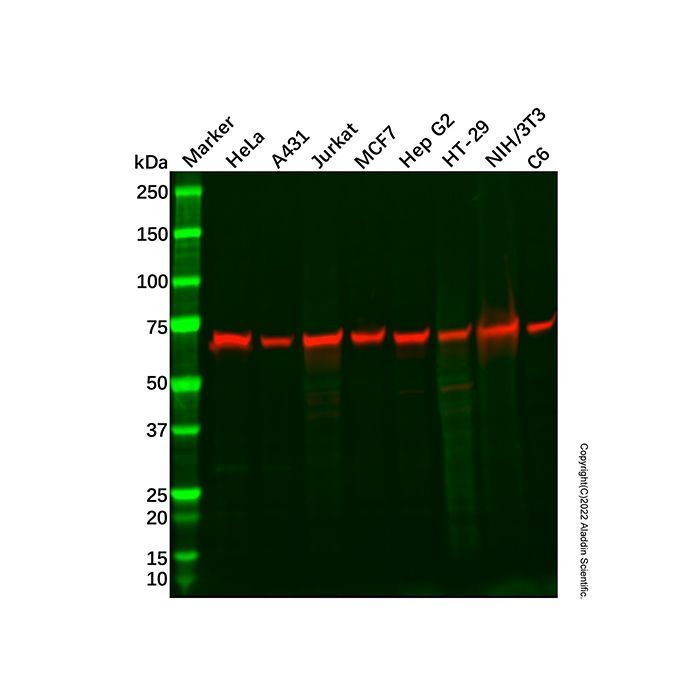
WB: HeLa, A431, Jurkat, MCF7, Hep G2, HT-29, NIH/3T3 and C6 cell lysates. IHC: Human lung cancer tissue. ICC/IF: HeLa cells.
Coniugazione
Unconjugated
Grado
ExactAb™, Recombinant, Validated
Isotipo
Rabbit IgG
SDS-PAGE
150 kDa
Metodo di purificazione
Antigen affinity purified
Concentrazione
0.2 mg/mL
Product Line
Prodotti biologici
Stoccaggio e spedizione
Forma
Liquid
Condizioni di conservazione di stoccaggio
Store at -20°C,Avoid repeated freezing and thawing
Spedito in
Ice chest + Ice pads
Stabilità e conservazione
Store at 4℃ short term (1-2 weeks). Store at -20℃ long term (24 months). Upon receipt, it is recommended to aliquot. Avoid freeze/thaw cycle.
Immagini
Recombinant DDX5 Antibody (Ab099481) - Western Blot All lanes: Recombinant DDX5 Antibody (Ab099481) at 1/1000 dilution Samples: Lysates at 20 µg per lane Secondary: Goat Anti-Rabbit IgG H&L (HRP) (Ab170144) at 1/20000 dilution Predicted band size: 69 kDa Observed band size: 68 kDa Exposure time: 14.2 s
Recombinant DDX5 Antibody (Ab099481) - IF/ICC Immunocytochemistry analysis of DDX5 (green) in HeLa using Recombinant DDX5 Antibody (Ab099481), and cells were counterstained with DAPI (blue).
Recombinant DDX5 Antibody (Ab099481) - IHC Immunohistochemistry analysis of paraffin-embedded Human lung cancer using Recombinant DDX5 Antibody (Ab099481). High-pressure and temperature Sodium Citrate pH 6.0 was used for antigen retrieval.
Applicazione
Applicazione
Dilution info
WB
1/500-1/1000
IF/ICC
1/50-1/200
IHC
1/50 - 1/100
Documentazione
📋 Safety Data Sheet (SDS)
Comprehensive hazard, handling, storage, and regulatory compliance document.
Determine the necessary mass, volume, or concentration for preparing a solution.
Dilution Calculator
Determine the dilution needed to prepare a stock solution.
Reconstitution Calculator
Recensioni
Recensioni dei clienti
Application Protocols
Only item-specific, tested applications and conditions can be listed here.
Tested applications (e.g., WB, IF, IHC, IP), recommended dilutions, positive controls, antigen retrieval methods, and incubation conditions: Not specified for this item; refer to CoA/Spec Sheet.
For general methodological guidance, see the Reaction & Applications and Reaction Conditions sections, which provide non-item-specific best practices.
Biological Roles
Target overview (literature; not item-specific)
DDX5 (p68) is a member of the DEAD-box RNA helicase family characterized by the conserved Asp-Glu-Ala-Asp (DEAD) motif. It participates in ATP-dependent remodeling of RNA and RNP complexes.
Functional roles
RNA metabolism: Involved in pre-mRNA splicing, rRNA processing, and ribosome biogenesis through remodeling of RNA secondary structures and RNP assembly.
Transcriptional regulation: Acts as a co-regulator with multiple transcription factors, modulating gene expression via interactions with chromatin-associated complexes.
R-loop and genome maintenance: Implicated in resolving RNA–DNA hybrids and maintaining genomic stability in coordination with other helicases and nucleases.
Cell signaling and stress responses: Integrates signaling inputs to adjust RNA processing; phosphorylation and other PTMs can modulate its activity and localization.
Localization and expression
Predominantly nuclear with nucleolar enrichment under some conditions; expression is widespread in proliferating cells.
Research implications
Due to its central role in RNA biology, DDX5 is frequently studied in the context of RNA processing networks, transcriptional programs, and ribonucleoprotein dynamics. An antibody against DDX5 enables interrogation of these pathways via WB, IP/RIP, IF/ICC, and related assays.
Buffer Applications
This section addresses buffer systems relevant to handling antibody reagents rather than formulating sample buffers for enzymes.
General buffer systems for antibody workflows (not item-specific)
Storage buffers: PBS or TBS, pH 7.2–7.6. Stabilizers may include 10–50% glycerol for -20°C storage without freezing. Preservatives (e.g., 0.02–0.05% sodium azide) can deter microbial growth in non-cellular applications.
Blocking buffers: 3–5% non-fat dry milk or BSA in TBST/PBST for WB; serum or commercial blockers for IF/IHC to reduce non-specific binding.
Wash buffers: TBST or PBST (0.05–0.1% Tween-20) balance stringency and epitope integrity. For IP/RIP, adjust salt (150–500 mM NaCl) and detergent (0.1–1% NP-40/Triton X-100) to control specificity.
Antigen retrieval (IHC): Citrate buffer pH ~6.0 or Tris-EDTA pH ~9.0; optimization is tissue and fixation dependent.
Sample preparation: For nuclear proteins like DDX5, use nuclear extraction buffers or employ permeabilization (0.1–0.5% Triton X-100) for IF/ICC.
Item-specific formulation
Exact buffer composition for this product is not specified; refer to the CoA/Spec Sheet for pH, salt, stabilizer, and preservative details.
Green Alternatives
Antibody products inherently rely on cold-chain logistics and aqueous buffers; opportunities for greener practice focus on formulation, handling, and shipping.
Practical greener choices (general; not item-specific)
Shipping: Consolidate orders to reduce packaging waste; opt for ground over air where feasible within stability limits.
Storage efficiency: Maintain organized -20°C storage to minimize door-open time and energy use; aliquot to reduce waste from freeze–thaw damage.
Buffer components: Where compatible, use preservatives at minimal effective concentrations; avoid sodium azide if downstream metal-affinity instruments or copper/lead plumbing are affected, substituting with gentler biocides or sterile technique.
Plastic reduction: Use reusable cold blocks and racks, and minimize single-use plastics where biosafety permits.
Process optimization: Titrate antibody to reduce excess consumption; use highly sensitive detection chemistries to lower reagent usage.
Comparison (general considerations)
Sodium azide vs. azide-free: Azide-free formulations are preferable for live-cell work and certain conjugations but may require sterile handling and shorter bench stability.
Glycerol content: 10–50% glycerol enables -20°C storage without freezing, reducing freeze–thaw cycles; however, glycerol increases viscosity and may interfere with some assays.
Pharmaceutical Uses
Not applicable as a therapeutic; this product is designated For research use only.
General formulation context for antibodies (explanatory; not item-specific and not for clinical use)
Research reagents are typically formulated in buffered saline with stabilizers to maintain structural integrity during storage and handling.
Excipient roles: Glycerol (cryoprotection), sugars (osmotic balance), amino acids (stability), and surfactants (reduce surface adsorption) may be used depending on the application; specifics for this item are not provided.
GMP/Pharmacopeia: No GMP/clinical qualifications are claimed in the Product Data. Do not use in humans or for diagnostics without appropriate regulatory clearance.
For any regulatory or manufacturing applications, a distinct GMP-grade product and full quality documentation would be required; this catalog item is intended strictly for laboratory research.
Physical Properties
Item-specific facts (from Product Data)
Appearance: Not specified for this item; refer to CoA/Spec Sheet.
Concentration and formulation: Not specified for this item; refer to CoA/Spec Sheet.
pH, osmolality, stabilizers, preservatives (e.g., BSA, glycerol, azide): Not specified for this item; refer to CoA/Spec Sheet.
Literature/general values for proteins/antibodies (for context only; not item specifications)
Antibody molecular mass: Typically ~150 kDa for IgG, ~25 kDa (light chain) and ~50 kDa (heavy chain).
Isoelectric point (pI): IgG often pI ~6–9 depending on isotype and sequence.
Solubility: Highly soluble in neutral buffered saline; stability influenced by ionic strength, pH 6.5–8.0, and cryoprotectants (e.g., 10–50% glycerol).
Stability: Sensitive to repeated freeze–thaw; stability improved by aliquoting and storage at low temperature.
Notes
Because item-specific solution composition and protein concentration are not provided, users should consult the CoA/Spec Sheet for exact formulation, concentration, and any stabilizers/preservatives used.
Quality and Grades
Item-specific facts (from Product Data)
Grade/Purity: Recombinant, ExactAb™, Validated.
What these designations generally imply (explanatory; not additional specs)
Recombinant: Produced via a defined expression system to ensure lot-to-lot genetic and biochemical consistency relative to the specified antibody sequence, reducing variability versus hybridoma-derived material.
ExactAb™: Brand/line designation indicating sequence-defined, engineered, and tightly controlled production and QC processes aimed at reproducible performance. Specific QC criteria (purity, endotoxin, aggregate level, binding affinity) are not provided here; refer to CoA/Spec Sheet.
Validated: Indicates internal validation against the intended antigen (DDX5) using defined applications. However, application types, tested species, and validation data are not specified for this item; please consult the CoA/Spec Sheet or request the validation report.
Recommended QC checks at receipt (good practice)
Verify lot number and any stated concentration by A280 or ELISA (if provided).
Confirm binding by a quick dot blot or WB using a known DDX5-positive lysate.
Inspect for turbidity/particulate matter; clarify by brief low-speed spin if needed.
Documentation to request
CoA with binding/ELISA titer, purity method (e.g., SDS-PAGE), host/isotype, epitope mapping (if available), and recommended applications/dilutions.
Reaction and Applications
Item-specific applications from manufacturer: Not specified for this item; refer to CoA/Spec Sheet.
General research applications for anti-DDX5 antibodies (literature/good practice; not item-specific promises)
Western blot (WB): Detection of DDX5 in whole-cell or nuclear extracts; typical SDS-PAGE transfer to PVDF/nitrocellulose, chemiluminescent or fluorescent detection.
Immunofluorescence (IF) / Immunocytochemistry (ICC): Visualization of subcellular localization of DDX5 (commonly nuclear) in fixed cells; requires permeabilization (e.g., 0.1–0.5% Triton X-100) and appropriate blocking.
Immunoprecipitation (IP/Co-IP): Enrichment of DDX5 and associated RNP complexes for downstream MS or immunoblotting; use RNase inhibitors when probing RNA-dependent interactions.
Chromatin/RNA applications: RNA immunoprecipitation (RIP) or crosslinking IP (CLIP-like) to study DDX5–RNA interactions; optimization of crosslinking and stringency is assay-specific.
IHC: Detection in tissue sections; antigen retrieval and fixation conditions must be optimized per tissue.
Assay considerations
Validate species reactivity using positive control lysates that express DDX5 robustly (e.g., HeLa, HEK293; literature examples).
Titrate antibody to determine optimal signal-to-noise; include isotype and no-primary controls.
For nucleo-proteins like DDX5, nuclear extraction or proper permeabilization can improve signal.
Reaction Conditions
Not applicable to chemical synthesis. For immunoassays, conditions are assay-dependent and should be optimized empirically.
General assay conditions (guidance; not item-specific specifications)
WB: Use reducing SDS-PAGE, transfer to PVDF/nitrocellulose, block 30–60 min, primary incubation 1 h at RT or overnight at 4°C, followed by species-appropriate secondary.
IF/ICC: Fix (e.g., 4% paraformaldehyde), permeabilize (0.1–0.5% Triton X-100), block in serum/BSA, incubate primary 1–16 h at appropriate temperature, then fluorescent secondary and counterstain.
IP/RIP: Lysis in non-denaturing buffer, antibody coupling to Protein A/G resin, incubation with lysate, stringent washes, elution. Include RNase inhibitors for RNA-dependent interactions.
Note: Specific dilutions, incubation times, and species reactivity for this item are not provided; refer to the CoA/Spec Sheet.
Safety and Handling
Item-specific facts (from Product Data)
Storage conditions: Store at -20°C. Avoid repeated freezing and thawing.
Shipping: Ice chest + ice pads (cold-chain).
GHS classification, signal word, hazard statements, pictograms: Not specified for this item; refer to SDS.
General safety guidance for antibody reagents (not item-specific)
Typical hazards: Protein solutions are generally of low acute toxicity but may contain preservatives (e.g., sodium azide) or stabilizers; consult SDS for exact formulation.
PPE: Laboratory coat, gloves, and eye protection. Avoid inhalation of aerosols and contact with skin and eyes.
Handling: Work on ice when appropriate to minimize proteolysis/denaturation. Mix gently; avoid vigorous vortexing that can induce aggregation/foaming.
Incompatibilities: Avoid strong oxidizers and extreme pH. Sodium azide (if present) is incompatible with lead/copper plumbing; collect waste appropriately.
First aid (general): If skin/eye contact occurs, rinse with water for several minutes; remove contaminated clothing. If inhaled, move to fresh air. If ingested, rinse mouth. Seek medical attention as per SDS guidance.
Spills: Absorb with inert material; decontaminate with appropriate disinfectant if biological contamination is a concern.
Waste: Dispose according to institutional biosafety and chemical waste procedures, particularly if azide or other preservatives are present.
Always defer to the product-specific SDS for authoritative safety information.
Solvent Selection
Not typically applicable. This product is a recombinant antibody supplied in an aqueous buffer. Selection of organic solvents is not relevant to its use.
Practical guidance (general)
Use neutral aqueous buffers (e.g., PBS or TBS) compatible with antibody stability and your assay.
Avoid organic solvents and strong denaturants unless performing deliberate denaturation for analytical purposes.
Maintain isotonicity and pH ~7–8 to preserve binding activity.
For details on the exact formulation of this item, refer to the CoA/Spec Sheet.
Reconstitution: Not specified for this item; refer to CoA/Spec Sheet.
General guidance (not item-specific; for typical antibody handling)
If supplied lyophilized: Reconstitute with sterile, nuclease-free water or buffer to the recommended concentration; allow to dissolve gently on ice. If no reconstitution instructions are provided, contact technical support.
Aliquoting: Upon first thaw/reconstitution, aliquot into single-use volumes to prevent freeze–thaw cycles. Use low-protein-binding tubes.
Working buffer: Maintain pH 7.2–7.6 (PBS/TBS). For -20°C storage without freezing, 30–50% glycerol is commonly used; confirm compatibility with your assays.
Thawing: Thaw on ice; mix gently by inversion. Avoid vigorous vortexing and repeated temperature cycling.
Short-term storage: At 4°C for days to a few weeks depending on preservative; long-term per item instruction (-20°C for this product). Consult CoA/Spec Sheet for any preservatives (e.g., sodium azide) and stabilizers present.
Always refer to the product-specific CoA/Spec Sheet and SDS for definitive instructions.
Molecular formula: Not specified for this item; refer to CoA/Spec Sheet.
Molecular weight: Not specified for this item; refer to CoA/Spec Sheet. (Antibodies typically ~150 kDa for full-length IgG; literature)
SMILES / InChIKey / CAS / CID: Not applicable to protein biologics; not specified for this item.
Structure class: Protein biologic (immunoglobulin format; recombinant). Exact subtype (monoclonal vs. recombinant polyclonal, isotype) not specified for this item.
General/literature context (DDX5 target)
Target: DDX5 (also known as p68), a DEAD-box RNA helicase family member involved in RNA metabolism and transcriptional regulation.
Epitope/host species/reactivity profile: Not specified for this item; refer to CoA/Spec Sheet.
2D/architectural description (general)
Antibodies comprise two heavy and two light chains forming variable regions that recognize an antigen (here, an epitope on DDX5). Without clone/isotype data, finer structural details cannot be provided for this item.
Synthetic Utility
Not applicable. This product is a recombinant antibody and is not used as a small-molecule synthetic reagent or building block.
Where relevant for conjugation workflows (general)
Antibody functional groups (lysines, cysteines, carbohydrate moieties) can be leveraged for bioconjugation (e.g., HRP/fluorophore/biotin). However, this item’s conjugation state or availability of specific reactive handles is not specified; consult the CoA/Spec Sheet if a conjugated format is offered.
Target Specificity
Only item-specific data may be listed here.
Antigen/Target: DDX5 (DEAD-box helicase 5) — general target name inferred from product title.
Clone, isotype, host species, epitope, species reactivity, cross-reactivity, and affinity: Not specified for this item; refer to CoA/Spec Sheet.
No additional target-binding specifications are provided in the Product Data.
Domande frequenti
What does ExactAb? mean?
ExactAb? indicates the product has been validated for use in rigorous antibody validation workflows. Validation may include positive/negative control samples, signal-to-noise testing, and protocol-specific QC. Lot-specific test data is published on the Certificate of Analysis where available.
What does Recombinant mean?
Recombinant is a defined analytical purity tier suitable for workflows requiring a specific validated property. It specifies a minimum assay percentage, controlled limits on common impurities (water, heavy metals, residue on ignition), and lot-to-lot consistency. Recombinant is one of several purity tiers — choose based on the sensitivity and regulatory requirements of your method.
How should this product be stored?
Store at ?20 °C. Avoid repeated freeze–thaw cycles. Aliquot into single-use volumes before freezing.
How is this product shipped?
This product ships in an insulated container with ice pads. Unpack on arrival and transfer it to the storage condition stated above.
What documentation is provided?
Available product documentation, including Certificates of Analysis (COA), Safety Data Sheets (SDS), and specification sheets, is shown in the product document area. Document availability and access follow the current site policy.
Which species reactivity has this antibody been validated against?
Validated reactivity is listed on the PDP and on each lot's datasheet. We validate against the most commonly tested species for the target (Recombinant DDX5 Antibody); cross-reactivity in untested species may exist but is not guaranteed. Contact technical support for specific species inquiries.
Need help choosing the grade?
Our grade selection guide covers purity, stabilizer status, and application suitability for all variants in our catalog.
Utilizziamo i cookie per garantire il corretto funzionamento del sito web e, ove consentito, per migliorare la tua esperienza. Puoi gestire le tue preferenze in qualsiasi momento nelle Impostazioni. Per saperne di più, consulta la nostra Cookie Policy.
Desidera che le inviamo un messaggio quando avremo sconti disponibili?
Ricordamelo più tardi
Grazie! Controlli la sua casella di posta per confermare.
Products are supplied to verified businesses, institutions, and qualified professionals for research and development use only. Not for use in humans, animals, diagnosis, or therapy.

 ZJ24F0505898