QUALITÀ & PUREZZARecombinant?Recombinant — produced via recombinant expression for defined sequence and consistency. Use for reproducible, animal-free proteins of known origin.ExactAb™?ExactAb™ — Aladdin's antibody line emphasizing precision and validated quality. Use for reliable, specificity-validated antibody applications.Validated?Validated grade — performance confirmed in defined applications before release. Use when you want documented assurance the reagent works as stated.0.8 mg/mL
Rabbit anti Human Rab9 Antibody, Recombinant, could be used for WB, IHC and so on. Application:
WB: 1/500-1/1000 IHC: 1/50-1/100
IF/ICC: 1/200
Protein Function: Involved in the transport of proteins between the endosomes and the trans Golgi network.
Specifiche
Product Name
Recombinant Rab9 Antibody - Anticorpo primario, specific to Rab9, Rabbit IgG
Sinonimi
AI195561 antibody|DmRab9 antibody|Rab 9 antibody|RAB 9A antibody|RAB9 member RAS oncogene family antibody|RAB9A antibody|RAB9A member RAS oncogene family antibody|RAS ASSOCIATED PROTEIN RAB9 antibody|Ras related protein Rab 9A antibody|Ras-related protein Rab-9A antibody|Sid6061p antibody|Sid99 antibody|RAB9A|RAB9
Specifiche e purezza
ExactAb™, Validated, Recombinant, 0.8 mg/mL
Specie ospite
Coniglio
Specificità
Rab9
Immunogeno
A synthetic peptide derived from human Rab9 (AA 47-60)
Controllo positivo
WB: HeLa, K562, MCF7, Hep G2, HEK293, NIH/3T3 and C6 cell lysates. IHC: Human colon cancer tissue. IF/ICC : HeLa cells.
Coniugazione
Unconjugated
Grado
ExactAb™, Recombinant, Validated
Isotipo
Rabbit IgG
SDS-PAGE
150 kDa
Metodo di purificazione
Antigen affinity purified
Concentrazione
0.8 mg/mL
Product Line
Prodotti biologici
Stoccaggio e spedizione
Forma
Liquid
Condizioni di conservazione di stoccaggio
Store at -20°C,Avoid repeated freezing and thawing
Spedito in
Ice chest + Ice pads
Stabilità e conservazione
Store at 4℃ short term (1-2 weeks). Store at -20℃ long term (24 months). Upon receipt, it is recommended to aliquot. Avoid freeze/thaw cycle.
Immagini
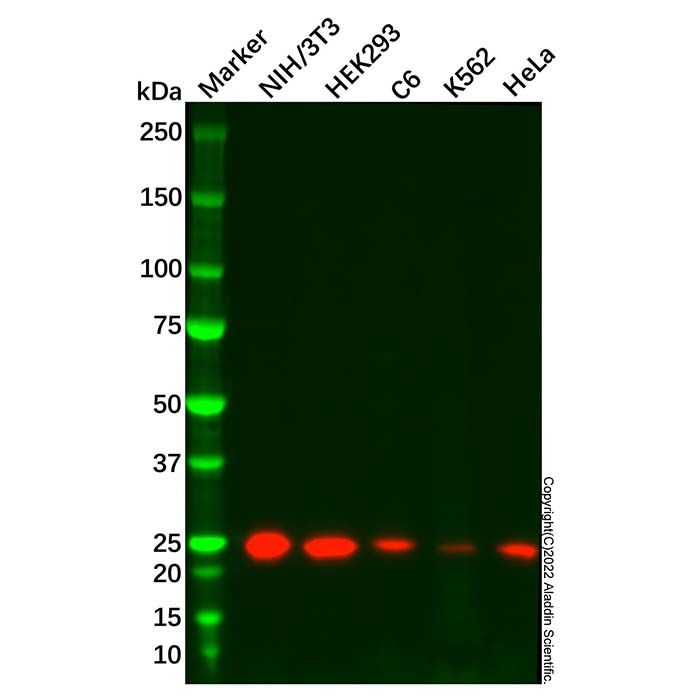
Recombinant Rab9 Antibody (Ab124272) - Western Blot All lanes: Recombinant Rab9 Antibody (Ab124272) at 1/1000 dilution Samples: Lysates at 20 µg per lane Secondary: Goat Anti-Rabbit IgG H&L (HRP) (Ab170144) at 1/20000 dilution
Predicted band size: 23 kDa Observed band size: 25 kDa Exposure time: 23.1 s
Recombinant Rab9 Antibody (Ab124272) - Western Blot All lanes: Recombinant Rab9 Antibody (Ab124272) at 1/1000 dilution Samples: Lysates at 20 µg per lane Secondary: Goat Anti-Rabbit IgG H&L (HRP) (Ab170144) at 1/20000 dilution
Predicted band size: 23 kDa Observed band size: 25 kDa Exposure time: 10.0 s
Recombinant Rab9 Antibody (Ab124272) - IHC Immunohistochemistry analysis of paraffin-embedded Human colon cancer using Recombinant Rab9 Antibody (Ab124272). High-pressure and temperature Sodium Citrate pH 6.0 was used for antigen retrieval.
Recombinant Rab9 Antibody (Ab124272) - IF/ICC IF analysis of Recombinant Rab9 Antibody (Ab124272) in HeLa cells. The cells were fixed and permeabilized with 100% methanol for 5 minutes, and blocked with 5% BSA for 1 hour at room temperature. Cells were stained with Recombinant Rab9 Antibody (Ab124272) at 1/200 dilution in blocking buffer overnight at 4°C, and then incubated with Goat Anti-Rabbit IgG H&L (AF647) (Ab181958) at a dilution of 1/1000 for 1 hour at room temperature in the dark (red). Cells were counterstained with DAPI (blue).
Applicazione
Applicazione
Dilution info
WB
1/500-1/1000
IHC
1/50 - 1/100
IF/ICC
1/200
Dati avanzati
Obiettivi associati (umani)
RAB9ATbioRas-related protein Rab-9A (0 Activities)
Determine the necessary mass, volume, or concentration for preparing a solution.
Dilution Calculator
Determine the dilution needed to prepare a stock solution.
Reconstitution Calculator
Recensioni
Recensioni dei clienti
Application Protocols
Product-specific, tested applications and recommended dilutions are not provided.
Item-specific (Product Data):
Validated: The product is labeled “Validated,” but the exact applications, dilutions, and positive controls are Not specified for this item; refer to CoA/Spec Sheet.
General protocol outlines (literature/general; not validated for this item):
Western Blot (WB): Prepare lysates (RIPA or mild lysis for membrane proteins). Load 10–30 μg protein/lane. Transfer to PVDF. Block with 5% milk/TBST. Primary incubation with anti-Rab9 antibody at an empirically determined dilution (e.g., 1:500–1:5,000 typical ranges). HRP-conjugated secondary and ECL detection.
Immunofluorescence (IF/ICC): Fix cells with 4% PFA, permeabilize with 0.1% Triton X-100, block with 3% BSA. Incubate primary 1–2 h RT or overnight 4°C. Use appropriate fluorescent secondary. Co-stain with late endosome/TGN markers for localization.
Immunoprecipitation (IP): Couple antibody to Protein A/G resin; incubate clarified lysates 1–4 h at 4°C. Wash with lysis buffer; elute with low-pH buffer or SDS sample buffer for analysis.
Consult the CoA/Spec Sheet for product-specific recommendations and any tested applications.
Biological Roles
Context for the antigen target (Rab9), useful when designing experiments. This section summarizes literature/general biology and does not imply item-specific validation.
Rab9 overview:
Rab9 (also known as RAB9A/B in humans) is a small GTPase of the Rab family. It cycles between GDP-bound (inactive) and GTP-bound (active) states to regulate membrane trafficking.
Primary role: Mediates retrograde transport from late endosomes to the trans-Golgi network (TGN), influencing lysosomal enzyme trafficking and endosome maturation.
Molecular interactions:
Engages with effectors such as TIP47/PLIN3, RAB9-interacting protein (RAB9IP), and components of retromer-associated pathways (literature).
Prenylation at the C-terminus targets Rab9 to membranes; GDI/GDF proteins control cytosol–membrane cycling.
Cellular and systems impact (literature):
Perturbation of Rab9 affects mannose 6-phosphate receptor (MPR) recycling, cargo sorting, and lysosomal hydrolase delivery.
Crosstalk with other Rabs (Rab7, Rab11) coordinates endosome maturation and TGN retrieval routes.
Experimental implications:
Antibodies to Rab9 are commonly used to map late endosome/TGN compartments and to monitor trafficking phenotypes post genetic or pharmacologic perturbation of endolysosomal systems.
Note: This product is labeled For research use only (Product Data) and is not intended for diagnostic or clinical applications.
Buffer Applications
While this reagent is an antibody rather than a buffering agent, successful use relies on selecting appropriate buffers and additives.
Item-specific (Product Data):
Storage Conditions: Store at −20°C; Avoid repeated freezing and thawing.
Supplied buffer and concentration: Not specified for this item; refer to CoA/Spec Sheet.
General buffer guidance for antibodies (literature/general):
Storage/dilution buffers: PBS (10–20 mM phosphate, 137 mM NaCl, 2.7 mM KCl, pH 7.2–7.6) or TBS (20–50 mM Tris, 150 mM NaCl, pH 7.4–8.0).
Blocking buffers (for WB/IHC/IF): 3–5% BSA, casein, or 5% non-fat milk in PBS/TBS; include 0.05–0.1% Tween-20 for washes to reduce non-specific binding.
Antigen retrieval (IHC, if applicable): Citrate buffer pH 6.0 or Tris-EDTA pH 9.0 with controlled heating; optimize per tissue.
Additives for stability: 10–50% glycerol for −20°C storage to prevent freezing; 0.01–0.05% sodium azide for preservative effect (avoid if conjugated to peroxidase or for live-cell work).
Practical tips:
Filter buffers (0.22 μm) to ensure sterility in long incubations.
Avoid chelators/detergents that may disrupt protein–protein interactions during IP unless required by the protocol.
Refer to the CoA/Spec Sheet for the exact buffer system supplied with this item.
Green Alternatives
Sustainability considerations for antibody-based experiments focus on buffer selection, preservation, and waste minimization rather than solvent replacement.
General greener practices (literature/general):
Use PBS/TBS prepared from concentrates to reduce packaging; choose reusable glass where compatible with sterility needs.
Prefer azide-free formulations when possible to reduce aquatic toxicity; substitute with sterile filtration and low-temperature storage. If azide is required, minimize concentration and manage waste responsibly.
Reduce single-use plastics by consolidating aliquots and using recyclable tip boxes; adopt energy-efficient freezers and maintain −70°C rather than −80°C where validated to reduce power consumption.
Implement digital record-keeping to limit printing of protocols and data.
Tradeoffs:
Azide-free, carrier-free antibodies may have reduced shelf-life without cold-chain rigor; balance hazard reduction with stability needs.
Glycerol lowers freezing point and reduces freeze–thaw damage but introduces organic carbon to wastewater; use the minimal effective percentage.
Item-specific notes:
Shipping: Provided on ice packs (Product Data) to maintain cold chain without dry ice, reducing CO2 footprint for short transits when appropriate.
Any claims of “green” formulation or preservative content are Not specified for this item; refer to CoA/Spec Sheet.
Pharmaceutical Uses
This product is a research-grade antibody and is not for diagnostic, therapeutic, or in vivo use.
Item-specific (Product Data):
Research Use Note: For research use only.
General context (literature/general; not item-specific claims):
Research antibodies may be employed in pharmaceutical R&D workflows, including target validation, mechanism-of-action studies, biomarker detection in preclinical samples, and process analytics.
Formulation excipients in research antibodies can include PBS/TBS salts, glycerol (cryoprotection), carrier proteins (BSA), and preservatives (sodium azide). Such excipients improve stability during storage and handling but are not suitable for clinical products.
Pharmacopeial status: Research antibodies typically do not have pharmacopeial monographs; GMP-grade, diagnostic, or therapeutic antibodies follow distinct quality frameworks not applicable here.
Practical guidance:
If application requires low endotoxin, carrier-free, or formulation without azide (e.g., for cell culture or functional assays), verify with the CoA—Not specified for this item.
Do not use for patient sample testing intended for clinical decision-making without appropriate validation and regulatory compliance.
Always adhere to institutional policies for non-clinical research reagents.
Physical Properties
Physical characteristics of antibodies depend on sequence, buffer, and formulation; item-specific constants are not provided for this product.
Item-specific (Product Data):
Appearance: Not specified for this item; refer to CoA/Spec Sheet.
Molecular Weight: Not specified for this item; refer to CoA/Spec Sheet.
Literature/general values (typical for IgG-class research antibodies; not item-specific):
Approx. molecular mass: ~150 kDa for full-length IgG; ~50 kDa (heavy) and ~25 kDa (light) under reducing SDS-PAGE.
Isoelectric point (pI): Typically ~6–9 depending on isotype and sequence.
Solubility: Freely soluble in aqueous buffers (PBS, TBS) with stabilizers (e.g., 0.02–0.05% sodium azide, 10–50% glycerol) used to enhance stability.
Extinction coefficient: Sequence dependent; often estimated at 1.3–1.5 (A280, 1 mg/mL) for IgG (literature). Exact value requires sequence.
Aggregation tendency: Reduced by low-temperature storage, inclusion of salts (100–150 mM NaCl), and cryoprotectants (glycerol).
Refractive index, density, logP, pKa: Not applicable/meaningful for macromolecular protein solutions; dominated by buffer properties.
For authoritative, item-specific physical properties (concentration, buffer composition), refer to the CoA/Spec Sheet.
Quality and Grades
Understanding the labeling on this antibody helps align it with fit-for-purpose applications.
Item-specific (Product Data):
Grade/Purity: Recombinant, ExactAb™, Validated.
What this generally implies (literature/general; not item-specific performance claims):
Recombinant antibody: Produced from defined expression constructs in cell culture, enabling high lot-to-lot consistency, renewable supply, and absence of host-immunization variability seen with traditional monoclonal/polyclonal sources.
ExactAb™: Branding typically denotes sequence-defined reagents with stringent manufacturing controls and traceability. Consult the CoA for the exact definition and any sequence disclosure associated with this mark.
Validated: Indicates the manufacturer has performed application-relevant testing. However, specific validated applications, sample types, and species reactivity are Not specified for this item; refer to CoA/Spec Sheet.
Practical implications for users:
Expect reduced lot drift and reproducibility benefits with recombinant formats.
Request or review the validation data (WB/IHC/IF/ELISA/FC, linearity, KD/affinity if available) before critical experiments.
If low endotoxin or carrier-free status is required (e.g., for cell-based functional assays), confirm on the CoA—Not specified for this item.
For audit trails, include the SKU (Ab124272) and batch/lot number from the product label in records.
Reaction and Applications
As a biological binding reagent, this antibody is not a reactant in synthetic organic chemistry. Its “applications” pertain to immunoassay and detection workflows rather than chemical reactions.
Item-specific application list: Not specified for this item; refer to CoA/Spec Sheet.
General laboratory applications for antibodies targeting Rab proteins (literature/general):
Western blot (WB) to detect Rab9 in cell/tissue lysates; appropriate for verifying expression changes across endosomal trafficking conditions.
Immunofluorescence (IF) or immunocytochemistry (ICC) to visualize Rab9-positive late endosomes and trans-Golgi network (TGN)-associated compartments; co-stain with compartment markers (e.g., LAMP1, TGN46) for localization.
Immunoprecipitation (IP) to enrich Rab9 complexes; use non-denaturing lysis buffers (e.g., 0.5% NP-40, 150 mM NaCl) to preserve GTPase interactions.
ELISA for quantitative detection when purified antigen standards are available.
Practical tips (general):
Validate species reactivity using controls with known Rab9 expression.
Include nucleotide-state controls for small GTPases (GTPγS vs GDP loading) if studying interaction partners.
Optimize antibody dilution, incubation time, and antigen retrieval (for IHC) empirically.
Note: None of the above are confirmed for this specific item; consult the CoA/Spec Sheet for validated applications.
Reaction Conditions
Not applicable in the context of chemical reactions. However, users may perform biochemical incubations where conditions influence antibody–antigen binding.
General incubation parameters (literature/general; not item-specific):
WB primary incubation: 1–16 h at 4–25°C in PBS/TBS with 1–5% BSA or milk; optimize concentration empirically.
IF/ICC: 1–2 h at room temperature or overnight at 4°C; include permeabilization (e.g., 0.1–0.3% Triton X-100) if intracellular antigens are targeted.
IP: 1–4 h at 4°C with gentle rotation in non-denaturing lysis buffer (e.g., 20–50 mM Tris, 150 mM NaCl, 0.5–1% NP-40/Triton, protease inhibitors).
IHC: Antigen retrieval conditions vary (citrate pH 6.0 or Tris-EDTA pH 9.0, 10–20 min heat-induced); blocking and detection optimized per tissue.
Notes:
Salt, pH, and detergent levels modulate affinity and background; start with conventional conditions and titrate.
Secondary antibody compatibility requires matching the host/isotype of the primary; host/isotype for this item is Not specified; refer to CoA/Spec Sheet.
These parameters are general guidance only and are not validated for this specific product.
Safety and Handling
Safety profile for laboratory handling of protein antibodies.
GHS classification and hazard statements (item-specific): Not specified for this item; refer to SDS. Many antibody formulations are not classified as hazardous, but always verify the supplied SDS.
General laboratory precautions (literature/good practice):
PPE: Wear lab coat, gloves, and safety glasses. Avoid inhalation of aerosols; handle solutions in a biosafety cabinet if sterility is required.
Preservatives: Formulations may contain sodium azide or other biocides; avoid contact with acids (azide can form explosive hydrazoic acid) and flush drains thoroughly with large volumes of water to prevent metal azide accumulation in plumbing.
Incompatibilities: Avoid strong oxidizers and proteases; minimize exposure to elevated temperatures and repeated freeze–thaw cycles to prevent denaturation and aggregation.
First aid (general): In case of contact, rinse skin/eyes with water. If inhaled, move to fresh air. If ingested, rinse mouth. Seek medical attention if symptoms occur. Defer to SDS for detailed instructions.
Waste disposal: Follow institutional biosafety and chemical hygiene plans. Preservative-containing solutions (e.g., azide) may require special handling per local regulations.
Always consult the product-specific SDS for definitive hazard, exposure, and response guidance.
Solvent Selection
This product is a protein antibody and is not used with organic solvent systems in the way small molecules are. Solvent polarity/partitioning considerations do not typically apply.
Item-specific note:
Supplied/storage buffer composition is Not specified for this item; refer to CoA/Spec Sheet.
General guidance for antibody-compatible aqueous media (literature/general):
Preferred matrices: Phosphate-buffered saline (PBS, pH 7.2–7.6) or Tris-buffered saline (TBS, pH 7.4–8.0), often with 0.01–0.05% preservative (e.g., sodium azide) for storage and 0.1% Tween-20 for wash buffers in immunoassays.
Avoid: High percentages of organic solvents (acetonitrile, methanol, DMSO) as they can denature antibodies; if unavoidable (e.g., antigen retrieval or specific assays), limit exposure time and temperature.
Additives: 10–50% glycerol can mitigate freeze–thaw damage during storage at −20°C; BSA or casein can be used as blockers in assay buffers when compatible with the detection system.
For definitive instructions on the supplied buffer and compatible diluents for this specific item, see the CoA/Spec Sheet and the “Storage & Reconstitution” tab.
Storage and Reconstitution
Guidance for maintaining integrity of this research antibody.
Item-specific (Product Data):
Storage Conditions: Store at −20°C.
Handling: Avoid repeated freezing and thawing.
Shipping: Ice chest + ice pads.
Supplied concentration/buffer: Not specified for this item; refer to CoA/Spec Sheet.
General storage best practices (literature/general):
Upon receipt: Inspect for container integrity; briefly centrifuge to collect liquid from the cap.
Aliquoting: Divide into single-use aliquots in low-protein-binding tubes to prevent freeze–thaw cycles; typical aliquots 10–50 μL depending on usage frequency.
Temperature: For long-term storage, −20°C with 30–50% glycerol prevents freezing and reduces denaturation; for very long-term or sensitive formulations, −80°C may be used if compatible. Short-term (≤1–2 weeks) at 2–8°C can be acceptable if preservative is present.
Thawing: Thaw on ice; mix gently by inversion—avoid vigorous vortexing. Keep on ice during setup.
Reconstitution: If supplied lyophilized (not specified here), reconstitute with sterile buffer (e.g., PBS) to the recommended concentration; allow to equilibrate 10–15 min at RT with gentle mixing. Filter-sterilize if sterility is critical.
Light and contamination: Protect from light if conjugated (not specified) and maintain aseptic technique to prevent microbial growth.
For exact buffer composition, concentration, and any reconstitution instructions unique to this lot, refer to the CoA/Spec Sheet.
Structure and Identity
Concise overview of identity and structural class for this research antibody.
Item-specific (Product Data):
SKU: Ab124272
Product Name: Recombinant Rab9 Antibody
Grade/Purity: Recombinant, ExactAb™, Validated (as labeled by supplier)
CAS: Not specified for this item; refer to CoA/Spec Sheet.
InChIKey / SMILES: Not applicable to protein biologics.
Molecular class: Immunoglobulin protein reagent (commonly an IgG isotype for research antibodies).
Typical architecture: Two heavy and two light chains forming a Y-shaped heterotetramer; variable domains (VH/VL) confer antigen binding; constant domains (CH/CL) drive effector/isotype properties.
Epitope target: Rab9 (member of the Rab family of small GTPases) — protein antigen; exact epitope, clonality, and host/isotype are Not specified for this item; refer to CoA/Spec Sheet.
Molecular formula: Not meaningful for macromolecules of heterogeneous composition; protein sequence defines identity.
2D/functional features (general):
Antigen-binding fragments (Fab) at each arm with complementarity-determining regions (CDRs) recognizing Rab9 epitopes.
Fc region mediates stability and potential secondary antibody recognition in immunoassays.
Note: Structural specifics (amino-acid sequence, clone ID, isotype, epitope mapping) are Not specified for this item; refer to CoA/Spec Sheet.
Synthetic Utility
Not applicable. This product is a recombinant antibody used as a biological detection and capture reagent; it is not a building block or reagent for synthetic organic chemistry.
For researchers seeking chemical tools instead:
Consider peptide antigens or small-molecule probes targeting Rab GTPases for mechanistic biochemistry.
For conjugation workflows (general): Antibodies can be chemically modified (e.g., NHS-ester labeling of lysines, maleimide-thiol coupling) to attach dyes or enzymes, but such modifications are downstream user operations and not intrinsic to this item. Any conjugation compatibility for this specific product is Not specified; refer to CoA/Spec Sheet.
Target Specificity
Item-specific target and reactivity details are required to design precise experiments.
Antigen name/epitope: Not specified for this item; refer to CoA/Spec Sheet. Product name indicates intended target is Rab9, but exact epitope mapping is not provided.
Species reactivity: Not specified for this item; refer to CoA/Spec Sheet.
Clonality/clone ID: Not specified for this item; refer to CoA/Spec Sheet.
Isotype/host: Not specified for this item; refer to CoA/Spec Sheet.
Conjugate (if any): Not specified for this item; refer to CoA/Spec Sheet.
General note (literature): Rab9 is conserved among mammals; cross-reactivity can vary with isoforms (RAB9A vs RAB9B). Always verify species and isoform specificity using supplied validation data.
Domande frequenti
What does ExactAb? mean?
ExactAb? indicates the product has been validated for use in rigorous antibody validation workflows. Validation may include positive/negative control samples, signal-to-noise testing, and protocol-specific QC. Lot-specific test data is published on the Certificate of Analysis where available.
What does Recombinant mean?
Recombinant is a defined analytical purity tier suitable for workflows requiring a specific validated property. It specifies a minimum assay percentage, controlled limits on common impurities (water, heavy metals, residue on ignition), and lot-to-lot consistency. Recombinant is one of several purity tiers — choose based on the sensitivity and regulatory requirements of your method.
How should this product be stored?
Store at ?20 °C. Avoid repeated freeze–thaw cycles. Aliquot into single-use volumes before freezing.
How is this product shipped?
This product ships in an insulated container with ice pads. Unpack on arrival and transfer it to the storage condition stated above.
What documentation is provided?
Available product documentation, including Certificates of Analysis (COA), Safety Data Sheets (SDS), and specification sheets, is shown in the product document area. Document availability and access follow the current site policy.
Which species reactivity has this antibody been validated against?
Validated reactivity is listed on the PDP and on each lot's datasheet. We validate against the most commonly tested species for the target (Recombinant Rab9 Antibody); cross-reactivity in untested species may exist but is not guaranteed. Contact technical support for specific species inquiries.
Hai bisogno di aiuto per scegliere la qualità?
La nostra guida alla selezione delle qualità copre purezza, stato dello stabilizzatore e idoneità all'applicazione per tutte le varianti del nostro catalogo.
Utilizziamo i cookie per garantire il corretto funzionamento del sito web e, ove consentito, per migliorare la tua esperienza. Puoi gestire le tue preferenze in qualsiasi momento nelle Impostazioni. Per saperne di più, consulta la nostra Cookie Policy.
Desidera che le inviamo un messaggio quando avremo sconti disponibili?
Ricordamelo più tardi
Grazie! Controlli la sua casella di posta per confermare.
Products are supplied to verified businesses, institutions, and qualified professionals for research and development use only. Not for use in humans, animals, diagnosis, or therapy.

 ZJ24F0404024