QUALITÀ & PUREZZARecombinant?Recombinant — produced via recombinant expression for defined sequence and consistency. Use for reproducible, animal-free proteins of known origin.ExactAb™?ExactAb™ — Aladdin's antibody line emphasizing precision and validated quality. Use for reliable, specificity-validated antibody applications.Validated?Validated grade — performance confirmed in defined applications before release. Use when you want documented assurance the reagent works as stated.0.7 mg/mL
Rabbit anti Human VAMP2 Antibody, Recombinant, could be used for WB and so on. Application · WB: 1/500-1/1000 Involved in the targeting and/or fusion of transport vesicles to their target membrane.
Specifiche
Product Name
Recombinant VAMP2 Antibody - Anticorpo primario, specific to VAMP2, Rabbit IgG
Sinonimi
FLJ11460 antibody|RATVAMPB antibody|RATVAMPIR antibody|SYB antibody|SYB2 antibody|Synaptobrevin 2 antibody|Synaptobrevin-2 antibody|VAMP 2 antibody|VAMP-2 antibody|Vamp2 antibody|Vesicle associated membrane protein 2 antibody|Vesicle-associated membrane protein 2 (synaptobrevin 2) antibody|Vesicle-associated membrane protein 2 antibody
Specifiche e purezza
ExactAb™, Validated, Recombinant, 0.7 mg/mL
Specie ospite
Coniglio
Specificità
VAMP2
Immunogeno
A synthetic peptide derived from human VAMP2 (AA 19-32)
Controllo positivo
WB: Mouse brain, SK-N-SH, RAW 264.7, NIH/3T3 and C6 lysates.
Coniugazione
Unconjugated
Grado
ExactAb™, Recombinant, Validated
Isotipo
Rabbit IgG
SDS-PAGE
150 kDa
Metodo di purificazione
Antigen affinity purified
Concentrazione
0.7 mg/mL
Product Line
Prodotti biologici
Stoccaggio e spedizione
Forma
Liquid
Condizioni di conservazione di stoccaggio
Store at -20°C,Avoid repeated freezing and thawing
Spedito in
Ice chest + Ice pads
Stabilità e conservazione
Store at 4℃ short term (1-2 weeks). Store at -20℃ long term (24 months). Upon receipt, it is recommended to aliquot. Avoid freeze/thaw cycle.
Immagini
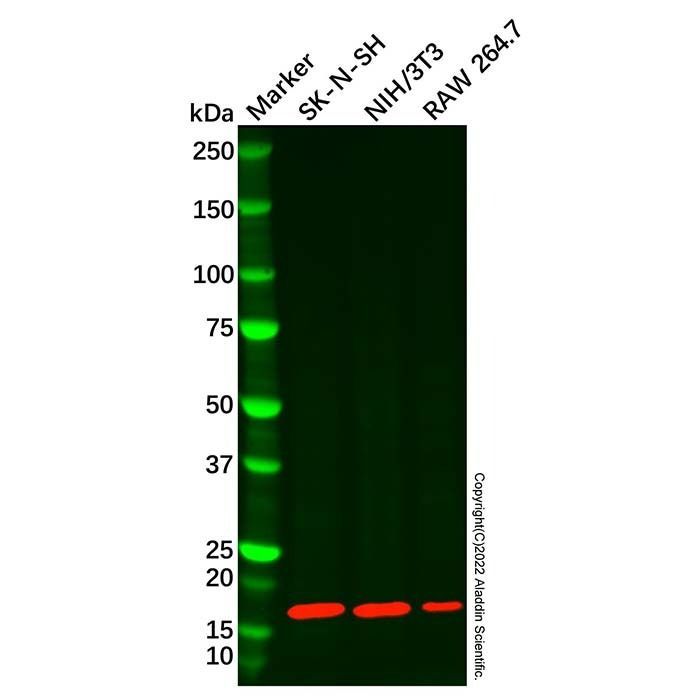
Recombinant VAMP2 Antibody (Ab133855) - Western Blot All lanes: Recombinant VAMP2 Antibody (Ab133855) at 1/1000 dilution Samples: Lysates at 20 µg per lane Secondary: Goat Anti-Rabbit IgG H&L (HRP) (Ab170144) at 1/20000 dilution
Predicted band size: 13 kDa Observed band size: 17 kDa Exposure time: 100.0 s
Recombinant VAMP2 Antibody (Ab133855) - Western Blot All lanes: Recombinant VAMP2 Antibody (Ab133855) at 1/1000 dilution Samples: Lysates at 20 µg per lane Secondary: Goat Anti-Rabbit IgG H&L (HRP) (Ab170144) at 1/20000 dilution
Predicted band size: 13 kDa Observed band size: 17 kDa Exposure time: 10.1 s
Applicazione
Applicazione
Dilution info
WB
1/500-1/1000
Dati avanzati
Obiettivi associati (umani)
VAMP2TbioVesicle-associated membrane protein 2 (0 Activities)
Determine the necessary mass, volume, or concentration for preparing a solution.
Dilution Calculator
Determine the dilution needed to prepare a stock solution.
Reconstitution Calculator
Recensioni
Recensioni dei clienti
Application Protocols
Specific tested applications and recommended dilutions for Ab133855 are not provided here; refer to the CoA/Spec Sheet. The following are general, non-item-specific starting points for anti-VAMP2 antibodies:
Western blot (general)
Sample: Neuronal lysates or brain tissue homogenates (detergent-based lysis). Load 10–30 µg total protein per lane.
Primary incubation: 4°C overnight in TBST + 5% BSA or milk. Start at 1:500–1:2,000 and titrate.
Controls: Positive—rodent brain; negative—VAMP2 knockout or siRNA-treated samples.
Immunofluorescence/IHC (general)
Fixation: 4% PFA; permeabilize with 0.1–0.3% Triton X-100 as needed for membrane antigens.
Blocking: 3–5% BSA or appropriate serum. Start at 1:200–1:1,000 primary dilution; optimize for tissue thickness and detection method.
Co-stains: Synapsin, MAP2, or PSD95 to delineate synaptic compartments.
Immunoprecipitation (general)
Use 1–5 µg antibody per mg lysate protein; incubate 1–4 h at 4°C; capture with Protein A/G beads matched to isotype (isotype not specified here—verify on CoA).
Always confirm actual working dilutions and conditions with the item’s CoA/Spec Sheet.
Biological Roles
VAMP2 (vesicle-associated membrane protein 2), also known as synaptobrevin-2, is a well-characterized neuronal SNARE protein (literature) integral to synaptic vesicle exocytosis.
Biology of VAMP2 (literature; general context, not item-specific claims)
Localization: Embedded in synaptic vesicle membranes via a single-pass transmembrane helix; cytosolic N-terminal region contains the SNARE motif.
Function: Forms the core SNARE complex with syntaxin-1 and SNAP-25 to drive Ca2+-triggered membrane fusion underlying neurotransmitter release.
Regulation: Interacts with complexin, synaptotagmin, and other presynaptic factors; phosphorylation and membrane lipid environment can modulate fusion kinetics.
Genetics: Encoded by VAMP2; essential for efficient synaptic transmission in many neuronal circuits.
Research utility: Antibodies against VAMP2 are used to assess synaptic vesicle abundance, presynaptic terminal density, neuronal maturation, and to monitor vesicle cycling in cultured neurons and brain tissue.
Note: The specific epitope, affinity, and cross-species reactivity of this antibody are not provided here; consult the CoA/Spec Sheet for item-specific details.
Buffer Applications
This product is an antibody reagent and is not used as a buffering agent. For experimental use, it should be diluted in compatible biological buffers.
Practical guidance
Use PBS or TBS with optional carrier protein (e.g., 1–5% BSA) and 0.05–0.1% Tween-20 for immunoassays, as appropriate to the protocol (general guidance).
Avoid amine-containing buffers during NHS ester conjugations, and avoid azide when working with peroxidase-based detection. For this item, exact buffer compatibility is not specified; check the CoA/Spec Sheet.
Green Alternatives
Green chemistry comparisons among organic solvents are not directly applicable to an antibody reagent. Nonetheless, sustainable practices can be integrated into antibody workflows:
Buffer and consumable choices (general)
Prefer phosphate or HEPES buffers prepared from concentrated stocks to reduce packaging waste.
Use glycerol judiciously; while helpful for freeze–thaw stability, it increases cold-chain mass. Consider aliquoting at working concentrations to minimize repeated shipping.
Select low-fluorinated or non-fluorinated membranes and minimize single-use plastics by employing reusable, validated labware when possible.
Cold-chain efficiency
Consolidate shipments and use right-sized insulated containers. This item ships on ice; plan receipt to reduce transit time and dry ice/ice pack consumption.
Waste handling
If sodium azide is present (not specified for this item), collect azide-containing waste separately and avoid discharge to copper/lead plumbing. Follow institutional green-lab guidance for bioreagent disposal.
Pharmaceutical Uses
This antibody is supplied strictly for research use only and is not intended for diagnostic or therapeutic applications.
General formulation context (not item-specific)
Antibodies in regulated applications require cGMP manufacture, defined excipients, and pharmacopeial characterization; no such claims are made for this item.
In the research setting, antibodies may serve as analytical reagents for in-process controls or characterization assays in biopharmaceutical development, provided appropriate qualification is performed by the user.
No pharmacopeial status, excipient profile, or clinical formulation information is provided for this item; refer to CoA/Spec Sheet if needed.
Physical Properties
Item-specific physico-chemical data
Appearance: Not specified for this item; refer to CoA/Spec Sheet.
Concentration/formulation buffer: Not specified for this item; refer to CoA/Spec Sheet.
Molecular weight (observed): Not specified for this item; refer to CoA/Spec Sheet.
pH, excipients (e.g., glycerol, BSA, preservatives): Not specified for this item; refer to CoA/Spec Sheet.
CAS, CID, SMILES, InChIKey: Not applicable/not provided.
General/literature context for antibodies (not item-specific)
What these designations generally imply (general, not item-specific specs)
Recombinant: The antibody’s variable regions are expressed from defined genetic sequences in a controlled host system, providing superior lot-to-lot consistency, reduced background from undefined serum proteins, and improved supply continuity compared to hybridoma ascites.
ExactAb (brand/program): Typically denotes a standardized, sequence-defined reagent with consistent performance characteristics across lots and with documented validation criteria. Refer to the product’s CoA/Spec Sheet for the exact scope of validation for Ab133855.
Validated: Indicates application-specific performance has been experimentally verified by the manufacturer (e.g., WB, IHC, IF, ELISA). Specific validated applications, species, and dilution ranges are not listed here—consult the CoA/Spec Sheet.
Quality control practices (general)
Identity: Often confirmed by sequence, expression tag analysis, or antigen-binding assays.
Purity: Commonly assessed by SDS-PAGE and size-exclusion chromatography to verify monomeric content and low aggregates.
Functional testing: Affinity/avidity toward the immunogen and specificity across species/isoforms are typically evaluated; cross-reactivity profiling may be included.
User guidance
Always match your application and species with the stated validation on the CoA. If using outside validated conditions, run pilot titrations and include positive/negative controls.
Reaction and Applications
Classical synthetic chemistry reactions (e.g., Grignard, cross-coupling) are not applicable to antibody reagents.
Relevant laboratory applications (general for antibodies; not item-specific)
Immunoassays: Western blot (WB), immunofluorescence (IF/IC), immunohistochemistry (IHC), ELISA, and immunoprecipitation (IP) for detection of VAMP2.
Enrichment: Pull-downs or IP of native VAMP2-containing complexes for proteomic analyses.
Quality control: Use as a positive control reagent when validating VAMP2 expression systems or neuronal differentiation protocols.
Practical tips (general)
Titrate antibody concentration for each matrix and detection system to optimize signal-to-noise.
Validate specificity with peptide competition or knockout/knockdown controls where feasible.
Maintain cold chain and avoid protease contamination during IP or tissue processing.
Note: Specific validated applications for this SKU are not provided here; refer to the CoA/Spec Sheet.
Reaction Conditions
Classical chemical reaction conditions are not applicable to antibody reagents.
Assay conditions (general guidance for antibodies; not item-specific)
Western blot: Typical primary antibody incubations are conducted at 4°C overnight or 1–2 h at room temperature in blocking buffer; actual dilutions must be empirically determined.
IHC/IF: Incubate with appropriate blocking/penetration buffers; optimize fixation (PFA vs. methanol) and retrieval as required by antigen. VAMP2 is a membrane-associated protein; permeabilization may be critical.
ELISA: Use carbonate-bicarbonate coating buffer or high-binding plates; titrate capture/detection concentrations.
Specific validated conditions for SKU Ab133855 are not provided here; refer to the CoA/Spec Sheet and perform small-scale titrations.
Safety and Handling
Regulatory and GHS
Signal word, hazard statements, pictograms, and classification: Not specified for this item; refer to the product SDS for authoritative information.
Research Use: For research use only.
General laboratory precautions (good practice for antibodies)
PPE: Wear lab coat, gloves, and eye protection when handling liquid antibody solutions and during procedures generating aerosols or splashes.
Biosafety: Treat as a low-risk biological reagent; avoid ingestion, inhalation, and contact with skin/eyes. Handle in a clean area to prevent contamination.
Preservatives: Many antibody solutions contain sodium azide; avoid contact with acids that can form toxic hydrazoic acid vapors and prevent accumulation in copper/lead plumbing. Composition for this item is not specified—verify in SDS/CoA.
First aid (overview; defer to SDS)
Skin/eye contact: Rinse with water for several minutes; remove contaminated clothing; seek medical attention if irritation persists.
Ingestion/inhalation: Move to fresh air; rinse mouth; seek medical advice as appropriate.
Storage incompatibilities and handling
Keep cold as specified; avoid repeated freeze–thaw cycles.
Do not mix with oxidizers or acids if sodium azide is present (check SDS/CoA). Use dedicated, labeled containers and clean pipette tips to avoid microbial contamination.
Solvent Selection
This product is an aqueous antibody reagent, not an organic solvent. Solvent selection is generally not applicable.
Practical guidance
Use standard biological buffers (e.g., PBS, TBS) compatible with the antibody’s provided formulation. Exact buffer composition for this item is not specified; check the CoA/Spec Sheet.
Avoid high percentages of organic solvents (acetone, acetonitrile, methanol) that can denature antibodies unless specifically required for a protocol and validated for this reagent.
For conjugation or special applications, select buffers free of amines, azides, or reducing agents as appropriate to the chemistry employed.
Storage and Reconstitution
Item-specific storage and shipping
Storage Conditions: Store at -20°C; avoid repeated freezing and thawing (per product data). Maintain cold chain.
Formulation, concentration, and whether the item is liquid or lyophilized are not specified here; refer to CoA/Spec Sheet for exact instructions.
General guidance (not item-specific): If lyophilized, reconstitute with sterile, antibody-grade water or buffer to the recommended concentration; allow to dissolve gently on ice. If supplied in solution, mix by gentle inversion—do not vortex.
Aliquoting: Immediately aliquot into single-use volumes to prevent freeze–thaw cycles. Use low-protein-binding tubes and tips.
Working buffers: Use sterile PBS/TBS with carrier protein (e.g., 0.1–1% BSA) if compatible with your application; avoid preservatives that interfere with downstream enzymes or conjugations.
Stability
Short-term: Keep on ice during use; store at 4°C for brief periods only if the formulation supports it (check CoA).
Long-term: -20°C as specified; some antibodies also tolerate -80°C storage for multi-year stability—verify on CoA/Spec Sheet.
Avoid microbial contamination; use aseptic technique and include preservative only if compatible with your workflow.
Structure and Identity
Recombinant VAMP2 Antibody is a protein-based affinity reagent targeting VAMP2.
Molecular formula: Not specified for this item; refer to CoA/Spec Sheet.
Molecular weight: Not specified for this item; refer to CoA/Spec Sheet.
Sequence/isotype/clone: Not specified for this item; refer to CoA/Spec Sheet.
SMILES / InChIKey: Not applicable to proteins/antibodies (not provided).
Structural features (general, literature)
Antibodies are Y-shaped immunoglobulins composed of two heavy and two light chains linked by disulfide bonds, with variable domains conferring antigen specificity via complementarity-determining regions (CDRs).
Recombinant production typically means the antibody variable domains are expressed from defined sequences in a host system, providing lot-to-lot consistency compared with hybridoma-derived materials.
If the format is IgG, the Fc region mediates secondary detection and purification; if a fragment (Fab/scFv), Fc is absent. Exact format for this item is not specified here.
Synthetic Utility
Not applicable. This product is a biological affinity reagent rather than a synthetic building block or reagent.
Where relevant to lab workflows (general)
Can be used to immunoprecipitate VAMP2 complexes prior to MS-based proteomics, aiding target identification and interactome studies.
Enables analytical detection of VAMP2 in complex matrices for process development or basic research.
For chemical synthesis applications, consider the appropriate chemical reagents described elsewhere in the catalog.
Target Specificity
Antigen target (from product name)
Target: VAMP2
Item-specific details not provided
Epitope/peptide mapping: Not specified for this item; refer to CoA/Spec Sheet.
Species reactivity: Not specified for this item; refer to CoA/Spec Sheet.
Clone, isotype, host, format (IgG/Fab/scFv), conjugate: Not specified for this item; refer to CoA/Spec Sheet.
No further target-specific data are available in the provided product data. Users should verify compatibility with their species/tissues and applications via the CoA/Spec Sheet.
Domande frequenti
What does ExactAb? mean?
ExactAb? indicates the product has been validated for use in rigorous antibody validation workflows. Validation may include positive/negative control samples, signal-to-noise testing, and protocol-specific QC. Lot-specific test data is published on the Certificate of Analysis where available.
What does Recombinant mean?
Recombinant is a defined analytical purity tier suitable for workflows requiring a specific validated property. It specifies a minimum assay percentage, controlled limits on common impurities (water, heavy metals, residue on ignition), and lot-to-lot consistency. Recombinant is one of several purity tiers — choose based on the sensitivity and regulatory requirements of your method.
How should this product be stored?
Store at ?20 °C. Avoid repeated freeze–thaw cycles. Aliquot into single-use volumes before freezing.
How is this product shipped?
This product ships in an insulated container with ice pads. Unpack on arrival and transfer it to the storage condition stated above.
What documentation is provided?
Available product documentation, including Certificates of Analysis (COA), Safety Data Sheets (SDS), and specification sheets, is shown in the product document area. Document availability and access follow the current site policy.
Which species reactivity has this antibody been validated against?
Validated reactivity is listed on the PDP and on each lot's datasheet. We validate against the most commonly tested species for the target (Recombinant VAMP2?Antibody); cross-reactivity in untested species may exist but is not guaranteed. Contact technical support for specific species inquiries.
Hai bisogno di aiuto per scegliere la qualità?
La nostra guida alla selezione delle qualità copre purezza, stato dello stabilizzatore e idoneità all'applicazione per tutte le varianti del nostro catalogo.
Utilizziamo i cookie per garantire il corretto funzionamento del sito web e, ove consentito, per migliorare la tua esperienza. Puoi gestire le tue preferenze in qualsiasi momento nelle Impostazioni. Per saperne di più, consulta la nostra Cookie Policy.
Desidera che le inviamo un messaggio quando avremo sconti disponibili?
Ricordamelo più tardi
Grazie! Controlli la sua casella di posta per confermare.
Products are supplied to verified businesses, institutions, and qualified professionals for research and development use only. Not for use in humans, animals, diagnosis, or therapy.

 ZJ24F0607327