QUALITÀ & PUREZZARecombinant?Recombinant — produced via recombinant expression for defined sequence and consistency. Use for reproducible, animal-free proteins of known origin.ExactAb™?ExactAb™ — Aladdin's antibody line emphasizing precision and validated quality. Use for reliable, specificity-validated antibody applications.Validated?Validated grade — performance confirmed in defined applications before release. Use when you want documented assurance the reagent works as stated.0.6 mg/mL
Rabbit anti Human VPS35 Antibody, Recombinant, could be used for WB, IHC and so on. Application · WB: 1/500-1/1000 · IHC: 1/50-1/100 Protein Function Essential component of the retromer complex, a complex required to retrieve lysosomal enzyme receptors (IGF2R and M6PR) from endosomes to the trans-Golgi network. Also required to regulate transcytosis of the polymeric immunoglobulin receptor (pIgR-pIgA).
Specifiche
Product Name
Recombinant VPS35 Antibody - Anticorpo primario, specific to VPS35, Rabbit IgG
Sinonimi
DKFZp434E1211 antibody|DKFZp434P1672 antibody|FLJ10752 antibody|FLJ13588 antibody|FLJ20388 antibody|hVPS35 antibody|Maternal embryonic 3 antibody|Maternal-embryonic 3 antibody|MEM 3 antibody|MEM3 antibody|PARK17 antibody|TCCCTA00141 antibody|Vacuolar protein sorting 35 (yeast) antibody|Vacuolar protein sorting 35 antibody|Vacuolar protein sorting 35 homolog antibody|Vacuolar protein sorting associated protein 35 antibody|Vacuolar protein sorting-associated protein 35 antibody|Vesicle protein sorting 35 antibody|VPS 35 antibody|VPS35 antibody|MEM3|PARK17
Specifiche e purezza
Recombinant, ExactAb™, Validated, 0.6 mg/mL
Specie ospite
Coniglio
Specificità
VPS35
Immunogeno
A synthetic peptide derived from human VPS35 (AA 159-172)
Controllo positivo
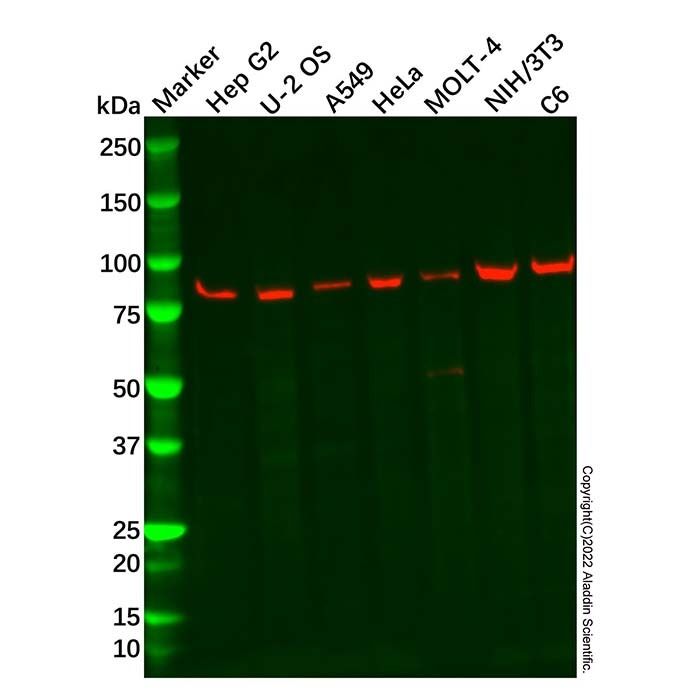
WB: Hep G2, U-2 OS, A549, HeLa, MOLT-4, NIH/3T3 and C6 cell lysates. IHC: Human lung cancer tissue.
Coniugazione
Unconjugated
Grado
ExactAb™, Recombinant, Validated
Isotipo
Rabbit IgG
SDS-PAGE
150 kDa
Metodo di purificazione
Antigen affinity purified
Concentrazione
0.6 mg/mL
Product Line
Prodotti biologici
Stoccaggio e spedizione
Forma
Liquid
Condizioni di conservazione di stoccaggio
Store at -20°C,Avoid repeated freezing and thawing
Spedito in
Ice chest + Ice pads
Stabilità e conservazione
Store at 4℃ short term (1-2 weeks). Store at -20℃ long term (24 months). Upon receipt, it is recommended to aliquot. Avoid freeze/thaw cycle.
Immagini
Recombinant VPS35 Antibody (Ab134464) - Western Blot All lanes: Recombinant VPS35 Antibody (Ab134464) at 1/1000 dilution Samples: Lysates at 20 µg per lane Secondary: Goat Anti-Rabbit IgG H&L (HRP) (Ab170144) at 1/20000 dilution
Predicted band size: 92 kDa Observed band size: 89 kDa Exposure time: 65.6 s
Recombinant VPS35 Antibody (Ab134464) - IHC Immunohistochemistry analysis of paraffin-embedded Human lung cancer using Recombinant VPS35 Antibody (Ab134464). High-pressure and temperature Sodium Citrate pH 6.0 was used for antigen retrieval.
Applicazione
Applicazione
Dilution info
WB
1/500-1/1000
IHC
1/50 - 1/100
Dati avanzati
Obiettivi associati (umani)
VPS35TbioVacuolar protein sorting-associated protein 35 (0 Activities)
Determine the necessary mass, volume, or concentration for preparing a solution.
Dilution Calculator
Determine the dilution needed to prepare a stock solution.
Reconstitution Calculator
Recensioni
Recensioni dei clienti
Application Protocols
Application protocols must be drawn from product-specific validation data. For this SKU, the catalog listing does not include tested applications, dilutions, or sample preparation guidance.
Manufacturer-provided applications: Not specified for this item; refer to CoA/Spec Sheet.
Recommended dilutions: Not specified for this item; refer to CoA/Spec Sheet.
Positive control samples: Not specified for this item; refer to CoA/Spec Sheet.
Secondary antibody compatibility: Not specified for this item; refer to CoA/Spec Sheet.
Please consult the SDS/CoA or contact technical support for item-specific protocols and validation details.
Biological Roles
Focus here is on the biology of the target protein, VPS35 (vacuolar protein sorting–associated protein 35), not on therapeutic claims.
VPS35 function (literature)
VPS35 is a core component of the retromer cargo-recognition complex (with VPS26 and VPS29), coordinating the sorting and retrieval of membrane proteins from endosomes to the trans-Golgi network and to the plasma membrane.
It recognizes sorting motifs in cargo proteins and collaborates with SNX-BAR dimers that sculpt endosomal tubules.
Cellular processes (literature)
Endosomal trafficking and receptor recycling (e.g., CI-MPR, Wntless, and various GPCRs).
Maintenance of lysosome and Golgi homeostasis; influence on autophagic flux and mitochondrial quality control indirectly via trafficking.
Research significance (literature)
VPS35 mutations and altered expression are widely studied in cell biology and model organisms to dissect endosomal transport pathways and proteostasis networks.
Localization (literature)
Predominantly endosomal/TGN-associated; punctate cytoplasmic staining consistent with retromer-positive endosomes.
This section summarizes general biology to contextualize use of a VPS35 antibody. Item-specific epitope, affinity, or species cross-reactivity are not specified for this SKU.
Buffer Applications
Antibody performance depends strongly on buffer composition. The following are general best practices; item-specific formulation for this SKU is not provided.
Working buffers (general, literature)
PBS, pH 7.2–7.6 (with 0.05–0.1% Tween-20 for washes) for Western blot and ELISA workflows.
TBS, pH 7.4–8.0 for alkaline phosphatase detection or when phosphate interferes.
Blocking buffers: 3–5% nonfat dry milk or 1–5% BSA in PBS/TBS; choose milk-free for phospho-epitope work.
Antigen retrieval (IHC, general)
Heat-induced retrieval in citrate buffer (10 mM, pH ~6) or Tris-EDTA (pH ~9) depending on epitope stability.
Sample preparation (general)
Lysis buffers: RIPA for broad extraction (may reduce IP); NP-40/Triton-based buffers preserve complexes for IP/Co-IP; include protease inhibitors.
Storage buffers (general)
For aliquots at −20°C, inclusion of 30–50% glycerol is common; presence for this item is not specified—consult CoA/SDS.
Item-specific buffer recipe or required additives for Ab134464: Not specified; refer to CoA/Spec Sheet.
Green Alternatives
Antibody-based assays already operate in aqueous media, offering an inherently greener profile than many organic-solvent-intensive chemistries. Greener choices focus on buffer components, waste minimization, and hazard reduction.
Opportunities for greener practice (general)
Preservatives: use azide-free formulations when possible to reduce aquatic toxicity; for this item, preservative status is not specified.
Detergents: prefer readily biodegradable surfactants at the lowest effective concentration (e.g., polysorbates) and avoid nonylphenol ethoxylates.
Blocking agents: choose plant-based milk powders or recombinant proteins over animal serum when suitable.
Ready-to-use buffers: prepare from concentrates/tablets to minimize plastic and shipping mass.
Minimize waste: optimize assay to reduce antibody volume per test; recover and recycle SDS-PAGE/casting plastics where programs exist.
Trade-offs (general)
Azide-free storage may reduce shelf-life at 2–8°C; consider sterile technique and aliquoting at −20°C to compensate.
Detergent reductions can increase background—balance signal-to-noise with environmental impact.
Item-specific green alternatives or certifications: Not specified for this item; refer to CoA/Spec Sheet.
Pharmaceutical Uses
This product is designated for research use only. No clinical, diagnostic, or therapeutic uses are claimed or supported.
Potential roles in pharmaceutical R&D workflows (general)
Analytical reagent for characterizing VPS35 expression in cell lines or tissues used in drug discovery.
Tool for mechanism-of-action studies where endosomal trafficking or retromer function is implicated.
Biomarker method development (e.g., exploratory IHC/WB assays) in preclinical research.
Formulation/excipient status
Not applicable; this antibody is not provided as a pharmaceutical excipient and is not accompanied by pharmacopeial monographs.
GMP/clinical suitability
Not specified for this item; this SKU is not intended for human or veterinary use.
All activities must remain within research use only, consistent with the product’s designation.
Physical Properties
Item-specific physical data were not provided.
Item-specific data
Appearance: Not specified for this item; refer to CoA/Spec Sheet.
Concentration/formulation: Not specified for this item; refer to CoA/Spec Sheet.
pH/buffer composition: Not specified for this item; refer to CoA/Spec Sheet.
Molecular weight: Not specified for this item; refer to CoA/Spec Sheet.
Protein antibody properties (general, literature)
Typical IgG molecular mass: ~150 kDa (two ~50 kDa heavy chains, two ~25 kDa light chains).
Isoelectric point (pI): commonly ~6–9 depending on subclass and sequence.
Solubility: high in aqueous buffers (e.g., PBS, TBS); aggregation increases near isoelectric point or under low ionic strength.
Stability: enhanced by neutral pH, moderate ionic strength, and stabilizers (e.g., sugars, proteins); avoid repeated freeze–thaw.
Temperature sensitivity: prolonged exposure to >4–8°C can reduce activity; freezing can be tolerated if properly buffered and aliquoted.
Recombinant: produced from defined heavy and light chain expression constructs, enabling high lot-to-lot consistency and reduced background compared with polyclonal or unstable hybridoma lines.
ExactAb™: brand designation indicating controlled manufacturing and documentation standards at Aladdin Scientific.
Validated: indicates the antibody has undergone performance checks; the specific validated applications, species, or epitopes are not listed for this SKU. Consult the CoA/Spec Sheet for validation details.
Stabilizers and preservatives
Not specified for this item; refer to CoA/Spec Sheet. The presence of carriers (e.g., BSA), sugars, glycerol, or biocides can impact assay background and storage stability.
What to verify before use
Clonality (mono vs poly), host/isotype, epitope region (full-length vs peptide), and tested applications are not specified here; review the product datasheet to match your assay.
Certificate of Analysis (CoA) should list lot-specific concentration, purity/aggregate profile (if measured), and storage buffer.
Typical QC for recombinant antibodies (general, literature)
Binding/activity: ELISA to immunogen, titer/affinity estimates.
Specificity: WB/IHC/IF patterns in positive vs knockout controls.
Integrity: SDS-PAGE under reducing/non-reducing conditions; size-exclusion chromatography for aggregates.
Reaction and Applications
As a research antibody targeting VPS35, typical laboratory applications involve immunorecognition rather than chemical transformations.
Common application families (general, literature)
Western blot (WB): detection of VPS35 in denatured lysates to quantify expression or assess knockout/overexpression.
Immunofluorescence (IF)/confocal imaging: subcellular localization of VPS35 in endosomal/retromer compartments.
Immunohistochemistry (IHC): tissue-level distribution of VPS35 after appropriate fixation and antigen retrieval.
Immunoprecipitation (IP)/Co-IP: enrichment of VPS35 and associated retromer components for interactome analysis.
Proximity ligation or in situ assays: probing VPS35 interactions in cells.
Target biology context (literature)
VPS35 is a core component of the retromer complex, mediating cargo recognition for endosome-to-TGN and endosome-to-plasma membrane recycling.
Practical considerations (general)
Epitope sensitivity: fixation and retrieval conditions strongly influence signal; optimize citrate or EDTA retrieval for IHC as needed.
Controls: include isotype controls, secondary-only controls, and ideally VPS35 knockout/siRNA samples to confirm specificity.
Load/amounts: for WB, typical loads are 10–30 µg total protein per lane; antibody dilution depends on titer (not specified for this item).
Manufacturer-validated applications for this SKU: Not specified; consult the CoA/Spec Sheet for any vendor-tested methods.
Reaction Conditions
Conventional chemical reaction parameters (solvents, catalysts, yields) are not applicable to antibody use. For immunoassays, conditions are biological/biochemical.
General immunoassay conditions (literature; not item-specific)
WB: denatured proteins separated by SDS-PAGE, transferred to membranes; antibody incubations typically 1 h at room temperature or overnight at 4°C with appropriate blocking.
IF/IHC: fixation (PFA or formalin), permeabilization (e.g., 0.1–0.3% Triton X-100 where needed), and antibody incubations in buffered protein blockers; antigen retrieval may be required.
IP: incubation of clarified lysates with antibody and protein A/G resin at 4°C for 1–4 h or overnight; stringent vs mild wash buffers tuned to preserve complexes.
Temperature and stability considerations
Keep antibody solutions cold (on ice or 4°C) during setup; avoid extended room-temperature exposure.
Item-specific incubation times, dilutions, and conditions for Ab134464 are not specified; consult the CoA/Spec Sheet.
Safety and Handling
Always consult the SDS for authoritative safety information. Item-specific hazard classification was not provided for this SKU.
GHS information (item-specific)
Signal word: Not specified for this item; refer to SDS.
Hazard statements (H-codes): Not specified for this item; refer to SDS.
Pictograms: Not specified for this item; refer to SDS.
General laboratory precautions (best practice)
Personal protective equipment: lab coat, gloves (nitrile), and safety glasses when handling liquid antibody preparations.
Engineering controls: work on a clean bench; use biological safety cabinet if handling biological materials/cell lysates.
Hygiene: avoid ingestion/inhalation; do not pipette by mouth; wash hands after use.
Handling notes specific to antibodies (general)
Avoid repeated freeze–thaw cycles to prevent aggregation and loss of binding activity (explicitly noted for this item).
Preservatives: some antibody formulations contain sodium azide or other biocides; presence/amount for this item is not specified—consult SDS before mixing with copper/lead plumbing or using in live-cell applications.
Incompatibilities: avoid strong oxidizers, extreme pH, and organic solvents that denature proteins.
First-aid (general)
Skin/eye contact: rinse with water for several minutes; remove contaminated clothing; seek medical attention if irritation persists.
Ingestion/inhalation: move to fresh air; rinse mouth; obtain medical advice.
Spill/cleanup (general)
Absorb with inert material, clean with aqueous detergent, dispose according to institutional biosafety procedures.
Solvent Selection
This product is an aqueous protein reagent; conventional organic solvent selection is not applicable. Focus is on buffer selection and formulation.
Buffer systems (general, literature)
PBS (10–50 mM phosphate, 150 mM NaCl, pH 7.2–7.6): broadly compatible with immunoassays; maintains ionic strength.
TBS (20–50 mM Tris, 150 mM NaCl, pH 7.4–8.0): favored for alkaline phosphatase detection or when phosphate interferes.
Additives: 0.01–0.1% Tween-20 can reduce nonspecific binding in washes; 10–50% glycerol can support sub-zero storage. For this item, specific formulation is not specified.
When to choose which buffer (general guidance)
Phosphate-sensitive systems or metal chelation assays: use TBS.
Phospho-epitope detection: avoid phosphatases; include inhibitors where appropriate.
Live-cell or functional assays: use azide-free buffers; preservative status for this item is not specified.
Comparison (general)
PBS: strong pH buffering near neutral; potential interference with some metal-dependent steps.
TBS: broader pH working range; Tris can interact with aldehydes during fixation chemistry.
Item-specific buffer composition for this SKU: Not specified; refer to CoA/Spec Sheet.
Storage and Reconstitution
Follow the item-specific guidance provided.
Storage conditions (item-specific)
Store at −20°C.
Avoid repeated freezing and thawing.
Shipped in an ice chest with ice pads.
Additional item-specific details
Appearance, buffer composition, stabilizers/preservatives, and concentration: Not specified for this item; refer to CoA/Spec Sheet.
Reconstitution instructions (if lyophilized) or aliquoting guidance (if liquid): Not specified for this item; refer to CoA/Spec Sheet.
General note: For any antibody, maintaining cold chain and preventing freeze–thaw cycling are critical to preserve binding activity. For authoritative directions for this SKU, defer to the CoA/Spec Sheet.
Structure and Identity
Overview: Recombinant VPS35 Antibody formulated for research use. Item-specific structural identifiers common to small molecules are not applicable to protein biologics.
Item-specific identifiers
Molecular formula: Not specified for this item; refer to CoA/Spec Sheet.
Molecular weight: Not specified for this item; refer to CoA/Spec Sheet.
SMILES: Not applicable for proteins/antibodies.
InChIKey: Not applicable for proteins/antibodies.
CAS/CID: Not specified for this item; refer to CoA/Spec Sheet.
Target identity (from product name)
Antigen: VPS35 (vacuolar protein sorting–associated protein 35).
Structural features (general, literature)
Typical research antibodies are IgG-class immunoglobulins composed of two heavy and two light chains, forming a Y-shaped heterotetramer stabilized by disulfide bonds.
Domains: two antigen-binding Fab regions (variable domains with CDR loops) and one Fc region mediating effector and Fc receptor interactions.
Recombinant antibodies are expressed from defined heavy/light chain sequences in a heterologous system, enhancing lot-to-lot consistency versus hybridoma-derived material.
Linear polypeptide chains with conserved immunoglobulin domains (β-sandwich folds); variable domains confer specificity to epitopes within VPS35. Epitope details for this item: Not specified for this item; refer to CoA/Spec Sheet.
Synthetic Utility
Not typically applicable. As a biologic affinity reagent, this antibody is not used as a synthetic building block or reagent in chemical transformations.
Relevant laboratory “utility” (general)
Functions as a molecular recognition probe for VPS35 in biochemical and cell biology assays.
Can be immobilized on protein A/G resins for immunoprecipitation of VPS35-containing complexes.
For classical organic synthesis applications (e.g., coupling, catalysis, stoichiometric transformations), this product is not applicable.
Target Specificity
Only product-data-derived information is provided in this section.
Antigen/Target: VPS35 (vacuolar protein sorting–associated protein 35) — derived from the product name.
Clone ID: Not specified for this item; refer to CoA/Spec Sheet.
Clonality: Not specified for this item; refer to CoA/Spec Sheet.
Host species/isotype: Not specified for this item; refer to CoA/Spec Sheet.
Epitope/Immunogen: Not specified for this item; refer to CoA/Spec Sheet.
Species reactivity: Not specified for this item; refer to CoA/Spec Sheet.
Cross-reactivity: Not specified for this item; refer to CoA/Spec Sheet.
No additional specificity details are available from the provided product data.
Domande frequenti
What does ExactAb? mean?
ExactAb? indicates the product has been validated for use in rigorous antibody validation workflows. Validation may include positive/negative control samples, signal-to-noise testing, and protocol-specific QC. Lot-specific test data is published on the Certificate of Analysis where available.
How should this product be stored?
Store at ?20 °C. Avoid repeated freeze–thaw cycles. Aliquot into single-use volumes before freezing.
What does Recombinant mean?
Recombinant is a defined analytical purity tier suitable for workflows requiring a specific validated property. It specifies a minimum assay percentage, controlled limits on common impurities (water, heavy metals, residue on ignition), and lot-to-lot consistency. Recombinant is one of several purity tiers — choose based on the sensitivity and regulatory requirements of your method.
How is this product shipped?
This product ships in an insulated container with ice pads. Unpack on arrival and transfer it to the storage condition stated above.
What documentation is provided?
Available product documentation, including Certificates of Analysis (COA), Safety Data Sheets (SDS), and specification sheets, is shown in the product document area. Document availability and access follow the current site policy.
Which species reactivity has this antibody been validated against?
Validated reactivity is listed on the PDP and on each lot's datasheet. We validate against the most commonly tested species for the target (Recombinant VPS35 Antibody); cross-reactivity in untested species may exist but is not guaranteed. Contact technical support for specific species inquiries.
Hai bisogno di aiuto per scegliere la qualità?
La nostra guida alla selezione delle qualità copre purezza, stato dello stabilizzatore e idoneità all'applicazione per tutte le varianti del nostro catalogo.
Utilizziamo i cookie per garantire il corretto funzionamento del sito web e, ove consentito, per migliorare la tua esperienza. Puoi gestire le tue preferenze in qualsiasi momento nelle Impostazioni. Per saperne di più, consulta la nostra Cookie Policy.
Desidera che le inviamo un messaggio quando avremo sconti disponibili?
Ricordamelo più tardi
Grazie! Controlli la sua casella di posta per confermare.
Products are supplied to verified businesses, institutions, and qualified professionals for research and development use only. Not for use in humans, animals, diagnosis, or therapy.

 ZJ24F0607329