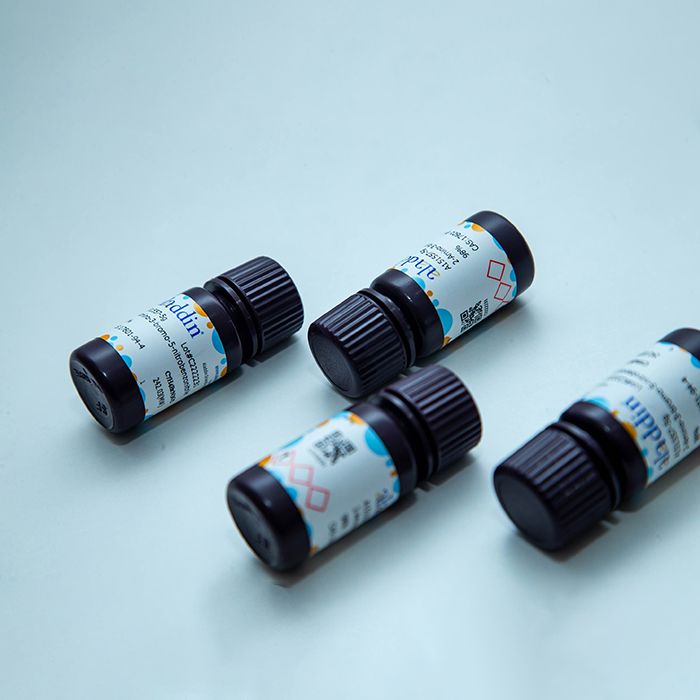
Relamorelin (RM-131) TFA, a pentapeptide ghrelin analog, is a selective ghrelin/growth hormone secretagogue receptor (GHSR) agonist with a K i of 0.42 nM for GHS-1a receptor. Relamorelin TFA is centrally penetrant. Relamorelin TFA increases growth hormone levels and accelerates gastric emptying. Relamorelin TFA has the potential for cachexia, gastroparesis, and gastric/intestinal dysmobility disorders research
In Vitro
Relamorelin (RM-131) TFA shows ∼3 times greater affinity for GHS-1a (K i =0.42 nM) than native ghrelin (K i =1.12 nM). Relamorelin TFA is 6 times more potent (EC 50 =0.71 nM) in activating the GHS-1a receptor than native ghrelin (EC 50 =4.2 nM) as assessed in vitro by calcium mobilization. MCE has not independently confirmed the accuracy of these methods. They are for reference only.
In Vivo
Relamorelin (RM-131; 50-500 nmol/kg/day; s.c.; continuous infusion for 5 days) TFA decreases the loss of body mass and fat mass. Relamorelin (500 nmol/kg/day; continuous infusion for 5 days) TFA increases the food intake and weight gain in rats . RM-131 (250-500 nmol/kg; a single s.c.) TFA stimulates acute food intake in wt but not growth hormone secretagogue receptor (GHR) ko mice. MCE has not independently confirmed the accuracy of these methods. They are for reference only. Animal Model: F344/NTacfBR male rats implanted with tumor Dosage: 50, 500 nmol/kg/day Administration: SC; continuous infusion at a rate of 0.5 μL/h for 5 d Result: Resulted in an increase in food intake (tumor/saline 41.4 g, tumor/BIM-28131 72.5 g) and weight gain (tumor/saline -10.3%, tumor/BIM-28131 +19.5%).
Form:Solid
IC50& Target:Ki: 0.42 nM (GHS-1a)
Specifiche
Specifiche e purezza
≥99%
Meccanismi biochimici e fisiologici
Relamorelin (RM-131) TFA, a pentapeptide ghrelin analog, is a selective ghrelin/growth hormone secretagogue receptor (GHSR) agonist with a K i of 0.42 nM for GHS-1a receptor. Relamorelin TFA is centrally penetrant. Relamorelin TFA increases growth hormone
Condizioni di conservazione di stoccaggio
Desiccated,Store at -80°C
Spedito in
Dry ice packs + Cold packs
Questo prodotto richiede spedizione a catena fredda. I servizi di terra e altri servizi economici non sono disponibili.
Purezza
≥99%
Nomi e identificatori
Peso molecolare
905.00
Dati avanzati
Certificati (CoA, COO, BSE/TSE e tabella di analisi)
C of A & Other Certificates(BSE/TSE, COO):
Analytical Chart:
Proprietà chimiche e fisiche
Solubilità
H2O : 100 mg/mL (110.50 mM; Need ultrasonic)
Calcolatori di soluzioni
Molarity Calculator
Determine the necessary mass, volume, or concentration for preparing a solution.
Dilution Calculator
Determine the dilution needed to prepare a stock solution.
Reconstitution Calculator
Recensioni
Recensioni dei clienti
Application Protocols
No tested application protocols, recommended concentrations, or validated assay formats are provided in the Product Data for this item.
General literature-based guidance for peptide agonist studies (to be validated by the user):
Cell-based assays: prepare sterile stock solutions (water or DMSO), dilute into culture-compatible buffer/media, and assess responses using readouts such as calcium flux, cAMP, or reporter assays. Include vehicle and negative controls.
Binding assays: perform saturation/competition assays on membranes or intact cells expressing the receptor of interest. Use serial dilutions spanning ≥4–5 orders of magnitude to define potency curves.
Stability checks: monitor by analytical HPLC and LC–MS after preparation and after incubation under assay conditions to confirm integrity.
These are non-specific suggestions and should not be treated as validated protocols for SKU R648040.
Biological Roles
No item-specific biological role or target information is provided in the Product Data. The following is general literature context for peptide agonist analogues related to the ghrelin axis, offered for research planning only and not as product specifications.
Ghrelin pathway (general): Ghrelin is an endogenous peptide hormone that activates the growth hormone secretagogue receptor (GHS-R1a), a GPCR. Synthetic analogues are widely used to study receptor pharmacology, intracellular signaling cascades, and receptor trafficking.
Cellular readouts (general): Activation can be monitored via G-protein signaling (Gq/Gi/Gs context-dependent), calcium mobilization, cAMP modulation, and downstream kinase activation.
Research applications:
Probe receptor binding affinity, agonist efficacy, and biased signaling using cell-based assays.
Map structure–activity relationships (SAR) by comparing analogues with varied residue substitutions or backbone constraints.
Note: Do not infer therapeutic properties from these roles. This product is provided strictly for research use only.
Buffer Applications
This product is a peptide TFA salt and is not itself a buffering agent. Therefore, conventional buffer system design (e.g., phosphate, HEPES, TRIS) does not apply to the compound as a reagent.
Practical notes (general):
Prepare assay solutions in an appropriate biological buffer (e.g., PBS, HEPES) compatible with your cells or biochemical system.
If initial dissolution requires acidified water or a co-solvent, back-dilute into the working buffer and verify pH and osmolality.
Sterile filtration (0.22 µm) may be used for cell-based work if the peptide remains soluble.
For buffer recipes and pH ranges, refer to standard laboratory buffer references; these are independent of this compound.
Green Alternatives
While a greener "alternative compound" is not typically applicable for a specific peptide tool compound, aspects of handling and formulation can be optimized for greener practice (general guidance):
Counterion considerations:
TFA is persistent in the environment. Where feasible for your application, consider acetate or hydrochloride counterions in development-scale research to reduce TFA burden (requires re-salting; not item-specific and not supplied here).
Solvent choices:
Prefer water or aqueous buffers when solubility permits.
If organic co-solvent is needed, minimize DMSO volume; small amounts of ethanol or glycerol may substitute in some bioassays.
Process suggestions:
Use microscale dissolution tests to limit solvent waste.
Employ amber vials and low headspace to extend solution lifetime, reducing repeated preparations.
Comparison (general):
TFA salt vs acetate salt
Environmental profile: TFA (less preferred) vs acetate (more benign)
Solubility in acidic media: both generally favorable; specific performance depends on sequence
Assay interference: TFA can suppress MS signals; acetate often more MS-friendly
These are general sustainability considerations and not specifications for SKU R648040.
Pharmaceutical Uses
No pharmacopeial status or excipient role is provided for this item. Aladdin supplies this material for research use only; it is not for human or veterinary use.
General formulation considerations for peptide salts (literature/general):
Vehicles: sterile water, saline, or buffer systems are commonly explored in pre-formulation research; pH adjustment may improve solubility/stability.
Stabilization strategies: inclusion of antioxidants, bulking agents (e.g., mannitol, trehalose), or surfactants (e.g., polysorbates at low levels) can be evaluated in research settings.
Counterion impact: TFA counterions can influence MS analysis and may affect pH and isotonicity; re-salting to acetate or HCl is sometimes explored during development (not applicable to the supplied catalog item unless performed by the user).
No clinical or therapeutic claims are made or implied. For any regulated use, consult appropriate pharmacopeial and regulatory guidance; this listing provides no such designation.
Physical Properties
Item-specific physicochemical constants are not provided in the Product Data. Typical properties of peptide TFA salts are noted as literature/general guidance only.
Item-specific (specification status):
Appearance: Not specified for this item; refer to CoA/Spec Sheet.
Molecular Weight: Not specified for this item; refer to CoA/Spec Sheet.
Molecular Formula: Not specified for this item; refer to CoA/Spec Sheet.
Melting point, boiling point, density, refractive index, logP: Not specified for this item; refer to CoA/Spec Sheet.
Solubility: Not specified for this item; refer to CoA/Spec Sheet.
Literature/general peptide salt behavior (for planning only):
Aggregate state: typically a solid (often amorphous or lyophilized powder for small peptides)
Hygroscopicity: many peptide TFA salts are hygroscopic and may absorb moisture; handle quickly in low-humidity environments
Solubility tendencies: small peptides often dissolve in water, dilute acids (e.g., 0.1% TFA or acetic acid), phosphate buffers, or DMSO; actual solubility depends strongly on the specific sequence and modifications
pH effects: basic residues increase water solubility in acidic media; aromatic/hydrophobic content may favor organic co-solvent use
Important: Do not treat the above as specifications. For exact values and solvent recommendations for this catalog item, consult the CoA/Spec Sheet.
Quality and Grades
Item-specific grade/purity are not provided in the Product Data.
Grade/Purity: Not specified for this item; refer to CoA/Spec Sheet.
Context for peptide TFA salts (general):
Peptide materials are commonly supplied as TFA salts after RP-HPLC purification. Trace TFA content and counterion stoichiometry may vary and are typically reported on the CoA.
Purity reporting: peptide purity is often determined by analytical RP-HPLC (UV at 214/220 nm) and mass spectrometry. Minor related substances may include deletion sequences, diastereomers (from epimerization), or protecting-group remnants.
Residual solvents and water: lyophilized peptides can contain residual water and volatile buffers. Karl Fischer or thermogravimetric data may be presented on the CoA.
Identity confirmation: MS (ESI/MALDI), exact mass/charge states, and sometimes NMR for small peptides; amino acid analysis or sequencing may be used as supportive evidence.
UV characteristics: aromatic residues (e.g., Trp, Tyr, Phe) contribute to UV absorbance; low-UV solvent systems (e.g., TFA/water/acetonitrile) are standard for HPLC assays (general note).
For this specific catalog item, consult the CoA/Spec Sheet for actual purity, counterion content, and analytical method details.
Reaction and Applications
Manufacturer Applications: Not provided in the Product Data for this item.
General research uses for synthetic peptide agonist analogues (literature/general):
Serve as reference standards or tool compounds in receptor pharmacology, binding assays, and signal transduction studies in vitro. Relamorelin analogues are commonly used to probe ghrelin-receptor–mediated pathways in cells or membranes; verify receptor context in your laboratory system.
Employed as positive controls in pathway activation readouts (e.g., calcium flux, cAMP, ERK phosphorylation), pending assay validation.
Utilized in SAR benchmarking against new analogues in medicinal chemistry campaigns.
Practical considerations:
Prepare fresh aliquots to minimize freeze–thaw; filter-sterilize (0.22 µm) for cell-based assays where compatible.
Confirm concentration by UV absorbance if aromatic residues are present (e.g., Trp/Tyr at 280 nm), or by amino acid analysis; exact extinction coefficients depend on sequence (not provided for this item).
Verify receptor expression in assay cells and include negative controls to assess off-target responses.
Note: The above points are general guidance for peptide receptor agonists and are not item-specific specifications.
Reaction Conditions
No chemical reaction conditions are specified for this product in the catalog data, as it is supplied as a peptide TFA salt intended for use as a research reagent rather than a synthetic intermediate.
General assay preparation conditions (literature guidance only):
Stock solution: dissolve in water, 0.1% TFA(aq), or DMSO depending on solubility; typical stock concentrations for peptides range from 1–10 mM, subject to sequence solubility and assay needs.
Working solutions: dilute stocks into assay buffer (e.g., HBSS, PBS, HEPES-buffered media) to the desired final concentration; minimize organic co-solvent content.
Temperature: prepare and store solutions on ice or at 2–8°C during short handling to mitigate degradation; avoid repeated warming–cooling cycles.
Light sensitivity: peptides with Trp/Tyr may be photosensitive; use amber vials if applicable.
These recommendations are general and must be validated for the specific lot and application. They are not item specifications.
Safety and Handling
Hazard classifications are not provided in the Product Data. Always consult the SDS for authoritative information and institutional requirements.
GHS information: Not specified for this item; refer to SDS.
Signal word / H-statements / Pictograms: Not specified for this item; refer to SDS.
General laboratory guidance for peptide TFA salts (literature/common practice):
PPE: wear lab coat, safety glasses, and appropriate gloves. Avoid inhalation of powders; consider handling under a hood or with local exhaust.
Avoid contact: TFA counterions can render preparations mildly acidic; avoid skin and eye contact.
Incompatibilities: avoid strong bases (may deprotect/epimerize certain residues) and strong oxidizers. Keep away from moisture to prevent hydrolysis or aggregation.
First aid (general):
Skin/eye contact: rinse with copious water for at least 15 minutes; remove contaminated clothing. Seek medical attention if irritation persists.
Inhalation: move to fresh air; obtain medical attention if symptoms occur.
Ingestion: rinse mouth; do not induce vomiting; seek medical advice.
Spills: avoid dust formation; gently sweep or use a HEPA-filtered vacuum; dispose according to local regulations.
Waste: collect aqueous/organic solutions and solids as chemical waste following institutional procedures.
Always defer to the SDS for definitive hazard data and to your EHS office for site-specific handling protocols.
Solvent Selection
No item-specific solubility data are provided. The following are literature-based considerations for small peptide TFA salts and should be verified empirically for this item.
Polarity class: highly polar, ionic salt; solubility hinges on sequence hydrophobicity and charge.
Common solvents (general):
Water or aqueous buffers (e.g., PBS) often suitable for hydrophilic sequences.
Dilute acid (e.g., 0.05–0.1% TFA or acetic acid in water) can improve solubility for basic peptides by ensuring protonation.
DMSO or DMF can aid dissolution of hydrophobic/aromatic sequences; subsequently dilute with aqueous media.
Alcohols (MeOH, EtOH) sometimes assist as co-solvents.
Practical approach:
Start with a small test aliquot and screen water, 0.1% TFA(aq), and DMSO at room temperature.
Gentle warming (≤37°C) and brief sonication can help; avoid prolonged heating to prevent degradation.
Compatibility notes (general):
Avoid strong base unless specifically required; risk of amide hydrolysis/epimerization.
For bioassays, limit DMSO content (commonly ≤0.1–1% v/v in final mixtures) and sterile-filter if appropriate.
Important: For definitive solvent recommendations for Relamorelin TFA (SKU R648040), refer to the product’s CoA/Spec Sheet or perform small-scale solubility testing.
Storage and Reconstitution
Storage conditions (from Product Data):
Store desiccated, at -80°C.
Shipped on dry ice packs + cold packs to maintain low temperature.
Additional handling guidance (general, not item-specific):
Upon receipt: allow the sealed container to equilibrate to room temperature in a desiccator before opening to avoid moisture condensation.
Aliquoting: if reconstitution is required, prepare single-use aliquots to minimize freeze–thaw cycles. Store aliquots at -80°C.
Reconstitution solvent: Not specified for this item; refer to CoA/Spec Sheet. As general practice for peptides, consider water, dilute acid (e.g., 0.1% TFA or acetic acid), or DMSO depending on solubility; confirm compatibility with your application.
Solution storage (general): aqueous solutions are typically kept at 2–8°C for short term (hours–days) or -20 to -80°C for longer term; verify stability by analytical HPLC/LC–MS.
Light/moisture protection: use amber vials where appropriate and maintain low humidity.
Always defer to the product’s CoA/Spec Sheet and SDS for item-specific reconstitution instructions and stability guidance.
Structure and Identity
Relamorelin TFA is supplied as the trifluoroacetate salt of a synthetic peptide agonist analogue. Item-specific identifiers are not provided in the Product Data.
Compound type: synthetic peptide, provided as a trifluoroacetate (TFA) salt
Counterion: trifluoroacetate, typically associated with peptide purification by TFA-containing RP-HPLC (general information)
Functional groups (general/literature):
Peptide amide backbone with multiple amide bonds
Side-chain functionalities characteristic of amino acids (e.g., aromatic, polar, or aliphatic residues depending on sequence; exact sequence not provided)
Terminal functionalities typically include N-terminus and C-terminus (often protected/modified in peptide analogues; specifics not provided)
Associated trifluoroacetate anion (CF3COO−)
Item-specific identifiers (refer to CoA/Spec Sheet):
Molecular Formula: Not specified for this item; refer to CoA/Spec Sheet.
Molecular Weight: Not specified for this item; refer to CoA/Spec Sheet.
SMILES: Not specified for this item; refer to CoA/Spec Sheet.
InChIKey: Not specified for this item; refer to CoA/Spec Sheet.
CAS: 2863659-22-5 (provided)
2D description (general): A short peptide chain comprising sequential amide-linked residues; side chains project alternately from the backbone. The salt form includes one or more trifluoroacetate counterions ion-paired to protonated basic sites.
Synthetic Utility
Relamorelin TFA is an end-product peptide salt rather than a general synthetic building block. Synthetic applications are therefore limited. General considerations (literature):
Use as a reference standard in analytical method development (LC–MS, HPLC) for peptide quantification or stability-indicating methods.
Employed as a benchmark ligand in medicinal chemistry to contextualize SAR of new analogues targeting the same receptor pathway.
Limited derivatization: N- or side-chain conjugations (e.g., fluorescent tags, biotin) may be feasible under mild conditions if reactive handles exist; the exact sequence and available handles for this item are not provided.
Not typically used in multistep small-molecule synthesis or in common name reactions.
Because the exact sequence and protective group status are not specified for this item, any modification strategies must be developed empirically and verified by analytical characterization.
Target Specificity
Item-specific target information, binding constants, or receptor specificity are not provided in the Product Data. No epitope, antigen, species reactivity, or clone/isotype information applies, as this is not an antibody product.
Consult primary literature for receptor pharmacology relevant to ghrelin-pathway peptide analogues if your research requires such detail. Do not infer target data for this catalog item without experimental confirmation.
Domande frequenti
What is the purity of this product?
This product is supplied at ≥99% purity (chemical assay). Lot-specific values are stated on the Certificate of Analysis.
How should this product be stored?
Store at ?80 °C, desiccated. Keep the container tightly closed with desiccant — the material is moisture-sensitive.
How is this product shipped?
This product ships frozen with dry ice and cold packs. Unpack on arrival and transfer it to the storage condition stated above; handle dry ice with insulated gloves in a ventilated area.
What are the CAS number, molecular formula and molecular weight?
The CAS Number is 2863659-22-5, the molecular formula is C45H51F3N8O7S, and the molecular weight is 905.00 g/mol.
What documentation is provided?
Available product documentation, including Certificates of Analysis (COA), Safety Data Sheets (SDS), and specification sheets, is shown in the product document area. Document availability and access follow the current site policy.
Utilizziamo i cookie per garantire il corretto funzionamento del sito web e, ove consentito, per migliorare la tua esperienza. Puoi gestire le tue preferenze in qualsiasi momento nelle Impostazioni. Per saperne di più, consulta la nostra Cookie Policy.
Desidera che le inviamo un messaggio quando avremo sconti disponibili?
Ricordamelo più tardi
Grazie! Controlli la sua casella di posta per confermare.
Products are supplied to verified businesses, institutions, and qualified professionals for research and development use only. Not for use in humans, animals, diagnosis, or therapy.