GRADE & PURITYMoligand™?Moligand™ — Aladdin's line of ligands and bioactive small molecules. Use for receptor, pathway, and binding studies needing defined small-molecule tools.10 mM in DMSO
Moligand™, 10 mM in DMSO Moligand™ for sensitive chromatographic and analytical workflows requiring minimal baseline interference.
🌡
Storage & shipping
Store at -80°C Ships Dry ice packs + Cold packs Check lot-specific COA for exact specifications.
📋
Quality documents
SDS, COA, datasheet, and spec sheet available for download. Lot-specific COA accessible via lot number lookup.
📚
Literature proof
Cited in 0 peer-reviewed publications across chromatography, organic synthesis, and cross-coupling reactions.
Panoramica
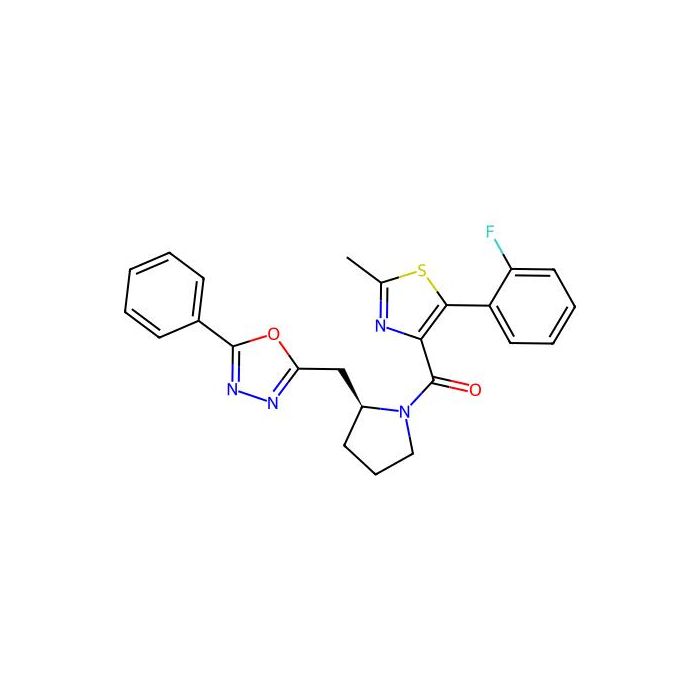
SB-674042 is a potent and selective non-peptide orexin OX 1 receptor antagonist (K d =5.03 nM), exhibits 100-fold selectivity for OX 1 over OX 2 receptors with IC 50 values of 3.76 nM and 531 nM, respectively .
Specifications
Specifiche e purezza
Moligand™, 10 mM in DMSO
Condizioni di conservazione di stoccaggio
Store at -80°C
Spedito in
Dry ice packs + Cold packs
Questo prodotto richiede spedizione a catena fredda. I servizi di terra e altri servizi economici non sono disponibili.
Certificati (CoA, COO, BSE/TSE e tabella di analisi)
C of A & Other Certificates(BSE/TSE, COO):
Analytical Chart:
Calcolatori di soluzioni
Molarity Calculator
Determine the necessary mass, volume, or concentration for preparing a solution.
Dilution Calculator
Determine the dilution needed to prepare a stock solution.
Reconstitution Calculator
Recensioni
Recensioni dei clienti
Application Protocols
No tested applications, assay formats, or recommended dilutions are provided for this item in the catalog listing.
General guidance (not item-specific; verify and optimize in your lab):
Prepare a DMSO stock (e.g., 10–50 mM), then generate a serial dilution in DMSO for plate-based assays to achieve accurate titrations upon aqueous dilution.
Maintain constant final DMSO across wells and controls.
Include vehicle controls and, where appropriate, orthogonal readouts (binding vs. function) to confirm target engagement.
For any validated, item-specific protocols (e.g., WB/IHC/IF/FC are not applicable to small molecules), refer to future updates or the CoA if provided.
Biological Roles
Item-specific biological data are not provided in this listing.
Literature/general context (for research use only):
SB-674042 is reported in the literature as a small-molecule antagonist of the orexin-1 receptor (OX1R, HCRTR1). The orexin (hypocretin) neuropeptide system comprises OX1R and OX2R, which modulate arousal, stress responses, reward pathways, and feeding behaviors.
As a selective OX1R antagonist, SB-674042 is commonly utilized as a tool compound to dissect OX1R-mediated signaling versus OX2R contributions in cellular and ex vivo systems. Selectivity versus OX2R and other GPCRs is discussed in the primary literature; exact Ki/IC50 values are not specified here.
Typical experimental paradigms (general):
Inhibition of orexin A (OXA)-induced responses in OX1R-expressing cells (e.g., calcium mobilization, reporter gene assays).
Receptor binding assays to quantify displacement of radiolabeled orexin ligands at OX1R.
Pathway studies examining downstream effectors (e.g., phospholipase C signaling, ERK phosphorylation) under OX1R blockade.
Important: No medical or clinical claims are made. This compound is provided strictly as a research tool to interrogate orexin biology in vitro or in non-clinical models.
Buffer Applications
This product is a hydrophobic small-molecule ligand rather than a buffering agent. It does not serve as a pH buffer component.
General assay buffer considerations (not item-specific):
Use physiological buffers (e.g., HEPES, PBS) supplemented with minimal DMSO (often ≤0.1–0.5% v/v) when introducing compound stocks.
Include appropriate carriers (e.g., 0.1% BSA) or detergents (e.g., 0.01–0.05% Tween-20) only if compatible with your assay readout and target.
Validate that the buffer composition does not alter receptor pharmacology or assay sensitivity.
Green Alternatives
Green chemistry considerations are not directly applicable because this listing is a bioactive screening compound, not a process solvent or bulk reagent.
General best practices for greener use in screening workflows:
Minimize DMSO volumes and use microplate formats that reduce waste.
Consolidate shipments and store long-term at prescribed low temperatures to reduce product loss and re-orders.
Use aqueous assay buffers with the lowest feasible co-solvent content, validating performance.
There are no direct "green alternatives" to SB-674042 as a chemical entity, since the biological activity is structure-specific. Any substitutions would be alternative tool compounds with different structures and profiles; selection should be guided by target pharmacology rather than green metrics.
Pharmaceutical Uses
No excipient or pharmacopeial status is provided for this item. This product is supplied strictly for research use only.
General, non-clinical context:
SB-674042 is commonly referenced in the literature as a selective OX1R antagonist used as a tool compound in discovery research, assay development, and target validation.
Potential roles in pharmaceutical R&D (preclinical research settings) include: reference control in receptor-binding and functional assays, selectivity benchmarking versus related GPCR targets, and use in phenotypic screens probing orexin pathway involvement.
Important: No therapeutic, diagnostic, or clinical claims are made for this product. It is not approved for human or veterinary administration and is not intended for formulation development without appropriate regulatory due diligence.
Physical Properties
Appearance: Not specified for this item; refer to CoA/Spec Sheet.
Molecular weight (item-specific): Not specified for this item; refer to CoA/Spec Sheet.
Molecular formula (item-specific): Not specified for this item; refer to CoA/Spec Sheet.
Melting point, boiling point, density, refractive index: Not specified for this item; refer to CoA/Spec Sheet.
Solubility (item-specific): Not specified for this item; refer to CoA/Spec Sheet.
LogP, pKa: Not specified for this item; refer to CoA/Spec Sheet.
General notes (literature/practice):
For screening compounds of this class, stocks are commonly prepared in anhydrous DMSO and diluted into assay buffers immediately prior to use to minimize precipitation. Exact solubility limits for SB-674042 should be verified experimentally.
If handling as a solid at low temperature, allow to equilibrate in a desiccator before opening to reduce moisture condensation. These are general best practices and not item-specific specifications.
Quality and Grades
Grade/Purity: Moligand™
What Moligand™ typically implies (general program description; not item-specific specifications):
Curated small-molecule ligands suitable for screening, target validation, and SAR exploration.
Emphasis on identity confirmation (e.g., LC–MS/HRMS and/or NMR) and high chemical purity suitable for bioassay development. Exact purity thresholds and test methods can vary by lot; verify on the CoA.
Packaged and shipped to preserve integrity for library use (e.g., low-temperature logistics).
Item-specific details such as exact purity %, residual solvents, water content, and assay verification: Not specified for this item; refer to CoA/Spec Sheet.
Practical implications for users:
Expect compound quality aligned with discovery screening needs (low impurities that could confound assays).
Confirm identity/purity data on receipt (match CoA) before critical studies.
If using in quantitative studies (e.g., potency ranking), consider an orthogonal purity check (HPLC area% vs. qNMR) and document salt form if applicable (not specified in this listing).
Reaction and Applications
This product is a finalized bioactive small molecule intended for screening and target engagement studies, not a synthetic reagent. As such, it is not typically employed as a catalyst, coupling partner, or stoichiometric reagent in preparative organic reactions.
Applicable research uses (general, non-clinical):
Reference compound for receptor pharmacology, target validation, and pathway interrogation in cellular or biochemical assays.
Not applicable here: Grignard reactions, cross-couplings, or other synthetic methodologies. For synthesis-focused content, see the Synthetic Utility and Reaction Conditions sections (both largely not applicable to this compound’s intended use).
Reaction Conditions
Preparative reaction conditions are not applicable. This product is intended for bioassays rather than chemical synthesis.
General handling for assay preparation (not item-specific):
Prepare concentrated stocks in dry DMSO under inert gas if long-term stability is a concern; aliquot to minimize freeze–thaw cycles.
Dilute into assay buffer immediately before use; mix thoroughly to avoid local supersaturation and precipitation.
Typical working concentrations in cell-based assays for small-molecule GPCR ligands range from low nanomolar to low micromolar; determine optimal ranges empirically for your system.
Safety and Handling
GHS classification, signal word, pictograms, and H-statements: Not specified for this item; refer to SDS.
Research Use: For research use only. Not for human or veterinary use.
Recommended PPE (general best practice): Laboratory coat, nitrile gloves, safety glasses; handle powders in a fume hood or ventilated enclosure to avoid inhalation of dust or aerosols.
Handling guidance:
Work on clean, dry surfaces; avoid cross-contamination of screening libraries.
When preparing DMSO stocks, use low-water content solvent and sterile, chemically compatible vials.
Avoid skin contact and inhalation; prevent ingestion. Wash thoroughly after handling.
Storage incompatibilities (general): Avoid strong oxidizers and strong acids/bases unless compatibility is known. Keep away from sources of ignition and moisture when applicable.
First-aid overview (consult SDS for details):
Skin/eye contact: Rinse with copious water for at least 15 minutes; seek medical attention if irritation persists.
Inhalation: Move to fresh air; seek medical attention if symptoms occur.
Ingestion: Rinse mouth; do not induce vomiting; seek medical attention.
Waste disposal: Dispose according to institutional and local regulations for organic research chemicals.
Special notes: Hazard details for this specific item are not provided in this listing. The SDS is the authoritative source for safe handling, exposure limits, and response measures.
Solvent Selection
This product is a bioactive small molecule supplied for screening/library applications rather than as a reaction solvent. Solvent selection therefore focuses on dissolution for stock solutions and biological assays.
Primary stock solvent (general practice):
DMSO (anhydrous) is commonly used to prepare concentrated stocks (e.g., 10–50 mM), then diluted into assay buffers immediately before use to limit precipitation and DMSO exposure to cells/enzymes.
Alternative co-solvents (if needed; literature/practice):
DMF, acetonitrile, or ethanol in small percentages as co-solvents with aqueous buffers; compatibility must be validated per assay.
Aqueous handling:
Many heteroaromatic ligands have limited water solubility; use minimal final DMSO (often ≤0.1–0.5% v/v in cell assays) to avoid solvent effects. Determine actual solubility empirically for SB-674042.
Buffer compatibility tips:
Include carrier protein (e.g., 0.1% BSA) or nonionic surfactant (e.g., 0.01–0.05% Tween-20) in binding assays when permissible to mitigate nonspecific binding/adsorption; validate that these additives do not affect your readout.
Not specified for this item: exact solubility limits, pH stability window, or co-solvent ratios. Verify experimentally and consult CoA for any item-specific notes.
Ethanol: lower solvating power; higher volatility; can perturb membranes.
DMF/ACN: good solvency; check assay/cellular tolerance carefully.
Storage and Reconstitution
Storage conditions (item-specific): Store at -80°C.
Shipped in (item-specific): Dry ice packs + Cold packs to maintain low temperature.
Container: Keep tightly closed in a moisture-free, light-protected container as appropriate for small-molecule libraries.
Stability: Exact shelf-life and stability data are not specified for this item; refer to CoA/Spec Sheet.
Reconstitution and working solution guidance (general best practice; not item-specific specifications):
Allow the container to equilibrate to room temperature in a desiccator before opening to prevent moisture condensation.
Dissolve in anhydrous DMSO to make a concentrated stock (e.g., 10–50 mM). Filter sterilize through a compatible low-protein-binding membrane if sterility is required.
Aliquot and store stocks at -20 to -80°C to avoid repeated freeze–thaw cycles. Record freeze–thaw count.
On the day of use, dilute into buffered media immediately before dosing; keep final DMSO low and constant across controls.
Note: When available, always prioritize item-specific instructions on the CoA/SDS over general guidance.
Structure and Identity
Item-specific identifiers:
Product Name: SB-674042
SKU: S1494212
CAS: 483313-22-0
PubChem CID: 10204153
Category: Small molecules and compound libraries (小分子和化合物库)
Molecular formula: Not specified for this item; refer to CoA/Spec Sheet.
Molecular weight: Not specified for this item; refer to CoA/Spec Sheet.
SMILES: Not specified for this item; refer to CoA/Spec Sheet.
InChIKey: Not specified for this item; refer to CoA/Spec Sheet.
Structural features (general/literature): SB-674042 is reported in the literature as a small-molecule antagonist of the orexin-1 receptor (OX1R). Detailed ring systems and functional group annotations are not provided in this listing; consult primary literature or the CoA/SDS for an exact 2D structure description.
2D structure description: Not specified here; see CoA/Spec Sheet for structure depiction.
Synthetic Utility
This compound is supplied as a finished bioactive small molecule for screening. It is not typically used as a synthetic intermediate or reagent.
Not applicable: Use as a coupling partner, protecting group reagent, catalyst, or stoichiometric reagent.
If derivatization is desired for probe development (e.g., biotinylation or fluorophore tagging), consult the primary literature for structure–activity relationships to identify positions tolerant to modification. Such modifications are outside the scope of this catalog listing and may alter target engagement.
Target Specificity
Item-specific target data for this catalog entry are not provided.
General literature note: SB-674042 is described as a selective antagonist of the orexin-1 receptor (OX1R). Exact potency, selectivity ratios, and off-target profiles are not specified here; consult primary literature and the CoA/SDS for additional details if available.
Need help choosing the grade?
Our grade selection guide covers purity, stabilizer status, and application suitability for all variants in our catalog.
We use cookies to ensure the website functions properly and, where permitted, to improve your experience. You can manage your preferences at any time in Settings. Learn more in our Cookie Policy.
Shall we send you a message when we have discounts available?
Remind me later
Thank you! Please check your email inbox to confirm.
Products are supplied to verified businesses, institutions, and qualified professionals for research and development use only. Not for use in humans, animals, diagnosis, or therapy.