QUALITÀ & PUREZZAMoligand™?Moligand™ — Aladdin's line of ligands and bioactive small molecules. Use for receptor, pathway, and binding studies needing defined small-molecule tools.≥98%
Storage
Protected from light,Store at -20°C,Argon charged,Desiccated
In Vitro:Selepressin acetate (100 nM, 48 or 72 h) ameliorates thrombin or VEGF-induced HLMVECs barrier dysfunction. Selepressin acetate (1-1000 nM, 72 h) prevents the LPS-Induced loss of VE-cadherin and cortical actin in HLMVECs. Selepressin acetate (100
In Vivo:Selepressin acetate (1 μg/kg/min, left jugular vein infusion for 12 min) increases 38.5% of the mean arterial pressure (MAP) in LPS-induced, fluid-resuscitated rabbit endotoxemia model. Selepressin acetate (7 pmol/kg/min, 10 μL/min, i.v. infusion) bl
Specifiche
Specifiche e purezza
Moligand™, ≥98%
Condizioni di conservazione di stoccaggio
Protected from light,Store at -20°C,Argon charged,Desiccated
Spedito in
Ice chest + Ice pads
Questo prodotto richiede spedizione a catena fredda. I servizi di terra e altri servizi economici non sono disponibili.
Certificati (CoA, COO, BSE/TSE e tabella di analisi)
C of A & Other Certificates(BSE/TSE, COO):
Analytical Chart:
Proprietà chimiche e fisiche
Solubilità
H2O : 100 mg/mL (90.23 mM; Need ultrasonic)
Sensibilità
Moisture & light sensitive
Calcolatori di soluzioni
Molarity Calculator
Determine the necessary mass, volume, or concentration for preparing a solution.
Dilution Calculator
Determine the dilution needed to prepare a stock solution.
Reconstitution Calculator
Recensioni
Recensioni dei clienti
Application Protocols
No vendor-tested application protocols are provided for this item. The following are general, literature-based starting points for peptidic GPCR ligands and are not item-specific instructions.
GPCR calcium flux assay (general outline)
Plate cells expressing human AVPR1A at appropriate density on poly-D-lysine–coated plates; culture overnight.
Load with Ca2+-sensitive dye in assay buffer (e.g., HEPES-buffered saline with 2.5 mM probenecid) for 30–60 min at 37 °C.
Equilibrate at room temperature; stimulate with serial dilutions of ligand; record fluorescence in real time.
Analyze concentration–response to estimate EC50/Emax; include vehicle and known reference agonist controls.
Radioligand binding (membranes) – competition format (general)
Prepare membrane fractions expressing AVPR1A.
Incubate with fixed concentration of radiolabeled vasopressin analog and varying concentrations of test ligand in binding buffer (e.g., 50 mM Tris, pH 7.4, with Mg2+ and BSA) at 25 °C.
Separate bound/free by rapid filtration; quantify radioactivity; fit Ki via Cheng–Prusoff correction.
Notes
Optimize buffer components, temperature, and incubation time for your system.
Validate absence of adsorption losses; use low-bind plastics and consider carrier protein if compatible.
Refer to peer-reviewed protocols for detailed conditions and to your institutional safety rules for handling dyes and radioligands.
Biological Roles
Literature/general biology (context; not item specifications)
Target pathway: Selepressin is described as a selective agonist of the vasopressin V1a receptor (AVPR1A), a Gq/11-coupled GPCR that activates phospholipase C, leading to IP3/DAG production and Ca2+ mobilization.
Physiological framework: The vasopressin system regulates vascular smooth muscle tone, social behavior pathways, and stress responses in mammals (literature). V1a receptors are broadly expressed in vascular and certain CNS tissues.
Signaling outputs: V1a activation commonly stimulates Ca2+-dependent kinases, Rho/ROCK pathways, and MAPK cascades, influencing contraction and gene expression.
Selectivity rationale: Structural features of vasopressin analogs (e.g., ring conformation, side-chain basicity, aromatic residues) tune receptor subtype selectivity (V1a vs V1b vs V2) (literature).
Research utility
As a tool ligand, selepressin enables dissection of AVPR1A-specific signaling, receptor desensitization/internalization, and biased agonism studies.
Comparative profiling against vasopressin, terlipressin, and V2-selective ligands (e.g., desmopressin) helps map subtype-specific pharmacology.
Important caveats
Biological activity is assay- and system-dependent; receptor expression level, G-protein complement, and buffer composition can shift observed potency and efficacy.
No medical or clinical claims are implied; for research use only as stated in Product Data.
Buffer Applications
This product is a peptide ligand used primarily in receptor pharmacology. It is not a buffering reagent per se, but buffer selection is critical for reproducible bioassay results.
General buffer guidance (literature; not item specifications)
Common assay buffers: HEPES- or Tris-buffered saline (e.g., 10–25 mM buffer, 140 mM NaCl, 1–2 mM Ca2+/Mg2+ if required by the system), pH 7.2–7.4.
Additives to reduce adsorption and degradation: 0.05–0.1% BSA or casein (if compatible), 0.01% Tween-20 for binding assays to lower nonspecific binding, protease inhibitors for tissue homogenates.
pH sensitivity: Avoid extremes (<5 or >8) unless justified; peptides can hydrolyze or undergo side reactions at high/low pH.
Filtration: 0.22 μm sterile filtration for cell-based assays; pre-wet filters with buffer to minimize peptide loss.
Practical tips
Prepare fresh working solutions immediately before use; store aliquots at −20 °C for short periods if necessary.
Validate that any carrier proteins or surfactants do not interfere with receptor signaling or detection chemistry.
For quantitative work, establish a standard operating buffer and document ionic strength, temperature, and any cofactors to ensure inter-experiment comparability.
Green Alternatives
Because this product is a peptide acetate salt rather than an organic solvent or reagent, “green alternatives” mainly concern solvent and process choices during handling and assays.
Greener solvent choices (general guidance)
Prefer water or buffered aqueous media as primary solvents whenever compatible with your assay.
Use minimal DMSO for stock solutions; target ≤1–2% v/v in final assay mixtures to reduce solvent burden.
Comparison (general, not item-specific)
Water/buffer vs DMSO
Environmental impact: Water/buffer is preferred.
Assay performance: Water/buffer is typically ideal for peptide ligands; DMSO may be necessary for high-concentration stocks.
Avoid high volumes of DMF/NMP due to toxicity and disposal concerns.
Operational improvements
Prepare concentrated master stocks to minimize waste and reduce the number of freeze–thaw cycles.
Use low-adsorption labware to limit loss and re-preparation.
Plan serial dilutions to match plate layouts, minimizing overage.
Disposal
Aqueous peptide solutions can often be disposed of via biologically compatible waste streams per institutional rules; avoid halogenated solvent mixtures. Always follow local regulations.
These recommendations aim to reduce solvent use and environmental footprint without altering the chemistry of the active research material.
Pharmaceutical Uses
This listing is for research use only and is not intended for human or veterinary use.
Item-specific (from Product Data)
Research Use Note: For research use only.
General context (literature; not item-specific claims)
Selepressin has been investigated in the scientific literature as a selective vasopressin V1a receptor agonist. In pharmaceutical R&D settings, such ligands may be used as reference standards, positive controls in receptor assays, or tools in preclinical pharmacology.
Peptide acetate salts are commonly formulated in aqueous media for in vitro work; excipient selection (e.g., isotonic buffers, stabilizers) is application-dependent and outside the scope of this catalog entry.
Compliance note
No pharmacopeial monograph or GMP status is indicated for this item. It is not certified for clinical, diagnostic, or therapeutic use. Consult institutional policies for any translational research activities.
Physical Properties
Item-specific (from Product Data)
Appearance: Not specified for this item; refer to CoA/Spec Sheet.
Molecular weight: Not specified for this item; refer to CoA/Spec Sheet.
Literature/general properties for peptide acetate salts (context; not item specifications)
Physical state: Typically white to off-white amorphous solid or lyophilized powder (literature for peptides).
Solubility: Frequently soluble in water and aqueous buffers; high-concentration stocks often prepared in sterile water or DMSO before dilution into buffer (literature). Actual solubility should be confirmed with the CoA.
pKa/logP: Not generally defined for peptides as single values; overall ionization depends on sequence and counterions (literature).
Hygroscopicity: Many peptide acetate salts exhibit hygroscopic behavior; handle under dry conditions (literature).
Not determined for this catalog item (consult CoA/Spec Sheet)
Melting point/boiling point
Density
Refractive index
UV–Vis spectrum and extinction coefficients
HPLC purity trace and residual solvent profile
Practical note (general): For lyophilized peptide salts, apparent solubility can depend on counterion content and concentration. Brief sonication and stepwise pH adjustments (avoiding extreme pH) are commonly used to achieve complete dissolution. Always verify with small-scale trials before preparing assay-grade stocks.
Quality and Grades
Item-specific (from Product Data)
Grade/Purity: Moligand™
What Moligand™ implies (general description)
The Moligand™ designation indicates the material is curated for ligand- and small-molecule/peptidic screening workflows, emphasizing suitability for biochemical/pharmacological assays rather than bulk commodity use.
Typical expectations for Moligand™ items (context; refer to CoA for specifics):
HPLC/LC–MS identity confirmation and assay-focused purity assessment.
Controlled counterion (acetate) form for aqueous compatibility.
Batch-specific certificates providing purity and analytical traces.
Stabilizers and additives
No stabilizers are specified for this item. If present in a specific lot, such information will appear on the CoA. Do not assume presence or absence of TFA, salts, or residual solvents without reviewing lot documentation.
How to use this grade effectively
Verify lot-specific purity, counterion content, and water content prior to quantitative pharmacology.
For plate-based screening, consider preparing single-use aliquots at defined concentrations (e.g., 10 mM in DMSO or 1–10 mg/mL in water/buffer, as permitted by solubility) to ensure reproducibility. Confirm exact solvent compatibility for this lot on the CoA.
Reaction and Applications
Item-specific (from Product Data)
Manufacturer Applications: Not specified in the listing; this product is designated for research use only.
Literature/general research applications for selepressin (context; not item specifications)
GPCR pharmacology: Selepressin is reported as a selective agonist for the vasopressin V1a receptor (AVPR1A). It is commonly used to probe V1a-mediated signaling pathways (e.g., Gq/PLC/IP3/Ca2+ readouts) in recombinant or native systems.
Binding assays: Radioligand displacement or fluorescent ligand binding to quantify affinity and selectivity across V1a/V1b/V2 receptors.
Functional assays: Measurement of intracellular calcium mobilization, ERK phosphorylation, or reporter gene activation in cell lines expressing V1a (literature).
Systems biology: Tool compound for dissecting vasopressinergic signaling networks and receptor trafficking/internalization.
Practical considerations (general)
Prepare fresh working solutions; peptide ligands can adhere to plastics—use low-bind tubes/plates and include carrier protein (e.g., 0.1% BSA) if assay permits.
For concentration–response curves, bracket expected EC50 with 8–12 half-log dilutions. Confirm linearity of signal with time and receptor expression.
Validate selectivity under your assay conditions; receptor reserve and coupling efficiency can shift observed potency.
Note: The above applications are literature-based context for vasopressin-receptor ligands and are not item-specific performance claims. Always confirm activity in your system.
Reaction Conditions
This product is not generally employed as a substrate or reagent in synthetic transformations; thus, classical “reaction conditions” are not applicable.
Assay preparation conditions (general, literature-based; not item-specific)
Stock solutions: Often prepared in sterile water or DMSO at concentrations suitable for serial dilution. Filter-sterilize aqueous stocks when used in cell-based assays.
Working concentrations: Determined empirically via concentration–response curves; ensure vehicle (e.g., DMSO) is matched across controls.
Temperature: Most cell-based assays at 25–37 °C; binding assays at 4–25 °C depending on kinetics and receptor stability.
Time course: Equilibration for binding can range from minutes to hours; functional readouts (Ca2+ flux, ERK) are typically rapid (seconds–minutes). Optimize per system.
Stability factors (general)
Avoid prolonged exposure to room temperature and light. Use low-protein-binding labware. Include antioxidants only if validated not to perturb signaling.
For any chemical derivatization or labeling, select mild aqueous-compatible chemistries (e.g., NHS esters for primary amines) and confirm by LC–MS; conditions must be tailored to the actual sequence, which is not provided here.
Safety and Handling
Item-specific (from Product Data)
Storage: Protect from light; store at −20 °C; argon charged; desiccated.
Shipping: Ice chest + ice pads.
GHS classification, pictograms, signal word, H‑statements: Not specified for this item; refer to SDS.
General laboratory safety guidance (not a substitute for SDS)
PPE: Lab coat, gloves (nitrile recommended), and safety glasses. Work in a clean area to avoid cross-contamination of bioassays.
Handling: Minimize exposure to ambient moisture and air. Open vials at room temperature under inert atmosphere when feasible. Allow cold vials to equilibrate in a desiccator before opening to prevent condensation.
Incompatibilities: Avoid strong oxidizers, strong acids/bases during storage, and reactive acylating/alkylating agents that could modify peptide functional groups (general peptide guidance).
First aid (general): If inhaled or ingested, seek medical attention. In case of skin/eye contact, rinse with water for at least 15 minutes and remove contaminated clothing. Provide SDS to responders.
Accidental release: Avoid aerosolization. Absorb small spills with inert material (e.g., dry wipe), then wet-clean the surface. Dispose according to institutional and local regulations.
Stability considerations (general)
Peptide acetates may undergo hydrolysis/oxidation in solution; prepare fresh working solutions and store aliquots at low temperature. Avoid repeated freeze–thaw cycles.
Always consult the product-specific SDS for authoritative hazard and response information.
Solvent Selection
Selepressin acetate is a peptidic ligand; solvent choice should prioritize chemical stability, complete dissolution, and assay compatibility.
Item-specific (from Product Data)
No item-specific solvent recommendations provided; consult CoA/Spec Sheet.
Literature/general guidance for peptide acetate salts (not item specifications)
Primary solvents: Sterile water or aqueous buffers (e.g., PBS, HEPES) typically provide good solubility for acetate salts. Adjust pH moderately if needed; avoid extremes that promote hydrolysis.
Co-solvents: DMSO can be used to make high-concentration stocks when aqueous solubility is limited; dilute immediately into assay buffer to ≤1–2% DMSO final to protect cells/enzymes where applicable.
Acidic aids: Small percentages of acetic acid can help dissolve basic peptides; verify assay tolerance.
Avoid: Alcohols and nonpolar solvents are generally poor for peptides and can induce aggregation/precipitation (literature).
Comparison snapshot (general)
Water/buffer: Highest biocompatibility; may limit concentration if solubility is modest.
DMSO: Excellent solvating power; ensure compatibility with biological assays and materials.
DMF/NMP: Strong solvents but less favored for bioassays and more challenging to remove; use only if justified.
Practical tips
Filter sterile working solutions (0.22 μm) when appropriate.
Determine solubility empirically at your working temperature and ionic strength; record conditions for reproducibility.
Storage and Reconstitution
Item-specific (from Product Data)
Storage conditions: Protect from light; store at −20 °C; argon charged; desiccated.
Shipping: Ice chest + ice pads.
Reconstitution guidance (general for peptide acetate salts; not item-specific specifications)
Allow vial to warm in a desiccator to room temperature before opening to avoid moisture condensation.
Initial dissolution: Begin with sterile water or compatible buffer. If solubility is limited, prepare a small-volume DMSO concentrate and dilute into buffer immediately. Avoid extreme pH.
Concentration: Determine empirically; common lab practice is 1–10 mg/mL (aqueous) or up to 10–50 mM (DMSO), contingent on solubility and assay tolerance. Verify visually for clarity and absence of particulates.
Sterility: For cell-based assays, 0.22 μm filter after dissolution when compatible with peptide stability.
Aliquoting and storage in solution (general)
Prepare single-use aliquots to avoid repeated freeze–thaw.
Store aliquots at −20 °C or below, protected from light. For extended storage, −80 °C is often preferred.
Stability: Peptides may degrade in aqueous solution; limit storage time (days at 4 °C; weeks at −20 °C) and monitor by LC–MS/HPLC if critical.
Additional notes
Avoid metal contamination and oxidants; use clean, low-binding plasticware or silanized glass.
Record solvent, pH, and concentration on each aliquot for traceability.
For definitive, lot-specific guidance (including exact solubility and sequence-dependent precautions), consult the CoA/Spec Sheet.
Structure and Identity
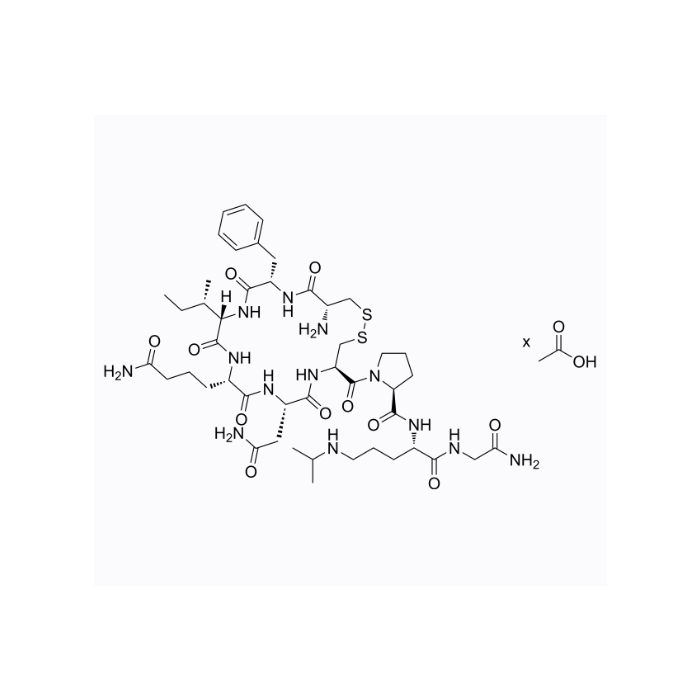
Brief overview: Selepressin acetate is supplied as a research-grade ligand in Aladdin’s Moligand™ collection. Detailed structural identifiers are not provided for this catalog entry; see CoA/Spec Sheet for definitive item-specific identity data.
Item-specific (from Product Data)
SKU: S659198
Name: Selepressin acetate
Grade: Moligand™
CAS: 876296-47-8 (free base)
Molecular formula: Not specified for this item; refer to CoA/Spec Sheet.
Molecular weight: Not specified for this item; refer to CoA/Spec Sheet.
SMILES: Not specified for this item; refer to CoA/Spec Sheet.
InChIKey: Not specified for this item; refer to CoA/Spec Sheet.
Literature/general chemistry (for context; not item specifications)
Selepressin (also known as FE 202158) is described in the literature as a synthetic vasopressin V1a-receptor–selective peptide agonist.
Many vasopressin analogs are cyclic nonapeptides featuring a disulfide bridge (Cys–Cys) and C‑terminal amide (literature). Exact sequence and post-translational modifications for this item are not specified here.
Structural features (descriptive, literature-based)
Peptidic ligand scaffold; potential presence of aromatic (Tyr/Phe) side chains and basic residues typical of vasopressin analogs.
Acetate denotes the counterion form of the peptide salt and does not define sequence.
2D structure in words (literature)
Typically a compact, cyclic peptide backbone formed by an intramolecular disulfide, projecting polar (amide) and side-chain functionalities that enable high-affinity GPCR binding. Exact atom-level representation for this item is not provided in this listing.
Synthetic Utility
Selepressin acetate is a finished peptidic ligand rather than a general synthetic building block; it is not typically used as a reagent in organic synthesis. However, several research-adjacent utilities are relevant.
General utility (literature; not item-specific)
Reference/standard: Serves as a positive control for AVPR1A activation in screening cascades.
Conjugation studies: Peptide ligands are sometimes derivatized with fluorophores or affinity tags to enable binding and trafficking assays. Feasibility depends on available functional groups (e.g., N-terminus, Lys side chain) in the specific sequence; this item’s modifiable sites are not specified—consult CoA/spec for sequence.
Structure–activity relationship (SAR): Can act as a benchmark in medicinal chemistry efforts targeting V1a selectivity.
Not typically applicable
Named organic reactions, catalyst screening, or stoichiometric reagent functions do not generally apply to bioactive peptides like selepressin.
If chemical modification is intended (e.g., labeling), assess potential impact on receptor affinity and signaling bias, and verify that the chosen chemistry is compatible with peptide functional group tolerance.
Target Specificity
Item-specific (from Product Data)
Target, antigen, epitope, clone/isotype, species reactivity: Not applicable/not specified for this item.
Literature context (not item-specific claims)
Selepressin is described as a selective agonist of the vasopressin V1a receptor (AVPR1A). Actual target confirmation, potency, and selectivity for this lot are not specified here and should be established under the user’s assay conditions.
Users should perform in-house verification of receptor specificity and functional responses using appropriate positive/negative controls and, where possible, orthogonal assay formats (e.g., binding vs functional readouts).
Hai bisogno di aiuto per scegliere la qualità?
La nostra guida alla selezione delle qualità copre purezza, stato dello stabilizzatore e idoneità all'applicazione per tutte le varianti del nostro catalogo.
Utilizziamo i cookie per garantire il corretto funzionamento del sito web e, ove consentito, per migliorare la tua esperienza. Puoi gestire le tue preferenze in qualsiasi momento nelle Impostazioni. Per saperne di più, consulta la nostra Cookie Policy.
Desidera che le inviamo un messaggio quando avremo sconti disponibili?
Ricordamelo più tardi
Grazie! Controlli la sua casella di posta per confermare.
Products are supplied to verified businesses, institutions, and qualified professionals for research and development use only. Not for use in humans, animals, diagnosis, or therapy.