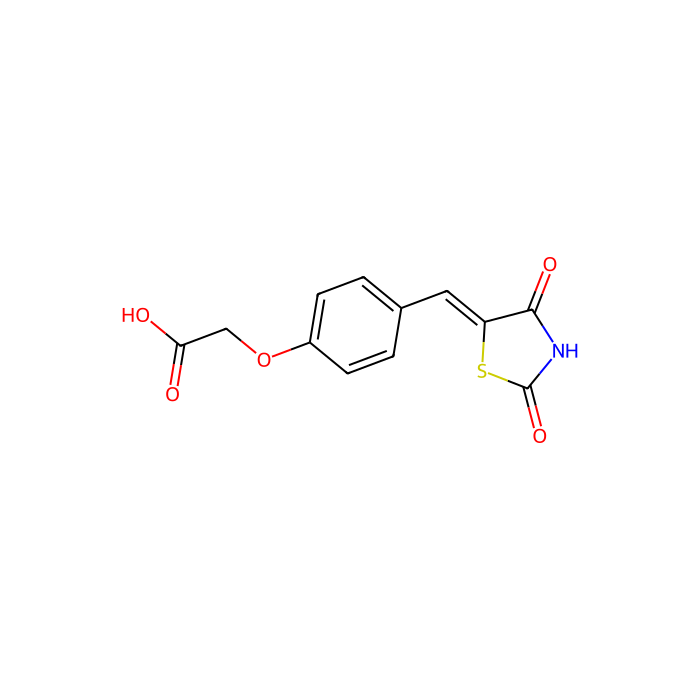
This compound belongs to the class of organic compounds known as phenoxyacetic acid derivatives. These are compounds containing an anisole where the methane group is linked to an acetic acid or a derivative.
External Descriptors
Not available
1. Djoumbou Feunang Y, Eisner R, Knox C, Chepelev L, Hastings J, Owen G, Fahy E, Steinbeck C, Subramanian S, Bolton E, Greiner R, and Wishart DS. ClassyFire: Automated Chemical Classification With A Comprehensive, Computable Taxonomy. Journal of Cheminformatics, 2016, 8:61.
Certificati (CoA, COO, BSE/TSE e tabella di analisi)
C of A & Other Certificates(BSE/TSE, COO):
Analytical Chart:
Proprietà chimiche e fisiche
Solubilità
Solvent:DMSO, Max Conc. mg/mL: 27.93, Max Conc. mM: 100
Peso molecolare
279.270 g/mol
XLogP3
1.800
Hydrogen Bond Donor Count
2
Hydrogen Bond Acceptor Count
6
Rotatable Bond Count
4
Exact Mass
279.02 Da
Monoisotopic Mass
279.02 Da
Topological Polar Surface Area
118.000 Ų
Heavy Atom Count
19
Formal Charge
0
Complexity
426.000
Isotope Atom Count
0
Defined Atom Stereocenter Count
0
Undefined Atom Stereocenter Count
0
Defined Bond Stereocenter Count
1
Undefined Bond Stereocenter Count
0
The total count of all stereochemical bonds
1
Covalently-Bonded Unit Count
1
Calcolatori di soluzioni
Molarity Calculator
Determine the necessary mass, volume, or concentration for preparing a solution.
Dilution Calculator
Determine the dilution needed to prepare a stock solution.
Reconstitution Calculator
Recensioni
Recensioni dei clienti
Application Protocols
No validated, item-specific application protocols were provided.
General protocols for small-molecule screening and handling (non-item-specific):
Stock preparation: Weigh accurately in a low-humidity environment; dissolve in anhydrous DMSO to 10–50 mM. Filter sterilize if required for cell-based assays (0.22 μm PTFE for organic stocks, or dilute then filter through PES/RC membranes compatible with aqueous media).
Aliquoting: Dispense into amber, low-bind vials/plates to avoid adsorption. Store frozen aliquots to minimize freeze–thaw cycles if stability allows.
Assay dosing: Use acoustics or pin-tools for nanoliter transfers when possible; equilibrate plates to room temperature before opening to reduce condensation. Include vehicle controls matching DMSO percentage and appropriate positive/negative controls.
Analytical QC: Before biological testing, confirm identity and purity via LC–MS and HPLC; record retention time and mass for future tracking.
Data integrity: Include duplicates or triplicates, randomized well placement, and plate-mapped controls to identify edge effects.
Note: Because target and mechanism are not specified, users should adapt these general steps to their platform and confirm compatibility through pilot experiments.
Biological Roles
Specific biological targets, pathways, or mechanisms for TCS 3035 are not provided in the Product Data. No claims are made regarding activity, potency, or selectivity.
General considerations for small-molecule research tools (non-item-specific):
If TCS 3035 is used as a putative tool compound, independently verify literature-reported targets and activities using orthogonal assays and appropriate controls; confirm compound identity and purity before biological testing.
Evaluate ADME-relevant properties as needed (solubility, chemical stability, plasma stability, permeability, nonspecific binding) to interpret assay outcomes correctly.
Rule out assay interference (e.g., aggregation, redox cycling, fluorescence interference) using standard counterscreens (detergent-supplemented assays, light-absorbance scans, redox/fluorescence interference panels).
Research use only: This product is intended strictly for laboratory research. It is not intended for diagnostic, therapeutic, or in vivo clinical applications.
Buffer Applications
Not typically applicable as a buffer component. TCS 3035 is a small molecule likely used as a research tool or library member rather than a buffering agent.
Practical notes for assay buffers (general guidance):
Prepare compound stocks in DMSO or other suitable solvent, then dilute into assay buffers (e.g., HEPES, PBS, Tris) maintaining final organic solvent content within assay tolerance.
Monitor pH drift upon compound addition, especially with basic or acidic compounds; adjust buffer capacity accordingly.
Include vehicle controls matching the final solvent percentage.
Item-specific buffer-related specifications (pKa, solubility in buffer, stability): Not specified for this item; refer to CoA/Spec Sheet.
Green Alternatives
Item-specific solvent or process data are not provided, so green chemistry considerations are offered at a general level for handling small-molecule research compounds.
General greener choices (non-item-specific):
Solvent selection: consider ethyl acetate, 2-MeTHF, CPME, and ethanol as greener alternatives to chlorinated or high-toxicity polar aprotics when compatible with solubility and reactivity.
Workups: adopt aqueous biphasic systems and minimize halogenated solvent use. Employ solid-supported scavengers to reduce waste.
Energy: favor ambient-temperature and catalytic processes; use microwaves judiciously to shorten reaction times and reduce energy consumption.
Analytical: minimize acetonitrile use in LC by method optimization (shorter columns, higher temperature, aqueous-rich mobile phases) where resolution permits.
Illustrative comparison (general; not item-specific):
THF vs 2-MeTHF: 2-MeTHF is bio-based, has lower peroxide formation propensity and better water immiscibility, often enabling easier separations, but may alter reaction rates/selectivities.
DCM vs EtOAc/CPME: EtOAc/CPME can replace DCM in many extractions and some reactions; consider boiling point and azeotrope behavior.
Implement green metrics (e.g., E-factor, PMI) where applicable and document choices in method write-ups to support sustainability goals.
Pharmaceutical Uses
No excipient, compendial, or manufacturing role is specified for this product.
Positioning:
TCS 3035 is supplied for research use only. It is not approved for human or veterinary use, drug substance/intermediate manufacture, or diagnostic applications.
General context (non-item-specific):
Small molecules used in discovery are sometimes evaluated in pre-formulation studies (solubility screening, salt selection, stability). Such activities should be conducted strictly within research settings and not construed as clinical development.
If formulation-like studies are performed in vitro (e.g., to improve assay delivery), document solvent systems, excipients, and stability, and ensure they are compatible with the biological system under study.
Item-specific pharmacopeial status, residual solvent class, or elemental impurity classification: Not specified for this item; refer to CoA/Spec Sheet.
Physical Properties
Item-specific property data were not provided in the Product Data.
Item-specific values:
Appearance: Not specified for this item; refer to CoA/Spec Sheet.
Molecular weight: Not specified for this item; refer to CoA/Spec Sheet.
Melting point: Not specified for this item; refer to CoA/Spec Sheet.
Boiling point: Not specified for this item; refer to CoA/Spec Sheet.
Density: Not specified for this item; refer to CoA/Spec Sheet.
Solubility: Not specified for this item; refer to CoA/Spec Sheet.
LogP/logD, pKa, refractive index: Not specified for this item; refer to CoA/Spec Sheet.
General guidance for small-molecule research compounds (literature/practice, not item-specific):
Most screening compounds are supplied as solids or concentrated DMSO solutions; solubilization is commonly performed in anhydrous DMSO, then diluted into aqueous assay buffers with final DMSO ≤0.1–1% v/v.
If weak aqueous solubility is encountered, consider co-solvents (DMF, ethanol), gentle warming (<40 °C), sonication, or salt formation where chemically permissible.
Analytical characterization of physical form (polymorph/solvate) can impact dissolution and should be considered for reproducibility.
Note: For definitive specifications (e.g., melting point range, HPLC purity, water content), consult the lot-specific CoA/Spec Sheet and SDS. Do not infer physical constants without verification.
Quality and Grades
Item-specific quality grade/purity metrics were not provided.
Item-specific status:
Grade/Purity: Not specified for this item; refer to CoA/Spec Sheet.
Interpreting quality information (general guidance for small-molecule research compounds):
Research grade: typically suitable for discovery biology and medicinal chemistry. Purity is often reported by HPLC/UPLC (% area) with supporting NMR and LC–MS; limits for residual solvents, water (KF), and inorganic impurities may be included.
Stabilizers/antioxidants: if present, will be listed on the CoA. These can influence bioassays and analytical methods; remove or account for them as needed.
Analytical traceability: lot-specific CoAs should include structure confirmation (1H NMR, MS), purity methodology and conditions, and, where relevant, chiral purity or counterion identity.
Best practices:
Verify assay compatibility of any residual solvents or counterions (e.g., TFA salts can affect pH and protein binding).
For quantitative biology, confirm identity/purity in-house prior to SAR or dose–response work.
If UV-critical analytics are planned (e.g., HPLC-UV), request UV cutoff/impurity profiles from the CoA, as applicable.
Contact Aladdin Scientific for lot-specific CoA and any additional documentation (SDS, analytical reports) required for your application.
Reaction and Applications
Manufacturer-provided application notes are not available for this item.
General research applications for small molecules classified within “small molecule & compound libraries” (non-item-specific):
Chemical biology: use as a tool compound in target screening, pathway interrogation, or phenotypic assays after identity and purity verification.
Probe development workflows: confirm activity in primary screening, follow with orthogonal assays, counter-screens, and selectivity profiling; perform stability and solubility assessments to mitigate assay artifacts.
Analytical reference: use as a reference standard in LC–MS method development once purity and exact mass are confirmed via CoA.
If employing TCS 3035 in synthesis:
Without structural information, specific reaction families cannot be recommended. If the compound contains common functional handles (e.g., aryl halide, nitrile, amide), typical transformations might include cross-couplings, reductions/oxidations, or functional-group interconversions.
Practical considerations:
Establish a verified stock solution protocol (solvent, concentration, storage) supported by stability checks (LC–MS at time 0 and after storage cycles).
Control for DMSO content in biological assays and include vehicle controls.
Use plate mapping and replicate wells to identify edge or evaporation effects in high-throughput settings.
Reaction Conditions
No item-specific reaction condition data are provided.
General laboratory guidance for small-molecule handling (non-item-specific):
Solution preparation: For insoluble materials, begin with DMSO or DMF at 10–50 mM, then dilute into assay medium. Apply gentle warming (≤40 °C) and sonication if needed. Avoid prolonged heating without stability data.
Stability checks: Assess short-term stability by LC–MS and HPLC over 24–72 h at intended storage and assay temperatures. Evaluate freeze–thaw resilience if aliquots will be cycled.
Light and air sensitivity: If unknown, protect from light (amber vials) and minimize oxygen exposure during storage and handling.
If employing TCS 3035 in synthesis (structure-dependent):
Choose reagents and catalysts only after confirming compatible functional groups. Conduct small-scale scouts before scale-up.
Typical temperature windows for common transformations: 0–25 °C for coupling reactions with sensitive motifs; 60–120 °C for robust aryl couplings (sealed tube/microwave). These are general ranges and not specific to this item.
Always consult the CoA/SDS and perform preliminary trials to define safe and effective conditions for your intended application.
Safety and Handling
Safety data were not provided in the Product Data and may vary by lot. Exercise prudent laboratory precautions.
Item-specific safety fields:
GHS classification: Not specified for this item; refer to SDS.
Signal word: Not specified for this item; refer to SDS.
Hazard statements (H-phrases): Not specified for this item; refer to SDS.
Pictograms: Not specified for this item; refer to SDS.
General safe-handling guidance (defer to SDS for authoritative instructions):
PPE: lab coat, safety glasses, and nitrile gloves as a minimum. Use appropriate respiratory protection if dust/aerosols may form and engineering controls are inadequate.
Engineering controls: handle powders/solutions in a fume hood; avoid inhalation, ingestion, and skin contact. Prevent aerosolization during weighing and dispensing.
Incompatibilities: unknown for this specific compound; as a precaution, segregate from strong oxidizers, strong acids/bases, and reactive reducing/alkylating agents until compatibility is confirmed.
First aid (general): in case of skin contact, wash with soap and water; for eye exposure, rinse cautiously with water for several minutes; if inhaled, move to fresh air; if ingested, rinse mouth. Seek medical attention as appropriate and provide SDS.
Spill response: avoid dust formation. Absorb solutions with inert material; collect in labeled container for disposal. Decontaminate area and ventilate.
Waste: dispose in accordance with institutional, local, and national regulations; classify based on SDS hazard profile once available.
Always consult the product SDS before first use and train personnel accordingly.
Solvent Selection
Item-specific solubility and polarity data are not provided. The guidance below reflects common practices for small molecules used in screening and chemical biology.
General solvent recommendations (non-item-specific):
Primary stock solvent: anhydrous DMSO is the default for many hydrophobic and moderately polar compounds. Prepare concentrated stocks (e.g., 10–50 mM), then dilute into assay buffer with final DMSO typically ≤0.1–1% v/v.
Alternative solvents: DMF or ethanol can be used where DMSO is incompatible with the assay. Acetonitrile is suitable for LC sample preparation.
Aqueous solubility strategies: adjust pH only if the compound is ionizable and stable; use co-solvent mixtures (DMSO/H2O or ethanol/H2O), cyclodextrin complexation, or surfactants (e.g., 0.01–0.1% Tween-20) as assay-compatible.
For synthetic use: choose solvents that balance solubility with reactivity and safety (e.g., MeCN, THF, MeOH, toluene); verify compatibility with the compound’s functional groups.
Comparison (general):
DMSO: strongest solubilizing power; high boiling point; hygroscopic.
DMF: strong solvent, but more problematic for some bioassays; higher toxicity concerns.
Ethanol: biocompatible at low percentages; limited solubilization for highly lipophilic compounds.
Acetonitrile: good for LC-MS; moderate polarity; miscible with water.
Always verify solvent compatibility with your assay system and stability of TCS 3035 by small-scale trials.
Storage and Reconstitution
Item-specific storage and shipping information are provided; reconstitution details are not specified.
Item-specific facts (from Product Data):
Storage conditions: Store at 2–8 °C.
Shipped in: Wet ice.
Reconstitution guidance (general, not item-specific):
Solvent selection: If the compound is hydrophobic or of uncertain solubility, begin with anhydrous DMSO to prepare a concentrated stock (e.g., 10–50 mM). For more polar compounds, DMF or aqueous buffers (with pH adjustment) may be suitable if chemically stable.
Procedure: Allow vial to equilibrate to room temperature before opening to avoid condensation. Weigh quickly in a low-humidity environment. Add solvent incrementally with gentle vortexing and brief sonication as needed. Avoid strong heating unless stability is verified.
Filtration: If particulate remains or sterility is required, pass the solution through an appropriate 0.22 μm membrane compatible with the solvent system.
Aliquoting and stability: Divide into single-use aliquots in amber vials or plates. Minimize headspace and freeze–thaw cycles. Record preparation date, solvent, and concentration on each aliquot.
Long-term storage considerations (general):
If stability is unknown, prefer frozen storage of stock solutions (e.g., −20 to −80 °C) and short-term use of working dilutions kept on ice during experiments.
Protect from light and moisture as a precaution unless the CoA/SDS indicates otherwise.
For definitive reconstitution concentrations, solubility limits, and shelf-life, consult the lot-specific CoA/Spec Sheet.
Structure and Identity
Brief overview: TCS 3035 is provided as a small-molecule research compound. The Product Data include registry identifiers but no structural descriptors.
Item-specific facts (from Product Data):
SKU: T287453
Product name: TCS 3035
CAS: 871085-49-3
PubChem CID: 2295463
InChIKey: 410601 (note: appears truncated/non-standard; verify against SDS/CoA)
SMILES: Not specified for this item; refer to CoA/Spec Sheet.
Molecular formula: Not specified for this item; refer to CoA/Spec Sheet.
Molecular weight: Not specified for this item; refer to CoA/Spec Sheet.
Structural features:
Specific functional groups, ring systems, and stereochemistry: Not specified for this item; refer to CoA/Spec Sheet.
Descriptive 2D structure (in words):
Not available from the provided data. Users should consult the product CoA or authoritative databases (CAS RN 871085-49-3; CID 2295463) to obtain the definitive structural representation prior to method development or analytical qualification.
Acquire a lot-specific CoA containing SMILES/InChIKey.
Confirm identity by orthogonal methods where appropriate (e.g., LC–MS exact mass, 1H/13C NMR, HPLC purity) before use in critical studies.
Synthetic Utility
The structural details of TCS 3035 are not provided; therefore, specific synthetic transformations cannot be recommended for this exact compound.
General guidance (non-item-specific):
If TCS 3035 is to be derivatized, first establish its functional group map by NMR/IR/MS and, if needed, single-crystal or HRMS confirmation. Identify orthogonally addressable handles (e.g., aryl halides, amines, carboxylic acids) for diversification.
Typical transformations in medicinal chemistry libraries include: amide coupling (EDC/HATU), Suzuki–Miyaura or Buchwald–Hartwig couplings for aryl systems, reductive amination for carbonyl–amine unions, and heterocycle formation strategies.
Protecting group strategy should be tailored to the compound’s sensitivity; consider stability to acid/base, oxidation, and heat.
Analytical support: track reaction progress with LC–MS; purify by flash chromatography or preparative LC; confirm structure and purity by 1H/13C NMR and HPLC.
For any derivative work, ensure you retain a portion of the original material for reference and quality comparison.
Target Specificity
Target, binding partner, or pathway specificity for TCS 3035 is not provided in the Product Data.
Item-specific details:
Target/Pathway: Not specified for this item; refer to CoA/Spec Sheet or primary literature.
Species reactivity/ortholog profiling: Not specified for this item; refer to CoA/Spec Sheet.
General guidance (non-item-specific):
If used as a putative modulator, run orthogonal assays and counter-screens to confirm on-target activity and assess selectivity against related target families.
Employ concentration–response curves across multiple systems, include time-dependence studies, and evaluate potential assay interference (fluorescence/absorbance overlap, redox activity, aggregation).
Consider chemoproteomics or broad profiling panels for deconvolution if the target is unknown or literature is conflicting.
Domande frequenti
What is the purity of this product, and how is it determined?
This product is supplied at ≥98% purity, determined by HPLC. Lot-specific values are stated on the Certificate of Analysis.
How should this product be stored?
Store at 2–8 °C. Refrigerated storage is required to maintain the specified shelf life.
How is this product shipped?
This product ships chilled on wet ice. Unpack on arrival and transfer it to the storage condition stated above.
What are the CAS number, molecular formula and molecular weight?
The CAS Number is 871085-49-3, the molecular formula is C??H?NO?S, and the molecular weight is 279.27 g/mol. InChIKey WXMCOLGPDOYHNK-UITAMQMPSA-N.
What documentation is provided?
Available product documentation, including Certificates of Analysis (COA), Safety Data Sheets (SDS), and specification sheets, is shown in the product document area. Document availability and access follow the current site policy.
Utilizziamo i cookie per garantire il corretto funzionamento del sito web e, ove consentito, per migliorare la tua esperienza. Puoi gestire le tue preferenze in qualsiasi momento nelle Impostazioni. Per saperne di più, consulta la nostra Cookie Policy.
Desidera che le inviamo un messaggio quando avremo sconti disponibili?
Ricordamelo più tardi
Grazie! Controlli la sua casella di posta per confermare.
Products are supplied to verified businesses, institutions, and qualified professionals for research and development use only. Not for use in humans, animals, diagnosis, or therapy.