QUALITÀ & PUREZZACarrier Free?Carrier-free — supplied without added carrier protein/stabilizer. Use when carriers (e.g. BSA) would interfere with conjugation or sensitive assays.ExactAb™?ExactAb™ — Aladdin's antibody line emphasizing precision and validated quality. Use for reliable, specificity-validated antibody applications.Validated?Validated grade — performance confirmed in defined applications before release. Use when you want documented assurance the reagent works as stated.0.5 mg/mL
ExactAb™, Validated, Carrier Free, 0.5 mg/mL Carrier Free,ExactAb™,Validated per flussi di lavoro cromatografici e analitici sensibili che richiedono un'interferenza minima della linea di base.
🌡
Stoccaggio e spedizione
Store at -20°C,Avoid repeated freezing and thawing Spedizione Ice chest + Ice pads. Consultare il COA specifico del lotto per le specifiche esatte.
📋
Documenti di qualità
SDS, COA, scheda tecnica e scheda delle specifiche disponibili per il download. COA specifico del lotto accessibile tramite ricerca per numero di lotto.
📚
Prova documentale
Citato in 0 pubblicazioni peer-reviewed su cromatografia, sintesi organica e reazioni di accoppiamento incrociato.
Panoramica
Rabbit anti Human DDX39B Antibody, Polyclonal, could be used for WB, IHC, Flow and so on. Application: · WB: 1/1000 · IHC: 1/100-1/500 · Flow: 1/10-1/50 Protein Function Component of the THO subcomplex of the TREX complex. The TREX complex specifically associates with spliced mRNA and not with unspliced pre-mRNA. It is recruited to spliced mRNAs by a transcription-independent mechanism. Binds to mRNA upstream of the exon-junction complex (EJC) and is recruited in a splicing- and cap-dependent manner to a region near the 5' end of the mRNA where it functions in mRNA export. The recruitment occurs via an interaction between THOC4 and the cap-binding protein NCBP1. DDX39B functions as a bridge between THOC4 and the THO complex. The TREX complex is essential for the export of Kaposi's sarcoma-associated herpesvirus (KSHV) intronless mRNAs and infectious virus production. The recruitment of the TREX complex to the intronless viral mRNA occurs via an interaction between KSHV ORF57 protein and THOC4. Splice factor that is required for the first ATP-dependent step in spliceosome assembly and for the interaction of U2 snRNP with the branchpoint. Has both RNA-stimulated ATP binding/hydrolysis activity and ATP-dependent RNA unwinding activity. Even with the stimulation of RNA, the ATPase activity is weak. Can only hydrolyze ATP but not other NTPs. The RNA stimulation of ATPase activity does not have a strong preference for the sequence and length of the RNA. However, ssRNA stimulates the ATPase activity much more strongly than dsRNA. Can unwind 5' or 3' overhangs or blunt end RNA duplexes in vitro. The ATPase and helicase activities are not influenced by U2AF2 and THOC4.
Specifiche
Product Name
UAP56 Antibody - Anticorpo primario, specific to DDX39B, Rabbit IgG
This BAT1 antibody is generated from rabbits immunized with a KLH conjugated synthetic peptide from the C-terminal region of human BAT1. (AA 351-380).
Controllo positivo
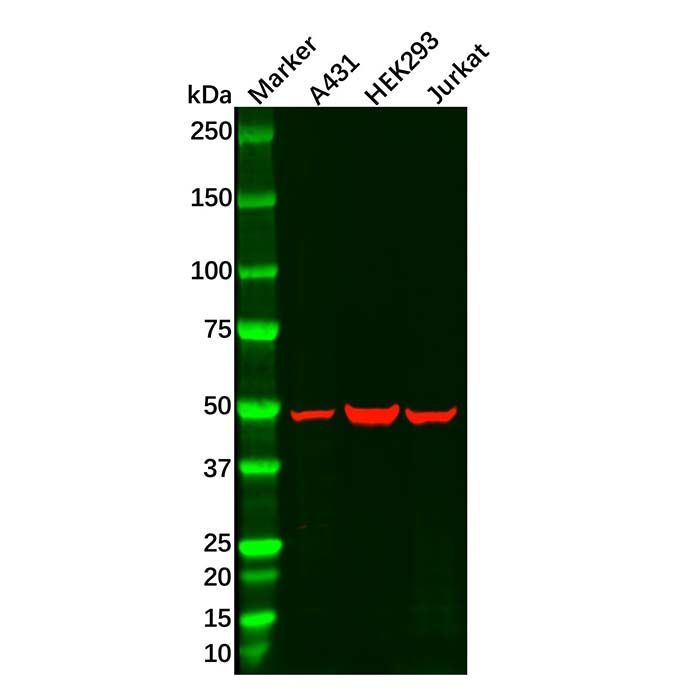
WB: K562, HeLa, A431, HEK293 and Jurkat cell lysates. IHC: Human kidney tissue. Flow: K562 cells.
Coniugazione
Unconjugated
Grado
Carrier Free, ExactAb™, Validated
Isotipo
Rabbit IgG
SDS-PAGE
150 kDa
Metodo di purificazione
Protein A purified+ Peptide affinity purified
Concentrazione
0.5 mg/mL
Product Line
Prodotti biologici
Stoccaggio e spedizione
Forma
Liquid
Condizioni di conservazione di stoccaggio
Store at -20°C,Avoid repeated freezing and thawing
Spedito in
Ice chest + Ice pads
Stabilità e conservazione
Store at 4°C short term (1-2 weeks). Store at -20°C long term (24months). Upon receipt, it is recommended to aliquot. Avoid freeze/thaw cycle.
Immagini
UAP56 Antibody (Ab133187) - Western Blot All lanes: UAP56 Antibody (Ab133187) at 1/1000 dilution Samples: Lysates at 20 µg per lane Secondary: Goat Anti-Rabbit IgG H&L (HRP) (Ab170144) at 1/20000 dilution
Predicted band size: 49 kDa Observed band size: 49 kDa Exposure time: 35.4 s
UAP56 Antibody (Ab133187) - Western Blot All lanes: UAP56 Antibody (Ab133187) at 1/1000 dilution Samples: Lysates at 20 µg per lane Secondary: Goat Anti-Rabbit IgG H&L (HRP) (Ab170144) at 1/20000 dilution
Predicted band size: 49 kDa Observed band size: 49 kDa Exposure time: 16.5 s
UAP56 Antibody (Ab133187) - IHC Formalin-fixed and paraffin-embedded human kidney reacted with UAP56 Antibody (Ab133187), which was peroxidase-conjugated to the secondary antibody, followed by DAB staining. This data demonstrates the use of this antibody for immunohistochemistry; clinical relevance has not been evaluated.
UAP56 Antibody (Ab133187) - Flow Cytometry UAP56 Antibody (Ab133187) flow cytometry analysis of K562 cells (bottom histogram) compared to a negative control cell (top histogram). FITC-conjugated goat-anti-rabbit secondary antibodies were used for the analysis.
Applicazione
Applicazione
Dilution info
IHC
1/100-1/500
WB
1/1000
Flow Cytometry
1/10-1/50
Documentazione
📋 Scheda di dati di sicurezza (SDS)
Documento completo su pericoli, manipolazione, stoccaggio e conformità normativa.
Determine the necessary mass, volume, or concentration for preparing a solution.
Dilution Calculator
Determine the dilution needed to prepare a stock solution.
Reconstitution Calculator
Recensioni
Recensioni dei clienti
Application Protocols
Item-specific validated applications and recommended dilutions
Not specified for this item; refer to CoA/Spec Sheet for tested applications (e.g., WB, IF/ICC, IP, ELISA) and suggested working dilutions.
General protocol guidance (literature; adapt to your assay)
Western blot: Start with 1:1,000 primary dilution in TBST + 3% BSA; incubate 1 h at RT or overnight at 4°C. Use nuclear extracts if probing nuclear targets; include loading controls.
Immunofluorescence/ICC: Begin at 1–5 μg/mL; fix with paraformaldehyde or methanol depending on antigen preservation; permeabilize as appropriate for nuclear proteins.
Immunoprecipitation: 1–5 μg antibody per 0.5–1 mg lysate protein as a starting point; optimize bead type and salt/detergent levels for specificity.
ELISA: 0.1–1 μg/mL for capture/detection is a typical starting range; titrate for signal-to-noise.
Controls and validation
Include positive control lysates/cells known to express UAP56 and negative controls (isotype or no-primary). Consider RNAse treatment controls if studying RNA-dependent complexes.
Biological Roles
About the target (literature; general background, not product claims)
UAP56 refers to U2AF65-associated protein of ~56 kDa, a nuclear DEAD-box RNA helicase implicated in pre-mRNA splicing and mRNA nuclear export. It functions in spliceosome assembly by interacting with splicing factors and assists in TREX complex formation, coupling transcription with mRNA processing/export.
Cellular localization: Predominantly nuclear with enrichment at sites of active transcription (literature). Involved in ATP-dependent RNA remodeling events characteristic of DEAD-box family helicases.
Biological significance: Essential for proper gene expression by facilitating exon definition and mRNP maturation; perturbation can affect splicing fidelity and export efficiency.
Using an antibody to UAP56 (general guidance)
Antibodies against UAP56 are routinely used to probe spliceosomal dynamics, to co-immunoprecipitate TREX/splicing components, and to map nuclear architecture via immunofluorescence.
Item-specific note
Species reactivity, epitope mapping, and cross-reactivity details for Ab133187 are not specified; consult the CoA/Spec Sheet for experimental validation against your organism and application.
Buffer Applications
Relevance
As an antibody reagent, performance depends on the working buffer system used in your assay. No item-specific buffer is provided; the guidance below reflects general practice.
General buffer systems (literature; examples, not item-specific specs)
Western blot (WB): TBS or PBS with 0.1% Tween-20 (TBST/PBST) for washes; blocking with 3–5% BSA or milk in TBST. Primary antibody diluent often TBST + 1–5% BSA. Optimize ionic strength to reduce nonspecific binding.
Immunofluorescence (IF/ICC): PBS or TBS with 1–3% BSA and 0.05–0.1% Tween-20. Permeabilization with 0.1–0.5% Triton X-100 or saponin as appropriate to target localization (nuclear for UAP56). Include DNase/RNase considerations only if protocol requires.
Immunoprecipitation (IP/Co-IP): Non-denaturing buffers (e.g., 20–50 mM Tris, 150 mM NaCl, 0.1% NP-40/Triton X-100) with protease/RNase inhibitors per experimental goals. Stringency adjustments via salt and detergent.
ELISA: Coating in carbonate–bicarbonate buffer (pH ~9.6) or PBS; blocking with BSA or casein; sample/antibody diluent matched to matrix.
Important caution
This product is Carrier Free; if your protocol relies on protein blockers in the antibody diluent, add them at point-of-use. Validate that added carriers do not interfere with downstream steps (e.g., conjugation, MS).
Green Alternatives
Context
Antibody products are aqueous protein formulations; “green” considerations focus on minimizing waste, avoiding hazardous preservatives, and optimizing storage to reduce cold-chain energy use.
Practical sustainability steps (general guidance)
Use right-sized aliquots to prevent freeze–thaw losses, thereby reducing repeated shipments and waste.
Choose low-protein-binding, recyclable plastics where possible; consolidate orders to minimize packaging.
Avoid sodium azide where incompatible with downstream applications or disposal constraints; however, the presence/absence of azide in this item is not specified.
Use room-temperature stable secondary reagents where feasible to reduce cold-chain burden; primary antibody stability is governed by formulation—follow Storage & Reconstitution for this item.
Alternatives and trade-offs
Carrier-containing formats (with BSA) can reduce loss to surfaces but complicate conjugation and mass spectrometry workflows; Carrier Free (this item) reduces background and hazardous waste associated with protein carriers but may require more careful handling.
Item-specific note
No formulation details or preservatives are specified for this item; refer to CoA/Spec Sheet for environmental, health, and safety statements.
Pharmaceutical Uses
Scope
This product is an analytical/research-grade antibody. It is not formulated, tested, or indicated for therapeutic, diagnostic, or in vivo use.
Formulation and excipient context (general, not item-specific)
Research antibodies may be supplied carrier-free (as here) or with stabilizers such as BSA, glycerol, sugars, and salts to enhance stability. The presence of any preservatives (e.g., sodium azide, ProClin) in this item is not specified.
Manufacturing and QC considerations (general)
For process development or analytical characterization in biopharmaceutical settings, carrier-free primary antibodies can be advantageous for conjugation (e.g., HRP, biotin, fluorophores) and for minimizing extraneous proteins in LC–MS workflows.
Regulatory note
Not GMP-grade; not suitable for clinical administration. For any regulated use, source a GMP-compliant critical reagent and perform appropriate qualification.
Item-specific note
No pharmacopeial status, sterility claims, or endotoxin specifications are provided for this item; refer to CoA/Spec Sheet if required for your application.
Physical Properties
Item-specific physical constants
Molecular weight, isoelectric point (pI), extinction coefficient, concentration, formulation buffer, and excipients: Not specified for this item; refer to CoA/Spec Sheet.
Appearance: Not specified for this item; refer to CoA/Spec Sheet.
General properties of IgG-class antibodies (literature; typical values, not item-specific)
Approximate size: ~150 kDa for full-length IgG; fragments (Fab, scFv) differ. The exact size for this product is not specified.
Thermal behavior: Proteins denature on heating; typical unfolding midpoints 60–75°C depending on buffer and formulation. Boiling is not recommended unless for SDS-PAGE sample prep.
Solubility: Highly soluble in aqueous buffers (e.g., PBS, Tris) at neutral pH; aggregation risk increases near pI or at high ionic strength without stabilizers.
pH stability: Many IgGs are most stable near pH 6–7.4; exposure to extreme pH can cause deamidation/aggregation.
Storage compatibility: Sensitive to freeze–thaw cycles which may induce aggregation; stabilizers (glycerol, sugars, proteins) can mitigate, when present.
Not applicable to proteins
Boiling point, melting point, density, logP, refractive index: Not applicable for macromolecular biologics; not specified for this item.
Practical notes
If the antibody is provided lyophilized or carrier-free in solution, handle gently, avoid vigorous vortexing, and filter only with low-protein-binding devices if absolutely necessary.
Quality and Grades
Item-specific grades (from Product Data)
Carrier Free: Formulated without added carrier proteins (e.g., BSA, gelatin). Benefits include minimized background in immunoassays, compatibility with conjugation chemistries, and accurate protein quantification. Note: Carrier-free solutions can be more prone to adsorption losses; pre-blocked plastics or low-bind tubes are recommended.
ExactAb™: Product branding indicating controlled, high-consistency antibody preparation. Specific process details are proprietary; consult the manufacturer’s documentation for exact criteria.
Validated: The product has undergone application-specific validation by the manufacturer. Exact validated applications and species reactivity are not listed here; refer to the CoA/Spec Sheet.
What these grades imply in practice
Analytical expectations: Carrier-free antibodies are typically QC-tested for purity by SDS-PAGE and for identity/activity in immunoassays. For this specific lot, detailed acceptance criteria (purity %, residual DNA/host cell proteins, endotoxin, aggregation) are not specified for this item.
Performance considerations: Absence of carrier proteins improves conjugation efficiency (e.g., NHS esters, maleimide linkers) and reduces non-specific binding in sensitive assays.
Documentation and traceability
Lot-specific CoA should provide concentration, buffer composition, purity profile, and validation data. When preparing critical experiments (e.g., quantitative Western blot, IP-MS), verify lot-to-lot comparability using control samples.
Reaction and Applications
This section is generally not applicable to an antibody reagent.
Antibodies do not participate as reagents in classical organic reactions; instead they are used as binding reagents in immunoassays and affinity enrichment. For this product, application details are covered under Application Protocols and Target Specificity.
If you plan to derivatize/conjugate the antibody (e.g., biotinylation, enzyme or fluorophore labeling), follow protein conjugation chemistry best practices (NHS-ester amine labeling, maleimide thiol labeling). Buffer exchange into amine-free, reducing agent–free buffers is typically required. Specific conjugation suitability for this item is not provided; consult CoA/Spec Sheet.
Reaction Conditions
Not applicable to organic reaction conditions
Antibodies are not employed under classical synthetic reaction conditions (solvent, temperature, catalysts, yields). Experimental conditions relevant to antibodies concern incubation times, temperatures, and buffer compositions in immunoassays.
General assay conditions (literature; not item-specific specs)
Incubations: Primary antibody incubations often 1–2 h at room temperature or overnight at 4°C, depending on assay (WB/IF/IP/ELISA) and antibody affinity.
Temperatures: Maintain on ice or at 4°C during prolonged handling to limit proteolysis/aggregation. Avoid >25°C exposures for extended periods.
Buffer: Near-neutral pH buffers with appropriate blockers and detergents to minimize nonspecific binding.
Item-specific note
Validated applications are indicated in Product Data but not enumerated. For precise conditions (dilution ranges, incubation times), refer to the CoA/Spec Sheet and optimize empirically with positive and negative controls.
Safety and Handling
GHS and hazard information (item-specific)
Signal word, H-statements, pictograms, GHS classification: Not specified for this item; refer to the SDS.
General safety for antibodies (literature/good laboratory practice)
Antibody reagents are typically classified as non-hazardous mixtures but may contain preservatives (e.g., sodium azide) or buffering salts. This item is listed as Carrier Free; no carrier proteins are added. Presence/absence of preservatives is not specified.
Avoid ingestion, inhalation of dried powders/aerosols, and contact with skin/eyes. Use standard PPE: lab coat, safety glasses, and disposable nitrile gloves.
Work in a clean area; treat as a biological protein solution. Disinfect surfaces after spills; absorb liquids with inert material and dispose according to institutional biosafety procedures.
Incompatibilities and conditions to avoid
Avoid repeated freeze–thaw cycles (explicit in Product Data) due to aggregation/functional loss.
Avoid extreme pH, high shear (vortexing/sonication), and prolonged exposure to elevated temperatures or direct sunlight.
First-aid (general guidance; consult SDS)
Skin/eye contact: Rinse with water for several minutes; remove contaminated clothing.
Inhalation of aerosols/powders: Move to fresh air.
Ingestion: Rinse mouth with water. Seek medical attention if symptoms occur.
Waste disposal
Dispose of antibody-containing waste as laboratory chemical/biological waste per local regulations. Consult SDS for authoritative guidance.
Solvent Selection
Applicability to this product
As a protein biologic, the UAP56 Antibody is used in aqueous buffers rather than organic solvents. Solvent selection focuses on buffer composition to maintain stability and activity.
General buffer guidance (literature; not item-specific specs)
Common working buffers: PBS (pH 7.2–7.4) or Tris-buffered saline (TBS, pH 7.4–8.0) with 0.05–0.1% non-ionic surfactant (Tween-20) for assay wash steps. For storage, low-salt PBS/TBS at near-neutral pH is typical unless otherwise specified.
Additives: If not carrier-free by design, stabilizers like 10–50% glycerol, 0.1–1% BSA, or sugars (trehalose/sucrose) may enhance freeze–thaw resilience. This item is Carrier Free; do not add carriers unless your application requires them.
Avoid: High concentrations of denaturants (urea, guanidinium), organic cosolvents, and extremes of pH which can denature antibodies.
Compatibility considerations
Detergents and blocking agents can affect binding; optimize concentrations empirically in ELISA, WB, IF/ICC, or IP.
Filtration: If sterility is required, use 0.2 μm low-protein-binding membranes and minimize shear.
Item-specific note
Exact formulation and recommended diluent for this item are not specified; refer to CoA/Spec Sheet and your assay’s standard operating procedures.
Storage and Reconstitution
Item-specific instructions (from Product Data)
Storage: Store at -20°C.
Handling: Avoid repeated freezing and thawing.
Shipping: Shipped on ice chest with ice pads.
General guidance for carrier-free antibodies (literature; not item-specific specs)
Aliquoting: Upon receipt, aliquot into single-use volumes in low-protein-binding tubes to prevent freeze–thaw cycles and surface adsorption.
Short-term storage: 2–8°C for up to several days may be acceptable for working aliquots; for longer-term storage, keep at -20°C or -80°C depending on formulation. This item’s exact buffer/preservatives are not specified.
Reconstitution: If provided lyophilized, reconstitute gently with sterile, neutral pH buffer (e.g., PBS) to the desired concentration. Avoid vigorous vortexing; mix by gentle inversion. Specific reconstitution volume and buffer are not specified for this item; refer to CoA/Spec Sheet.
Stability monitoring: Inspect for turbidity or precipitate. If aggregation is suspected, clarify by brief low-speed spin; avoid filtration unless necessary and use low-protein-binding membranes.
Record-keeping: Document aliquot IDs, concentrations, and freeze dates to manage inventory and performance over time.
Compatibility cautions
Avoid buffers containing primary amines (e.g., Tris) immediately prior to NHS-ester conjugation, and avoid reducing agents (DTT, TCEP) prior to maleimide-thiol conjugation.
Structure and Identity
Item-specific facts (from Product Data)
Product name: UAP56 Antibody (SKU: Ab133187)
Category: Antibody (research reagent)
Grade/Purity: Carrier Free; ExactAb™; Validated
CAS, CID, InChIKey, SMILES: Not applicable to protein biologics; not specified for this item; refer to CoA/Spec Sheet.
Molecular formula and molecular weight: Not specified for this item; refer to CoA/Spec Sheet.
General structure (literature, for context; not item-specific specs)
Typical antibody format: IgG-class glycoprotein composed of two heavy and two light chains linked by disulfide bonds, with antigen-binding variable domains (Fv) and constant regions (Fc). Exact subclass/isotype for this item is not specified.
Recognizes the protein target “UAP56” (antigen name as provided). Epitope, clone, and species reactivity are not specified for this item.
2D/functional group description (literature)
Antibodies are macromolecular proteins rich in peptide bonds, disulfide linkages (–S–S–), carbohydrate moieties (N-glycans in Fc), and numerous ionizable side chains (Lys, Arg, Asp, Glu, His) conferring pH-dependent charge and solubility.
Identity confirmation
For antibodies, identity is typically established by immunoassay against the antigen, SDS-PAGE under reducing/non-reducing conditions, and sequence/clone records. Specific identity data for this item are not provided here; consult CoA/Spec Sheet.
Synthetic Utility
Not applicable
As an antibody reagent, this product is not used as a building block or reagent in chemical synthesis. It serves as a binding/affinity reagent in biochemical assays. For conjugation chemistry (labeling), see Reaction & Applications for general notes and consult conjugation kits/protocols appropriate for carrier-free antibodies.
Target Specificity
Item-specific information
Antigen/target name: UAP56 (as provided).
Clone, isotype, host species, epitope, species reactivity, cross-reactivity, and application validations: Not specified for this item; refer to CoA/Spec Sheet.
General context (literature; not product claims)
UAP56 is a nuclear RNA helicase associated with pre-mRNA splicing and mRNA export. Antibody specificity is typically established by peptide competition, knockdown/knockout validation, or overexpression controls. Use such controls to confirm target specificity in your system.
Domande frequenti
How should this product be stored?
Store at ?20 °C. Avoid repeated freeze–thaw cycles. Aliquot into single-use volumes before freezing.
What does ExactAb? mean?
ExactAb? indicates the product has been validated for use in rigorous antibody validation workflows. Validation may include positive/negative control samples, signal-to-noise testing, and protocol-specific QC. Lot-specific test data is published on the Certificate of Analysis where available.
What does Carrier Free mean?
Carrier Free indicates that the material has been processed and tested for specialty industrial processing. Specifications focus on the impurities that affect performance in that application — for example, metal content for electronics, particle size for batteries, refractive index for optics, or moisture content for moisture-sensitive processes.
How is this product shipped?
This product ships in an insulated container with ice pads. Unpack on arrival and transfer it to the storage condition stated above.
What documentation is provided?
Available product documentation, including Certificates of Analysis (COA), Safety Data Sheets (SDS), and specification sheets, is shown in the product document area. Document availability and access follow the current site policy.
Which species reactivity has this antibody been validated against?
Validated reactivity is listed on the PDP and on each lot's datasheet. We validate against the most commonly tested species for the target (UAP56 Antibody); cross-reactivity in untested species may exist but is not guaranteed. Contact technical support for specific species inquiries.
Hai bisogno di aiuto per scegliere la qualità?
La nostra guida alla selezione delle qualità copre purezza, stato dello stabilizzatore e idoneità all'applicazione per tutte le varianti del nostro catalogo.
Utilizziamo i cookie per garantire il corretto funzionamento del sito web e, ove consentito, per migliorare la tua esperienza. Puoi gestire le tue preferenze in qualsiasi momento nelle Impostazioni. Per saperne di più, consulta la nostra Cookie Policy.
Desidera che le inviamo un messaggio quando avremo sconti disponibili?
Ricordamelo più tardi
Grazie! Controlli la sua casella di posta per confermare.
Products are supplied to verified businesses, institutions, and qualified professionals for research and development use only. Not for use in humans, animals, diagnosis, or therapy.

 ZJ24F0303482