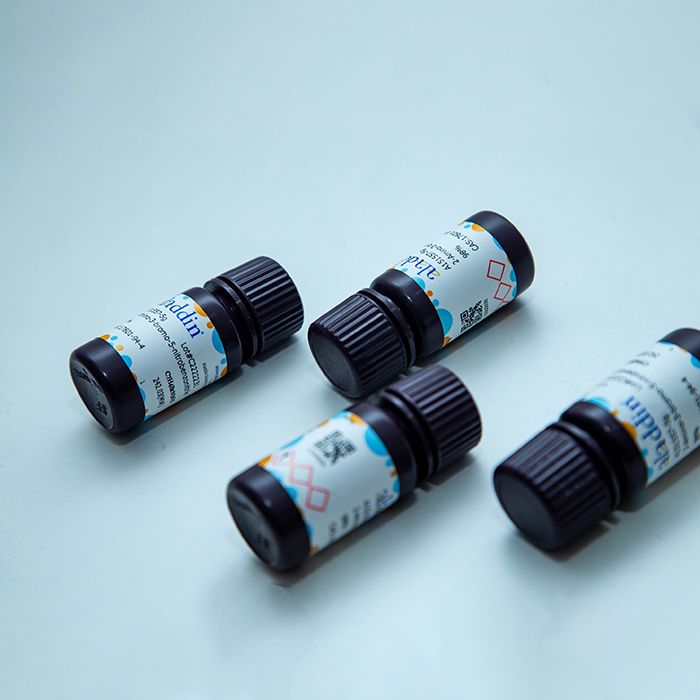
Urocortin III, mouse TFA is a corticotropin-releasing factor ( CRF )-related peptide. Urocortin III preferentially binds and activates CRF-R2. Urocortin III (Ucn3) is a known component of the behavioral stress response system. Urocortin III and CRF-R
Appearance:Solid
Biological Activity:Urocortin III, mouse TFA is a corticotropin-releasing factor ( CRF )-related peptide. Urocortin III preferentially binds and activates CRF-R2. Urocortin III (Ucn3) is a known component of the behavioral stress response system. Urocortin III and CRF-R
Specifiche
Specifiche e purezza
≥99%
Condizioni di conservazione di stoccaggio
Desiccated,Store at -80°C
Spedito in
Dry ice packs + Cold packs
Questo prodotto richiede spedizione a catena fredda. I servizi di terra e altri servizi economici non sono disponibili.
Purezza
≥99%
Nomi e identificatori
Peso molecolare
4286.99
Dati avanzati
Certificati (CoA, COO, BSE/TSE e tabella di analisi)
C of A & Other Certificates(BSE/TSE, COO):
Analytical Chart:
Proprietà chimiche e fisiche
Solubilità
H2O : 25 mg/mL (5.83 mM; Need ultrasonic)
Calcolatori di soluzioni
Molarity Calculator
Determine the necessary mass, volume, or concentration for preparing a solution.
Dilution Calculator
Determine the dilution needed to prepare a stock solution.
Reconstitution Calculator
Recensioni
Recensioni dei clienti
Application Protocols
The following are general, non–item-specific protocols suitable for Urocortin III peptides; optimize empirically.
Reconstitution and stock preparation
Warm vial to room temperature in a desiccated environment. Briefly centrifuge.
Add sterile water or 0.1% acetic acid to achieve 0.5–2 mg/mL. Mix gently until fully dissolved.
If insoluble, add minimal DMSO or 20% acetonitrile/water, then dilute with buffer. Adjust pH to 7.2–7.4 as needed.
Sterile-filter (0.22 μm, low-protein-binding) if sterility is required. Aliquot and store at −80°C.
GPCR cAMP accumulation assay (example)
Plate CRF2-expressing cells in 96- or 384-well format.
Preincubate with IBMX per kit instructions.
Treat with a dilution series of Urocortin III (e.g., 0.1 nM–1 μM) for 20 min at 37°C.
Measure cAMP via HTRF or ELISA. Fit concentration–response to obtain EC50 and Emax.
Competition binding (example)
Incubate membranes expressing CRF2 with a fixed radioligand concentration and graded Urocortin III.
Equilibrate 60–90 min at 25°C; separate bound/free by filtration. Analyze Ki via Cheng–Prusoff.
Include carrier protein (0.1% BSA) or 0.01–0.05% polysorbate to reduce adsorption at low concentrations.
Biological Roles
General literature context (not item-specific claims):
Urocortin III (Ucn3) is an endogenous neuropeptide within the corticotropin-releasing factor (CRF) family. It preferentially activates CRF receptor type 2 (CRF2/CRHR2) over CRF1, functioning as a selective agonist in numerous systems.
Signaling: CRF2 is a class A GPCR predominantly coupling to Gs, elevating intracellular cAMP and activating PKA/CREB pathways; secondary signaling can include ERK1/2 depending on cell context.
Physiology: Ucn3 has been implicated in central and peripheral stress-response pathways, energy homeostasis, and neuroendocrine regulation in rodent models. These are foundational research insights; no clinical or therapeutic claims are made or implied.
Structure–activity relationships (SAR): Specific residues near the N-terminus and central helical region of CRF-family peptides contribute to CRF2 selectivity; C-terminal integrity is typically important for high-affinity binding.
Use of this product: As a research tool peptide, Urocortin III is commonly applied to characterize CRF2-mediated signaling, benchmark receptor assays, and serve as a positive control agonist in pharmacology studies.
Buffer Applications
This item is not a buffering agent. However, successful use in assays depends on appropriate buffer systems.
Practical guidance (general):
Reconstitution: Start in sterile water or 0.1% acetic acid; after complete dissolution, dilute into isotonic buffers (e.g., PBS or HBSS) at pH 7.2–7.4.
Working buffers: For receptor assays, HEPES-buffered saline with 0.1% BSA can reduce nonspecific binding. For plate-based cAMP assays, include phosphodiesterase inhibitors (e.g., IBMX) per kit protocols.
Adsorption control: Add 0.01–0.05% polysorbate-20 or 0.1% BSA when working at low-nanomolar concentrations to mitigate loss to plastics.
Filtration: If sterility is required, filter through a low-protein-binding 0.22 μm membrane after complete dissolution and pH adjustment.
Stability in buffer: Peptides may undergo deamidation/oxidation over time; prepare fresh working solutions and keep on ice during use. Avoid repeated freeze–thaw cycles.
Green Alternatives
Peptide reagents themselves are not solvents, but greener handling choices can be made around counterions, solvents, and workflows.
Counterion selection: TFA is persistent and environmentally unfriendly. Where compatible, exchange TFA for acetate or chloride by repeated dissolution in water and lyophilization or by SPE desalting. Trade-off: counterion exchange can slightly alter solubility and may reduce short-term stability in some cases.
Solvent choices: Prefer water or buffered aqueous systems over high-percent organic solvents. If a co-solvent is required, choose ethanol or isopropanol in place of acetonitrile when assay tolerance allows; minimize DMSO volume.
Analytical methods: Use LC–MS with formic acid or acetic acid modifiers rather than TFA when sensitivity is important—improves ionization efficiency and reduces halogenated waste.
Process considerations: Work at small scales, prepare concentrated stocks to minimize container use, and use low-adsorption plastics to reduce repeat preparations and waste.
Comparison (general):
TFA vs. acetate counterion: acetate is more biodegradable and MS-friendly; TFA can enhance initial solubility but complicates MS and waste management.
ACN vs. ethanol co-solvent: acetonitrile offers superior peptide chromatographic behavior but carries higher environmental and supply-chain impacts; ethanol is greener but may not dissolve highly hydrophobic sequences as effectively.
Pharmaceutical Uses
For research use only; not for human or veterinary use, clinical diagnosis, or therapeutic applications.
General formulation context (preclinical research):
Bioassay standards: Urocortin III can serve as a positive control agonist in GPCR pharmacology platforms and as a reference material for assay qualification.
Vehicle considerations: For in vivo exploratory studies in animals (institutional approval required), peptides are often formulated in isotonic buffers with stabilizers (e.g., 0.1% BSA). Any such work must follow applicable regulations; Aladdin Scientific provides reagents strictly for research use.
Analytical development: Employed to develop and validate LC–MS or HPLC methods for CRF-family peptides, including recovery, carryover, and adsorption testing.
No pharmacopeial status or excipient use is specified for this item; refer to CoA/Spec Sheet for any available compendial information.
Physical Properties
Appearance: Not specified for this item; refer to CoA/Spec Sheet. (Peptide TFA salts are commonly supplied as white to off-white lyophilized solids.)
Molecular weight (exact): Not specified for this item; refer to CoA/Spec Sheet.
Molecular formula: Not specified for this item; refer to CoA/Spec Sheet.
Solubility: Item-specific solubility is not provided. General guidance for peptides:
Water, dilute acidic aqueous solutions (e.g., 0.1% TFA or 0.1% acetic acid), or physiological buffers may be suitable.
For hydrophobic sequences, initial dissolution in a minimal volume of DMSO or 10–30% acetonitrile/water can aid solubilization, followed by dilution with buffer.
pH considerations: TFA counterion can acidify aqueous solutions; adjust to target pH after full dissolution.
pKa/logP: Not typically assigned for heterogeneous peptide mixtures; not applicable as single-value descriptors.
Melting/boiling point, density, refractive index: Not applicable/not determined for peptide solids; not used operationally.
Literature/context (general):
Peptide TFA salts are hygroscopic to varying degrees and may absorb moisture/CO2; handling under dry conditions is recommended.
Solubility is sequence-dependent; small test dissolutions (e.g., 0.5–2 mg/mL) help define an optimal solvent system before scaling.
Quality and Grades
Grade/purity: Not specified for this item; refer to CoA/Spec Sheet.
Counterion: Trifluoroacetate (TFA) salt form. TFA is commonly used in peptide purification/lyophilization and may remain as the counterion after HPLC isolation.
Implications of TFA:
TFA can suppress MS signals in some ESI-MS workflows; desalting or counterion exchange (e.g., to acetate) may improve spectral quality.
TFA lowers solution pH; for pH-sensitive assays, neutralize carefully after dissolution.
Recommended quality verifications (general):
Identity by LC–MS (observed mass vs. theoretical), and purity profiling by analytical RP-HPLC with appropriate detection (UV 214/220 nm, or MS).
For bioassays, confirm functional activity in a small-scale pilot assay (e.g., receptor cAMP response) before committing larger resources.
Documentation: Certificate of Analysis (CoA) typically provides batch-specific purity, counterion content, residual solvents, and water content when applicable. Use the CoA/Spec Sheet for item-specific specifications and acceptance criteria.
End use restrictions: For research use only; not for human or veterinary use, diagnostic, or clinical applications.
Reaction and Applications
This product is a bioactive peptide reagent rather than a small-molecule synthetic intermediate. It is primarily used in biochemical and cell-based assays.
Research applications (literature/general):
GPCR pharmacology: Tool agonist for corticotropin-releasing factor receptor type 2 (CRF2/CRHR2) signaling studies; used to probe receptor selectivity vs. CRF1.
Binding/competition assays: Radioligand displacement or fluorescent ligand binding to quantify receptor affinity and selectivity.
Physiology models: Neuronal or endocrine cell models expressing CRF2 to study stress-axis related signaling cascades (non-clinical research use only).
Practical notes:
Prepare concentrated peptide stocks (e.g., 100–1000 μM) and aliquot to minimize freeze–thaw cycles.
Include low levels of carrier protein/surfactant to reduce adsorption at sub-micromolar concentrations.
Verify functional activity with a reference curve in your specific assay system; receptor density, buffer composition, and temperature can significantly shift apparent potency.
Reaction Conditions
Classical chemical reaction conditions are not applicable. Below are general assay conditions from the literature for functional use of CRF-family peptides; adjust to your platform.
Cell-based cAMP assay (general):
Cells: HEK293 or CHO stably expressing human or mouse CRF2.
Buffer: HBSS or HEPES-buffered saline, 0.1% BSA, ± 0.5 mM IBMX.
Agonist range: 0.1 nM to 1 μM Urocortin III to generate full concentration–response curves.
Incubation: 15–30 min at 37°C; readout via HTRF, ELISA, or luminescent cAMP kits.
Binding assays (general):
Radioligand: 125I-labeled CRF-family ligand; perform competition with Urocortin III to estimate Ki.
Conditions: 4–25°C, 60–120 min, membrane preparations or intact cells; separate bound/free by filtration.
Data analysis: Fit to a four-parameter logistic model; report EC50/IC50 with confidence intervals. Confirm receptor expression level to contextualize potency shifts.
These conditions are literature-style guidance and must be empirically optimized. No item-specific activity specifications are provided for this product.
Safety and Handling
GHS classification: Not specified for this item; refer to SDS.
Signal word / H-statements / pictograms: Not specified for this item; refer to SDS.
General hazards: Peptide solids can cause irritation upon inhalation, skin, or eye contact. Avoid aerosolization and direct contact. Handle inside a fume hood or ventilated enclosure during weighing.
PPE: Lab coat, safety glasses, and appropriate disposable gloves (e.g., nitrile). Use respiratory protection if dust generation is possible and local exhaust is unavailable.
Handling notes:
Work quickly with the vial at ambient temperature to minimize moisture uptake; recap promptly.
Use antistatic tools and weigh boats to reduce airborne particulates.
Prepare solutions with sterile, nuclease-free water or buffer if downstream bioassays demand.
Incompatibilities: Strong bases may induce peptide backbone/side-chain degradation; strong oxidants can damage susceptible residues (e.g., Met, Cys, Trp). Avoid prolonged exposure to elevated temperatures and light.
First aid (overview):
Inhalation: Move to fresh air; seek medical attention if symptoms persist.
Skin/eyes: Rinse with water for several minutes; remove contaminated clothing; seek medical advice if irritation continues.
Ingestion: Rinse mouth; do not induce vomiting; seek medical attention.
Waste: Dispose according to institutional peptide/organic waste protocols and local regulations. Always consult the SDS for authoritative safety guidance.
Solvent Selection
This peptide is not a traditional solvent. The section below provides guidance for dissolving and handling peptide TFA salts in solution.
General dissolution strategy (literature/practice):
Start with sterile water or mildly acidic aqueous media (e.g., 0.1% TFA or 0.1% acetic acid) to aid initial wetting and dissolution.
If insoluble, use a minimal volume of DMSO or 10–30% acetonitrile/water to fully dissolve, then stepwise dilute with buffer to the working concentration.
Maintain final DMSO content below 0.1–1% v/v for sensitive cellular assays, as appropriate.
Buffer compatibility:
Phosphate- or HEPES-buffered saline at pH 7.2–7.4 is commonly used for receptor pharmacology after neutralization.
Include carrier protein (e.g., 0.1% BSA) or polysorbate (0.01–0.05%) to minimize peptide adsorption to plastics/glass for low-nanomolar work.
Comparison (general):
Acidic aqueous (0.1% TFA) vs. acetate: acetate is greener and more MS-friendly; TFA better suppresses secondary structure/aggregation during initial dissolution but can interfere with MS.
DMSO co-solvent vs. neat aqueous: DMSO enhances dissolution of hydrophobic sequences but may affect some bioassays; validate tolerance.
Storage and Reconstitution
Storage conditions (item-specific): Desiccated, Store at −80°C. Shipped on dry ice packs + cold packs. Minimize time at ambient temperature during receipt and handling.
Stability: Peptides are generally stable when kept frozen and dry. Avoid repeated freeze–thaw; use aliquots.
Reconstitution (general guidance):
Use sterile water or 0.1% acetic acid for initial dissolution; TFA counterion may acidify the solution.
For hydrophobic sequences, dissolve first in a small volume of DMSO or 20–30% acetonitrile/water, then dilute with buffer to working concentration.
Adjust pH to physiological range after complete dissolution if required by the assay.
Working solution handling: Keep on ice during use; prepare fresh daily when possible. Add carrier protein (e.g., 0.1% BSA) to limit adsorption losses for low-nanomolar applications.
Long-term storage of solutions: If necessary, store aliquoted solutions at −80°C. Avoid more than one freeze–thaw cycle; discard thawed aliquots after use.
Documentation: For any item-specific mass, purity, or residual TFA content that may influence reconstitution volumes and assay design, consult the batch CoA/Spec Sheet.
Research Use Note: For research use only.
Structure and Identity
Peptidic research reagent corresponding to mouse Urocortin III (Ucn3) provided as the trifluoroacetate (TFA) salt.
Product identifier: Urocortin III, mouse TFA; SKU U658815
CAS: Not specified for this item; refer to CoA/Spec Sheet.
Molecular formula: Not specified for this item; refer to CoA/Spec Sheet.
Molecular weight: Not specified for this item; refer to CoA/Spec Sheet.
SMILES: Not specified for this item; refer to CoA/Spec Sheet.
InChIKey: Not specified for this item; refer to CoA/Spec Sheet.
Structural class: Peptide (bioactive neuropeptide), supplied as a TFA counterion salt, typically lyophilized.
2D structural description: Linear chain of L-amino acids (sequence not provided for this specific item), with protonated side chains/c-terminus balanced by trifluoroacetate anions in the solid state.
Literature/context (general):
Urocortin III (Ucn3) is an endogenous member of the corticotropin-releasing factor (CRF) peptide family and is commonly described as a 38–41 residue neuropeptide that shows high selectivity for CRF type-2 receptors (CRF2/CRHR2). Exact sequence, modifications (e.g., C-terminal amidation), and mass vary by source; consult the CoA for this product’s definitive identity details.
Synthetic Utility
This product is a finished peptide reagent and is not typically used as a building block in organic synthesis.
General chemistry context:
Peptide chemistry: Knowledge of Urocortin III’s sequence and protecting-group strategy is relevant for solid-phase peptide synthesis (SPPS) method development but is outside the scope of using this reagent.
Analytical standards: Can function as a qualitative/quantitative standard to benchmark RP-HPLC gradients, retention behavior of CRF-family peptides, and ionization patterns in LC–MS (after appropriate desalting if TFA suppresses response).
Assay controls: As a selective CRF2 agonist (literature), it is valuable as a positive control ligand in functional and binding assays when screening novel CRF-pathway modulators.
If chemical modification or labeling is desired (e.g., fluorescent tags, biotin), derivatization is typically performed on bespoke syntheses of the peptide rather than on finalized TFA-salt material, to control stoichiometry and preserve activity.
Target Specificity
Item-specific bioactivity data are not provided. Literature context for Urocortin III:
Primary target: Corticotropin-releasing factor receptor type 2 (CRF2/CRHR2), a class A GPCR.
Selectivity: Urocortin III acts as a selective agonist at CRF2 with markedly lower potency at CRF1 compared to CRF and Urocortin I (literature).
Species considerations: Mouse Ucn3 is commonly used across species in vitro; minor potency differences can occur between human and rodent CRF2 isoforms (CRF2α/β) and assay systems.
Mechanism: Predominant Gs coupling leading to cAMP production; downstream activation of PKA/CREB with potential engagement of ERK1/2 depending on cellular context.
For batch-specific activity or binding constants, consult experimental data generated in your laboratory or any activity data that may accompany the CoA/Spec Sheet.
Domande frequenti
What is the purity of this product?
This product is supplied at ≥99% purity (chemical assay). Lot-specific values are stated on the Certificate of Analysis.
How should this product be stored?
Store at ?80 °C, desiccated. Keep the container tightly closed with desiccant — the material is moisture-sensitive.
How is this product shipped?
This product ships frozen with dry ice and cold packs. Unpack on arrival and transfer it to the storage condition stated above; handle dry ice with insulated gloves in a ventilated area.
What are the CAS number, molecular formula and molecular weight?
The CAS Number is U658815, the molecular formula is C188H313N52F3O54S2, and the molecular weight is 4286.99 g/mol.
What documentation is provided?
Available product documentation, including Certificates of Analysis (COA), Safety Data Sheets (SDS), and specification sheets, is shown in the product document area. Document availability and access follow the current site policy.
Utilizziamo i cookie per garantire il corretto funzionamento del sito web e, ove consentito, per migliorare la tua esperienza. Puoi gestire le tue preferenze in qualsiasi momento nelle Impostazioni. Per saperne di più, consulta la nostra Cookie Policy.
Desidera che le inviamo un messaggio quando avremo sconti disponibili?
Ricordamelo più tardi
Grazie! Controlli la sua casella di posta per confermare.
Products are supplied to verified businesses, institutions, and qualified professionals for research and development use only. Not for use in humans, animals, diagnosis, or therapy.