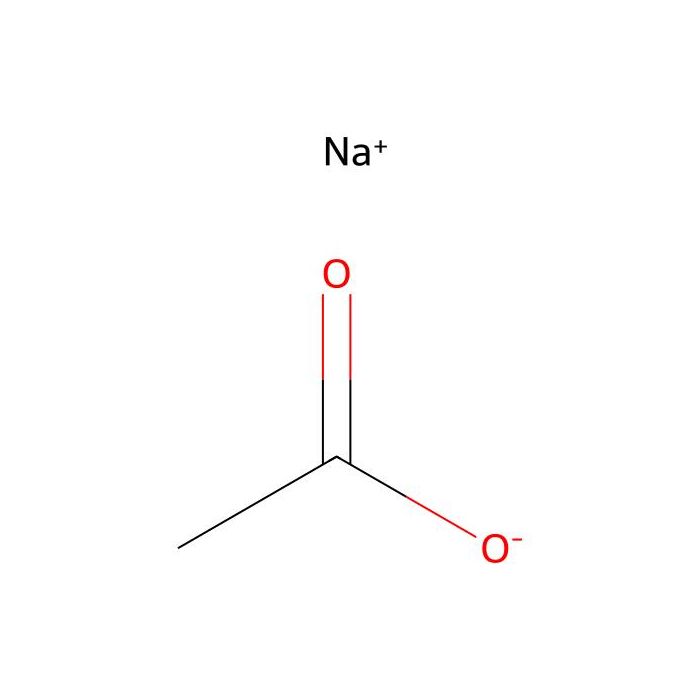
Acetate standard solution - 10mg/mL , CAS No.127-09-3

CAS: 127-09-3 Cat. No.: A742411 Formule: CH3COONa Poids moléculaire: 82.03 Numéro CE: 204-823-8 PubChem CID: 517045
DISPONIBLE À COMMANDE
GRADE & PURITY 10mg/mL
Storage
Room temperature,Argon charged
Shipped In
Normal
★
Size
USA
Allemagne (EU)*
Price
Qty
500ml
A742411-500ml
Sur commande · 8–12 semaines
299,90$US
Enter a quantity for the sizes you want to add.
🧪
Why this grade

10mg/mL for sensitive chromatographic and analytical workflows requiring minimal baseline interference.

🌡

Storage & shipping

Room temperature,Argon charged Ships Normal Check lot-specific COA for exact specifications.

📋

Quality documents

SDS, COA, datasheet, and spec sheet available for download. Lot-specific COA accessible via lot number lookup.

📚

Literature proof

Cited in 1671 peer-reviewed publications across chromatography, organic synthesis, and cross-coupling reactions.

Specifications

Spécifications et pureté
10mg/mL
Conditions de stockage de stockage
Room temperature,Argon charged
Expédié en
Normal
Noms et identifiants
Isomères SMILES
CC(=O)[O-].[Na+]
PubChem CID
517045
Poids moléculaire
82.03

Documentation

📋 Safety Data Sheet (SDS)

Comprehensive hazard, handling, storage, and regulatory compliance document.

Download SDS →

✅ Certificate of Analysis (COA)

Lot-specific quality data. Enter your lot number to retrieve the exact COA.

Look up COA →

📊 Datasheet

Quick-reference summary of product specifications and applications.

View datasheet →

🔬 Specification Sheet

Full quality attributes and acceptance criteria for this grade.

View spec sheet →

Advanced Data

Certificats (CoA, COO, BSE/TSE et tableau d'analyse)
C of A & Other Certificates(BSE/TSE, COO):
Analytical Chart:
Propriétés chimiques et physiques
Point d'éclair (°C)>250°C
Point de fusion (°C)324°C
FAQ et articles
Protein Tris-Acetate Electrophoresis System Standard Operating Procedure
TRAP Staining: Principle and Procedure
GST-Tagged Protein Purification
PAS Staining (Periodic Acid–Schiff, PAS) Standard Operating Procedure (SOP)
A Review of Ten Commonly Used Techniques for Detection, Quantification, and Interaction Analysis in Nucleic Acid Research
Selection of Common Research Salts: A Task Map for Alkali Metal Salts & Alkaline Earth Metal Salts (with Product Tables 1–6)
2-Methylpyridine–Borane (2-Picoline·BH₃) Reductive Amination Guide: Process Drivers for Replacing NaBH₃CN, the Practical Operating Window, and Scale-Up/Quench Close-Out Essentials (Including Product Tables 1–3)
Recent Advances in Methods for Measuring Starch-Related Indices in Plants and Their Application-Oriented Selection
Plant Omics Panorama: Workflow Frameworks and Multi-Omics Integration from Genomics to Transcriptomics, Proteomics, and Metabolomics
Acid Phosphatase: Dephosphorylation Reactions in Acidic Microenvironments and Their Research, Assay, and Detection Applications
Deoxyribonuclease (DNase): DNA Hydrolytic Cleavage Properties, Methodological Value, and Multi-Context Applications
Agarose Precast Gels: Composition, Advantages, and Application Workflows for Standardized Nucleic Acid Electrophoresis Matrices
Chymosin: A Review of Molecular Features, Coagulation Kinetics, and Activity Evaluation
Phytase: Enzymological Properties, Mechanism of Action, and Applications in Feed and Food
Chitinases: Substrate-Specific Degradation Mechanisms, Enzymatic Properties, and Application Directions
Functional Framework of Starch Metabolism-Related Enzymes in Food Science Research and Mechanistic Analysis of Quality Regulation
Acetyl-Group Metabolic Enzyme Network and In Vitro Enzymology Analysis
Metabolic Basis and Research Framework of Glycerol Utilization and Metabolic Reprogramming
Technical Comparison and Method Selection for Hydroxyproline Determination
Structural Characteristics, Operational Methods, and Separation Applications of Dextran Gels
Noncanonical Functions of Epigenetic Enzymes and Regulation of Mitochondrial Metabolism
Experimental Research on Candidate Probiotics: From Strain Identification and Mechanistic Evaluation to Product Selection
The Chemical Basis of Natural Lacquer Durability: Urushiol Structure, Oxidative Polymerization Film Formation, and Coating Film Properties
Experimental Evaluation of the Synergistic Actions of Endoglucanase, CBH I, and β-Glucosidase in Lignocellulosic Saccharification
Comparison of Iron Content Detection Methods: TPTZ, 1,10-Phenanthroline, Ferrozine, 2,2'-Bipyridine, and Instrumental Analysis
Phase-Partitioning Principles, System Differences, and Application Selection in Phenol-Based DNA and RNA Extraction
How to Evaluate Reaction Generality through Substrate Scope: From the Number of Examples to Standardized Substrate Selection
Air Decomposition of Solid Sodium Methoxide and Sodium Ethoxide—Effects on Cross-Coupling Reaction Optimization and Reproducibility
Citations of This Product
Calculateurs de solution
Avis

Avis des clients

Foire aux questions

How should this product be stored?
Store at room temperature under argon. It is supplied under an argon blanket; reseal under inert gas after each use.
How is this product shipped?
This product ships under standard ambient conditions. No temperature-controlled packaging is required.
What are the CAS number, molecular formula and molecular weight?
The CAS Number is 127-09-3, the molecular formula is CH3COONa, and the molecular weight is 82.03 g/mol.
What documentation is provided?
Available product documentation, including Certificates of Analysis (COA), Safety Data Sheets (SDS), and specification sheets, is shown in the product document area. Document availability and access follow the current site policy.

Shall we send you a message when we have discounts available?

Remind me later

Thank you! Please check your email inbox to confirm.

Oops! Notifications are disabled.