GAPDH Mouse mAb - Primary antibody, specific to GAPDH, IgG1

Cat. No.: Ab179920
DISPONIBLE À COMMANDE
QUALITÉ & PURETÉ Carrier Free ? Carrier-free — supplied without added carrier protein/stabilizer. Use when carriers (e.g. BSA) would interfere with conjugation or sensitive assays. ExactAb™ ? ExactAb™ — Aladdin's antibody line emphasizing precision and validated quality. Use for reliable, specificity-validated antibody applications. Azide Free ? Azide-free — without sodium azide preservative. Use in conjugations, cell work, or assays where azide is toxic or inhibitory. Validated ? Validated grade — performance confirmed in defined applications before release. Use when you want documented assurance the reagent works as stated. High Performance ? High-performance grade with optimized purity and performance characteristics. Use for sensitive analyses where ordinary grades fall short. PBS Only ? PBS-only formulation — supplied in phosphate-buffered saline with no other additives. Use when you need a clean PBS buffer free of stabilizers/carriers. See COA
Application
Flow Cytometry, WB
Host species
Mouse
Reactive species
Human
Isotype
Mouse IgG1
Clone Number
B07/4G9
Conjugation
Unconjugated
★
Taille
USA
Allemagne (EU)*
Prix
Qté
10μl
Ab179920-10μl
En stock ≥10
—
49,90$US
50μl
Ab179920-50μl
5 En stock
—
149,90$US
100μl
Ab179920-100μl
1 En stock
—
219,90$US
1ml
Ab179920-1ml
Fabrication sur commande aux États-Unis · 2–4 semaines ·
—
1 699,90$US
Enter a quantity for the sizes you want to add.
🧪
Pourquoi cette qualité

Carrier Free,ExactAb™,Azide Free,Validated,High Performance,PBS Only,See COA Azide Free,Carrier Free,ExactAb™,High Performance,PBS Only,Validated pour les flux de travail chromatographiques et analytiques sensibles nécessitant une interférence de ligne de base minimale.

🌡

Stockage & expédition

Store at -20°C,Avoid repeated freezing and thawing Expédition Ice chest + Ice pads. Consultez le COA spécifique au lot pour les spécifications exactes.

📋

Documents qualité

SDS, COA, fiche technique et fiche de spécifications disponibles au téléchargement. COA spécifique au lot accessible via la recherche par numéro de lot.

📚

Preuve documentaire

Cité dans 0 publications à comité de lecture couvrant la chromatographie, la synthèse organique et les réactions de couplage croisé.

Vue d’ensemble

Application
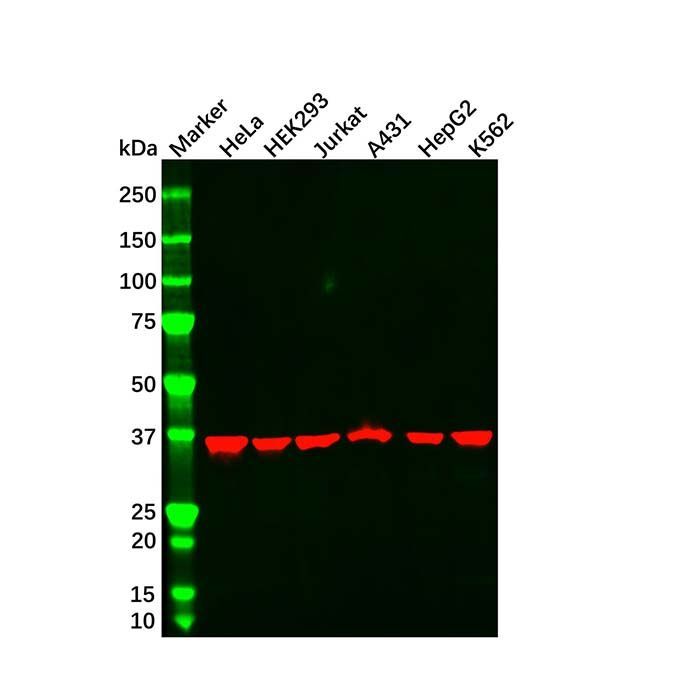
WB: 1/2,000-1/50,000 ; Predicted molecular weight: 37 kDa
Flow: 0.016 μg/mL-0.5 μg/mL
Description
Has both glyceraldehyde-3-phosphate dehydrogenase and nitrosylase activities, thereby playing a role in glycolysis and nuclear functions, respectively. This GAPDH antibody can be used as a loading control antibody.

Spécifications

Product Name
GAPDH Mouse mAb - Primary antibody, specific to GAPDH, IgG1
Synonymes
38 kDa BFA-dependent ADP-ribosylation substrate antibody | aging associated gene 9 protein antibody | Aging-associated gene 9 protein antibody | BARS-38 antibody | cb609 antibody | EC 1.2.1.12 antibody | Epididymis secretory sperm binding protein Li 162eP
Spécifications et pureté
Carrier Free,ExactAb™,Azide Free,Validated,High Performance,PBS Only,See COA
Espèce hôte
Mouse
Spécificité
GAPDH
Immunogène
Recombinant full length human GAPDH
Contrôle positif
WB: HEK293, HeLa, Jurkat, A431, HepG2 and K562 whole cell lysates Flow: HeLa cells
Conjugation
Unconjugated
Grade
Azide Free, Carrier Free, ExactAb™, High Performance, PBS Only, Validated
Isotype
IgG1
Type de chaîne lumineuse
kappa
Méthode de purification
Protein A purified
Concentration
See COA
Product Line
Produits biologiques
Stockage et expédition
Forme
Liquid
Conditions de stockage de stockage
Store at -20°C,Avoid repeated freezing and thawing
Expédié en
Ice chest + Ice pads
Stabilité et stockage
Store at +4°C short term (1-2 weeks). Store at -20°C or -80°C. Avoid freeze / thaw cycle.
Images

GAPDH Mouse mAb (Ab179920) - Western Blot
All lanes: GAPDH Antibody (Ab179920) at 0.1 μg/mL
Samples: Lysates at 20 µg per lane
Secondary: Goat Anti-Mouse IgG H&L (HRP) (Ab138040) at 1/20000 dilution

Predicted band size: 35.8 kDa
Observed band size: 36.4 kDa
Exposure time: 36.9 s

GAPDH Mouse mAb (Ab179920) - Flow Cytometry
Overlay histogram showing HeLa cells stained with GAPDH Mouse mAb (Ab179920) (Red). Cells were fixed and permeabilized with 100% methanol. A Goat Anti-Mouse IgG H&L (FITC) (Ab156254) was used as the secondary antibody. Unlabeled sample (Black) was used as a negative control. The mouse IgG (Ab170221) was used as an isotype control (Blue).

Application
Application
Dilution info
Flow Cytometry

0.016 μg/mL - 0.5 μg/mL

WB

1/2,000-1/50,000 ; Predicted molecular weight: 37 kDa

Documentation

📋 Fiche de données de sécurité (FDS)

Document complet couvrant les dangers, la manipulation, le stockage et la conformité réglementaire.

<<<<<<< HEAD Télécharger la SDS → ======= Télécharger la SDS → >>>>>>> release248-p3

✅ Certificat d'analyse (COA)

Données qualité spécifiques au lot. Saisissez votre numéro de lot pour récupérer le COA exact.

Rechercher le COA →

📊 Fiche technique

Résumé de référence rapide des spécifications et applications du produit.

Voir la fiche technique →

🔬 Fiche de spécifications

Attributs de qualité complets et critères d'acceptation pour cette qualité.

Voir la fiche de spécifications →

Données avancées

Cibles associées (humaines)
GAPDH Tchem Glyceraldehyde-3-phosphate dehydrogenase (0 Activities)
Activity TypeActivity Value -log(M)Mechanism of ActionActivity ReferencePublications (PubMed IDs)
Mécanismes d'action
Certificats (CoA, COO, BSE/TSE et tableau d'analyse)
C of A & Other Certificates(BSE/TSE, COO):
Analytical Chart:

Find and download the COA for your product by matching the lot number on the packaging.

3 results found

Lot NumberCertificate TypeDateArticle
ZJ23F1202278ZJ23F1202278Certificate of AnalysisDec 28, 2023 Ab179920
ZJ23F1202277ZJ23F1202277Certificate of AnalysisDec 28, 2023 Ab179920
ZJ23F1202276ZJ23F1202276Certificate of AnalysisDec 28, 2023 Ab179920
FAQ et articles
Calculateurs de solution
Avis

Avis des clients

Application Protocols

Tested applications, recommended dilutions, and positive control samples are not specified for this item; refer to the CoA/Spec Sheet.

Because this section must reflect only product data, no protocol details are provided here. Users should perform small‑scale titrations to establish optimal conditions once item‑specific guidance is obtained from the datasheet.

Biological Roles

Target overview: GAPDH (glyceraldehyde-3-phosphate dehydrogenase) is a central enzyme of glycolysis and a widely used housekeeping marker.

  • Core biochemical function (literature/general):

    • Catalyzes the sixth step of glycolysis: conversion of glyceraldehyde‑3‑phosphate to 1,3‑bisphosphoglycerate with concurrent reduction of NAD+ to NADH, proceeding via a thiohemiacetal and acyl‑enzyme intermediate.
    • Typically forms a homotetramer in the cytosol; highly conserved across species.
  • Moonlighting roles (literature/general):

    • Nuclear functions in transcriptional regulation and DNA repair; can translocate under stress.
    • Involvement in redox sensing via cysteine reactivity; can participate in S‑nitrosylation and oxidative modifications that modulate activity.
    • Roles in apoptosis, vesicular trafficking, and RNA binding have been reported in various systems.
  • Expression characteristics (literature/general):

    • Ubiquitous and generally stable in many cell types; however, expression can vary with metabolic state, hypoxia, differentiation, or treatment. Users should confirm stability in their specific experimental context before adopting GAPDH as a normalization control.
  • Subcellular localization (literature/general): Predominantly cytosolic; condition‑dependent nuclear or membrane associations have been observed.

This antibody is intended for research use only to detect GAPDH protein in biochemical and cell biology experiments; no diagnostic or therapeutic use is intended or implied.

Buffer Applications

Not typically applicable. This product is an antibody reagent supplied in PBS and is not used to prepare buffer systems.

  • Practical note: Ensure compatibility of your assay buffer (e.g., PBS, TBS with appropriate blockers/detergents) with the chosen detection method. Avoid additives that could interfere with antibody–antigen binding or downstream conjugation if you plan to label the antibody.
Green Alternatives

Considerations to reduce environmental impact while maintaining experimental quality:

  • Azide-free benefit (item-specific): This product is already Azide Free, avoiding the aquatic toxicity concerns associated with sodium azide in waste streams.

  • Carrier-free formulation (item-specific): Carrier Free reduces animal-derived additives and simplifies downstream purification and conjugation, potentially lowering resource use associated with additional cleanup steps.

  • Alternative formats (general):

    • Recombinant monoclonal or sequence-defined antibodies can enhance lot-to-lot consistency and may reduce animal use compared with hybridoma-derived materials (consult product origin on CoA).
    • Antibody fragments (F(ab’)2, Fab, scFv) can decrease mass of reagent used and may improve tissue penetration, reducing overall consumption.
  • Process improvements (general):

    • Optimize titration to use the minimum effective antibody amount.
    • Employ reusable, validated secondary reagents, or consider directly labeled primaries to cut extra incubation/wash steps and buffer volumes.
    • Implement buffer recycling where appropriate (e.g., reusing wash buffers after filtration) to reduce water use while maintaining assay performance.
  • Waste management (general):

    • Segregate proteinaceous, non‑hazardous aqueous waste from solvent and heavy‑metal streams.
    • Since this product is azide‑free, disposal is simplified relative to azide‑containing formulations—still follow local regulations and institutional policies.
Pharmaceutical Uses

Not applicable for therapeutic or diagnostic use. This antibody is labeled For research use only (item-specific) and is not manufactured under GMP for clinical applications.

  • Formulation/excipient note (general): PBS-only, azide-free, carrier-free formulations are often preferred for conjugation or cell‑based research assays. For any translational or regulated workflows, obtain a product with appropriate documentation (e.g., GMP-grade or IVD reagents) and perform full qualification.
Physical Properties

As an antibody reagent, small‑molecule physical constants (bp, mp, logP) are not applicable. Reported/typical properties are provided here only as general context; item‑specific specifications are not provided in the Product Data.

  • Form/appearance: Not specified for this item; refer to CoA/Spec Sheet.
  • Concentration: Not specified for this item; refer to CoA/Spec Sheet.
  • Buffer: PBS only (item-specific, from Product Data).
  • Additives/preservatives: Azide Free and Carrier Free (item-specific, from Product Data).
  • Molecular weight: Not specified for this item; refer to CoA/Spec Sheet. (General: intact IgG often ~150 kDa; literature.)
  • Isoelectric point (pI): Not specified for this item. (General: IgGs commonly pI ~6–9; literature, subclass/sequence dependent.)
  • Extinction coefficient (A280): Not specified for this item. (General: typical IgG ε280 ~210,000 M−1 cm−1; literature; sequence dependent.)
  • Solubility: Proteins are water‑soluble in physiological buffers; stability depends on pH, ionic strength, and excipients (literature/general).
  • Stability considerations (general): Avoid repeated freeze–thaw; store at recommended temperature to prevent aggregation or activity loss.

Because performance-relevant attributes such as isotype, affinity/avidity, concentration, and purity level beyond the provided grades are not specified, consult the product CoA/Spec Sheet for exact values when planning experiments or calculating dosing.

Quality and Grades

Item-specific quality designations (from Product Data) and what they imply for professional use:

  • Carrier Free: Supplied without protein carriers (e.g., BSA, gelatin). Advantages include accurate protein quantitation, lower risk of carrier interference in conjugations (e.g., HRP/biotin/fluorophores), and reduced background in sensitive assays. Practical note: to reduce adsorption losses during aliquoting/long storage, users may optionally add their own carrier after making working aliquots (general practice, not an item spec).

  • Azide Free: No sodium azide preservative present. Essential for applications involving live cells, primary neurons, enzymatic assays, or peroxidase-based detection that are inhibited by azide. Storage stability should rely on low temperature and aseptic handling.

  • PBS Only: Formulated solely in phosphate-buffered saline, simplifying downstream compatibility with most immunoassays and cell-based procedures. Verify pH/ionic strength on the CoA if your application is sensitive.

  • ExactAb™: Indicates a high-consistency antibody preparation (vendor designation). Typically suggests stringent lot-to-lot control and defined composition (explanation provided as general meaning of the mark; consult vendor notes for scope).

  • Validated, High Performance: Denotes that the antibody has undergone internal performance checks. Since specific application validations, species reactivity, and titers are not listed in the Product Data, consult the CoA/Spec Sheet for supported applications and example data before critical experiments.

Taken together, these grades make this antibody suitable for sensitive workflows (e.g., conjugation, cell-based assays) where additives such as azide or carriers would be detrimental.

Reaction and Applications

This product is a research antibody directed against GAPDH, a widely used housekeeping protein.

  • Typical research applications (general guidance; not item‑specific validations):

    • Western blot (WB) to verify equal loading/transfer as a cytosolic loading control.
    • Immunofluorescence (IF) or immunocytochemistry (ICC) to visualize cytoplasmic distribution of GAPDH.
    • Immunohistochemistry (IHC) on fixed tissues to assess ubiquitous expression patterns.
    • ELISA or plate-based detection where GAPDH capture/detection is needed.
    • Flow cytometry (less common) on permeabilized cells to benchmark intracellular staining.
  • Why anti-GAPDH: GAPDH expression is relatively stable across many cell types, providing a reference for normalization of protein levels in WB and other assays. Note that metabolic or stress conditions can modulate GAPDH abundance or localization; verify stability in your specific model.

  • Practical tips (general):

    • Use the supplied PBS formulation directly or dilute in antibody diluent with protein blocker to reduce nonspecific binding.
    • Because this lot is Carrier Free and Azide Free (item-specific), it is suitable for conjugation (e.g., NHS ester fluorophores) and for live‑cell compatible workflows that avoid azide.
    • Always titrate antibody concentration for each assay, matrix, and detection system to optimize signal‑to‑noise.

Item-specific validated applications and recommended dilutions are not provided in the Product Data—consult the CoA/Spec Sheet for tested use cases.

Reaction Conditions

Not applicable to small‑molecule reactions. For immunoassays, conditions are assay‑specific and should be optimized empirically.

General guidance for immunochemical “reaction” conditions (not item‑specific):

  • Temperature: Many bindings are performed at room temperature or 4°C to balance kinetics and specificity.
  • Incubation: Optimize time to achieve desired signal with minimal background; gentle agitation improves mass transport.
  • Buffers: PBS or TBS with blockers (e.g., serum, BSA, casein) and detergents (e.g., Tween‑20) as appropriate for the assay.
  • Conjugation: For labeling, use amine‑free buffers for NHS chemistry and reducing conditions for maleimide‑thiol coupling; strictly control molar ratios and quench residual reactives.

Item-specific recommended conditions (dilutions, incubation times, validated matrices) are not provided; consult the CoA/Spec Sheet.

Safety and Handling

Safety overview for laboratory use of protein antibodies; defer to the product SDS for definitive guidance.

  • GHS/CLP classification and hazard statements: Not specified for this item; refer to SDS. Antibody formulations without sodium azide (this product is Azide Free) typically present low acute hazards but can cause allergic reactions in sensitized individuals (general guidance).
  • Signal word/pictograms: Not specified for this item; refer to SDS.
  • Primary risks (general):
    • Potential for skin/eye/respiratory irritation from protein solutions or buffer components.
    • Biological origin material—practice good microbiological hygiene; not of human origin for therapeutic/diagnostic use.
  • PPE (general best practice): Lab coat, nitrile gloves, safety glasses; use a biosafety cabinet if aerosol generation is possible.
  • Handling: Avoid microbial contamination; keep container tightly closed. Minimize freeze–thaw cycles (explicitly noted in Product Data).
  • Incompatibilities (general): Avoid strong oxidizers and extremes of pH or high ionic detergents that may denature proteins. Do not add sodium azide if downstream live‑cell or enzymatic assays are planned; this item is azide‑free as supplied.
  • First aid (general): Rinse eyes/skin with water for several minutes if contacted; remove contaminated clothing. If inhaled, move to fresh air. Seek medical advice if symptoms persist. Provide SDS to healthcare personnel.
  • Spill/cleanup: Absorb with inert material, wash area with water and detergent; decontaminate surfaces. Dispose per institutional/municipal regulations for laboratory biological reagents.

Always consult the SDS and institutional EHS policies for authoritative safety instructions.

Solvent Selection

Not a solvent. This antibody is supplied in PBS only (item-specific) and is intended for use in aqueous buffers.

  • Practical guidance (general):
    • Maintain isotonic, near‑physiological pH buffers (e.g., PBS, TBS) for routine immunoassays. Avoid low‑ionic strength or extreme pH unless specifically required.
    • For conjugation or special assays, buffer exchange to amine‑free buffers (e.g., PBS without primary amines; for NHS chemistry) may be necessary.
    • Minimize exposure to organic solvents (acetonitrile, DMSO, methanol) which can denature proteins or impair binding.

For experimental planning, focus on the downstream assay buffer composition rather than solvent selection per se.

Storage and Reconstitution

Item-specific storage and logistics (from Product Data):

  • Storage conditions: Store at −20°C.
  • Handling caution: Avoid repeated freezing and thawing.
  • Shipping: Ice chest + ice pads (cold shipment).
  • Formulation: PBS only, Azide Free, Carrier Free.

General handling best practices (not item‑specific specifications):

  • Upon receipt, inspect for any signs of leakage or turbidity. If sterility is required, work aseptically.
  • If supplied in liquid form, aliquot into low‑protein‑binding tubes to minimize adsorption and avoid repeated freeze–thaw cycles.
  • For long-term storage, freezing at −20°C (as specified) is acceptable; many users prefer −80°C for multi‑year storage—verify stability on the CoA before deviating from the label.
  • Avoid frost‑free freezers and temperature cycling. Thaw on ice and mix gently; do not vortex aggressively.
  • If lyophilized (not specified for this item), reconstitute with sterile PBS or assay buffer to the desired concentration; allow to dissolve gently at room temperature, then place on ice. Filter (0.22 µm) if particulate matter is observed and the application tolerates filtration.
  • Optional (user practice): For working aliquots, adding inert protein (e.g., BSA) or glycerol can improve stability; ensure such additives are compatible with your downstream assays.

Always consult the CoA/Spec Sheet for any product‑specific reconstitution instructions and stability claims.

Structure and Identity

Brief description: This product is a mouse monoclonal antibody (mAb) directed against GAPDH (glyceraldehyde-3-phosphate dehydrogenase). As a protein biologic, it does not have a defined small‑molecule structure.

  • Item-specific identifiers from Product Data:

    • Antigen/Target: GAPDH (from product name)
    • Antibody type: Mouse monoclonal antibody (mAb)
    • CAS, CID, InChIKey, SMILES: Not applicable to antibodies; not provided for this item.
    • Molecular formula: Not specified for this item; refer to CoA/Spec Sheet.
    • Molecular weight: Not specified for this item; refer to CoA/Spec Sheet.
  • General structural features (literature/general):

    • Typical IgG architecture: two heavy chains and two light chains linked by disulfide bonds, forming a Y‑shaped homodimer of heterodimers.
    • Approximate mass of a full-length IgG is often ~150 kDa (isotype/clone dependent; literature value).
    • Functional domains: variable regions (VH/VL) for antigen recognition; constant regions (CH/CL) mediating effector functions; hinge region provides flexibility.
    • 2D/primary structure description: linear amino‑acid sequence with conserved framework regions interspersed by complementarity-determining regions (CDRs) that create the antigen-binding paratope.
  • Epitope/clone/isotype:

    • Not specified for this item; refer to CoA/Spec Sheet.

Notes: Exact sequence, clonality details (clone ID), isotype/subclass (e.g., IgG1, IgG2a), and any engineered features are item‑specific and were not provided in the Product Data.

Synthetic Utility

Not applicable. As a biological reagent (mouse monoclonal antibody), this product is not used as a chemical building block or reagent in synthetic organic chemistry.

For users interested in conjugation chemistry (general): the antibody’s primary amines (lysines, N-termini) and thiols (reduced cysteines) can be leveraged for bioconjugation (e.g., NHS‑ester, maleimide chemistries). Such modifications are part of bioconjugate workflows rather than small‑molecule synthesis.

Target Specificity

Item-specific facts from Product Data:

  • Antigen/Target: GAPDH (glyceraldehyde-3-phosphate dehydrogenase)
  • Antibody type: Mouse monoclonal antibody

Details not specified for this item; refer to CoA/Spec Sheet:

  • Clone ID and epitope mapping: Not specified.
  • Isotype/subclass and light chain type: Not specified.
  • Species reactivity (e.g., human, mouse, rat) and cross‑reactivity: Not specified.
  • Affinity/avidity or KD values: Not specified.
  • Validated applications and performance metrics: Not specified.

General note: GAPDH is highly conserved; however, actual species reactivity and epitope recognition are clone‑dependent and must be confirmed with item-specific data.

Foire aux questions

What does ExactAb? mean?
ExactAb? indicates the product has been validated for use in rigorous antibody validation workflows. Validation may include positive/negative control samples, signal-to-noise testing, and protocol-specific QC. Lot-specific test data is published on the Certificate of Analysis where available.
What does Carrier Free mean?
Carrier Free indicates that the material has been processed and tested for specialty industrial processing. Specifications focus on the impurities that affect performance in that application — for example, metal content for electronics, particle size for batteries, refractive index for optics, or moisture content for moisture-sensitive processes.
How should this product be stored?
Store at ?20 °C. Avoid repeated freeze–thaw cycles. Aliquot into single-use volumes before freezing.
How is this product shipped?
This product ships in an insulated container with ice pads. Unpack on arrival and transfer it to the storage condition stated above.
What documentation is provided?
Available product documentation, including Certificates of Analysis (COA), Safety Data Sheets (SDS), and specification sheets, is shown in the product document area. Document availability and access follow the current site policy.
Which species reactivity has this antibody been validated against?
Validated reactivity is listed on the PDP and on each lot's datasheet. We validate against the most commonly tested species for the target (GAPDH Mouse mAb); cross-reactivity in untested species may exist but is not guaranteed. Contact technical support for specific species inquiries.

Besoin d'aide pour choisir la qualité ?

Notre guide de sélection des qualités couvre la pureté, le statut du stabilisant et l'adéquation à l'application pour toutes les variantes de notre catalogue.

Voir le guide des qualités Carrier Free → Voir le guide des qualités Validated → Voir le guide des qualités ExactAb™ → Voir le guide des qualités Azide Free → Voir le guide des qualités High Performance → Voir le guide des qualités PBS Only →

Produits apparentés

Goat Anti-Mouse IgG H&L Antibody - Secondary antibody, for ELISA,LF,GICA various applications, from Mouse, generated in Goat
Goat Anti-Mouse IgG H&L (HRP) - Secondary antibody, for WB,ELISA,IHC-P various applications, from Mouse, generated in Goat, IgG
Mouse IgG - Isotype Control Antibody, generated in Rat, >95%, IgG
Rabbit Anti-Mouse IgG H&L (HRP) - Secondary antibody, IgG
Recombinant GAPDH Antibody - Primary antibody, specific to GAPDH, Rabbit IgG
BALB/c Mouse IgG - Isotype Control Antibody, IgG
Rabbit Anti-Mouse IgG antibody - Secondary antibody
Goat Anti-Mouse IgG H&L (FITC) - Secondary antibody
Goat Anti-Mouse IgG H&L (TRITC) - Secondary antibody
Goat Anti-Mouse IgG H&L Antibody - Secondary antibody, Goat IgG
Goat Anti-Mouse IgG H&L (Cy5) - Secondary antibody
Goat Anti-Mouse IgG H&L (HRP) - Secondary antibody
Goat Anti-Mouse IgG H&L (Biotin) - Secondary antibody
GAPDH Mouse mAb - Primary antibody, specific to GAPDH, IgG1
Rabbit Anti-Mouse IgG (HRP) - Secondary antibody
Rabbit Anti-Mouse IgG (Biotin) - Secondary antibody
Goat Anti-Mouse IgG H&L (HRP) - Secondary antibody, Goat IgG
Goat Anti-Mouse IgG H&L (TRITC) - Secondary antibody, Goat IgG
Goat Anti-Mouse IgG H&L (Biotin) - Secondary antibody, Goat IgG
Goat Anti-Mouse IgG H&L (FITC) - Secondary antibody, Goat IgG
Goat Anti-Mouse IgG H&L (Cy5) - Secondary antibody, Goat IgG
Goat Anti-Mouse IgG H&L (PE) - Secondary antibody, Goat IgG
Goat Anti-Mouse IgG H&L (APC) - Secondary antibody, Goat IgG
Mouse IgG (Biotin) - Isotype Control Antibody, Mouse IgG
Mouse IgG (PE) - Isotype Control Antibody, Mouse IgG
Mouse IgG (APC) - Isotype Control Antibody, Mouse IgG
Mouse IgG (FITC) - Isotype Control Antibody, Mouse IgG
Mouse IgG2a-Fc - Isotype Control Antibody, Mouse IgG2a
Goat Anti-Mouse IgG H&L (Alkaline Phosphatase) - Secondary antibody, Goat IgG
Goat Anti-Mouse IgG H&L (AF405) - Secondary antibody, Goat IgG
Goat Anti-Mouse IgG H&L (AF647) - Secondary antibody, Goat IgG
Mouse IgG2b-kappa, anti-Spike RBD - Isotype Control Antibody, specific to Spike RBD, Mouse IgG2b
Mouse IgG2a-kappa, anti-Spike RBD - Isotype Control Antibody, specific to Spike RBD, Mouse IgG2a
Mouse IgG3-kappa, anti-HEL - Isotype Control Antibody, specific to HEL, Mouse IgG3
Mouse IgG2c-kappa, anti-HEL - Isotype Control Antibody, specific to HEL, Mouse IgG2c
Mouse lgG2A(D265A)-kappa, anti-HEL - Isotype Control Antibody, specific to HEL, Mouse IgG2a(D265A)
Mouse IgG1(D265A)-kappa, anti-HEL - Isotype Control Antibody, specific to HEL, Mouse IgG1(D265A)
Mouse IgG (AF488) - Isotype Control Antibody, IgG
Mouse IgG (PerCP) - Isotype Control Antibody, IgG
Mouse IgG (AF405) - Isotype Control Antibody, IgG
IgG de souris (AF647) - Isotype Control Antibody, IgG
Goat Anti-Mouse IgG H&L (AF555) - Secondary antibody, specific to Mouse IgG, Goat IgG
IgG de souris (AF700) - Isotype Control Antibody, IgG
Goat Anti-Mouse IgG H&L (AF700) - Secondary antibody, specific to Mouse IgG, Goat IgG
Mouse IgG (PE-Cy5) - Isotype Control Antibody
Mouse IgG (PE-Cy7) - Isotype Control Antibody
Mouse IgG2b-kappa, anti-E8L - Isotype Control Antibody, specific to E8L
Mouse IgG2a-kappa, anti-A29L - Isotype Control Antibody, specific to A29L
Mouse IgG2c-kappa (AF647), anti-HEL - Isotype Control Antibody, specific to HEL
Mouse IgG2c-kappa (AF700), anti-HEL - Isotype Control Antibody, specific to HEL
Mouse IgG2c-kappa (AF405), anti-HEL - Isotype Control Antibody, specific to HEL
Mouse IgG2c-kappa (Biotin), anti-HEL - Isotype Control Antibody, specific to HEL
Mouse IgG2a-kappa (APC), anti-Spike RBD - Isotype Control Antibody, specific to Spike RBD
Mouse IgG2a-kappa (FITC), anti-Spike RBD - Isotype Control Antibody, specific to Spike RBD
Mouse IgG2a-kappa (AF700), anti-Spike RBD - Isotype Control Antibody, specific to Spike RBD
Mouse IgG2a-kappa (AF647), anti-Spike RBD - Isotype Control Antibody, specific to Spike RBD
Mouse IgG2a-kappa (AF555), anti-Spike RBD - Isotype Control Antibody, specific to Spike RBD
Mouse IgG2a-kappa (AF405), anti-Spike RBD - Isotype Control Antibody, specific to Spike RBD
Mouse IgG2c-kappa (FITC), anti-HEL - Isotype Control Antibody, specific to HEL
Mouse IgG2c-kappa (AF555), anti-HEL - Isotype Control Antibody, specific to HEL
Mouse IgG2c-kappa (APC), anti-HEL - Isotype Control Antibody, specific to HEL
Mouse IgG2c-kappa (PE), anti-HEL - Isotype Control Antibody, specific to HEL
Mouse IgG2a-kappa (Biotin), anti-Spike RBD - Isotype Control Antibody, specific to Spike RBD
Mouse IgG2a-Fc (Biotin) - Isotype Control Antibody
Mouse IgG2a-Fc (FITC) - Isotype Control Antibody
Mouse IgG (AF555) - Isotype Control Antibody
Mouse IgG2b-kappa (Biotin), anti-Spike RBD - Isotype Control Antibody, specific to Spike RBD
Mouse IgG2b-kappa (FITC), anti-Spike RBD - Isotype Control Antibody, specific to Spike RBD
Mouse IgG2b-kappa (APC), anti-Spike RBD - Isotype Control Antibody, specific to Spike RBD
Mouse IgG2b-kappa (APC-Cy7), anti-Spike RBD - Isotype Control Antibody, specific to Spike RBD
Goat Anti-Mouse IgG H&L (PE-Cy5) - Secondary antibody, specific to Mouse IgG
Centrose patent anti-dysadherin (anti-Dysadherin) - Primary antibody, specific to FXYD5
Mouse IgG2a-kappa (AF405), anti-A29L - Isotype Control Antibody, specific to A29L
Mouse IgG2a-kappa (AF488), anti-A29L - Isotype Control Antibody, specific to A29L
Mouse IgG2a-kappa (AF647), anti-A29L - Isotype Control Antibody, specific to A29L
Mouse IgG2a-kappa (AF700), anti-A29L - Isotype Control Antibody, specific to A29L
Mouse IgG2a-kappa (Biotin), anti-A29L - Isotype Control Antibody, specific to A29L
Mouse IgG2a-kappa (FITC), anti-A29L - Isotype Control Antibody, specific to A29L
Recombinant GAPDH Antibody - Primary antibody, specific to GAPDH
Mouse IgG3-kappa (Biotin), anti-HEL - Isotype Control Antibody, specific to HEL
Mouse IgG3-kappa (FITC), anti-HEL - Isotype Control Antibody, specific to HEL
Mouse IgG3-kappa (PE), anti-HEL - Isotype Control Antibody, specific to HEL
Mouse IgG3-kappa (AF488), anti-HEL - Isotype Control Antibody, specific to HEL
Mouse IgG3-kappa (APC), anti-HEL - Isotype Control Antibody, specific to HEL
Mouse IgG3-kappa (AF647), anti-HEL - Isotype Control Antibody, specific to HEL
Mouse IgG2b-kappa (AF555), anti-Spike RBD - Isotype Control Antibody, specific to Spike RBD
Goat Anti-Mouse IgG H&L (AF488) - Secondary antibody
Goat Anti-Mouse IgG H&L (PE-Cy7) - Secondary antibody
Mouse IgG (PE-Cy5.5) - Isotype Control Antibody
Goat Anti-Mouse IgG H&L (AF750) - Secondary antibody
Mouse IgG2a-kappa (AF555), anti-A29L - Isotype Control Antibody, specific to A29L
Mouse IgG2a-kappa (PE-Cy5.5), anti-A29L - Isotype Control Antibody, specific to A29L
Goat Anti-Mouse IgG H&L (AF546) - Secondary antibody
Goat Anti-Mouse IgG H&L (Oregon Green 488) - Secondary antibody
Goat Anti-Mouse IgG H&L (Cy3) - Secondary antibody
Mouse IgG2a-kappa (APC), anti-A29L - Isotype Control Antibody, specific to A29L
Mouse IgG3-kappa (AF555), anti-HEL - Isotype Control Antibody, specific to HEL
GAPDH Mouse mAb (Biotin) - Primary antibody, specific to GAPDH
GAPDH Mouse mAb (HRP) - Primary antibody, specific to GAPDH
Mouse IgG (PE-AF647) - Isotype Control Antibody

Souhaitez-vous que nous vous envoyions un message lorsque des réductions seront disponibles?

Me rappeler plus tard

Merci ! Veuillez vérifier votre boîte de réception e-mail pour confirmer.

Oups ! Les notifications sont désactivées.