GNMT Mouse mAb - Primary antibody, specific to GNMT, Mouse IgG2a

Cat. No.: Ab105966
DISPONIBLE À COMMANDE
QUALITÉ & PURETÉ Carrier Free ? Carrier-free — supplied without added carrier protein/stabilizer. Use when carriers (e.g. BSA) would interfere with conjugation or sensitive assays. ExactAb™ ? ExactAb™ — Aladdin's antibody line emphasizing precision and validated quality. Use for reliable, specificity-validated antibody applications. Validated ? Validated grade — performance confirmed in defined applications before release. Use when you want documented assurance the reagent works as stated. 0.5 mg/mL
Application
Flow Cytometry, WB
Host species
Mouse
Reactive species
Human, Mouse
Isotype
Mouse IgG2a
Clone Number
A41S18
Conjugation
Unconjugated
★
Taille
USA
Allemagne (EU)*
Prix
Qté
10μl
Ab105966-10μl
1 En stock
—
99,90$US
50μl
Ab105966-50μl
1 En stock
—
259,90$US
100μl
Ab105966-100μl
Fabrication sur commande aux États-Unis · 2–4 semaines ·
—
419,90$US
1ml
Ab105966-1ml
Fabrication sur commande aux États-Unis · 2–4 semaines ·
—
3 399,90$US
Enter a quantity for the sizes you want to add.

Vue d’ensemble

Mouse anti Human GNMT Antibody, Monoclonal (A41S18), could be used for WB, Flow and so on.


Spécifications

Product Name
GNMT Mouse mAb - Primary antibody, specific to GNMT, Mouse IgG2a
Synonymes
EC 2.1.1.20 antibody|Epididymis secretory sperm binding protein Li 182mP antibody|Glycine N methyltransferase antibody|Glycine N-methyltransferase antibody|Gnmt antibody|HEL S 182mP antibody|OTTHUMP00000016412 antibody|Glycine NMethyltransferase|Glycine N-Methyltransferase|GNMT
Spécifications et pureté
Carrier Free, ExactAb™, Validated, 0.5 mg/mL
Mécanismes biochimiques et physiologiques
Catalyzes the methylation of glycine by using S-adenosylmethionine (AdoMet) to form N-methylglycine (sarcosine) with the concomitant production of S-adenosylhomocysteine (AdoHcy). Possible crucial role in the regulation of tissue concentration of AdoMet and of metabolism of methionine.
Espèce hôte
Mouse
Spécificité
GNMT
Immunogène
Recombinant protein of human GNMT.
Contrôle positif
WB: Mouse liver lysates. Flow: U-2 OS cells.
Conjugation
Unconjugated
Grade
Carrier Free, ExactAb™, Validated
Isotype
Mouse IgG2a
Type de chaîne lumineuse
kappa
SDS-PAGE
150 kDa
Méthode de purification
Protein G purified
Concentration
0.5 mg/mL
Product Line
Produits biologiques
Stockage et expédition
Forme
Liquid
Conditions de stockage de stockage
Store at -20°C,Avoid repeated freezing and thawing
Expédié en
Ice chest + Ice pads
Stabilité et stockage
Store at 4℃ short term (1-2 weeks). Store at -20℃ long term (12 months). Upon receipt, it is recommended to aliquot. Avoid freeze/thaw cycle.
Images

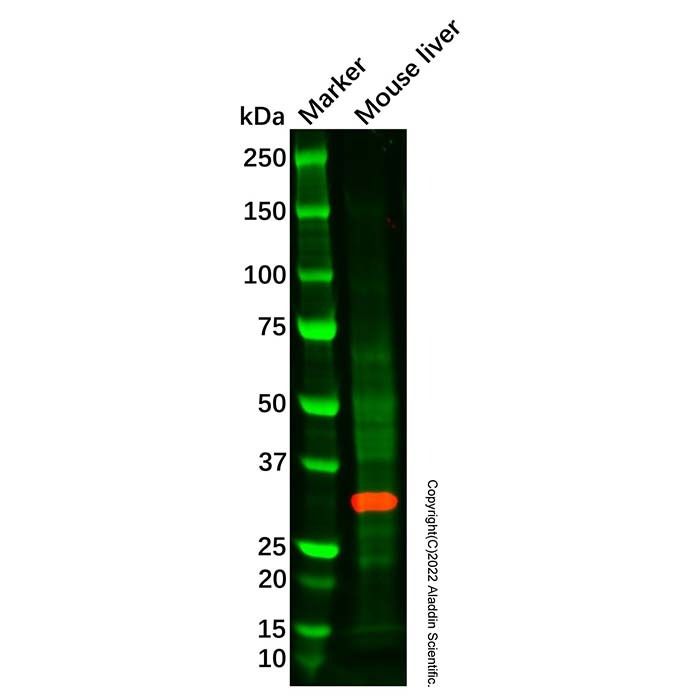
GNMT Mouse mAb (Ab105966) - Western Blot
All lanes: GNMT Mouse mAb (Ab105966) at 1/1000 dilution
Samples: Lysates at 20 µg per lane
Secondary: Goat Anti-Mouse IgG H&L (HRP) (Ab179001) at 1/20000 dilution

Predicted band size: 32 kDa
Observed band size: 31 kDa
Exposure time: 20.8 s

GNMT Mouse mAb (Ab105966) - Flow Cytometry
Flow cytometric analysis of U-2 OS cells using GNMT Mouse mAb (Ab105966). The cells were fixed with 2% paraformaldehyde (10 min) and then permeabilized with 90% methanol for 10 min. The cells were incubated in 2% bovine serum albumin to block non-specific protein-protein interactions followed by the antibody at 37℃ for 60 min. The secondary antibody Goat Anti-Mouse IgG (H&L) - AF488 was incubated at 37℃ for 40 min. Isotype control antibody (blue line) was used under the same condition.

Application
Application
Dilution info
WB

1/500-1/2000

Flow Cytometry

1/10-1/50

Données avancées

Cibles associées (humaines)
GNMT Tchem Glycine N-methyltransferase (0 Activities)
Activity TypeActivity Value -log(M)Mechanism of ActionActivity ReferencePublications (PubMed IDs)
Mécanismes d'action
Certificats (CoA, COO, BSE/TSE et tableau d'analyse)
C of A & Other Certificates(BSE/TSE, COO):
Analytical Chart:

Find and download the COA for your product by matching the lot number on the packaging.

2 results found

Lot NumberCertificate TypeDateArticle
ZJ24F1215289ZJ24F1215289Certificate of AnalysisJul 17, 2026 Ab105966
ZJ24F1215290ZJ24F1215290Certificate of AnalysisJul 17, 2026 Ab105966
FAQ et articles
Calculateurs de solution
Avis

Avis des clients

Application Protocols

Manufacturer-tested applications and recommended conditions are not provided in the Product Data for this item.

Item-specific guidance

  • Validated status is indicated, but specific assays, dilutions, and species are not specified for this item; refer to the CoA/Spec Sheet for authoritative protocols.

General protocol outlines (for planning only; not item-specific instructions)

  • Western blot (WB): Block membrane (e.g., 5% milk/TBST), incubate with primary antibody at an empirically determined dilution, wash, incubate with anti-mouse secondary, develop by chemiluminescence.
  • Immunohistochemistry (IHC): Perform fixation and antigen retrieval as appropriate, block, incubate with primary, wash, detect with HRP/DAB or fluorescence.
  • Immunofluorescence (IF/ICC): Fix/permeabilize as needed, block, incubate with primary and fluorescent secondary, mount and image.
  • ELISA: Optimize coating, blocking, primary incubation, and detection steps to achieve target sensitivity and linear range.

Always confirm item-specific recommendations (dilution ranges, retrieval conditions, incubation times) from the CoA/Spec Sheet before experimental use.

Biological Roles

Target: GNMT (glycine N-methyltransferase) — literature overview.

  • Enzymatic function: GNMT is a cytosolic, tetrameric enzyme that transfers a methyl group from S-adenosyl-L-methionine (SAM) to glycine, forming sarcosine and S-adenosyl-L-homocysteine (SAH). It plays a central role in regulating intracellular SAM/SAH ratios and the cellular methylation potential.
  • Metabolic integration: GNMT links one-carbon metabolism, folate cycle, and methionine cycle. It can act as a buffer for excess SAM, indirectly modulating DNA, RNA, and protein methylation reactions.
  • Tissue distribution: Highest expression is classically reported in liver (hepatocytes), with additional expression in other tissues at lower levels (literature). Subcellular localization is predominantly cytosolic.
  • Regulation (literature): Activity and expression are influenced by nutritional methionine status, folate levels, and hormonal and epigenetic signals. GNMT is known to bind 5-methyltetrahydrofolate, which can allosterically affect activity.
  • Research implications: Monitoring GNMT protein levels, localization, and interaction partners informs studies of methyl donor balance, hepatic metabolism, toxicology of methylation-perturbing xenobiotics, and systems biology of one-carbon pathways.

This antibody provides a tool to specifically detect GNMT protein in basic research settings. Application validation details, cross-reactivity profile, and isotype for this product are not specified; consult the CoA/Spec Sheet for item-specific information.

Buffer Applications

Not typically applicable. This product is an antibody reagent used within buffers rather than a buffering agent itself.

Practical notes (general)

  • Working buffers commonly include PBS or TBS with protein-based blockers (e.g., serum, casein) and mild detergents (e.g., 0.05% Tween-20) tailored to the application (WB, ELISA, IHC).
  • For Carrier Free antibodies, confirm whether preservatives are present before long incubations or cell-based applications. For this item, formulation details are not specified; refer to the CoA/Spec Sheet.
  • Ensure buffer pH and ionic strength maintain antibody stability and minimize nonspecific binding. Avoid primary amine buffers (e.g., Tris) when performing NHS ester conjugations.
Green Alternatives

Antibody reagents do not have direct solvent “green” alternatives like small-molecule solvents. Sustainability considerations focus on formulation, workflow, and packaging.

Greener practice considerations (general)

  • Concentrated formats reduce cold-chain volume and packaging waste. If supplied concentrated, aliquot to minimize freeze–thaw and reduce disposables.
  • Carrier-free format can eliminate azide and other preservatives when not needed; verify formulation for this item on the CoA/Spec Sheet.
  • Use reusable cold packs and insulated shippers where validated by your institution to reduce single-use materials.
  • Optimize assay design (e.g., microplate miniaturization) to reduce reagent use and plastic consumption.

Comparison of approaches (general)

  • Preservative-free vs. preservative-containing: preservative-free lowers hazardous waste but may require stricter aseptic technique; preservative-containing simplifies handling but can add toxic components (e.g., azide) to waste streams.
  • Direct labeling vs. secondary antibodies: direct labels reduce total antibody and buffer consumption in some workflows, but secondaries can amplify signal allowing lower primary use. Choose based on sensitivity vs. total reagent footprint.
Pharmaceutical Uses

For research use only (from Product Data). Not for human or veterinary diagnostic or therapeutic use.

Context in pharmaceutical R&D (general, non-clinical)

  • Analytical reagent: GNMT antibodies can support preclinical assay development (e.g., biomarker research, target engagement in discovery biology) without any implication of clinical use.
  • Process analytics: Antibodies are used in in-process controls and characterization assays during biologics development (e.g., Western blot or ELISA standards), but this product has no stated GMP status. Verify regulatory grade requirements for any QC use.
  • Conjugation-ready: Carrier-free format is typically preferred for custom labeling (biotin, enzymes, fluorophores) used in non-clinical bioanalytical assays.

Compliance notes

  • No claims of pharmacopeial status (USP/EP) or diagnostic clearance are provided. Any clinical or manufacturing application would require appropriate qualification and regulatory oversight beyond the scope of this product.
Physical Properties

This product is a mouse monoclonal antibody (protein biologic). Many small-molecule physical constants (bp, mp, SMILES) are not applicable.

Item-specific properties

  • Appearance: Not specified for this item; refer to CoA/Spec Sheet.
  • Concentration, formulation buffer, excipients/preservatives: Not specified for this item; refer to CoA/Spec Sheet.
  • Molecular weight: Not specified for this item; refer to CoA/Spec Sheet.

General/literature values and characteristics (for context)

  • Typical molecular mass for mouse IgG: ~150 kDa (literature), with heterogeneity from glycosylation and disulfide patterns.
  • Isoelectric point (pI): commonly ~6–9 depending on isotype and sequence (literature); actual pI for this clone is not specified for this item; refer to CoA/Spec Sheet.
  • Solubility: antibodies are water-soluble; commonly formulated in PBS or similar isotonic buffers (literature). Actual buffer composition for this item: Not specified for this item; refer to CoA/Spec Sheet.
  • Stability: sensitive to repeated freeze–thaw and elevated temperature; can adsorb to untreated surfaces (literature).

Notes on handling (practical)

  • Avoid foaming and vigorous vortexing to reduce aggregation risk (general guidance).
  • Use low-binding plastics and precoated tubes to minimize adsorption losses in dilute solutions (general guidance).
Quality and Grades

Grade/Purity designations (from Product Data): Carrier Free, ExactAb™, Validated.

What these designations mean (general definitions; see CoA/Spec Sheet for item-specific details)

  • Carrier Free: Supplied without added carrier proteins (e.g., BSA). Practical implications: improved performance in conjugation and labeling workflows and reduced background in cell-based assays. Note: absence of other excipients/preservatives is not specified for this item; confirm formulation on the CoA/Spec Sheet.
  • ExactAb™: Manufacturer branding indicating a high-consistency monoclonal antibody preparation. Typical expectations include defined specificity and lot-to-lot control. Specific criteria for this line should be confirmed with the manufacturer’s documentation.
  • Validated: Indicates the antibody has undergone internal performance verification. The exact validation methods/applications for this item are not specified in the Product Data; consult the CoA/Spec Sheet for tested applications, species reactivity, and representative data.

Additional QA considerations for professional users (general best practice)

  • Lot-specific titer, purity (SDS-PAGE), and endotoxin level (for cell work) should be reviewed on the CoA.
  • If performing conjugation (HRP, AP, fluorophores), carrier-free status facilitates predictable DOL (degree of labeling). Assess free amine content and buffer composition (avoid primary amines for NHS chemistry).
  • For quantitative assays, verify extinction coefficient or use BCA/A280 to confirm working concentration upon receipt.
Reaction and Applications

As an immunochemical reagent, this monoclonal antibody is intended for detection and capture of GNMT in research workflows rather than chemical synthesis.

Common research applications (general; not item-specific claims)

  • Immunoblotting (WB): detection of denatured GNMT in cell/tissue lysates following SDS-PAGE and transfer.
  • Immunoprecipitation (IP)/Co-IP: enrichment of GNMT and potential interaction partners from lysates for downstream MS or WB.
  • Immunofluorescence (IF)/Immunocytochemistry (ICC): localization of GNMT in fixed cells via fluorescence microscopy.
  • Immunohistochemistry (IHC): tissue-level detection of GNMT on fixed sections.
  • ELISA/antigen quantification: plate-based assays using capture or detection formats.

GNMT context (literature)

  • GNMT catalyzes methyl transfer from S-adenosyl-L-methionine (SAM) to glycine, producing sarcosine; it regulates SAM/SAH homeostasis. Studying GNMT with a specific mAb supports investigations of one-carbon metabolism and methylation balance.

Notes for successful use (general practice)

  • Validate species cross-reactivity and epitope compatibility for your sample type. For mouse mAbs on mouse tissue, consider anti-mouse background mitigation.
  • Optimize antibody dilution, antigen retrieval (IHC), and blocking conditions empirically.

Item-specific tested applications and recommended dilutions: Not specified for this item; refer to CoA/Spec Sheet.

Reaction Conditions

Not applicable to chemical reactions. For immunoassays, operating conditions are biological/incubation parameters rather than synthetic reaction conditions.

General working conditions for immunoassays (not item-specific; literature/practice)

  • Western blot: Incubate primary antibody in blocking buffer (e.g., 5% milk or BSA in TBST) at 4°C overnight or at room temperature for 1–2 h, followed by appropriate secondary detection. Optimize dilution empirically.
  • IHC/IF: Optimize fixation (PFA), permeabilization (e.g., 0.1–0.3% Triton X-100 for ICC as needed), antigen retrieval (citrate or EDTA buffers for FFPE), and blocking. Primary incubation typically 1–16 h at RT/4°C.
  • ELISA: Coat antigen or capture antibody on plates, block, incubate with samples and detection reagents; optimize incubation times and temperatures to balance sensitivity and background.

For this specific product, tested applications, recommended dilutions, and incubation parameters are not specified; consult the CoA/Spec Sheet for item-specific recommendations.

Safety and Handling

Safety information specific to this item is not provided in the product data. Always consult the SDS for authoritative guidance.

GHS classification (item-specific)

  • Signal word: Not specified for this item; refer to SDS.
  • Hazard statements (H-Statements): Not specified for this item; refer to SDS.
  • Pictograms: Not specified for this item; refer to SDS.

General safety guidance for antibody reagents (non-hazardous aqueous protein solutions, literature/practice)

  • Antibodies are typically considered non-hazardous; however, formulation may contain preservatives (e.g., sodium azide) in some products. This item is labeled Carrier Free; preservatives are not specified for this item. Verify composition on the CoA/Spec Sheet and SDS.
  • Avoid ingestion and contact with skin/eyes. Wear lab coat, gloves, and safety glasses when handling.
  • First aid (general): rinse skin/eyes with water if contacted; if inhaled as aerosol, move to fresh air; seek medical advice if irritation persists. Refer to SDS for details.

Storage incompatibilities and precautions

  • Do not mix with oxidizers or incompatible buffers without checking stability/compatibility data.
  • Avoid microbial contamination; use sterile technique when aliquoting.
  • Minimize freeze–thaw cycles to prevent aggregation and loss of activity.

Waste disposal

  • Dispose of proteinaceous and biological laboratory waste according to institutional biosafety procedures and local regulations.
Solvent Selection

Not typically applicable. This product is a protein aqueous reagent rather than a small-molecule solute requiring organic solvent selection.

Practical notes (general)

  • Antibodies are commonly supplied or reconstituted in isotonic aqueous buffers (e.g., PBS). The exact buffer and concentration for this item are not specified; refer to the CoA/Spec Sheet.
  • If buffer exchange is needed (e.g., for conjugation), use desalting columns or spin ultrafiltration (10–50 kDa MWCO, depending on desired recovery). Maintain pH and ionic strength suitable for antibody stability.
  • Avoid high concentrations of organic solvents (>10–20%) that can denature proteins unless performing controlled precipitation or specific labeling chemistries.
Storage and Reconstitution

Item-specific storage from Product Data

  • Storage temperature: Store at -20°C.
  • Handling: Avoid repeated freezing and thawing.
  • Shipping: Shipped in an ice chest with ice pads to maintain cold chain.

Practical guidance (general; verify with CoA/Spec Sheet)

  • Upon receipt: Inspect for container integrity and any visible particulates. Centrifuge briefly to collect contents before opening.
  • Aliquoting: To minimize freeze–thaw cycles, aliquot into low-binding microtubes sized for single-use or short-term use. Maintain sterility if performing cell-based assays.
  • Working temperature: Keep on ice during handling. For short-term storage (days to a week), 2–8°C is often acceptable; for longer-term storage, -20°C (as specified) or -80°C may be preferred depending on formulation. Follow item-specific instructions on the CoA/Spec Sheet.
  • Reconstitution: If supplied lyophilized (status not specified), reconstitute with sterile buffer recommended on the CoA/Spec Sheet to the desired concentration. Gently invert—do not vortex—to avoid aggregation. If supplied as liquid, no reconstitution is required.
  • Thawing: Thaw slowly on ice. Mix gently to homogenize. Never refreeze partially thawed vials.
  • Light and surface exposure: Protect from prolonged light if labeled; use low-binding plastics to reduce adsorption at low concentrations.

Formulation details (buffer, pH, stabilizers, preservatives) and concentration: Not specified for this item; refer to CoA/Spec Sheet.

Structure and Identity

Mouse monoclonal antibody (mAb) directed against GNMT (glycine N-methyltransferase).

  • SKU: Ab105966
  • Product name: GNMT Mouse mAb
  • Type: Protein biologic (immunoglobulin), monoclonal, mouse origin
  • Antigen target: GNMT (glycine N-methyltransferase)

Item-specific identifiers

  • CAS: Not applicable for antibodies
  • CID: Not applicable for antibodies
  • InChIKey: Not applicable for macromolecules
  • SMILES: Not applicable for macromolecules
  • Molecular formula: Not specified for this item; refer to CoA/Spec Sheet.
  • Molecular weight: Not specified for this item; refer to CoA/Spec Sheet.

Structural features (general, literature)

  • Typical mouse IgG architecture: two identical heavy chains (~50 kDa each) and two identical light chains (~25 kDa each) forming a Y-shaped heterotetramer via interchain disulfides.
  • Domains: variable (VH, VL) comprising antigen-binding fragment (Fab) regions; constant domains (CH1–CH3 for IgG, CL for light chain) creating Fc region with effector functions. Exact isotype/subclass and light-chain type for this item: Not specified for this item; refer to CoA/Spec Sheet.
  • Antigen-binding site recognizes an epitope on GNMT; precise epitope mapping and paratope residues: Not specified for this item; refer to CoA/Spec Sheet.

2D/sequence description

  • Sequence, CDRs, and clone ID: Not specified for this item; refer to CoA/Spec Sheet.
  • Post-translational features (glycosylation, glycoform distribution): Not specified for this item; refer to CoA/Spec Sheet.
Synthetic Utility

Not applicable. This product is a monoclonal antibody used as a biological affinity reagent rather than a synthetic building block or reagent in organic synthesis.

Related practical utility (general)

  • Affinity capture: Antibody can be immobilized on solid supports (e.g., Protein A/G beads or covalent coupling resins) for immunoprecipitation and pull-down of GNMT.
  • Analytical detection: Serves as a primary recognition element in immunoassays (ELISA, WB, IHC/IF), facilitating selective detection of GNMT in complex biological matrices.
Target Specificity

Item-specific information available from Product Data

  • Target/Antigen: GNMT (glycine N-methyltransferase)
  • Antibody type: Mouse monoclonal antibody (mAb)

Details not provided and should be confirmed on the CoA/Spec Sheet

  • Clone ID and epitope/epitope mapping: Not specified for this item; refer to CoA/Spec Sheet.
  • Isotype/subclass and light chain type: Not specified for this item; refer to CoA/Spec Sheet.
  • Species reactivity (human/mouse/rat, etc.) and cross-reactivity: Not specified for this item; refer to CoA/Spec Sheet.
  • Applications validated (WB, IHC, IF, ELISA, IP): Not specified for this item; refer to CoA/Spec Sheet.

Notes (general)

  • Monoclonal antibodies typically recognize a single epitope on the target protein, supporting high specificity. Actual specificity and off-target assessment for this product should be reviewed in the provided validation data when available.

Foire aux questions

What does ExactAb? mean?
ExactAb? indicates the product has been validated for use in rigorous antibody validation workflows. Validation may include positive/negative control samples, signal-to-noise testing, and protocol-specific QC. Lot-specific test data is published on the Certificate of Analysis where available.
How should this product be stored?
Store at ?20 °C. Avoid repeated freeze–thaw cycles. Aliquot into single-use volumes before freezing.
What does Carrier Free mean?
Carrier Free indicates that the material has been processed and tested for specialty industrial processing. Specifications focus on the impurities that affect performance in that application — for example, metal content for electronics, particle size for batteries, refractive index for optics, or moisture content for moisture-sensitive processes.
How is this product shipped?
This product ships in an insulated container with ice pads. Unpack on arrival and transfer it to the storage condition stated above.
What documentation is provided?
Available product documentation, including Certificates of Analysis (COA), Safety Data Sheets (SDS), and specification sheets, is shown in the product document area. Document availability and access follow the current site policy.
Which species reactivity has this antibody been validated against?
Validated reactivity is listed on the PDP and on each lot's datasheet. We validate against the most commonly tested species for the target (GNMT Mouse mAb); cross-reactivity in untested species may exist but is not guaranteed. Contact technical support for specific species inquiries.

Besoin d'aide pour choisir la qualité ?

Notre guide de sélection des qualités couvre la pureté, le statut du stabilisant et l'adéquation à l'application pour toutes les variantes de notre catalogue.

Voir le guide des qualités Carrier Free → Voir le guide des qualités Validated → Voir le guide des qualités ExactAb™ →

Produits apparentés

Goat Anti-Mouse IgG H&L Antibody - Secondary antibody, for ELISA,LF,GICA various applications, from Mouse, generated in Goat
Goat Anti-Mouse IgG H&L (HRP) - Secondary antibody, for WB,ELISA,IHC-P various applications, from Mouse, generated in Goat, IgG
Mouse IgG - Isotype Control Antibody, generated in Rat, >95%, IgG
Rabbit Anti-Mouse IgG H&L (HRP) - Secondary antibody, IgG
BALB/c Mouse IgG - Isotype Control Antibody, IgG
Rabbit Anti-Mouse IgG antibody - Secondary antibody
Goat Anti-Mouse IgG H&L (FITC) - Secondary antibody
Goat Anti-Mouse IgG H&L (TRITC) - Secondary antibody
Goat Anti-Mouse IgG H&L Antibody - Secondary antibody, Goat IgG
Goat Anti-Mouse IgG H&L (Cy5) - Secondary antibody
Goat Anti-Mouse IgG H&L (HRP) - Secondary antibody
Goat Anti-Mouse IgG H&L (Biotin) - Secondary antibody
Rabbit Anti-Mouse IgG (HRP) - Secondary antibody
Rabbit Anti-Mouse IgG (Biotin) - Secondary antibody
Goat Anti-Mouse IgG H&L (HRP) - Secondary antibody, Goat IgG
Goat Anti-Mouse IgG H&L (TRITC) - Secondary antibody, Goat IgG
Goat Anti-Mouse IgG H&L (Biotin) - Secondary antibody, Goat IgG
Goat Anti-Mouse IgG H&L (FITC) - Secondary antibody, Goat IgG
Goat Anti-Mouse IgG H&L (Cy5) - Secondary antibody, Goat IgG
Goat Anti-Mouse IgG H&L (PE) - Secondary antibody, Goat IgG
Goat Anti-Mouse IgG H&L (APC) - Secondary antibody, Goat IgG
Mouse IgG (Biotin) - Isotype Control Antibody, Mouse IgG
Mouse IgG (PE) - Isotype Control Antibody, Mouse IgG
Mouse IgG (APC) - Isotype Control Antibody, Mouse IgG
Mouse IgG (FITC) - Isotype Control Antibody, Mouse IgG
Mouse IgG2a-Fc - Isotype Control Antibody, Mouse IgG2a
Goat Anti-Mouse IgG H&L (Alkaline Phosphatase) - Secondary antibody, Goat IgG
Goat Anti-Mouse IgG H&L (AF405) - Secondary antibody, Goat IgG
Goat Anti-Mouse IgG H&L (AF647) - Secondary antibody, Goat IgG
Mouse IgG2b-kappa, anti-Spike RBD - Isotype Control Antibody, specific to Spike RBD, Mouse IgG2b
Mouse IgG2a-kappa, anti-Spike RBD - Isotype Control Antibody, specific to Spike RBD, Mouse IgG2a
Mouse IgG3-kappa, anti-HEL - Isotype Control Antibody, specific to HEL, Mouse IgG3
Mouse IgG2c-kappa, anti-HEL - Isotype Control Antibody, specific to HEL, Mouse IgG2c
Mouse lgG2A(D265A)-kappa, anti-HEL - Isotype Control Antibody, specific to HEL, Mouse IgG2a(D265A)
Mouse IgG1(D265A)-kappa, anti-HEL - Isotype Control Antibody, specific to HEL, Mouse IgG1(D265A)
Mouse IgG (AF488) - Isotype Control Antibody, IgG
Mouse IgG (PerCP) - Isotype Control Antibody, IgG
Mouse IgG (AF405) - Isotype Control Antibody, IgG
IgG de souris (AF647) - Isotype Control Antibody, IgG
Goat Anti-Mouse IgG H&L (AF555) - Secondary antibody, specific to Mouse IgG, Goat IgG
IgG de souris (AF700) - Isotype Control Antibody, IgG
Goat Anti-Mouse IgG H&L (AF700) - Secondary antibody, specific to Mouse IgG, Goat IgG
Mouse IgG (PE-Cy5) - Isotype Control Antibody
Mouse IgG (PE-Cy7) - Isotype Control Antibody
Mouse IgG2b-kappa, anti-E8L - Isotype Control Antibody, specific to E8L
Mouse IgG2a-kappa, anti-A29L - Isotype Control Antibody, specific to A29L
Mouse IgG2c-kappa (AF647), anti-HEL - Isotype Control Antibody, specific to HEL
Mouse IgG2c-kappa (AF700), anti-HEL - Isotype Control Antibody, specific to HEL
Mouse IgG2c-kappa (AF405), anti-HEL - Isotype Control Antibody, specific to HEL
Mouse IgG2c-kappa (Biotin), anti-HEL - Isotype Control Antibody, specific to HEL
Mouse IgG2a-kappa (APC), anti-Spike RBD - Isotype Control Antibody, specific to Spike RBD
Mouse IgG2a-kappa (FITC), anti-Spike RBD - Isotype Control Antibody, specific to Spike RBD
Mouse IgG2a-kappa (AF700), anti-Spike RBD - Isotype Control Antibody, specific to Spike RBD
Mouse IgG2a-kappa (AF647), anti-Spike RBD - Isotype Control Antibody, specific to Spike RBD
Mouse IgG2a-kappa (AF555), anti-Spike RBD - Isotype Control Antibody, specific to Spike RBD
Mouse IgG2a-kappa (AF405), anti-Spike RBD - Isotype Control Antibody, specific to Spike RBD
Mouse IgG2c-kappa (FITC), anti-HEL - Isotype Control Antibody, specific to HEL
Mouse IgG2c-kappa (AF555), anti-HEL - Isotype Control Antibody, specific to HEL
Mouse IgG2c-kappa (APC), anti-HEL - Isotype Control Antibody, specific to HEL
Mouse IgG2c-kappa (PE), anti-HEL - Isotype Control Antibody, specific to HEL
Mouse IgG2a-kappa (Biotin), anti-Spike RBD - Isotype Control Antibody, specific to Spike RBD
Mouse IgG2a-Fc (Biotin) - Isotype Control Antibody
Mouse IgG2a-Fc (FITC) - Isotype Control Antibody
Mouse IgG (AF555) - Isotype Control Antibody
Mouse IgG2b-kappa (Biotin), anti-Spike RBD - Isotype Control Antibody, specific to Spike RBD
Mouse IgG2b-kappa (FITC), anti-Spike RBD - Isotype Control Antibody, specific to Spike RBD
Mouse IgG2b-kappa (APC), anti-Spike RBD - Isotype Control Antibody, specific to Spike RBD
Mouse IgG2b-kappa (APC-Cy7), anti-Spike RBD - Isotype Control Antibody, specific to Spike RBD
Goat Anti-Mouse IgG H&L (PE-Cy5) - Secondary antibody, specific to Mouse IgG
Centrose patent anti-dysadherin (anti-Dysadherin) - Primary antibody, specific to FXYD5
Mouse IgG2a-kappa (AF405), anti-A29L - Isotype Control Antibody, specific to A29L
Mouse IgG2a-kappa (AF488), anti-A29L - Isotype Control Antibody, specific to A29L
Mouse IgG2a-kappa (AF647), anti-A29L - Isotype Control Antibody, specific to A29L
Mouse IgG2a-kappa (AF700), anti-A29L - Isotype Control Antibody, specific to A29L
Mouse IgG2a-kappa (Biotin), anti-A29L - Isotype Control Antibody, specific to A29L
Mouse IgG2a-kappa (FITC), anti-A29L - Isotype Control Antibody, specific to A29L
Mouse IgG3-kappa (Biotin), anti-HEL - Isotype Control Antibody, specific to HEL
Mouse IgG3-kappa (FITC), anti-HEL - Isotype Control Antibody, specific to HEL
Mouse IgG3-kappa (PE), anti-HEL - Isotype Control Antibody, specific to HEL
Mouse IgG3-kappa (AF488), anti-HEL - Isotype Control Antibody, specific to HEL
Mouse IgG3-kappa (APC), anti-HEL - Isotype Control Antibody, specific to HEL
Mouse IgG3-kappa (AF647), anti-HEL - Isotype Control Antibody, specific to HEL
Mouse IgG2b-kappa (AF555), anti-Spike RBD - Isotype Control Antibody, specific to Spike RBD
Goat Anti-Mouse IgG H&L (AF488) - Secondary antibody
Goat Anti-Mouse IgG H&L (PE-Cy7) - Secondary antibody
Mouse IgG (PE-Cy5.5) - Isotype Control Antibody
Goat Anti-Mouse IgG H&L (AF750) - Secondary antibody
Mouse IgG2a-kappa (AF555), anti-A29L - Isotype Control Antibody, specific to A29L
Mouse IgG2a-kappa (PE-Cy5.5), anti-A29L - Isotype Control Antibody, specific to A29L
Goat Anti-Mouse IgG H&L (AF546) - Secondary antibody
Goat Anti-Mouse IgG H&L (Oregon Green 488) - Secondary antibody
Goat Anti-Mouse IgG H&L (Cy3) - Secondary antibody
Mouse IgG2a-kappa (APC), anti-A29L - Isotype Control Antibody, specific to A29L
Mouse IgG3-kappa (AF555), anti-HEL - Isotype Control Antibody, specific to HEL
Mouse IgG (PE-AF647) - Isotype Control Antibody

Souhaitez-vous que nous vous envoyions un message lorsque des réductions seront disponibles?

Me rappeler plus tard

Merci ! Veuillez vérifier votre boîte de réception e-mail pour confirmer.

Oups ! Les notifications sont désactivées.