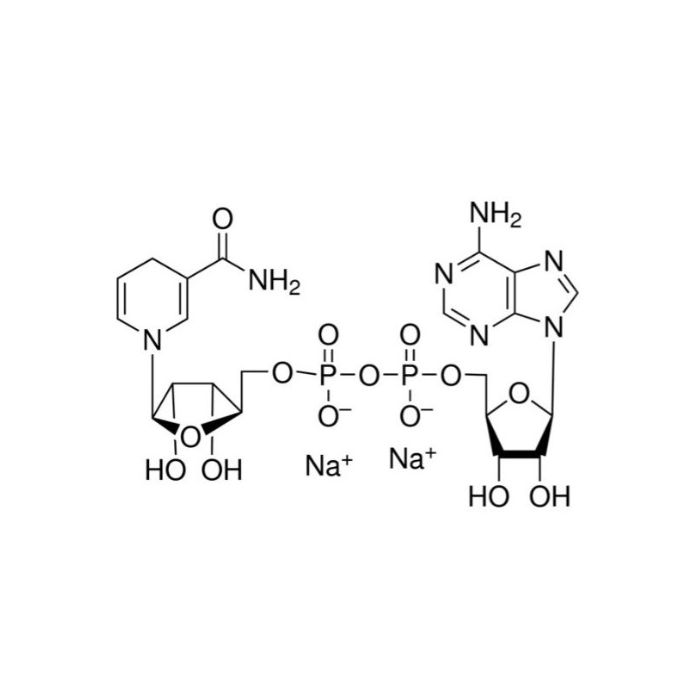
β-NADH - 10mM in DMSO , CAS No.606-68-8

CAS: 606-68-8 Cat. No.: N425025 分子式: C21H27N7Na2O14P2 分子量: 709.4 Beilstein Registry Number: 5230241 EC番号: 210-123-3
注文可能
グレード&純度 10mM in DMSO
Synonyms
606-68-8|Disodium nicotinamide adenine dinucleotide|Disodium NADH|NADH disodium salt|beta-Nicotinamide Adenine Dinucleotide Disodium Salt|NADH, disodium salt hydrate|NADH (disodium salt)|8295030YNC|disodium;[[(2R,3S,4R,5R)-5-(6-aminopurin-9-yl)-3,4-dihydr
Storage
Store at -80°C
Shipped In
Dry ice packs + Cold packs
★
サイズ
USA
ドイツ (EU)*
価格
個数
1ml
N425025-1ml
1 在庫あり
—
$99.90
Enter a quantity for the sizes you want to add.
🧪
このグレードを選ぶ理由

10mM in DMSO ベースライン干渉を最小限に抑える必要がある、感度の高いクロマトグラフィーおよび分析ワークフロー向け。

🌡

保管・配送

Store at -80°C Dry ice packs + Cold packs に出荷。正確な仕様については、ロット固有の COA をご確認ください。

📋

品質書類

SDS、COA、データシート、仕様書をダウンロードできます。ロット固有の COA はロット番号検索で入手可能です。

📚

文献的裏付け

クロマトグラフィー、有機合成、クロスカップリング反応に関する 36 件の査読済み論文で引用されています。

概要

β-Nicotinamide adenine dinucleotide (NAD+) and β-Nicotinamide adenine dinucleotide, reduced (NADH) comprise a coenzyme redox pair (NAD+:NADH) involved in a wide range of enzyme catalyzed oxidation reduction reactions. In addition to its redox function, NAD+/NADH is a donor of ADP-ribose units in ADP-ribosylaton (ADP-ribosyltransferases; poly(ADP-ribose) polymerases ) reactions and a precursor of cyclic ADP-ribose (ADP-ribosyl cyclases).
As a reagent, NADH can be used in enzyme cycling assays to amplify detection of activity of biologically relevant enzymes or metabolites present in low concentrations.

仕様

同義語
606-68-8 | Disodium nicotinamide adenine dinucleotide | Disodium NADH | NADH disodium salt | beta-Nicotinamide Adenine Dinucleotide Disodium Salt | NADH, disodium salt hydrate | NADH (disodium salt) | 8295030YNC | disodium;[[(2R,3S,4R,5R)-5-(6-aminopurin-9-yl)-3,4-dihydr
仕様と純度
10mM in DMSO
保管条件
Store at -80°C
入荷
Dry ice packs + Cold packs
この製品は冷冷この冷このこの製品の運送が必要です。地上およびその他の経済サービスは利用できません。
名前と識別子
パブケム・シド
パブケム・シド・ウル
https://pubchem.ncbi.nlm.nih.gov/substance/528775803
カノニカル・スマイル
C1C=CN(C=C1C(=O)N)C2C(C(C(O2)COP(=O)([O-])OP(=O)([O-])OCC3C(C(C(O3)N4C=NC5=C(N=CN=C54)N)O)O)O)O.[Na+].[Na+]
IUPAC Name
disodium;[[(2R,3S,4R,5R)-5-(6-aminopurin-9-yl)-3,4-dihydroxyoxolan-2-yl]methoxy-oxidophosphoryl] [(2R,3S,4R,5R)-5-(3-carbamoyl-4H-pyridin-1-yl)-3,4-dihydroxyoxolan-2-yl]methyl phosphate
InChIKey
QRGNQKGQENGQSE-WUEGHLCSSA-L
INCHI
1S/C21H29N7O14P2.2Na/c22-17-12-19(25-7-24-17)28(8-26-12)21-16(32)14(30)11(41-21)6-39-44(36,37)42-43(34,35)38-5-10-13(29)15(31)20(40-10)27-3-1-2-9(4-27)18(23)33;;/h1,3-4,7-8,10-11,13-16,20-21,29-32H,2,5-6H2,(H2,23,33)(H,34,35)(H,36,37)(H2,22,24,25);;/q;2*+1/p-2/t10-,11-,13-,14-,15-,16-,20-,21-;;/m1../s1
異性体SMILES
C1C=CN(C=C1C(=O)N)[C@H]2[C@@H]([C@@H]([C@H](O2)COP(=O)([O-])OP(=O)([O-])OC[C@@H]3[C@H]([C@H]([C@@H](O3)N4C=NC5=C(N=CN=C54)N)O)O)O)O.[Na+].[Na+]
WGKドイツ
3
代替CAS番号
58-68-4
分子量
709.4
Beilstein
5230241
Reaxy-Rn
5230241

ドキュメント

📋 安全データシート(SDS)

危険性、取扱い、保管、および規制遵守を網羅した包括的な文書。

<<<<<<< HEAD SDS をダウンロード → ======= SDS をダウンロード → >>>>>>> release248-p3

✅ 分析証明書(COA)

ロット固有の品質データ。ロット番号を入力して、正確な COA を取得してください。

COA を検索 →

📊 データシート

製品仕様と用途のクイックリファレンス概要。

データシートを見る →

🔬 仕様書

このグレードの完全な品質特性と合格基準。

仕様書を見る →

詳細データ

Taxonomic Classification

Taxonomy Tree

KingdomOrganic compounds
SuperclassNucleosides, nucleotides, and analogues
分類(5'->5')-dinucleotides
SubclassNot available
Intermediate Tree Nodes Not available
Direct Parent(5'->5')-dinucleotides
Alternative Parents Purine nucleotide sugars  Purine ribonucleoside diphosphates  Purine ribonucleoside monophosphates  Nicotinamide nucleotides  Pentose phosphates  Glycosylamines  6-aminopurines  Monosaccharide phosphates  N-substituted nicotinamides  Organic pyrophosphates  Aminopyrimidines and derivatives  Dihydropyridines  Alkyl phosphates  Imidolactams  N-substituted imidazoles  Vinylogous amides  Heteroaromatic compounds  Tetrahydrofurans  Amino acids and derivatives  Secondary alcohols  Primary carboxylic acid amides  Oxacyclic compounds  Enamines  Azacyclic compounds  Organopnictogen compounds  Hydrocarbon derivatives  Primary amines  Carbonyl compounds  Organic oxides  Organic zwitterions  Organic sodium salts  
Molecular FrameworkAromatic heteropolycyclic compounds
Substituents (5'->5')-dinucleotide - Purine nucleotide sugar - Purine ribonucleoside diphosphate - Purine ribonucleoside monophosphate - Nicotinamide-nucleotide - Pentose phosphate - Pentose-5-phosphate - Glycosyl compound - N-glycosyl compound - 6-aminopurine - Monosaccharide phosphate - N-substituted nicotinamide - Organic pyrophosphate - Imidazopyrimidine - Purine - Aminopyrimidine - Dihydropyridine - Alkyl phosphate - Hydropyridine - Pyrimidine - Monosaccharide - N-substituted imidazole - Organic phosphoric acid derivative - Imidolactam - Phosphoric acid ester - Azole - Tetrahydrofuran - Imidazole - Heteroaromatic compound - Vinylogous amide - Primary carboxylic acid amide - Carboxamide group - Amino acid or derivatives - Secondary alcohol - Carboxylic acid derivative - Enamine - Oxacycle - Organic alkali metal salt - Organoheterocyclic compound - Azacycle - Primary amine - Amine - Alcohol - Organic sodium salt - Organic nitrogen compound - Organic zwitterion - Hydrocarbon derivative - Organic oxide - Carbonyl group - Organic salt - Organooxygen compound - Organic oxygen compound - Organopnictogen compound - Organonitrogen compound - Aromatic heteropolycyclic compound
説明This compound belongs to the class of organic compounds known as (5'->5')-dinucleotides. These are dinucleotides where the two bases are connected via a (5'->5')-phosphodiester linkage.
External Descriptors Not available
3 D構造
インタラクティブ化学構造モデル


証明書(CoA、COO、BSE/TSEと分析図)
C of A & Other Certificates(BSE/TSE, COO):
Analytical Chart:
化学的性質と物理的性質
感度Air Sensitive,Heat Sensitive
分子量709.400 g/mol
XLogP3
Hydrogen Bond Donor Count6
Hydrogen Bond Acceptor Count19
Rotatable Bond Count11
Exact Mass709.089 Da
Monoisotopic Mass709.089 Da
Topological Polar Surface Area323.000 Ų
Heavy Atom Count46
Formal Charge0
Complexity1210.000
Isotope Atom Count0
Defined Atom Stereocenter Count8
Undefined Atom Stereocenter Count0
Defined Bond Stereocenter Count0
Undefined Bond Stereocenter Count0
The total count of all stereochemical bonds0
Covalently-Bonded Unit Count3
よくある質問と記事
NADH vs NADPH: Homologous coenzymes with distinct functional specialization
Niacin (Vitamin B3): Structural Features, Metabolic Roles, and Application Landscape
CCK-8 (WST-8) Colorimetric Cell Viability Assay: Principles, Experimental Design, and Typical Applications
Vitamins, Coenzymes, and Enzymes: A Metabolic Synergy Network and Its Disease Associations
NAD (Nicotinamide Adenine Dinucleotide): From a Metabolic Coenzyme to Homeostatic Regulation and Application Targets
Diaphorase: NAD(P)H-Dependent Electron-Transfer Activity and Its Applications in Detection and Research
A Panoramic Guide to Purines and Research Reagent Selection: Structural Hierarchy, Classification Map, Three Metabolic Pathways, and Typical Applications
Pyridine Research Selection Roadmap: Structural Features, Reaction Logic, and a Classification Navigator for Reagents/Building Blocks/Reference Standards (Tables 1–6)
Cellular Electron Transfer Networks and Mechanisms of Metabolism-Signaling Coupling
Acetyl-Group Metabolic Enzyme Network and In Vitro Enzymology Analysis
Metabolic Basis and Research Framework of Glycerol Utilization and Metabolic Reprogramming
Enzymatic Hydroxylation Mechanism of Salicylate Conversion to Catechol
Comparison of Urea Detection Methods: Reaction Mechanisms, Interference Factors, and Application Scenarios of the Urease Method and Diacetyl Monoxime Method
Oxalate Metabolism and Degradation Detection Methods: Enzymatic Assays, Chromatography, and Enzymatic Degradation System Analysis
What Is Synthetic Biology? The Industrialization Pathway from Upstream Reagent Toolchains to Biomanufacturing Applications
TCA Cycle Metabolite Detection Methods and Result Interpretation
β-Hydroxybutyrate Detection Methods and Metabolic Significance: Comparative Applications of Enzymatic Assays, Blood Ketone Meters, and LC-MS
Metabolic Functions and Experimental Detection of the Glycerol-3-Phosphate Pathway: Glycolysis, Glycerolipid Synthesis, and Mitochondrial Shuttle
Functional Roles of Auxiliary Enzymes in Enzyme-Coupled Colorimetric Reactions: Mutarotase, Oxidases, Peroxidases, and Dehydrogenases
How Coenzyme Q10 Acts on the Skin: Mitochondrial Electron Transfer, Antioxidant Protection of Membrane Lipids, and Lipid-Carrier Delivery
Structural Characteristics of Ergothioneine, OCTN1-Mediated Uptake by Skin Cells, and Antioxidant Mechanisms
Structural and Functional Differences Between Idebenone and Coenzyme Q10: From Side-Chain Structure to Redox Cycling and Mitochondrial Electron Transport
Citations of This Product
ソリューション計算機
レビュー

顧客レビュー

Shall we send you a message when we have discounts available?

Remind me later

Thank you! Please check your email inbox to confirm.

Oops! Notifications are disabled.