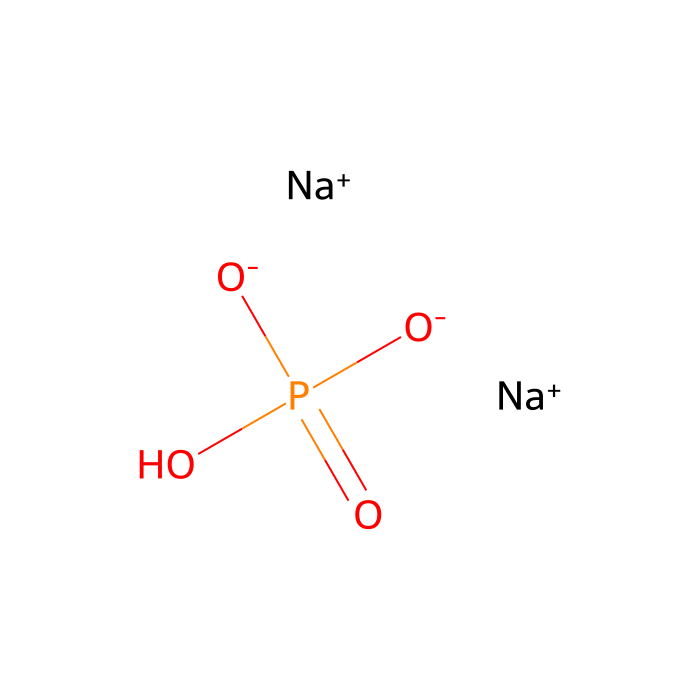
Sodium phosphate dibasic - Suitable for molecular biology, ≥99.5%(T) , CAS No.7558-79-4

CAS: 7558-79-4 Cat. No.: S118443 分子式: Na2HPO4 分子量: 141.96 EC番号: 231-448-7
注文可能
グレード&純度 Suitable for molecular biology ? Molecular-biology grade — free of nucleases and contaminants that degrade DNA/RNA. Use in cloning, PCR, and nucleic-acid work needing clean reagents. ≥99.5%(T)
Synonyms
Disodium hydrogen orthophosphate|Disodium phosphoric acid|OSMOPREP COMPONENT SODIUM PHOSPHATE, DIBASIC ANHYDROUS|Sodium phosphate, dibasic|Disodium Hydrogen Phosphate Submicron|Fleet enema|Disodium hydrophosphate|Sodium phosphate, dibasic (anhydrous)|SODIUM PHOSPHATE DIBASIC [WHO-DD]|SODIUM PHOSPHATE, DIBASIC, ANHYDROUS [II]|Dibasic sodium phosphate anhydrous|Disodium hydrogen phosphate, anhydrous|disodium hydrogenphosphate|disodium hydrogen-phosphate|Disodium phospahte|DISODIUM PHOSPHATE [HSDB]|Sodium phosphate (NaHPO4)|Acetest|Disodiumhydrogenphosphate|Soda phosphate|Disodium hydrogen orthophosphate;Sodium hydrogen phosphate|Sodium hydrogenphosphate|sodium hydrogen-phosphate|Disodium hydrogenorthophosphate|Disodium monohydrogen phosphate|DISODIUM PHOSPHATE [EP MONOGRAPH]|SODIUM PHOSPHATE, DIBASIC, ANHYDROUS|Sodium phosphate,dibasic,anhydrous|Sodiumphosphatedibasic|INS NO.339(II)|Disodium acid orthophosphate|Sodium phosphate dibasic, Trace metals grade|Sodium phosphate, exsiccated|Water Supply QC Check Sample: o-Phosphate Nutrients|DSP|SODIUM PHOSPHATE,DIBASIC,ANHYDROUS [VANDF]|VISICOL COMPONENT SODIUM PHOSPHATE, DIBASIC ANHYDROUS|Disodium hydrogen phosphate|di-sodium hydrogen phosphate|Disodium phosphate anhydrous|sodium hydrogen orthophosphate|INS-339(II)|Sodium acid phosphate, anhydrous|Sodium monohydrogen phosphate (2:1:1)|Sodium phosphate dibasic, biochemical grade|SODIUM PHOSPHATE, DIBASIC, ANHYDROUS [ORANGE BOOK]|SODIUM PHOSPHATE, DIBASIC [MI]|Disodium orthophosphate|Natriumphosphat [German]|secondary Sodium phosphate|sec-Sodium phosphate|Sodium phosphate dibasic|phosphoric acid, disodium salt, anhydrous|DISODIUM PHOSPHATE|DISODIUM PHOSPHATE [INCI]|Phosphoric acid, disodium salt|Disodium acid phosphate|Phosphoric acid, sodium salt (1:2)|Sodium hydrogen phosphate, anhydrous|SODIUM PHOSPHATE, DIBASIC ANHYDROUS|Phosphate of soda|Sodium hydrogen phosphate|disodium;hydrogen phosphate|Exsiccated sodium phosphate|Sodium Phosphate dibasic anhydrous|Disodium hydrogen monophosphate|Hydrogen disodium phosphate|phosphoric acid disodium salt|SODIUM PHOSPHATE [FHFI]|FEMA Number 2398|Sodium monohydrogen phosphate
Storage
Room temperature
Shipped In
Normal
★
サイズ
USA
ドイツ (EU)*
価格
個数
250g
S118443-250g
6 在庫あり
2 在庫あり
$99.90
Enter a quantity for the sizes you want to add.

仕様

同義語
Disodium hydrogen orthophosphate | Disodium phosphoric acid | OSMOPREP COMPONENT SODIUM PHOSPHATE, DIBASIC ANHYDROUS | Sodium phosphate, dibasic | Disodium Hydrogen Phosphate Submicron | Fleet enema | Disodium hydrophosphate | Sodium phosphate, dibasic (anhydrous) | SODIUM PHOSPHATE DIBASIC [WHO-DD] | SODIUM PHOSPHATE, DIBASIC, ANHYDROUS もっと見る
仕様と純度
Suitable for molecular biology, ≥99.5%(T)
保管条件
Room temperature
入荷
Normal
等級
Suitable for molecular biology
純度
≥99.5%(T)
名前と識別子
パブケム・シド
パブケム・シド・ウル
https://pubchem.ncbi.nlm.nih.gov/substance/488182863
SMILES
OP(=O)([O-])[O-].[Na+].[Na+]
IUPAC Name
disodium;hydrogen phosphate
InChIKey
BNIILDVGGAEEIG-UHFFFAOYSA-L
InChI
1S/2Na.H3O4P/c;;1-5(2,3)4/h;;(H3,1,2,3,4)/q2*+1;/p-2
異性体SMILES
OP(=O)([O-])[O-].[Na+].[Na+]
代替CAS番号
7778-77-0
分子量
141.96
Reaxys
11343459
Reaxys-RN_link_address
https://www.reaxys.com/reaxys/secured/hopinto.do?context=S&query=IDE.XRN=11343459&ln=

詳細データ

Taxonomic Classification

Taxonomy Tree

KingdomInorganic compounds
SuperclassMixed metal/non-metal compounds
分類Alkali metal oxoanionic compounds
SubclassAlkali metal phosphates
Intermediate Tree Nodes Not available
Direct ParentAlkali metal phosphates
Alternative Parents Inorganic sodium salts  Inorganic oxides  
Molecular FrameworkNot available
Substituents Alkali metal phosphate - Inorganic sodium salt - Inorganic oxide - Inorganic salt
説明This compound belongs to the class of inorganic compounds known as alkali metal phosphates. These are inorganic compounds in which the largest oxoanion is phosphate, and in which the heaviest atom not in an oxoanion is an alkali metal.
External Descriptors sodium phosphate
3 D構造
インタラクティブ化学構造モデル


証明書(CoA、COO、BSE/TSEと分析図)
C of A & Other Certificates(BSE/TSE, COO):
Analytical Chart:

Find and download the COA for your product by matching the lot number on the packaging.

11 results found

Lot NumberCertificate Type日付商品
E23101077E23101077Certificate of AnalysisOct 09, 2026 S118443
J2613282J2613282Certificate of AnalysisApr 21, 2026 S118443
I2504446I2504446Certificate of AnalysisAug 15, 2025 S118443
I2504705I2504705Certificate of AnalysisAug 15, 2025 S118443
E23101086E23101086Certificate of AnalysisApr 18, 2025 S118443
E23101067E23101067Certificate of AnalysisFeb 07, 2025 S118443
F2207271F2207271Certificate of AnalysisMar 20, 2024 S118443
F2207273F2207273Certificate of AnalysisMar 20, 2024 S118443
J2417316J2417316Certificate of AnalysisDec 10, 2022 S118443
A2119354A2119354Certificate of AnalysisNov 15, 2022 S118443
I2322094I2322094Certificate of AnalysisNov 15, 2022 S118443
化学的性質と物理的性質
感度Moisture sensitive.
分子量141.96
XLogP3
Hydrogen Bond Donor Count1
Hydrogen Bond Acceptor Count4
Rotatable Bond Count0
Exact Mass141.941 Da
Monoisotopic Mass141.941 Da
Topological Polar Surface Area83.400 Ų
Heavy Atom Count7
Formal Charge0
Complexity46.500
Isotope Atom Count0
Defined Atom Stereocenter Count0
Undefined Atom Stereocenter Count0
Defined Bond Stereocenter Count0
Undefined Bond Stereocenter Count0
The total count of all stereochemical bonds0
Covalently-Bonded Unit Count3
安全と危険(GHS)
ピクトグラム(s)
GHS05,   GHS07
信号
Danger
危険表示

H318:Causes serious eye damage

H319:Causes serious eye irritation

注意表示

P280:Wear protective gloves/protective clothing/eye protection/face protection.

P305+P351+P338:IF IN EYES: Rinse cautiously with water for several minutes. Remove contact lenses if present and easy to do - continue rinsing.

P264+P265:Wash hands [and …] thoroughly after handling. Do not touch eyes.

P305+P354+P338:IF IN EYES: Immediately rinse with water for several minutes. Remove contact lenses if present and easy to do. Continue rinsing.

P317:Get emergency medical help.

P337+P317:If eye irritation persists: Get medical help.

Reaxys
11343459
Reaxys-RN_link_address
https://www.reaxys.com/reaxys/secured/hopinto.do?context=S&query=IDE.XRN=11343459&ln=
よくある質問と記事
Aladdin@Guidelines for the formulation of commonly used buffers for biological experiments
Molecular Biology Grade
Common Types of Buffer Solutions
Differences Between Transformation and Transfection
How to Choose a Hydrogen Evolution (HER) Catalyst: Kinetic Barriers in Water Electrolysis, AWE/PEM/AEM Pathways, and a Materials-Family Roadmap (with a Product Map)
TEMPO-Catalyzed Oxidation Quick Reference (Alcohol Oxidation Focus): Three Regeneration Routes (NaOCl / Cu–O₂ / PIDA) + Selection & Troubleshooting
Installing a Redox Switch on Biomolecules: Principles, Conjugation Essentials, and an Application Guide for ATTO MB2 NHS ester
A Review of Ten Commonly Used Techniques for Detection, Quantification, and Interaction Analysis in Nucleic Acid Research
Selection of Common Research Salts: A Task Map for Alkali Metal Salts & Alkaline Earth Metal Salts (with Product Tables 1–6)
Methodological essentials for mineralization visualization: Alizarin Red S staining vs. Von Kossa silver staining
Recent Advances in Methods for Measuring Starch-Related Indices in Plants and Their Application-Oriented Selection
Phycocyanin: A Review of Sources, Structural Features, Production Processes, Applications, and Claimed Benefits
Amino Acid Oxidases: Oxygen-Dependent Oxidative Deamination Systems and Their Analytical and Applied Uses
Diaphorase: NAD(P)H-Dependent Electron-Transfer Activity and Its Applications in Detection and Research
Glutathione (GSH) Quantification: Method Systems, Experimental Workflows, and Key Quality-Control Considerations
Haptoglobin (Hp): A Key Carrier in the Free Hemoglobin Clearance–Detoxification Axis, with Assays and Applications
Lipase (Triacylglycerol Hydrolase): Interfacial Catalysis, Selectivity Classes, and Assay/Application Systems
Glucose Content Determination: A Systematic Review of Detection Principles, Method Validation, and Research Application Frameworks
Bromelain: Enzymological Properties and Key Points for Food, Pharmaceutical, and Industrial Applications
Chlorophyll: Structural Features, Physicochemical Properties, and Key Points for Research and Industrial Applications
AmpC β-Lactamases (Cephalosporinases): Mechanisms of Production, Diagnostic Pathways, and Research and Clinical Applications
Chitinases: Substrate-Specific Degradation Mechanisms, Enzymatic Properties, and Application Directions
Whey Protein: Composition Profile, Manufacturing Routes, and Key Product-Type Essentials
From Sucrose to Monosaccharides: Key Enzymatic Nodes and Regulatory Logic in Sugar Conversion
Acetyl-Group Metabolic Enzyme Network and In Vitro Enzymology Analysis
Structural Characteristics, Operational Methods, and Separation Applications of Dextran Gels
Selection Strategy for PBS, TBS, PBST, and TBST Washing Systems in IHC
Preparation Methods and Precautions for Silane Coupling Agent Primer Solutions
From Functional Groups to Experimental Decision-Making: Protein Crosslinker Selection and Experimental Essentials
The Chemical Basis of Natural Lacquer Durability: Urushiol Structure, Oxidative Polymerization Film Formation, and Coating Film Properties
Practical Guide to TSA Tyramide Signal Amplification: How to Select Reagents, Optimize the Workflow, and Reduce Background When Detection Signals Are Weak for Low-Abundance Targets
Signal Transduction Mechanism of Graphene Biosensors: From Molecular Recognition to Electrical/Optical Signal Readout and Materials Selection
Comparison of Bilirubin Detection Methods: Application Selection of the Diazo Method, Vanadate Oxidation Method, Bilirubin Oxidase Method, and HPLC
Plant Tissue and Cell Wall Staining Methods: Selection of Light Green, Safranin, Fast Green, and Composite Staining Systems
1,8-Naphthyridine-Based Aldose Reductase Inhibitors: Scaffold Construction, In Vitro Inhibitory Activity, and Directions for Structural Optimization
Citations of This Product
ソリューション計算機
レビュー

顧客レビュー

よくある質問

What does Suitable for molecular biology mean?
Suitable for molecular biology indicates that the product has been processed and tested for molecular biology and proteomics. Typical specifications include low or undetectable nuclease/protease activity, low endotoxin, controlled microbial limits and high lot-to-lot reproducibility.
How should this product be stored?
Store at room temperature.
How is this product shipped?
This product ships under standard ambient conditions. No temperature-controlled packaging is required.
What are the CAS number, molecular formula and molecular weight?
The CAS Number is 7558-79-4, the molecular formula is HNa2O4P, and the molecular weight is 141.96 g/mol. InChIKey BNIILDVGGAEEIG-UHFFFAOYSA-L.
What documentation is provided?
Available product documentation, including Certificates of Analysis (COA), Safety Data Sheets (SDS), and specification sheets, is shown in the product document area. Document availability and access follow the current site policy.

グレードの選択でお困りですか?

当社のグレード選定ガイドでは、カタログ内のすべてのバリエーションについて、純度、安定剤の状態、用途への適合性を網羅しています。

Suitable for molecular biology グレードガイドを見る →

Shall we send you a message when we have discounts available?

Remind me later

Thank you! Please check your email inbox to confirm.

Oops! Notifications are disabled.